
Why Build a Data & Graphing Bank (and Why It Works)
If you’re preparing for AP courses or exams that demand sharp data interpretation and graphing skills, there’s one strategy that consistently separates the nervous from the confident: building your own practice bank. Think of it as a personal library of problems, visualizations, mini-projects, and timed drills that reflect the real-world shapes of the questions you’ll face — not just generic worksheets. When you make your own bank, you learn twice: once when you create a problem and again when you solve it. That double exposure trains intuition, pattern recognition, and the muscle memory of thinking with data.
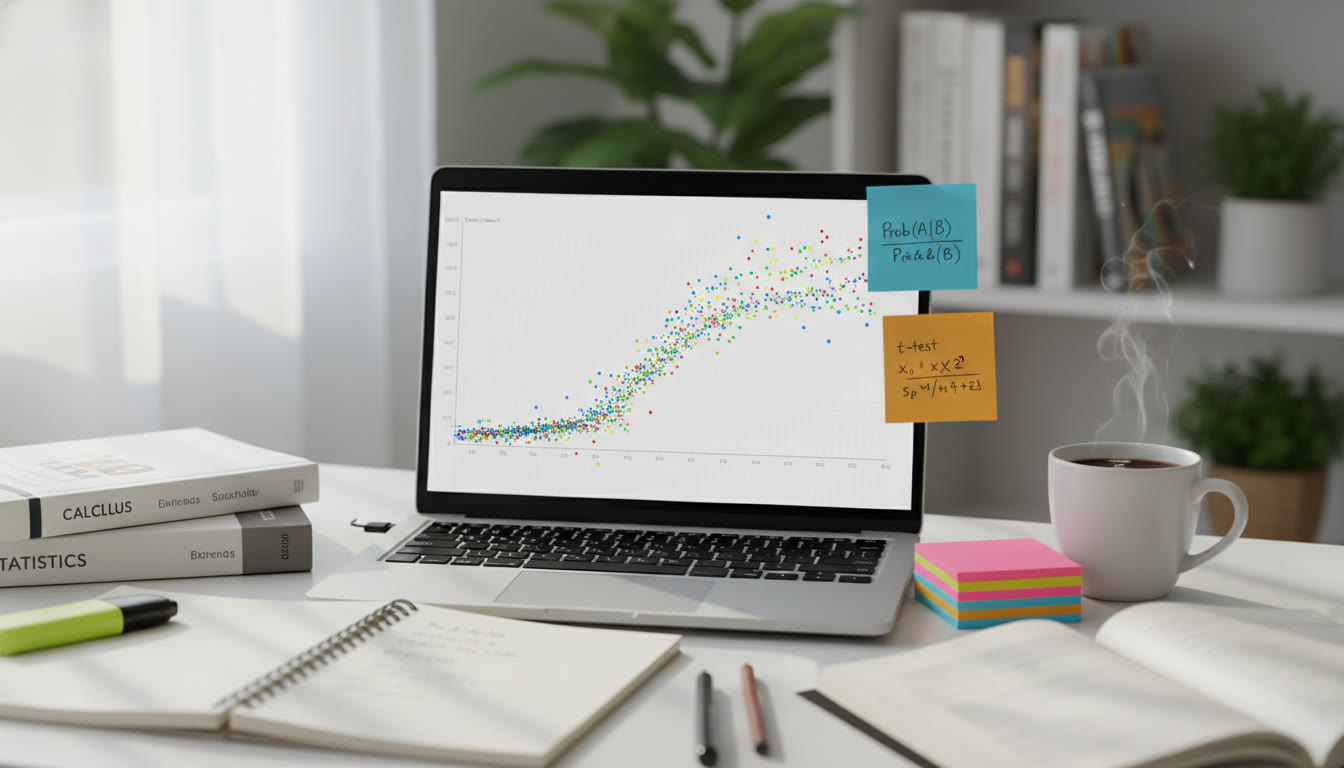
How a Practice Bank Beats One-Off Practice
One-off practice sessions are helpful, but they rarely build transfer — the ability to apply a concept in a slightly new context. A practice bank, by contrast, intentionally stores variations: datasets with the same underlying concept arranged differently, or the same graph with subtle tweaks. Over time, you’ll stop solving specific problems and start recognizing families of problems. That’s the exact skill AP graders reward: clarity, efficient strategy, and accurate interpretation.
What to Include in Your Data & Graphing Bank
Start with a simple structure and grow it. Organize by topic and skill so you can pull targeted practice when you’re short on time or need to focus on a weak spot.
- Core types of problems: scatterplots and correlation, histograms and distributions, boxplots and summary statistics, residuals and linear models, bar charts and categorical data, time-series plots.
- Difficulty levels: Beginner (interpretation and reading), Intermediate (calculation and explanation), Advanced (model building, inference, and synthesis).
- Formats: single-graph quick-reads, multi-graph comparisons, dataset-to-graph construction, error-spotting (what’s wrong with this graph?), and free-response style prompts where you must write a short interpretation or conclusion.
- Timed drills: 2–5 minute warm-ups, 15–25 minute mini-exams, and full 45–60 minute sections to simulate AP timing and pressure.
- Answer keys and scoring rubrics: Include not just answers, but model explanations and what earns full credit.
Sample Organization Template
Create folders and a naming system. Here’s a simple structure you can implement in Google Drive, a notes app, or a physical binder.
- TopicFolder/Level_Type_Date (e.g., “Correlation/Intermediate_Scatter_2025-09-12”)
- BankIndex.csv or a single master document linking to items with tags like “timed”, “free-response”, “requires-calculator”
- Monthly review list: which items to retake next month and which to retire
Practical Steps to Build Your Bank — Week by Week
Here’s a four-week plan to get a working bank up and running. You can repeat the cycle, add layers, and personalize it as you go.
| Week | Focus | Deliverables | Time Commitment |
|---|---|---|---|
| Week 1 | Foundations — reading and simple interpretation | 20 short graphs, answer key, index file | 4–6 hours |
| Week 2 | Calculations, summary stats, boxplots | 15 dataset-to-graph sets, model solutions | 5–7 hours |
| Week 3 | Modeling and inference, residuals | 10 multi-step free-response prompts | 6–8 hours |
| Week 4 | Timed practice and review | 2 timed sections, revision list, improvement plan | 6–9 hours |
How to Source Realistic Data
Your practice bank is strongest when it uses believable, messy data. Real datasets include quirks: missing values, outliers, and non-normal distributions. You can generate these purposely or download classroom datasets and sanitize them. The important part is that you include brief context — where the data came from and what a plausible real-world question might be.
Problem Types and Example Prompts
Below are compact templates you can use to generate many practice items. For each prompt, write an answer key with the explanation you’d expect on an AP free-response — not just the final number.
Scatterplot and Correlation
- Prompt: “A scatterplot shows students’ hours of weekly study versus their test scores. Describe the association and compute the correlation coefficient. What cautions would you raise about inferring causation?”
- Variation: Flip the association to nonlinear (e.g., plateau effect) or insert a clear outlier and ask students to compute correlation with and without that point.
Boxplot and Distribution Comparison
- Prompt: “Compare the distributions of two classes using boxplots. Comment on center, spread, skewness, and potential reasons for differences.”
- Variation: One distribution has a heavy right tail; another has more variability but higher median. Ask for an explanation using context (e.g., class size, grading policy).
Creating a Graph From a Dataset
- Prompt: “You are given a dataset of monthly rainfall and crop yield. Create an appropriate graph and justify your choice. Identify any patterns and propose a hypothesis for why they occur.”
Modeling and Residuals
- Prompt: “Fit a linear model to the data, report the slope and intercept, and interpret them in context. Create a residual plot and describe what it indicates about model fit.”
Timing, Feedback, and Mastery Loops
Practice without feedback is rehearsal; feedback creates learning. When you build your bank, pair each item with a short rubric: what an A answer contains, common pitfalls, and a one-line correction for each mistake.
Timed Drills — How Often and How Long?
Use the bank for daily micro-practice and weekly longer sessions.
- Daily: 10–15 minutes, 1–2 quick interpretations or a single graph reading.
- Weekly: 45–60 minutes, a mixed set of 6–10 problems including a free-response.
- Monthly: Simulated section under exam conditions, followed by self-scoring with your rubric.
Feedback Checklist for Self-Scoring
- Did I state the correct type of association (direction, strength, form)?
- Did I use appropriate vocabulary (median, mean, residual, outlier)?
- Did I tie numerical results to context with clear interpretation?
- Did I consider limitations and suggest follow-up questions or data checks?
Use Technology Smartly: Calculator, Desmos, and Spreadsheets
Graphing and calculation tools are allowed and useful — but they don’t replace understanding. Your bank should include tasks where you must (a) interpret output from a calculator/Desmos, (b) detect when a tool’s automated display might mislead, and (c) show brief manual checks of machine outputs. Practice translating a printed regression equation into an interpretation sentence — that’s a frequent AP ask.
Exercise: Calculator Cross-Check
Give students output that shows an r-squared of 0.85 but with a residual plot that reveals patterning. Ask: “Why should you be cautious about this model? What additional plots or transformations would you try?” These are the higher-level skills that earn points on AP free-response sections.
Tracking Progress: What Metrics to Watch
Learning with data should be data-driven. Track these KPIs for yourself and update the bank based on results.
- Accuracy per problem type (e.g., scatterplot reading vs. model interpretation).
- Average time per question for timed drills.
- Rubric score (0–5) on free-response prompts.
- Retention checks: percent correct when repeating the same item after 2–4 weeks.
Sample Progress Table
| Metric | Baseline | After 4 Weeks | Goal |
|---|---|---|---|
| Scatterplot Reading Accuracy | 68% | 84% | 90%+ |
| Timed Free-Response Score | 2.1 / 5 | 3.5 / 5 | 4 / 5 |
| Average Time Per Question | 6.2 min | 4.5 min | 3.5–4.0 min |
Examples of High-Value Practice Items (Create Many Variations)
Below are descriptions of five high-yield items you can replicate and vary to beef up your bank quickly.
- Outlier Impact Pack: Same scatterplot with one outlier inserted in different places. Variation: ask for correlation, slope, and a sentence on how the outlier affects interpretation.
- Distribution Swap: Two histograms side by side; one has a hidden bimodal structure. Ask for comparison and possible explanations (e.g., two sub-populations).
- Misleading Axis Challenge: A bar chart with truncated axes. Prompt students to identify how scaling misleads and redraw the graph correctly.
- Residual Detective: Give a residual plot and ask whether a linear model is appropriate, what transformation might improve fit, and to sketch the corrected model.
- Contextual Synthesis: A short dataset about temperature and energy consumption. Ask for visualization, hypothesis testing, and a one-paragraph policy recommendation for an imaginary city council.
Making Your Bank Sustainable: Collaboration and Review
Longevity comes from sharing and refining. Swap items with classmates, trade rubrics, and occasionally ask a teacher or tutor to grade a random sample. Peer review often reveals ambiguous wording or unintended shortcuts in prompts.
How Sparkl’s Personalized Tutoring Can Fit Naturally
If you want to accelerate your bank’s quality and learning rate, consider pairing your practice bank with targeted support. Sparkl’s personalized tutoring offers 1-on-1 guidance, tailored study plans, expert tutors who can help you design high-quality prompts, and AI-driven insights to spot weak patterns in your performance. A tutor can help refine rubrics so they match AP expectations, model ideal answers for free-response prompts, and suggest the exact types of variations to add when you’re stuck.
Common Pitfalls and How to Avoid Them
Students often make the same mistakes when practicing with graphs. Here’s a short list of recurring errors and concise fixes you can add to your rubric.
- Vague language: Saying “there is a relationship” without specifying direction, strength, and form. Fix: require at least one quantitative detail (e.g., slope or median).
- Context disconnect: Reporting statistics without tying them back to the scenario. Fix: add a rubric line “Translate numbers to the situation in one sentence.”
- Over-reliance on calculators: Blindly trusting an output without checking residuals or assumptions. Fix: include a short check step in answers for model-based questions.
- Misreading axes: Especially in multi-axis graphs or log scales. Fix: add a quick verification prompt: “What are the axis units?”
Stretch Projects: Beyond Practice Sets
Once your bank is healthy, use it for deeper projects that both strengthen skills and make your applications stand out.
- Mini Research Project: Use several items from your bank to write a short investigation — pose a question, analyze data, create visuals, and conclude with evidence. This mirrors college-level work and looks great on a portfolio.
- Teaching Module: Choose five problems and make a 10-minute video explanation for peers. Teaching what you learned consolidates understanding and reveals subtle gaps.
- Graph Critique Series: Publish a weekly critique of a graph from news or a class dataset, explaining strengths and what to fix. This hones judgment and communication.

Final Checklist to Launch Your Bank
Before you call your bank “ready,” run through this checklist:
- Have at least 100 items across difficulty levels.
- Include a minimum of 20 timed items and 20 free-response items with rubrics.
- Tag every item by topic, skill, and estimated completion time.
- Schedule a monthly review and a 3-month revision cycle to retire or rewrite poor prompts.
- Get at least one external review from a teacher or a Sparkl tutor to align scoring with AP expectations.
Wrap-Up: Your Bank Is a Learning Asset
Building a data and graphing practice bank transforms AP prep from passive study into active skill-building. It teaches interpretation, clarity of explanation, and the strategic thinking that AP graders reward. Treat the bank as a living tool: add variety, track outcomes, and iterate based on evidence. If you mix consistent self-practice with occasional expert feedback — for example using Sparkl’s personalized tutoring for targeted rubrics or model answers — you’ll be practicing smarter, not just harder. Over time, those hours of deliberate, varied practice add up into confidence and strong AP performance.
Start Today
Pick one small item to add to your bank right now: a scatterplot with a single outlier, a misleading bar chart with a truncated axis, or a short dataset you can convert into a histogram. Write the prompt, solve it, and create a one-paragraph model answer. That single item is the first brick in a structure that, by the end of your AP season, will have your data skills built solid and ready for test day.
Good luck — and remember: the best graphs tell a clear, honest story. Build a bank that helps you tell that story every time.

























No Comments
Leave a comment Cancel