
Introduction: Why A‑Level Habits Matter for AP History
If you’re coming from an A‑Level history background—or if you’re a parent helping a student who is—you already have a massive advantage heading into AP history courses and exams. A‑Level essays teach you depth, argumentation, and an appreciation for primary sources. But AP exams reward not only deep understanding but also concision, clarity, and the ability to demonstrate evidence density under timed conditions.
This article translates the best practices of A‑Level essaying into AP success. You’ll learn concrete methods to craft compelling theses, pack your paragraphs with high‑value evidence, and manage time so your writing is both persuasive and exam‑smart. Along the way I’ll give examples, a sample rubric, study routines, and tips on when a little extra help—like Sparkl’s personalized tutoring—can make the difference between a good score and a great one.
The Core Difference: Depth vs. Density (and why both matter)
A‑Level essays often reward expansive, nuanced arguments built across long essays. AP history exams—whether it’s US History, European History, or World History—ask for focused, clearly signposted arguments accompanied by dense, relevant evidence. It’s not that AP doesn’t value depth; it does. But depth must be packaged within a structure that exam graders can quickly parse: an explicit thesis, targeted thematic paragraphs, and well‑chosen pieces of evidence.
Think of A‑Level strength as a wide, powerful river; AP requires you to channel that river into a high‑pressure nozzle. The flow is the same, but the delivery is different.
Practical takeaway
- Keep the A‑Level habit of nuance, but prioritize concise thesis statements and evidence linked directly to the prompt.
- Train to show multiple pieces of corroborating evidence in each paragraph rather than long narrative digressions.

Building a High‑Impact Thesis for AP Prompts
The thesis is the spine of your essay. For AP history, an effective thesis must do four things—state your position, directly answer the prompt’s task (compare, evaluate, explain continuity/change, etc.), mention the time frame or region when relevant, and forecast the main lines of argument.
Thesis formula (exam‑friendly)
Position + Task Verb + Time/Scope (if needed) + Two Quick Supporting Points = A thesis that graders can immediately use to frame your essay.
Examples
- Prompt: Evaluate the extent to which the Progressive Era (1890–1920) represented a departure from earlier reform efforts in the United States.
Thesis: While the Progressive Era continued the American tradition of moral and social reform, it represented a significant departure in its embrace of federal regulatory power and professionalized social science—shifting reform from local initiatives to national institutional change.
- Prompt: Compare the causes of the Russian Revolution of 1917 and the Chinese Revolution of 1949.
Thesis: Both revolutions were driven by the failure of existing regimes to address economic distress and rural discontent; however, the Russian Revolution was catalyzed more immediately by wartime collapse and urban unrest, whereas the Chinese Revolution succeeded through sustained rural mobilization and guerrilla organization.
Evidence Density: What It Is and How to Achieve It
Evidence density means packing each paragraph with multiple, high‑value pieces of supporting information that directly tie back to your thesis. High‑value evidence for AP essays includes concise facts, named documents or laws, specific dates, leader names, statistics, primary source quotes (brief), and cause‑and‑effect links.
Strategies to increase evidence density
- Lead with a topic sentence that connects to the thesis, then provide 2–3 specific pieces of evidence before interpretation.
- Use short embedded citations (e.g., “the New Deal’s National Recovery Administration, 1933”)—you don’t need formal citation, but specificity matters.
- Pair factual evidence with quick analysis that links back to the thesis—don’t let facts float disconnectedly.
- Prefer multiple brief evidence points over one long narrative. Two distinct, specific pieces of evidence often score higher than a long descriptive paragraph.
Example paragraph (AP‑style)
Topic sentence: The New Deal marked a decisive expansion of federal responsibility for economic recovery, contrasting sharply with prior laissez‑faire policies. Evidence: The Emergency Banking Act of 1933 restored confidence by authorizing bank closures and reopenings; the Securities Act of 1933 introduced federal regulation of stock offerings; and the Social Security Act of 1935 created a federal safety net. Analysis: Together these measures show a shift from local and private remedies toward sustained federal intervention, aligning with the thesis that the New Deal institutionalized a new relationship between citizens and the national government.
Structure That Supports Density: Paragraph and Essay Templates
Use templates as scaffolding, not as rigid scripts. Templates reduce wasted time and make it easier to proofread in exam conditions.
Paragraph template (3–5 minutes in an exam)
- Topic sentence (1 line): Connects to thesis.
- Evidence 1 (1–2 lines): Specific fact, law, or name + date if possible.
- Evidence 2 (1–2 lines): Distinct supporting fact or primary source extract.
- Short analysis (2–3 lines): Explain how the evidence supports your topic sentence and thesis.
- Mini‑conclusion (1 line): Reassert link to thesis and transition.
Full essay timing (60–80 minute FRQ or DBQ)
- 5–10 minutes: Read prompt carefully, annotate the task and time frame, plan thesis and paragraph points.
- 5 minutes: Write a clear, explicit thesis.
- 40–55 minutes: Write 3–5 body paragraphs, using the paragraph template above.
- 5–10 minutes: Conclusion and quick proofread.
DBQ and LEQ Specifics: How to Demonstrate Evidence Density Under Different Tasks
DBQ (Document‑Based Question) and LEQ (Long Essay Question) differ in expected evidence types. DBQ requires you to use the provided documents plus outside knowledge; LEQ expects you to rely entirely on your own knowledge and evidence.
DBQ tips for density
- Use the documents as anchors—summarize each one in one sentence and immediately pair it with an outside fact or interpretation.
- Don’t over‑quote documents—use them to demonstrate engagement, then add external evidence to increase density.
- Group documents into themes rather than addressing each in isolation; this allows you to connect multiple documents with outside facts efficiently.
LEQ tips for density
- Rely on your strongest factual recall: laws, treaties, leaders, dates, and key events.
- For each paragraph, aim for at least two distinct pieces of specific evidence plus analysis.
- Practice timed LEQs with targeted recall lists to build a mental “evidence bank.”
Sample Rubric Snapshot: What AP Graders Look For
Below is a simplified rubric summarizing criteria AP graders commonly use when evaluating thesis and evidence. Use it as a checklist while proofreading.
| Criterion | Top Response (what to aim for) | Common Weakness |
|---|---|---|
| Thesis | Explicit, directly answers prompt, forecasts argument | Vague, off‑topic, or missing |
| Evidence Density | Multiple specific facts per paragraph tied to thesis | Generalizations, narrative without specifics |
| Document Use (DBQ) | Accurate, integrated use of documents + outside evidence | Quoting without analysis or missing outside support |
| Analysis & Reasoning | Interprets significance, explains cause/effect, compares | Descriptive or repetitive statements |
| Organization | Logical paragraphs, clear transitions, direct relation to thesis | Scattered ideas, weak paragraph structure |
Practice Moves That Boost Both Thesis Craft and Evidence Density
Skill development is deliberate. Below are targeted drills you can do in short blocks of time that produce disproportionately large improvements.
Drill 1: Two‑Sentence Thesis Workout (10 minutes)
- Pick a past prompt or create one.
- Write a one‑sentence thesis using the formula (Position + Task + Scope + 2 supporting points).
- Immediately write a one‑sentence expansion that names the two pieces of evidence you will use to support each point.
- Repeat with five prompts in a week.
Drill 2: Evidence Sprint (15 minutes)
- Choose a narrow topic (e.g., causes of the Mexican Revolution, 1910–1920).
- Write down 10 specific facts/names/dates you could use in a paragraph. No sentences—just compact items.
- Then practice arranging any three of those items into a tight paragraph with a topic sentence and one sentence of analysis.
Drill 3: Document Pairing (DBQ practice, 20 minutes)
- Take two short documents and identify the author, purpose, and audience in one line each.
- Write one sentence linking both documents to a broader outside fact or law.
- This builds the habit of connecting documents to outside evidence quickly.
Common Pitfalls and How to Avoid Them
- Overlong Background: Keep background context brief and purposeful. If it doesn’t support the thesis, cut it.
- One‑Evidence Paragraphs: Aim for at least two distinct evidence points per paragraph.
- Vague Analysis: Always answer “So what?” or “Why does this matter?” after presenting evidence.
- Ignoring the Prompt Verb: Compare, evaluate, analyze—treat those verbs differently. A ‘compare’ needs similarities and differences; an ‘evaluate’ needs judgement and criteria.
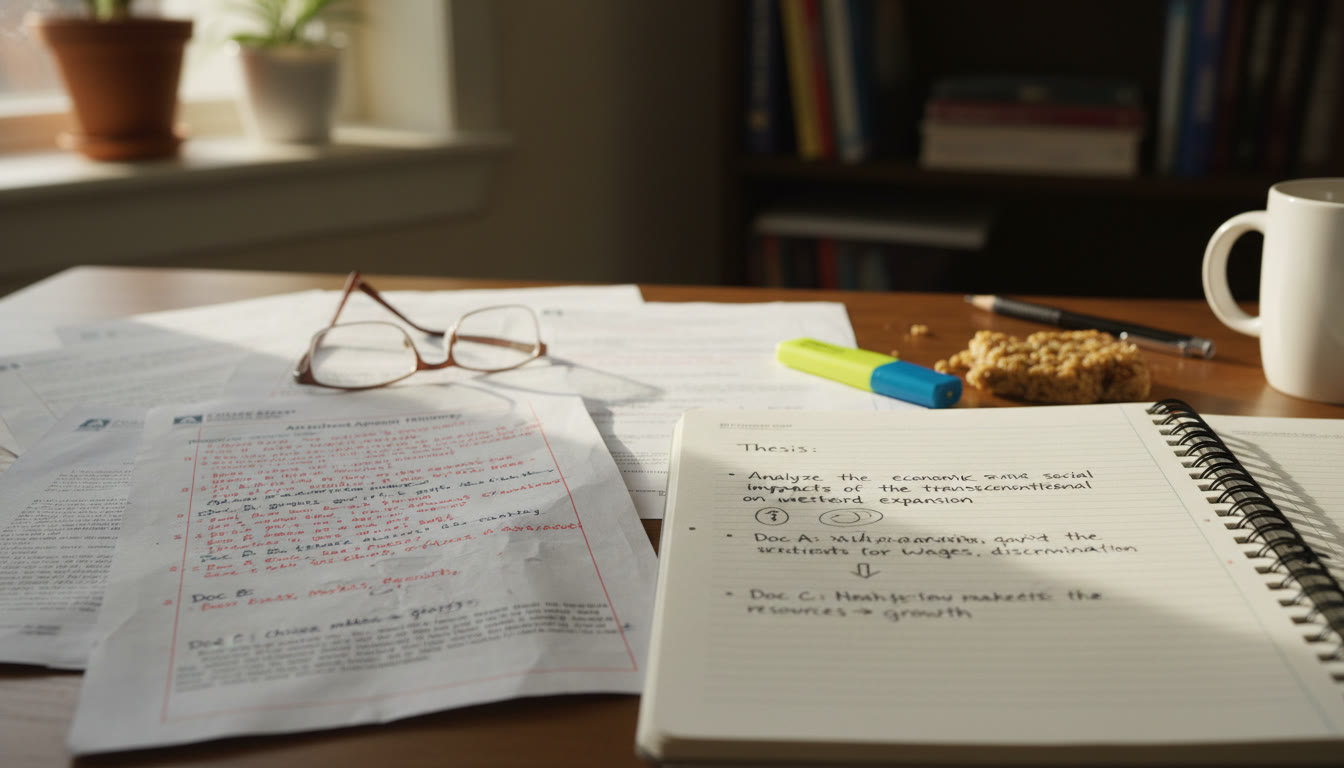
Real‑World Contexts: Linking Classroom Knowledge to Exam Answers
AP essays are graded by humans who appreciate clarity and relevant context. Referencing widely taught frameworks—industrialization, nationalism, imperialism, Cold War dynamics—helps situate your evidence. But avoid dumping textbook lists; instead, use frameworks to interpret evidence.
Example: If you’re writing about 19th‑century European revolutions, don’t just list events. Use the framework of “social composition of participants” and “economic triggers” to compare why 1830 failed where 1848 succeeded in certain regions. That analytical frame helps the grader see that your facts are being used deliberately.
Study Routines and Time Management for Sustained Improvement
Consistency beats cramming. Replace marathon, unfocused sessions with short, targeted practice blocks that emphasize thesis writing and evidence recall.
Weekly Plan (Sample)
- Monday (30–45 min): Thesis drills—5 prompts.
- Wednesday (30–45 min): Evidence sprint on one theme (write 3 timed paragraphs).
- Friday (60–90 min): Full timed DBQ or LEQ, then 20 minutes reviewing a rubric and annotating where you missed evidence or clarity.
- Weekend (30 min): Passive review—read a primary source, summarize it in one paragraph, and list three outside facts linked to it.
When to Get Extra Help: How Sparkl’s Personalized Tutoring Fits In
Most students see the biggest jumps when they combine deliberate practice with targeted feedback. That’s where personalized tutoring helps. A good tutor can:
- Identify recurring weaknesses in thesis construction or evidence use.
- Provide tailored study plans that focus on the exact skills a student needs to raise their score.
- Give 1‑on‑1 guidance during timed practice, offering immediate, actionable corrections.
- Use AI‑driven insights to track progress and suggest the next micro‑skills to practice.
If you’re balancing A‑Level expectations with AP pacing, targeted tutoring—like Sparkl’s personalized sessions—can help translate strong historical knowledge into exam‑friendly delivery, without losing nuance.
Putting It Together: A Full Example LEQ (Annotated)
Prompt: To what extent did industrialization cause social and political change in 19th‑century Europe?
Annotated approach:
- Plan (5 min): Thesis: Industrialization catalyzed profound social change through urbanization and labor restructuring, and it encouraged political responses ranging from liberal reform to reactionary conservatism—though the degree of change varied by state capacity and preexisting institutions.
- Paragraph 1: Social change—evidence: rapid urban population growth (e.g., Manchester, Paris mid‑1800s), the rise of factory labor and wage dependence, and the statistic of declining cottage industry employment in certain regions. Analysis: link to changing class identities and new demands for labor rights.
- Paragraph 2: Political responses—evidence: liberal reforms in Britain (Reform Acts), revolutionary movements in 1848, and conservative reforms to preserve order (e.g., Metternich’s diplomacy). Analysis: show how industrialization produced both pressure for political inclusion and elite reactions to maintain control.
- Paragraph 3: Variation by state—evidence: rapid industrializers (Britain, Belgium) saw different patterns than agrarian empires (Russia, Ottoman Empire). Analysis: argue that existing institutions mediated how industrialization translated into political change.
- Conclusion: Reassert that industrialization was a major causal factor but emphasize contingency—state structures and preindustrial legacies shaped outcomes.
Final Checklist Before You Submit or End the Exam
- Is the thesis explicit and clearly connected to the prompt?
- Does each paragraph begin with a topic sentence that ties to the thesis?
- Are there at least two specific pieces of evidence per paragraph?
- Have you explained why each piece of evidence matters (analysis), not just what it is?
- For DBQ: Did you use documents to support themes and add outside evidence?
- Did you address the prompt verb properly (compare, evaluate, analyze)?
Closing Thoughts: From Exam Room to Classroom Confidence
Moving from A‑Level history to AP doesn’t demand abandoning the analytical richness you already have. It asks you to translate that richness into a different register—one that prizes clear thesising and dense, relevant evidence that graders can readily see. With intentional drills, timed practice, and occasional targeted feedback, you can keep your A‑Level strengths and win on AP rubrics.
If you or your student want structured, personalized guidance—whether that’s refining thesis craft, increasing evidence density, or building a short, efficient study plan—Sparkl’s personalized tutoring offers 1‑on‑1 coaching, tailored study plans, expert tutors, and AI‑driven insights to accelerate improvement. A few focused sessions can unlock big scoring gains and restore confidence under exam conditions.
One last piece of advice
Practice smart: shorter, focused sessions on thesis and evidence beats longer, unfocused study. Treat every timed essay as a diagnostic: find the single biggest weakness, and spend the next week fixing it. With persistence and the right feedback, your essays will become sharper, denser, and more persuasive—just the qualities AP graders reward.























No Comments
Leave a comment Cancel