
Introduction — When Two Worlds Meet: A Level Art/Design and AP
Moving from A Level Art and Design to the AP Studio Art (now commonly called AP Art and Design) pathway is an exciting moment: you already know how to look closely, research rigorously, and develop a body of meaningful work. But the way you present that work to AP readers — through curated selections and powerful statements — is a different skill. In this guide I’ll walk you through practical, student-tested techniques for curating a portfolio and writing statements that sing. The advice works whether you’re aiming for AP 2-D, 3-D, or Drawing, and it’s friendly to parents who want to support without taking over.
Why Curation and Statement Writing Matter
At A Level you learned to build projects across a whole course; at AP the emphasis is on showing focused evidence of your visual thinking, technical skill, and sustained inquiry. The reader has a limited window and a rubric to apply. Curation is your way of choosing the strongest evidence. A clear, insightful statement helps the reader understand your intent, context, and growth — everything that lifts work from “nice” to “noteworthy.”
What AP Readers Are Looking For
- Demonstrated skill: technical control in chosen media and processes.
- Conceptual depth: a focused idea or investigation across multiple works.
- Evidence of development: sketches, experiments, and reflection that show thinking in progress.
- Coherence: a portfolio that feels intentionally put together, not a random collection.
Step 1 — Start With an Editorial Mindset
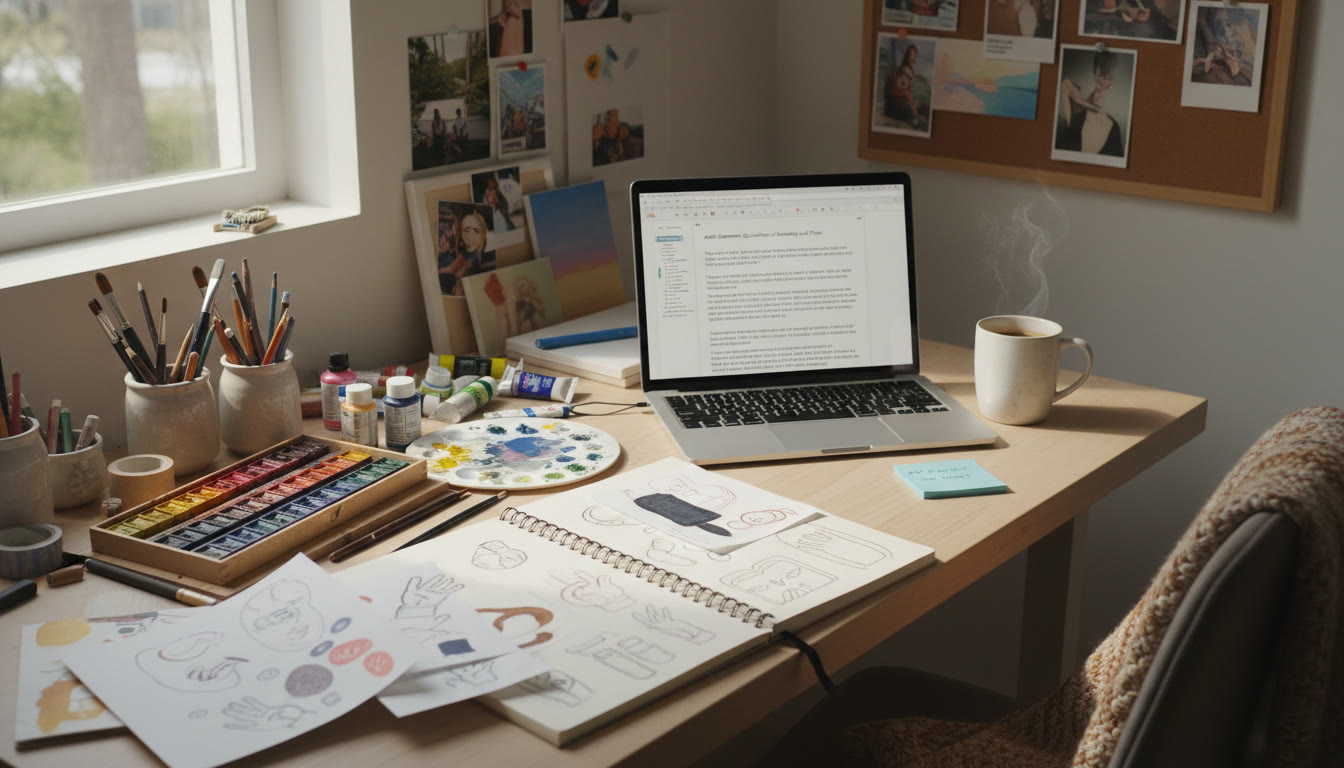
Curation begins by acting like an editor. Your job is to tell a concise, persuasive visual story. Ask yourself: what is the single thread (theme, technique, or conceptual question) that connects my strongest pieces? If your A Level coursework explored, say, architecture and memory, highlight pieces that show different approaches to that idea — a detailed observational drawing, a mixed-media collage probing texture, and a sculptural study of form.
Practical Editing Exercise
- Gather everything: prints, photos, scans, sketchbooks, process shots.
- Sort into three piles: Definitely Keep, Maybe, Archive.
- From “Definitely Keep,” choose a sequence of 6–12 pieces that together show skill, concept, and evolution (numbers vary by AP submission type).
Step 2 — Tell Your Story With Structure
A portfolio is more persuasive when it has a beginning, middle, and end. Think of it as a short visual essay.
Suggested Structure
- Opening: a piece that clearly introduces your subject or skill.
- Development: 3–6 works that explore different angles of your investigation.
- Climax: a technically confident, conceptually mature work.
- Reflection/Process: supporting pages showing idea development and experimentation.
Why Sequence Matters
Sequencing guides the reader’s eye and thinking. Two technically excellent pieces placed back-to-back might read as redundancy; spaced across the portfolio they demonstrate consistent skill. Use contrast — in scale, medium, or focus — to maintain interest and showcase range.
Step 3 — Choosing Pieces That Highlight Growth
AP portfolios are especially responsive to evidence of sustained investigation. That means your process work is not filler — it’s proof. Select sketches, mock-ups, and photographic documentation that show how an initial idea evolved into a finished piece.
What Counts as Effective Process Evidence
- Sequential sketches showing refinement of composition or concept.
- Notes or annotated images explaining choices or failures.
- Side-by-side comparisons documenting experiments with color, scale, or media.
Step 4 — Writing a Compelling Artist Statement
Think of the artist statement as a translator between your studio practice and the AP reader. It should clarify intent, contextualize choices, and reflect on development. Keep the tone confident but humble — the goal is clarity, not grandiosity.
Core Elements of a Strong Statement
- Context: What question or theme are you investigating?
- Process: How did you work and experiment to explore that question?
- Decisions: Why did you choose these media, techniques, or compositions?
- Reflection: What changed? What did you learn?
A Simple Statement Template
Use this as a writing scaffold and then personalize it. Keep it concise — AP statements are most effective when clear and focused.
- Opening sentence: One-line summary of your inquiry or theme.
- Body: Two short paragraphs — Process (how you explored it) and Decisions (media/techniques/visual choices).
- Closing: One sentence about what you learned and how the portfolio demonstrates growth.
Step 5 — Examples: A Mini Case Study
Below are two condensed, illustrative examples — one conceptual, one technical — to show how curation and statements pair. These are fictional but rooted in real student practices.
| Student Focus | Selected Works | Statement Highlight |
|---|---|---|
| Memory and Domestic Architecture | 1. Charcoal room study 2. Mixed-media collage of floorplans 3. 3D reduced-scale dwelling 4. Sketchbook evolution pages | “I investigate how rooms keep traces of lives lived; through material layering I attempt to show memory as sediment.” |
| Surface and Textile Technique | 1. Monoprint series exploring texture 2. Experimental dye samples 3. Finished textile wall piece 4. Process shots of surface tests | “My work began with inquiries into abrasion and dye; experiments with resist techniques led to a vocabulary of marks I repeated and transformed.” |
Step 6 — Common Pitfalls and How to Avoid Them
Students sometimes make avoidable mistakes when adapting A Level work for AP. Here’s how to sidestep them.
Pitfall 1: Overloading With Too Many Pieces
Less is often more. Choose pieces that serve your narrative. Repetition without clear purpose dilutes impact.
Pitfall 2: Vague Statements
Statements that offer only poetic language with no concrete description are risky. Pair expressive phrases with specific process details.
Pitfall 3: Hiding Weak Process Work
If a process image documents a failed idea that taught you something, include it — but explain what you learned. Failure can be persuasive when contextualized.
Practical Checklist Before Submission
Run through this checklist to make sure your submission is coherent and competitive.
- Do the selected works demonstrate technical skill across at least two distinct approaches?
- Does the statement clearly summarize your inquiry and methods?
- Is there visible evidence of development (sketches, tests, iterations)?
- Have you sequenced pieces to create narrative flow and contrast?
- Are images sharp, well-lit, and cropped to emphasize the work?
Integrating A Level Strengths Into AP Submissions
A Level programs emphasize extended personal investigations — use that to your advantage in AP. If you completed a long project for A Level, think about how to extract a coherent subset for AP: choose a unifying theme and pick the strongest evidence that shows both skill and progress.
Translating Coursework Into AP-Friendly Pieces
- Scale judiciously: large A Level works can be represented by detail shots that emphasize technique.
- Condense narrative: a 20-page A Level sketchbook can be curated to 6–8 pages showing key turning points.
- Prioritize clarity: AP readers want to understand your development at a glance; label process images if necessary.
How to Use Feedback — From Teachers, Peers, and Tutors
Feedback is a loop. After you curate your first draft, seek targeted input and iterate. Ask reviewers to answer specific questions: “Does the sequence suggest a clear idea? Where is the story unclear? Which works feel redundant?”
Why 1-on-1 Guidance Helps
One-on-one tutoring — for instance Sparkl’s personalized tutoring — can accelerate improvement. A knowledgeable tutor can help you refine sequencing, tighten a statement, and suggest experiments that demonstrate conceptual growth. Tutors are particularly useful for rehearsing how to explain your process in writing and in person.
Photographing and Documenting Work
Good images are essential. A brilliant idea can be lost under poor lighting or awkward cropping. Here are practical tips that don’t require a studio.
Simple Photo Setup
- Use natural, indirect daylight near a north-facing window or shoot outdoors in soft overcast light.
- Mount the camera (or phone) on a stable surface and shoot square-on for flat works; use tripod/steady hand for sculptures and angled views for depth.
- Include a detail shot for texture and a scale shot to show size.
- Edit minimally — adjust exposure, crop, and correct color; don’t over-filter.
Writing the Process Portfolio Narrative
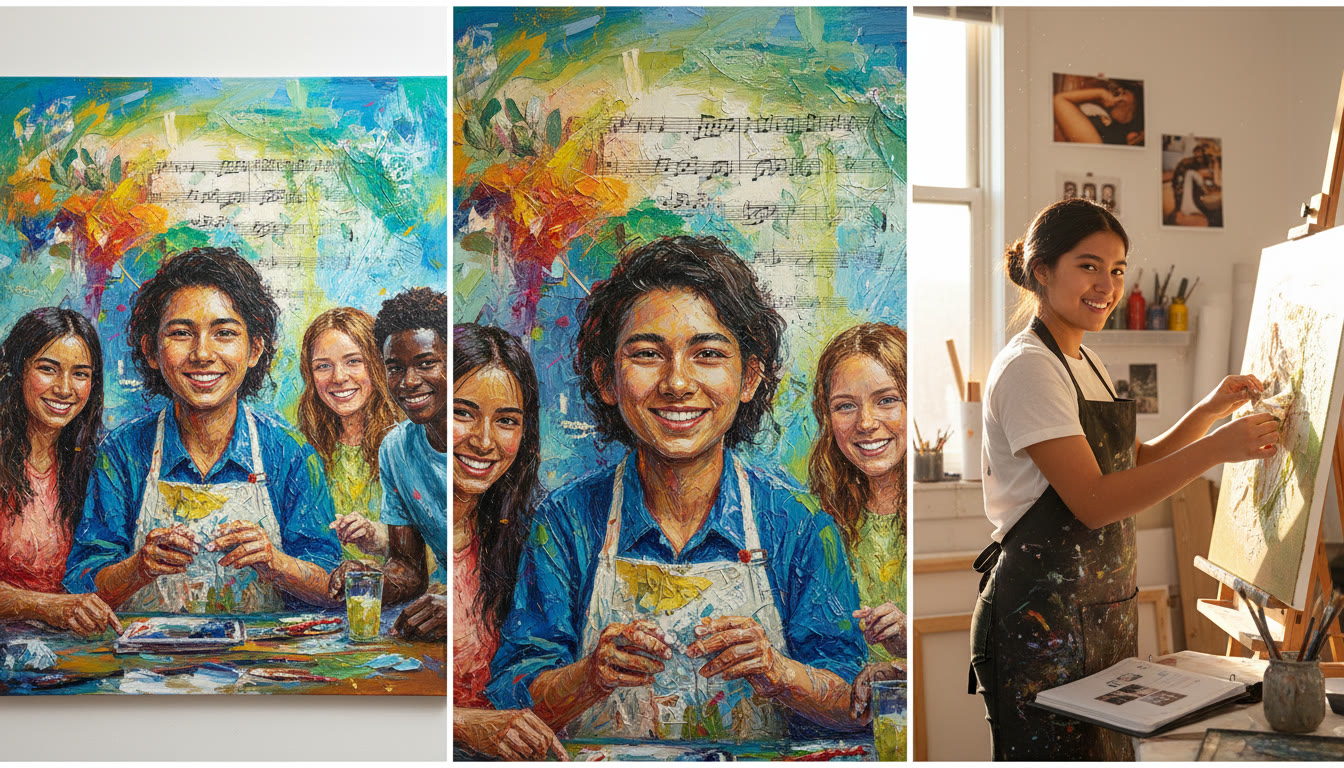
Some AP portfolios require woven narratives describing how specific pieces connect. When you write these, be specific: name techniques, materials, and the moment a decision changed direction. Keep language active and concrete.
Language Tips for Clarity and Depth
- Avoid passive constructions; say “I experimented with monoprint layering” rather than “monoprint layering was experimented with.”
- Quantify when useful: “I made 12 dye tests before settling on three motifs.”
- Balance reflective insight with practical description: show thinking and doing.
Using Rubrics to Your Advantage
AP readers apply rubrics to assess Evidence of Studio Work, Quality, Concentration, and Breadth (depending on the submission). Don’t guess — plan your portfolio so that each rubric category has explicit evidence. If the rubric asks for sustained investigation, include a sequence that traces an idea over time. If technical skill is evaluated, show range and control.
Self-Assessment Template
- Quality: Which works show strongest technical control? Why?
- Concentration: What is the unifying theme? Is it obvious after one read-through?
- Breadth: Do you demonstrate diverse approaches or media?
- Process: Is there clear documentation of iteration and development?
Timeline and Practical Planning
Start early and build in time for re-shooting images, revising statements, and getting feedback. A suggested timeline for students transitioning from A Level to AP:
- Months 1–2: Collect and photograph all work; begin rough editing.
- Months 3–4: Refine selections, produce any missing pieces, document process experiments.
- Months 5–6: Final sequencing, write and revise statements, get 2–3 rounds of targeted feedback.
How Personalized Tutoring Can Fit Into This Timeline
Working with a tutor can compress this timeline without cutting corners. Tutors provide focused critiques, craft targeted exercises to demonstrate missed rubric areas, and coach you on concise statement-writing. Sparkl’s personalized tutoring, for example, offers tailored study plans, expert tutors, and AI-driven insights that help prioritize which portfolio adjustments will most likely improve scores.
Final Polishing: Presentation Matters
Before you submit, do a final quality control pass.
- Proofread every statement and label — clarity is essential.
- Check image resolution, aspect ratio, and color accuracy.
- Confirm sequence looks cohesive on both desktop and mobile previews.
- Ask someone unfamiliar with the work to summarize the portfolio in one or two sentences — that summary should match your intended narrative.
Parent-Friendly Tips: How to Support Without Leading
Parents play a huge role by creating supportive environments. Here’s how to help productively.
- Offer practical support: studio time, materials, or transportation to critique sessions.
- Ask clarifying questions: “What is the idea you want the reader to remember?” instead of “Which piece is your favorite?”
- Encourage independence: let the student own both successes and missteps in the portfolio process.
Parting Advice — Keep the Artist, Not Just the Applicant
Successful AP portfolios show more than technical skill — they show curiosity, risk-taking, and growth. The goal is to present a true, compelling version of your practice that balances craft and inquiry. Treat the portfolio as a conversation with the reader: be honest, be specific, and let your visual voice come through.
One Final Practical Exercise
Before you submit, write a one-paragraph micro-statement of 40–60 words that summarizes your inquiry and one-sentence evidence of growth. If you can distill your work into that tiny capsule and it still feels true, your portfolio is likely coherent and focused.
Conclusion — From Classroom to Camera to College
Transitioning from A Level Art/Design to AP requires both translation and refinement. Focus your energy on curating a tight sequence, documenting meaningful process, and writing statements that explain decisions without over-explaining. Use feedback intentionally — and if you need guided, personalized help to prioritize improvements and practice concise explanations, a tutor can be a game-changer. Sparkl’s personalized tutoring models, for instance, pair 1-on-1 guidance with tailored study plans and expert feedback to help you present the clearest version of your work.
Above all, remember that great portfolios are made from many small choices made consistently over time. Start early, be selective, and let curiosity lead your visual investigations.
























No Comments
Leave a comment Cancel