
Why Case Comparison Cards Are a Game-Changer for AP Government
If you’re preparing for AP U.S. Government and Politics, you’ve probably found that the mountain of landmark cases, constitutional principles, and real-world implications can feel overwhelming. Case comparison cards — compact, side-by-side summaries of Supreme Court decisions and constitutional moments — turn that mountain into manageable, study-sized molehills. Think of them as cheat-sheets elevated to art: concise, clearly organized, and designed to highlight the patterns exam readers love to see.
In this blog, we’ll build a practical, student-friendly approach to producing and using case comparison cards. You’ll find templates, examples, a ready-to-use table that summarizes core elements at a glance, and study routines that make these cards stick. Along the way, I’ll sprinkle in realistic classroom and exam advice and show how targeted 1-on-1 guidance from Sparkl’s personalized tutoring can accelerate your progress when you need it.
How Case Comparison Cards Work — The Anatomy of a Powerful Card
A well-crafted case card gives you what you need in three to four potent lines plus a compact analysis. It’s the difference between passive recognition and active application. Here’s the anatomy:
- Case Name and Year: Quick label — e.g., “Marbury v. Madison (1803)”.
- Constitutional Question: The core question in one sentence — e.g., “Does the Supreme Court have authority to review acts of Congress?”
- Holding: The Court’s decision, boiled down to a clear proposition.
- Doctrine/Precedent Created: Names like “judicial review” or “clear and present danger test.”
- Impact/Significance: How the ruling changed power, policy, rights, or processes.
- Exam Hook: Two lines on how you can use this case in FRQs (Free-Response Questions) or essays — connections to concepts like federalism, separation of powers, civil liberties, or checks and balances.
Example Card (Model)
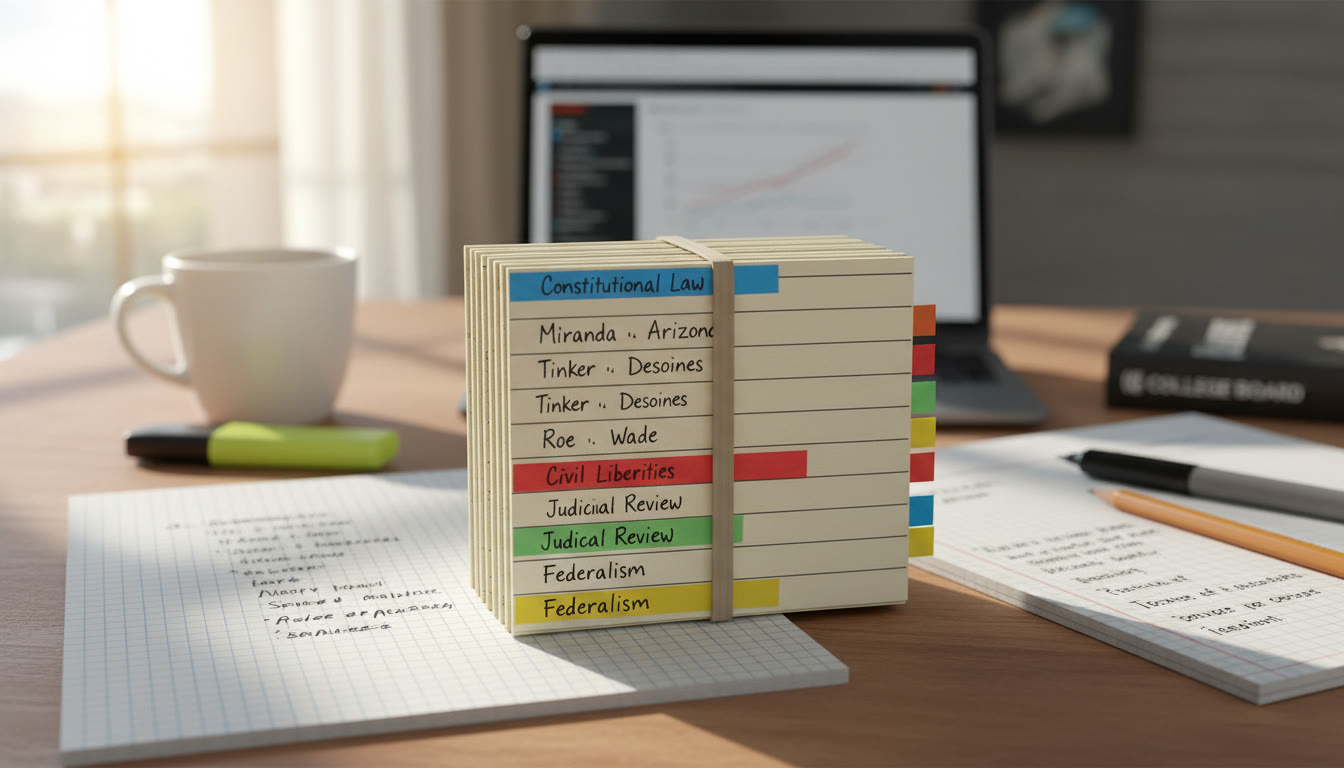
Marbury v. Madison (1803) — Question: Can the Supreme Court declare an act of Congress unconstitutional? Holding: Yes — established judicial review. Doctrine: Judicial Review. Impact: The Court became the arbiter of constitutional meaning. Exam Hook: Use to show judicial power in separation of powers discussions.
Top Cases to Include on Your Comparison Deck
Not every case is equal for the AP exam. Focus on high-utility cases that appear frequently in prompts or that illuminate enduring constitutional principles. Below is a compact table you can print or adapt into digital flashcards.
| Case | Year | Core Holding | Key Principle |
|---|---|---|---|
| Marbury v. Madison | 1803 | Established judicial review | Judicial Power / Separation of Powers |
| McCulloch v. Maryland | 1819 | Congress can create a national bank; states cannot tax it | Federalism / Supremacy Clause / Necessary and Proper |
| Gideon v. Wainwright | 1963 | Right to counsel for indigent defendants | Individual Rights / Due Process |
| Brown v. Board of Education | 1954 | Separate is inherently unequal; school segregation unconstitutional | Equal Protection / Civil Rights |
| McDonald v. City of Chicago | 2010 | Second Amendment applies to states via the Fourteenth Amendment | Incorporation / Individual Rights |
| New York Times Co. v. United States | 1971 | Prior restraint on publication is heavily disfavored | Freedom of the Press / Civil Liberties |
| Texas v. Johnson | 1989 | Flag burning is protected speech | Symbolic Speech / First Amendment |
| United States v. Lopez | 1995 | Congress’ commerce clause authority has limits | Federalism / Commerce Clause |
| Roe v. Wade | 1973 | Recognized a woman’s right to choose under privacy (note: legal status and public debate changed over time; check current law and cases for updates) | Privacy / Due Process |
Note: This table is designed as a starting point. Your deck should reflect your syllabus, teacher’s emphasis, and recent class prompts. If you’re unsure which cases your teacher emphasizes, ask — or use a session with Sparkl’s tutoring to prioritize cases tailored to your course and exam goals.
How to Structure Comparison Cards for Maximum Exam Value
Comparison cards become powerful when they force you to think in relationships. The AP exam rewards analysis — not just recall. Here are structure templates you can use depending on the task:
1) Short-Answer and FRQ-Ready Card
- Case Name (Year)
- One-line Holding
- Two-line Rationale (why the Court decided the way it did)
- One-line Impact/Connection to Constitutional Principle
- Exam Use: 1–2 sentence prompt scaffold (e.g., “Use in discussing limits on state power over individual rights.”)
2) Comparative Card (Two-Case Side-by-Side)
- Case A: Holding / Core Principle
- Case B: Holding / Core Principle
- Similarity: Shared doctrine or legal question
- Difference: Outcomes, scope, or constitutional basis
- When to Use: Which FRQ themes each best supports
3) Deep-Dive Card (For Essays)
- Factual Background in one sentence
- Legal Standard Applied
- Majority Reasoning
- Dissent/Concurrence Highlights
- Long-Term Effects and Policy Implications
- Counterarguments You Can Use to Show Complexity in Essays
Study Routines: How to Use Your Cards Daily and Before the Exam
Cards are only as useful as your study routine. Below are routines that work at different stages of prep.
Daily Micro-Review (15–25 minutes)
- Pick 6 cards. Spend 2–3 minutes per card: recall the holding, say it out loud, and write a one-sentence connection to a constitutional concept.
- Mix: Include at least one case you know well and one that’s new or shaky.
- Rotate: Keep a steady rotation so that every card appears at least twice a week.
Weekend Synthesis (60–90 minutes)
- Take 8–10 cards and group them by theme: Federalism, Civil Liberties, Institutions, Policy Implementation.
- Write a 10–15 minute mini-essay using 3–4 cases from different groups that answer a plausible FRQ prompt.
- Self-grade: Use the scoring rubric language — claim, evidence, reasoning.
Two Weeks Before the Exam — Intensive Drills
- Simulate exam conditions: pick a timed FRQ and force yourself to integrate 2–3 cards with clear analysis and comparative reasoning.
- Use Sparkl-style personalized targeting: identify weakest case categories and plan a 1-on-1 sprint to shore them up. Tutors can model high-scoring answers and refine your thesis construction.
Using Comparison Cards in Different Question Types
Different AP tasks require different uses of case cards. Here’s how to adapt:
Multiple Choice
Speed is essential. For MCQs, your cards function as rapid pattern-recognition training: work on identifying which constitutional principle a fact pattern evokes, not on memorizing long histories. Cards with concise doctrine labels (e.g., “Incorporation”, “Establishment Clause”) will help you match quickly.
Short Answer Questions (SAQs)
Use a card to bolt down a compact legal anchor sentence. A two-sentence use: first, state the holding; second, apply it to the scenario. Cards that include an “Exam Hook” line are gold here.
Free-Response Questions (FRQs)
FRQs are where comparative cards shine. The rubric rewards clear thesis statements, use of evidence (cases), and sound reasoning. A comparative card gives you two ready-made pieces of evidence and the contrast or similarity that makes analysis rich. For example, pairing McCulloch v. Maryland with United States v. Lopez lets you discuss the scope of federal power across eras.
Examples: Two Ready-Made Comparison Cards
Below are sample comparative cards you can copy into your deck.
Card 1 — McCulloch v. Maryland (1819) vs. United States v. Lopez (1995)
- McCulloch — Holding: National government has implied powers; states cannot tax federal institutions (Necessary and Proper Clause & Supremacy Clause).
- Lopez — Holding: Congress exceeded its Commerce Clause authority when it criminalized gun possession in school zones; commerce power has limits.
- Similarity: Both address federal power; both shape the balance between national authority and state sovereignty.
- Difference: McCulloch greatly broadened federal reach; Lopez marks a modern boundary on that reach.
- Exam Use: Use together to discuss evolving interpretations of enumerated powers across different historical contexts.
Card 2 — Gideon v. Wainwright (1963) vs. Miranda v. Arizona (1966)
- Gideon — Holding: Right to counsel is fundamental; states must provide attorneys for indigent defendants in felony cases.
- Miranda — Holding: Suspects must be informed of rights to remain silent and to counsel; confessions obtained without warnings may be inadmissible.
- Similarity: Both strengthen the procedural protections of criminal defendants under the Due Process Clause.
- Difference: Gideon focuses on access to counsel; Miranda focuses on protections during police interrogation.
- Exam Use: Use in prompts about civil liberties, state obligations, and the expansion of procedural rights.

Design Tips: Create Cards You’ll Actually Use
Design matters for memory. Here are quick, practical design tips:
- Color-code by theme (e.g., blue for federalism, red for civil liberties).
- Keep language active and concise — verbs help memory (“established”, “limited”, “incorporated”).
- Use symbols for quick recall — scales for “due process”, a shield for “national power”.
- Include one evocative fact per card to trigger fuller recall (e.g., “Little Rock 1957″ for Brown).”
- Keep cards portable — slip them into a phone-sized case for quick reviews between classes.
Common Mistakes and How to Avoid Them
Students often fall into patterns that limit the usefulness of cards. Here’s what to avoid:
- Too much text: If the card reads like a paragraph, it’s not a quick ref.
- Overemphasis on dates: Dates are helpful, but emphasize the holding and reasoning.
- Isolation: Don’t memorize cases as islands. Always link them to principles and to at least one other case.
- Neglecting practice: Cards are tools for active practice — make sure you simulate exam use.
How Personalized Tutoring Can Amplify Your Card System
Personalized tutoring—like Sparkl’s 1-on-1 guidance—can help you turn good flashcards into excellent exam tools. Tutors can:
- Help you prioritize which cases to include based on your class and the AP framework.
- Model how to weave cases seamlessly into FRQ responses and practice rubrics with you.
- Offer AI-driven insights for patterns in your mistakes and suggest targeted cards to close gaps.
When you’re crunched for time, a few coaching sessions can cut months of inefficient study into a sharper plan that matches your strengths and the AP scoring rubric.
Putting It All Together: A 4-Week Card-Based Study Plan
This plan assumes you have foundational class notes and 40–60 cases to work with. Tailor the pace to the time you have.
- Week 1 — Build: Create 20 core cards (high-utility cases). Daily micro-review + weekly synthesis.
- Week 2 — Expand: Add 20 more cards, start pair comparisons. Incorporate weekend timed SAQ practice.
- Week 3 — Consolidate: Reduce to the top 40 cards; start three FRQ simulations using 3–4 cards each.
- Week 4 — Polish: Daily drills, timed FRQs, and a final pass with comparative cards. Use one Sparkl tutoring session for feedback on an FRQ or card selection if possible.
Final Exam Week: Quick Hacks and Mindset
In the last five days, focus on clarity and confidence:
- Do light, active recall for 30–45 minutes per day; prioritize shaky cards.
- Practice one timed FRQ every other day. Use cards not as scripts but as scaffolds.
- Sleep and hydration beat extra cramming — memory consolidation happens while you rest.
- Use a 5-minute card check before the exam to prime key holdings and doctrines — not to learn new material.
Closing Thoughts: Make Cards Your Conversation Partner
The best case comparison cards don’t live in silence; they spark conversation — with classmates, teachers, and tutors. They force you to explain a holding, defend an interpretation, and relate a case to modern contexts. That active use is what transforms short summaries into deep, test-ready understanding.
Start small, keep your language tight, and build the habit of connecting cases with constitutional concepts. If you want focused help deciding which cases belong in your top 40 or want practice feedback tailored to your FRQ style, Sparkl’s personalized tutoring can provide targeted practice, tailored study plans, and expert tutors to help you convert knowledge into points on exam day.
Quick Checklist Before You Go
- Do you have a prioritized list of 40–60 cases? If not, start there.
- Are your cards color-coded and grouped by theme?
- Do you practice using cards in timed FRQ settings at least weekly?
- Have you scheduled at least one targeted tutoring session to calibrate weak areas?
Good luck — and remember: the goal isn’t to memorize every detail. It’s to build a reliable toolkit of case holdings and comparative reasoning that lets you analyze unfamiliar scenarios with confidence. Use your case comparison cards as living tools: revise them after every practice session, and they will pay dividends when it matters most.























No Comments
Leave a comment Cancel