
Why Practice Tests Are Your Most Valuable Study Tool
Think of practice tests as the GPS for your AP journey. They show where you are, where you’re headed, and — more importantly — the fastest route to get there. Too many students treat practice tests like homework: they take them hurriedly, glance at the score, and move on. If you want real progress, practice tests must be taken and reviewed with intention.
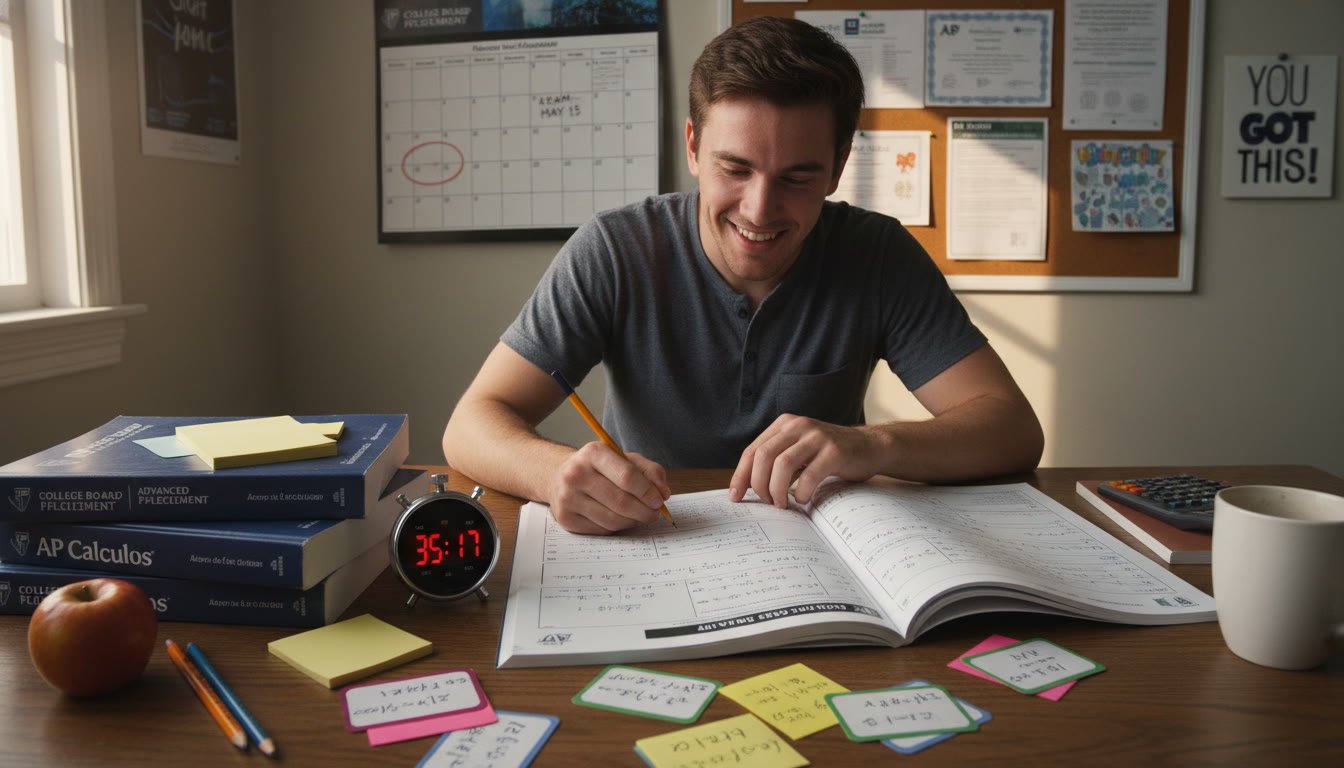
What practice tests actually measure
Practice tests measure more than raw content knowledge. They reveal:
- How well you understand the structure and question styles used in AP exams.
- Time management under pressure.
- Which content clusters and skills you miss most often (concept gaps vs. careless mistakes).
- Your test-taking stamina and focus patterns across sections.
When you begin seeing patterns in practice-test performance, you can stop guessing and start targeting.
Before You Take a Practice Test: Setup Like a Pro
Preparation matters. A practice test taken in chaotic conditions gives you noisy data; careful setup gives you clean, useful signals.
1. Choose the right test
Use official College Board practice exams or high-quality released questions that match the exam format you’ll face (paper vs. digital). Align the test choice with the phase of your preparation: early on, pick tests that sample the whole exam; closer to exam day, use full-length timed exams.
2. Recreate test conditions
- Time: Use a timer or stopwatch and follow the exact timing rules for each section.
- Environment: Quiet room, cleared desk, permitted calculator or reference materials only.
- Materials: Bluebooks or permitted digital tools for free-response sections, scratch paper, and your calculator model if allowed.
- Breaks: Schedule breaks if the real exam allows them (and stick to their length).
3. Set a specific goal for the session
Decide what you want from the test. Are you checking content knowledge? Practicing pacing? Simulating full exam stamina? A clear goal will shape how you take and review the test. For example, if your goal is pacing, focus on tracking time per question rather than agonizing over every answer.
During the Test: Strategies to Capture the Right Data
While taking the test, your main job is to gather accurate information — and to avoid introducing avoidable errors.
1. Use a consistent timing strategy
Develop time checkpoints. For instance, on a 60-question multiple-choice section with 60 minutes, aim to be at question 20 at the 20-minute mark and question 40 at the 40-minute mark. If you fall behind, use an on-the-fly triage system: quickly mark the hardest questions, answer the rest, then return to the marked items.
2. Track your thinking for later review
It helps to annotate lightly during the test: circle key words, jot a short note of why you eliminated an answer, or briefly note what you thought the question was testing. These micro-notes make post-test error analysis far faster and more accurate.
3. Distinguish types of mistakes in real time
When you’re unsure about an answer, mark whether your uncertainty is because of:
- Content Gap — you don’t know the underlying fact or concept.
- Skill/Strategy Gap — you could do the math but missed a step or didn’t set up the reasoning correctly.
- Pacing/Careless Error — you ran out of time, misread the question, or made an arithmetic slip.
These categories speed up the review — they tell you whether to re-learn a topic or to practice techniques like annotation and pacing.
After the Test: A Structured Review Process That Actually Works
Here’s where most learners fall short. A promising practice test becomes a wasted opportunity without disciplined review. Treat this stage as the engine of improvement.
Step 1: Capture your immediate reflections within 24 hours
Within a day, write a short reflection: how did the test feel? Where did you feel slow or confident? This preserves the emotional and cognitive context so you remember whether an error felt like a careless slip or a conceptual hole.
Step 2: Score carefully and log details
Score the test exactly as the real exam would be scored. Record section scores, timing for each section, and the number of omitted questions. Keep a running spreadsheet or a study journal so you can compare tests over time.
| Item | What to Record | Why It Helps |
|---|---|---|
| Raw Section Score | Number correct / total | Tracks skill-level progress by topic |
| Pacing Data | Time per question / checkpoint timestamps | Shows where you lose time and need efficiency drills |
| Error Category | Content, Strategy, Careless | Directs study focus — re-teach or technique practice |
| Emotion Notes | Anxiety, confidence spikes, focus lapses | Helps manage test-day mindset and stamina work |
Step 3: Deep-dive error analysis (the heart of review)
Work through every wrong and unsure question with this loop:
- Re-solve the question from scratch without looking at the answer.
- Compare your solution to the official answer or scoring rubric.
- Classify the mistake precisely (content gap, misread, algebraic sign error, forgetting unit, etc.).
- Create a repair plan: short targeted practice (e.g., 5 focused problems), a concept note, or a re-teach session.
For free-response questions, write what the scoring rubric expected and map your answer to those rubric points. If you missed a rubric point, note how you could have added that point concisely.
Step 4: Convert errors into mini-lessons
Every mistake is a teaching moment. For each error category, create a short mini-lesson you can revisit quickly:
- Content mini-lesson: 1 page of notes or a 5-minute video explaining the concept.
- Skill mini-lesson: 3-5 practice problems focusing on one technique (e.g., reading graphs, writing thesis statements, integration techniques).
- Careless-error drills: timed micro-quizzes where the only goal is precision (no complex concept testing).
These mini-lessons are your repair kit — concise, targeted, and repeatable.
Planning Your Practice-Test Schedule
Not every week needs a full-length test. Spacing practice tests intelligently gives you enough time to repair weaknesses between exams.
A sample timeline (semester-long prep)
Here’s an example plan for a student preparing over 16 weeks leading up to the AP exam:
- Weeks 1–4: Diagnostic test at the start, then weekly topic-focused practice (no full tests).
- Weeks 5–8: Biweekly half-tests (one multiple-choice block + one free-response block), targeted review each week.
- Weeks 9–12: Full-length practice test every two weeks; intensive reviews with mini-lessons the week after each test.
- Weeks 13–16: Weekly full-length tests in the final month, tapering content review and emphasizing pacing and stamina.
Adjust this schedule based on how quickly you learn. If you’re addressing deep content gaps, add more time between full tests to practice fundamentals.
Using Data to Drive Study Choices
Good test prep is data-driven. Use test logs to answer questions like:
- Which unit cost me the most points across three tests?
- Are my careless errors decreasing after precision drills?
- How does time-of-day affect my performance?
Sample progress tracker (what to chart weekly)
| Week | Test Type | Score | Primary Error Category | Action Taken |
|---|---|---|---|---|
| Week 1 | Diagnostic Full Test | 68% | Missing Conceptual Understanding | Created 3 concept mini-lessons |
| Week 4 | Half Test | 75% | Careless Errors | Started daily precision drill (10 min) |
Practical Review Techniques That Save Time and Boost Scores
1. The 3-Pass Review
Efficient and scalable, the 3-Pass Review works for whole exams and individual sections.
- Pass 1 — Score and categorize every question (easy, medium, hard; correct/incorrect).
- Pass 2 — Deep-dive wrong/uncertain questions only: rework, classify, and write the mini-lesson.
- Pass 3 — Spot-check the ‘easy’ correct answers for careless slips; sometimes a lucky guess means a fragile understanding.
2. Error Mapping
Create a one-page map after each practice test that shows the top 3 repeating mistakes with one-sentence remedies. Keep these maps in a binder to see if the same errors persist over time.
3. Active Review Over Passive Reading
Reading textbook chapters after a test won’t fix errors efficiently. Active review means doing problems, teaching the mini-lesson to a peer (or an imaginary student), and creating retrieval practice flashcards for the exact concept you missed.
Stamina and Test-Day Simulation
AP exams are long, and your brain needs practice to stay sharp. Simulate full exam conditions regularly so your body and mind adapt to sustained focus.
Tips for building stamina
- Do back-to-back sections in one sitting at least once every two weeks in the month before the exam.
- Practice nutrition and sleep routines on test simulation days (what you eat, caffeine timing, sleep hours).
- Train your mental resets: 30-second breathing breaks to clear your mind between sections.
When to Bring in Extra Support
Sometimes targeted, expert help accelerates improvement. If you see the same content gaps repeat across multiple practice tests or your pacing won’t improve, personalized tutoring can be a game-changer. Tutors can:
- Diagnose recurring mistakes faster than trial-and-error self-study.
- Create tailored study plans focused on your weak points.
- Model best practices for free-response scoring and time allocation.
For students who prefer a blend of human coaching and technology, Sparkl’s personalized tutoring offers 1-on-1 guidance, tailored study plans, expert tutors, and AI-driven insights that help prioritize practice tests and refine review loops. That combination can free you to focus on what matters most: repairing gaps and building confidence.
Common Mistakes Students Make and How to Avoid Them
- Taking too many tests too quickly — Without time to repair, you’ll repeat the same mistakes. Space tests so you can fix the errors they reveal.
- Only tracking scores, not error types — A rising score can hide persistent conceptual holes. Track both.
- Ignoring free-response feedback — Free-response is where points are earned deliberately. Analyze rubric points and practice concise responses.
- Over-reliance on passive review — Rereading notes is comfortable but ineffective. Replace it with active problem solving, teaching, and retrieval practice.
Using Technology and Resources Wisely
Digital tools help, but don’t let them become distractions. Use them for timed tests, instant scoring, and review, but always pair digital data with a human judgment: why was the mistake made and how will you fix it?
How to blend tech with human coaching
- Use digital timers and exam apps to simulate real timing.
- Log results in a spreadsheet for trend analysis — humans interpret the patterns.
- Share recurring error maps with a tutor so your one-on-one sessions are sharply focused and productive.
Measuring Progress Beyond Scores
Numbers matter, but so do process improvements. Ask yourself:
- Are I finishing sections more comfortably?
- Have careless errors decreased after precision drills?
- Can I explain previously missed concepts clearly to someone else?
If the answers trend positive, that improvement often precedes score jumps.
Sample Weekly Plan: Integrating Practice Tests and Review
Use this flexible template in the 8–12 weeks before your AP exam.
| Day | Activity | Goal |
|---|---|---|
| Monday | Topic mini-lessons and targeted problem set (60–90 minutes) | Repair content gaps from last test |
| Wednesday | Timed practice block (30–45 minutes) + quick review | Work on pacing and application |
| Friday | Full-length practice test or extended simulation (as scheduled) | Simulate test conditions and collect data |
| Weekend | Deep error analysis, rewrite mini-lessons, rest | Consolidate learning and recharge |
Mindset, Motivation, and the Final Weeks
A growth mindset changes how you react to practice-test results. Instead of seeing a low score as failure, view it as a precise diagnostic. Celebrate small wins: shaving 5 seconds per question on average, reducing rubric misses, or mastering a previously weak unit.
Keeping motivation steady
- Set short check-in goals (e.g., ‘‘Improve free-response rubric points by 1 in two weeks’’).
- Mix in creative study modes — teach a friend, record a three-minute explanation video, or build a one-page cheat sheet you’ve made from memory.
- Use accountability: schedule weekly check-ins with a teacher, parent, or tutor to discuss your practice-test insights.
In the final two weeks before the AP exam, prioritize confidence and clarity. Do shorter timed practices rather than marathon tests. Review your error maps and revisit your most meaningful mini-lessons.
Final Checklist for an Effective Practice-Test Cycle
- Recreate test conditions when taking practice tests.
- Record scores, time checkpoints, and error categories every time.
- Do a structured 3-Pass Review after each test.
- Turn mistakes into mini-lessons and drills.
- Space practice tests to allow for repair time.
- Use targeted tutoring and personalized plans when progress stalls; tools like Sparkl can pair human tutors with AI-driven insights for focused improvement.
Parting Words: Make Practice Tests a Conversation, Not a Verdict
Practice tests are not a final judgment — they’re a conversation between you and your future exam self. Ask better questions: not just “How did I score?” but “What did this test tell me I need to learn, and how will I fix it over the next two weeks?” Keep the conversation iterative. Take the test, analyze the data, fix the holes, and test again. Over time, that loop converts uncertainty into clarity and panic into confidence.

With disciplined practice-test routines, clear error analysis, and smart use of tutoring support when needed, you’ll enter test day with calm, competence, and a clear plan. Remember: the goal isn’t a perfect score on a single practice test — it’s consistent improvement and readiness on exam day. Take your tests seriously, review them ruthlessly, and let every mistake teach you one clear thing to do better next time.
Good luck — and keep practicing with purpose.




























No Comments
Leave a comment Cancel