
Why Your Lab Notebook Matters — Beyond the Classroom
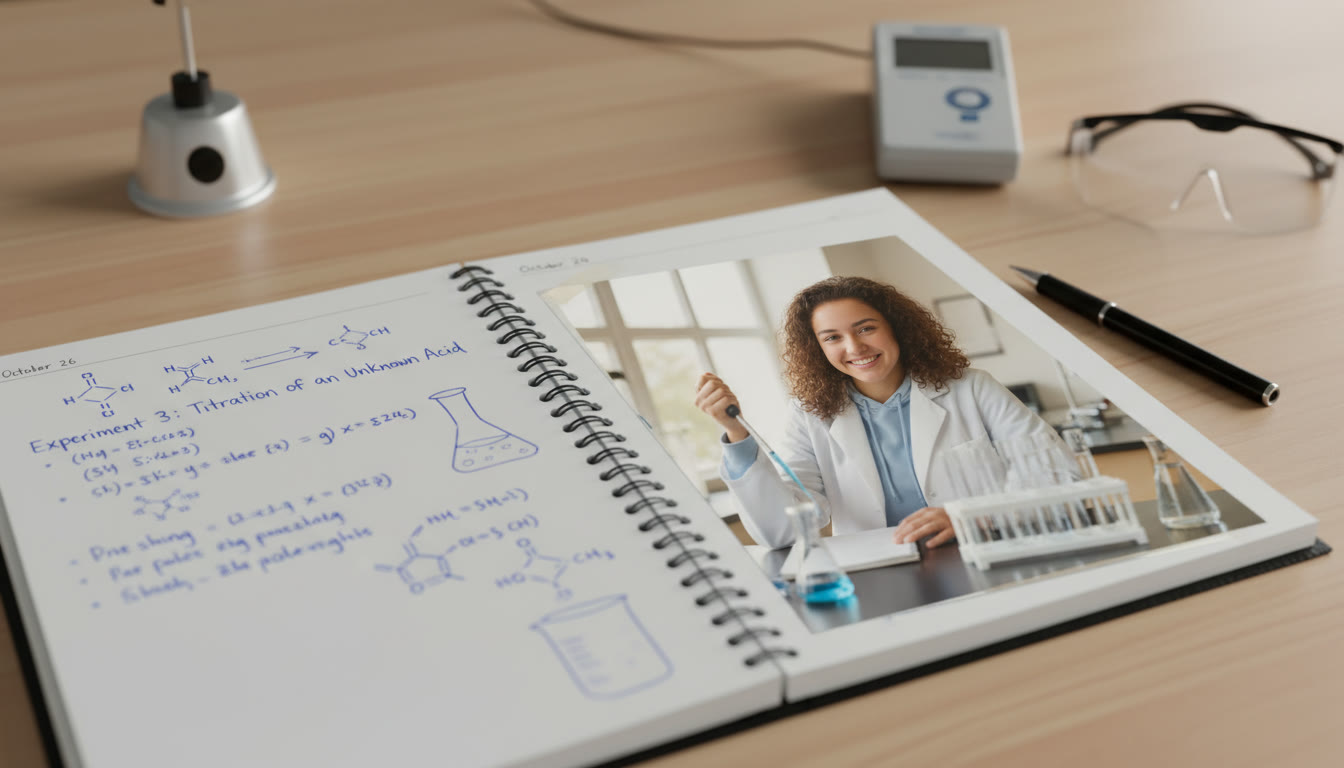
Think of your lab notebook as more than a place to scribble measurements and paste graphs. It’s a living record of your curiosity, rigor, and growth as a young scientist. Colleges and admissions officers — and later, research mentors and professors — look for evidence that you think like a scientist: you ask clear questions, design careful tests, record observations honestly and thoroughly, and reflect on what the data mean. A clean, consistent, and well-annotated lab notebook does exactly that. It tells a story of intellectual engagement in a way a grade alone cannot.
First Impressions Count: The Front Matter
Start strong. The first 10–15% of your notebook should give any reader the context they need to understand what follows. Keep the front matter tidy — neat, typed or clearly handwritten, and logically ordered.
What to include on the inside front cover or first pages
- Student name, course, teacher, school year (e.g., AP Biology, 2025–2026).
- Contact information (school email is fine) and classroom or lab section.
- Table of contents with page numbers — leave blank lines to add new entries as you go.
- Short statement of lab notebook purpose (one or two sentences): “Record of experiments, data, and reflections for AP Biology.”
- Safety information and lab partner names for collaborative entries.
The Daily Page: A Reproducible Structure
Consistency is one of the single most persuasive signals in a lab notebook. Adopt a reproducible structure for every entry so that a reader can quickly find the question, the method, the data, and the conclusion.
A practical page template (use every time)
- Date and Title: Put a short, descriptive title and the exact date. If work spans multiple days, list the date range.
- Purpose / Objective: One sentence stating the scientific question or aim.
- Hypothesis: A clear, testable prediction. If you’re using an “if… then…” format, keep it concise.
- Materials & Methods: Bullet points or numbered steps sufficient for someone else to reproduce your work. Include volumes, concentrations, times, and temperatures when relevant.
- Data / Observations: Raw data with units, sketches, photos (or references to photos), and time stamps. Don’t erase mistakes — cross them out with a single line and annotate.
- Analysis: Calculations, graphs, statistical tests, or reasoning that turn raw observations into results.
- Conclusion / Reflection: Interpret whether the hypothesis was supported and what the limitations were. Suggest next steps.
- Signatures / Peer Review: If possible, have your teacher or lab partner initial key entries — this demonstrates accountability and integrity.
Formatting That Communicates Care
Neatness is not mere aesthetics. A carefully formatted notebook suggests organized thinking and respect for the scientific method. But neatness doesn’t mean perfection — honest records of failed trials and messy data are powerful evidence of real scientific work.
Formatting tips that colleges notice
- Number every page and never remove pages.
- Use permanent ink for entries; draw tables and axes with ruler lines where appropriate.
- Keep the Table of Contents updated. Admissions readers often flip to it first.
- Date all entries and sub-entries.
- Label all figures, tables, and images with figure numbers and descriptive captions.
- When using digital photos, reference them in the notebook with file names and page numbers (e.g., Photo_AgarPlate_081225.jpg).
What to Record: The Difference Between Data and Evidence
Data are raw numbers or observations; evidence is the interpretation that connects data to your hypothesis. Both are essential, but colleges pay special attention to how you relate the two: do you show critical thinking? Do you acknowledge uncertainty?
Examples: Turning data into convincing evidence
- Instead of writing “reaction occurred,” note detailed observations like “solution turned cloudy after 2 min; precipitate settled after 10 min; pH decreased from 7.2 to 6.1.”
- Include controls and explain why they matter: “Control A (no enzyme) showed no color change, confirming the colorimetric change requires enzymatic activity.”
- When data are messy, show your calculations and thought process: “Outliers removed after justifying instrument malfunction — see page 12 for raw sensor log.”
Use Tables and Graphs — Clean, Labeled, and Helpful
Visual presentation is a huge time-saver for a reader. Tables make patterns more obvious. Graphs demonstrate quantitative thinking. Keep them simple, well-labeled, and directly connected to your claims.
Sample table: Lab Notebook Quick Reference for an Experiment
| Field | What to Write | Why It Matters |
|---|---|---|
| Date and Title | 2025-09-15: Effect of Light Intensity on Photosynthesis Rate | Identifies the entry and chronological order |
| Objective | Measure oxygen production of Elodea under varying lux levels | Sets the experimental focus |
| Materials & Methods | List concentrations, timings, lamp distance, measurement interval | Enables reproducibility |
| Raw Data | Volume O2 (mL) at 0, 5, 10, 15 min for each light level | Records observations objectively |
| Analysis | Graph of O2 vs Time; rate calculated via slope | Transforms data into interpretable results |
| Conclusion | Light intensity increases rate until saturation; possible photoinhibition at highest level | Demonstrates critical interpretation and limitations |
Images, Photos, and Digital Files — Reference Them Thoughtfully
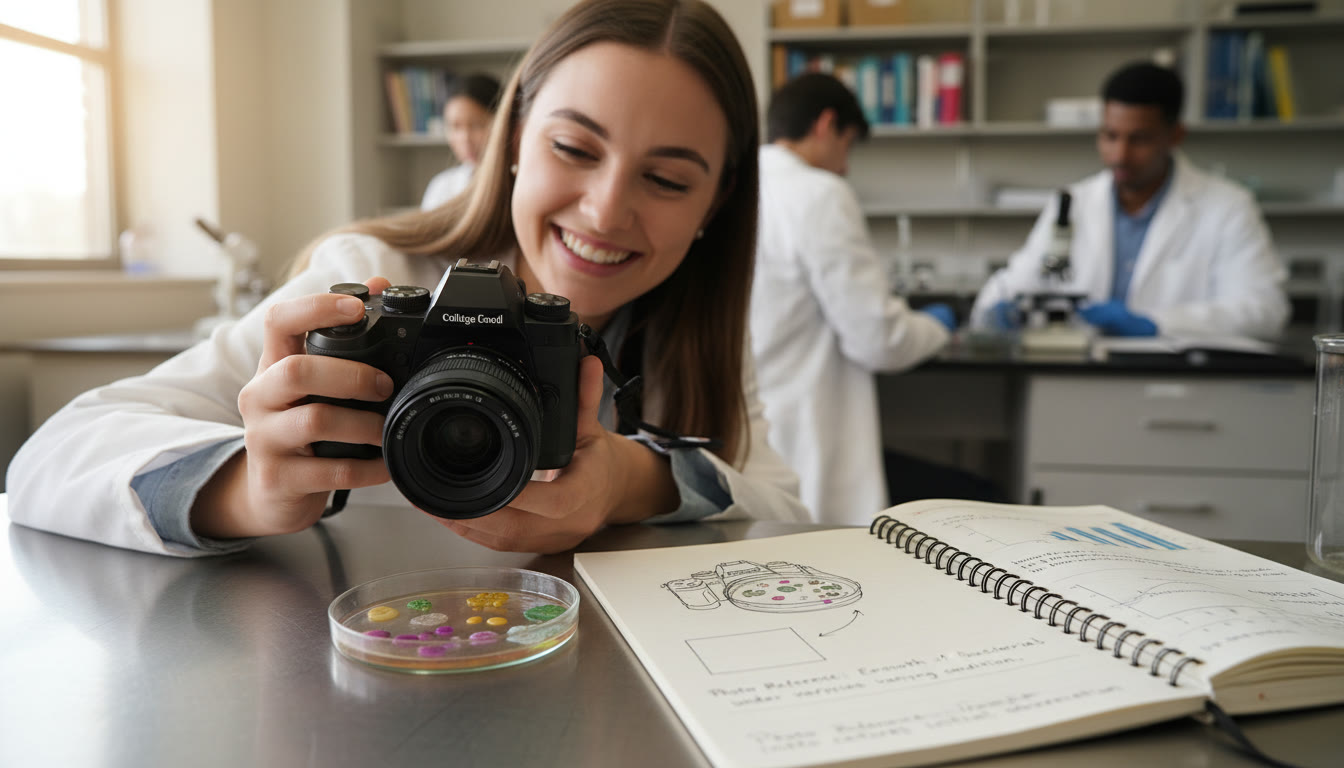
Photos can be compelling evidence of experimental conditions and outcomes, but they must be referenced and described. A notebook entry that says “see photo” without context is weaker than one that includes a brief caption explaining what the photo shows and why it matters.
How to integrate images
- Place the photo file name and thumbnail reference in the notebook (e.g., Photo_ColonyPlate_092625.jpg, page 45).
- Write a short caption under the photo reference: what is shown, scale, and time.
- Note any image-processing steps if you adjusted contrast, cropped, or annotated.
Academic Integrity: Honesty Is Non-Negotiable
Colleges value intellectual honesty. Your notebook is evidence of your process; altering data to better match a hypothesis undermines that trust. If something goes wrong, record the problem and explain how you corrected it. Admissions officers and lab supervisors prefer students who recognize and learn from mistakes.
Best practices for honest records
- Do not erase — cross out mistakes and annotate the reason.
- Note instrument calibrations, anomalies, and environmental conditions (e.g., “balance malfunction at 13:02; used backup balance after recalibration”).
- Keep original raw data, even if you summarize or transfer it to a clean table later.
Reflective Entries: Show How You Think
Beyond method and measurement, write short reflections that show metacognition. These are the passages that reveal your intellectual maturity and curiosity to colleges.
Reflection prompts to use regularly
- What surprised me about today’s results?
- What would I change in the design next time?
- Which sources of error are most likely to have affected the data?
- How does this experiment connect to a broader concept or real-world application?
Samples and Templates You Can Adopt
Below are compact templates you can copy into the top of your notebook or into a digital template to print — use them as a habit until they become second nature.
Short daily entry template
- Date / Title
- Objective / Hypothesis
- Materials & Methods (numbered)
- Raw Data / Observations
- Analysis (calculations / graph reference)
- Conclusion / Next steps
When to use a digital supplement
Physical notebooks are wonderful for lab classes and many admissions scenarios. But for complex projects involving large datasets, digital supplements — spreadsheets, photographs, or code repositories — are appropriate. If you use digital supplements, always reference them in the physical notebook with file names, timestamps, and brief descriptions so a reader can reconstruct the workflow.
How Colleges Evaluate Lab Notebooks
Admissions reviewers may not read every page, but when they do look, they search for patterns. Are entries dated and complete? Do you show growth across a term? Is there evidence of original thought or independent investigation? Quality notebooks often share several traits that make them stand out.
Checklist colleges tend to value
- Clear organization and consistent formatting.
- Evidence of independent inquiry — not just following a lab manual.
- Honest presentation of results, including failed experiments and troubleshooting.
- Analytical depth — calculations, meaningful graphs, and consideration of error.
- Connections to larger scientific questions or real-world relevance.
Examples: Strong vs. Weak Notebook Entries
Seeing concrete contrasts helps. Below are brief, anonymized examples that capture the difference between entries that impress and those that don’t.
| Weak Entry | Why It Falls Short | Strong Entry |
|---|---|---|
| “Did experiment. Results bad. Need to redo.” | Vague, no data, no explanation. | “2025-10-02: Enzyme assay — Hypothesis: Increasing temperature increases activity until denaturation. Raw data: absorbance readings at 0, 1, 2, 3 min for 20°C, 30°C, 40°C. Observed: 40°C yields lower initial rate; suspected denaturation (see photo_enz40_1002.jpg). Next: repeat with fresh enzyme and measure at 35°C. Teacher initialed: M.R.” |
| Table with numbers but no units or method. | Hard to interpret or reproduce. | Table with numbers, units, method, sample size, and a short note on outliers and controls. |
Translating Your Notebook for Admissions and Interviews
When you include lab experiences in college applications, you won’t upload entire notebooks, but you will select highlights. That selection should be purposeful and tell a coherent story about your scientific development.
How to prepare highlights
- Choose 2–4 representative entries that together show curiosity, method, and growth.
- Prepare a one-paragraph summary for each entry: context, what you did, what you learned, and why it mattered.
- Scan and label the pages carefully; ensure handwriting is legible in scans.
- Practice describing your work in an interview: focus on thought process over minor technical details.
Using Tutoring and Mentorship to Elevate Your Notebook
Working with a mentor — a teacher, a lab supervisor, or a private tutor — can help you refine experimental design, analysis, and communication. If you want structured support, personalized tutoring offers targeted feedback on how to present your lab work. For example, Sparkl’s personalized tutoring can provide 1-on-1 guidance to help you craft reproducible methods, build tailored study plans for lab skills, and get expert input on turning messy raw data into a compelling narrative. The benefit is specific, actionable advice that makes your notebook both more rigorous and more readable.
Common Questions Students Ask
Can I use a digital lab notebook?
Yes — many modern labs use electronic lab notebooks (ELNs). If your course allows digital records, keep them organized and backed up. Always reference digital files in any physical notebook entries, and ensure timestamps and file names are clear. When in doubt, ask your teacher which format they prefer.
How much detail is too much?
More detail is usually better, but clarity is king. Don’t write paragraphs that bury the point; instead, use concise sentences, bullet points, and labeled tables. The goal is reproducibility — if someone else can follow your steps and repeat the experiment, you’ve included enough detail.
Should I include failed experiments?
Absolutely. Failed experiments reveal thought process and resilience. Record what happened, why you think it happened, and what you’d change next time. That reflection often says more about your scientific maturity than a single successful trial.
Final Checklist Before Submitting or Presenting Notebook Pages
Run through this checklist when you choose pages to include in an application, a science fair, or a research portfolio.
- Are pages numbered and dated?
- Is the Table of Contents up to date?
- Are figures and tables labeled and captioned?
- Do entries include objective data and clear analysis?
- Are reflections and next-step ideas included?
- Have you annotated any data corrections or instrument issues?
- If digital files are used, do references correctly point to filenames and timestamps?
Closing Thoughts: Your Notebook Is a Narrative of Growth
Your lab notebook is a unique artifact that captures your journey as a thinker and doer. It’s where curiosity meets discipline and where questions become experiments and experiments become learning. By treating your notebook as a professional, living document — organized, honest, and reflective — you give colleges and mentors a window into not just what you know, but how you approach learning. Small habits — consistent dating, tidy tables, thoughtful reflections, and clear image references — compound into a portfolio that truly stands out.
If you want help turning your strongest experiments into narrative highlights for college applications or science fairs, consider targeted, personalized support. A tutor can help you structure entries, refine analyses, and practice explaining your work with clarity and confidence.
Keep experimenting, keep documenting, and remember: the most compelling lab notebooks are the ones that tell a clear, honest story about a mind at work.





















No Comments
Leave a comment Cancel