
Why the Synthesis Essay Isn’t a Summary (and Why That’s Good News)
The AP English Language and Composition synthesis essay asks you to do something deceptively simple: take a group of sources and use them to build an argument. But many students fall into the easiest trap—retelling the sources. That feels safe, because it’s concrete and low-risk, but it also misses the point of synthesis: your job is to connect, evaluate, and use sources as evidence for your own idea, not to be their echo.
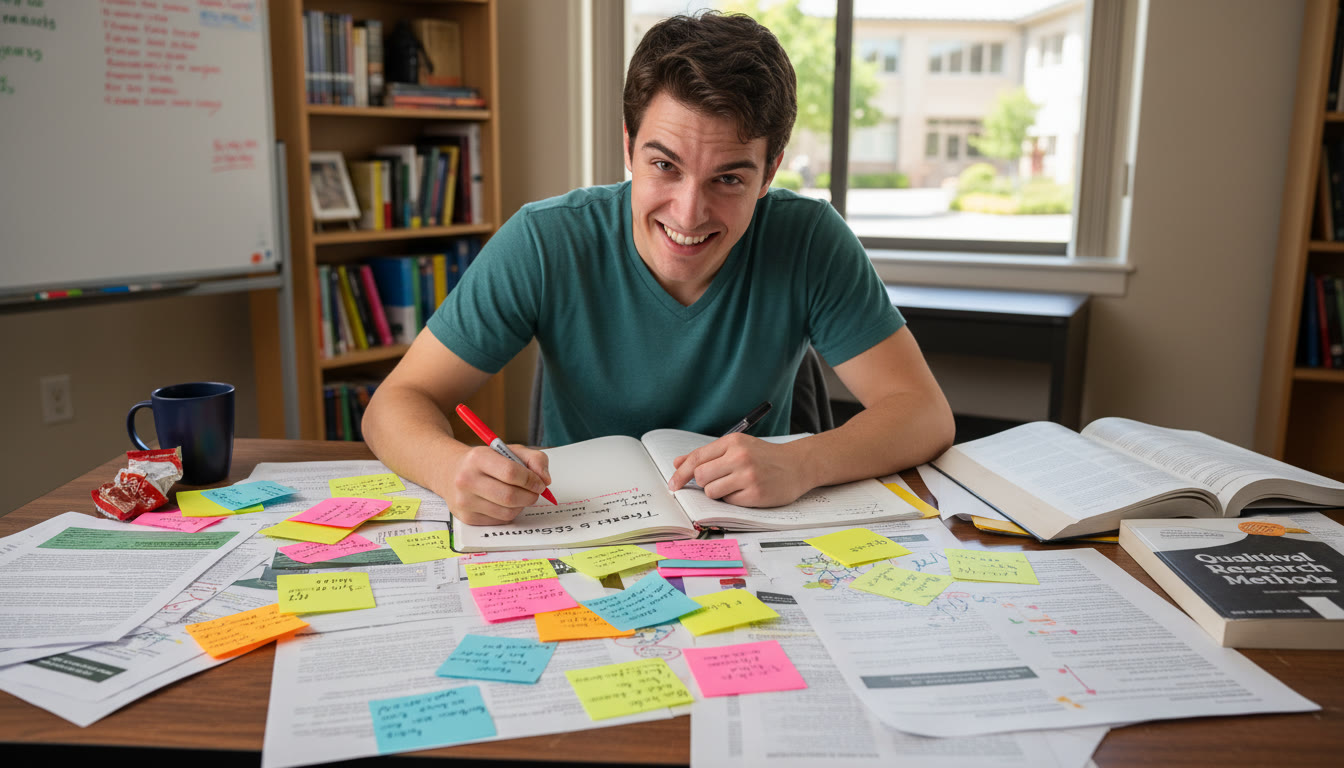
What the Collegeboard Really Wants
At its core, the synthesis task assesses three things: (1) clear and compelling argumentation, (2) purposeful selection and integration of sources, and (3) control of writing—structure, tone, and mechanics. The graders are looking for a voice that makes an original claim and uses the provided texts as tools, not as the script. So when you hear “don’t summarize,” translate that into action: analyze, evaluate, and weave.
Key Differences: Summary vs. Synthesis
Let’s be blunt. Summary answers the question “What did the sources say?” Synthesis answers “What do the sources mean together, and how do they support your claim?” You can summarize a source in one sentence if necessary. You should never spend a paragraph walking the reader through each source one by one unless your explicit purpose is to compare them—then keep it concise.
- Summary: Restates authors’ points without commentary.
- Synthesis: Uses sources to support, complicate, or contrast with your claim.
- Integration: Smoothly blends source material with your analysis so the reader sees evidence and interpretation together.
Quick Example
Summary: “Author A says that technology isolates people; Author B says it connects people globally.”
Synthesis: “While Author A emphasizes the isolating tendencies of personal devices, and Author B highlights global networks’ connective power, both reveal that technology reshapes social habits rather than determining whether we engage—so the central question becomes how personal choices and institutional contexts steer those habits.”
Practical Strategy: Read, Annotate, Decide
Before you draft a single sentence, invest time in deliberate reading. The synthesis prompt gives you a handful of sources for a reason: they’re the scaffolding. Here’s a simple, high-yield routine that top scorers use.
- Step 1 — Read the Prompt Carefully: Identify the task (argue, explain, analyze) and the sphere (education, technology, public policy). Make sure you understand the stance options—are you taking a position, or weighing perspectives?
- Step 2 — Skim Sources for Tone and Purpose: Note which sources are statistical, which are anecdotal, which are argumentative, and which are authoritative (e.g., studies, expert testimony). Circle key claims—no full paraphrase yet.
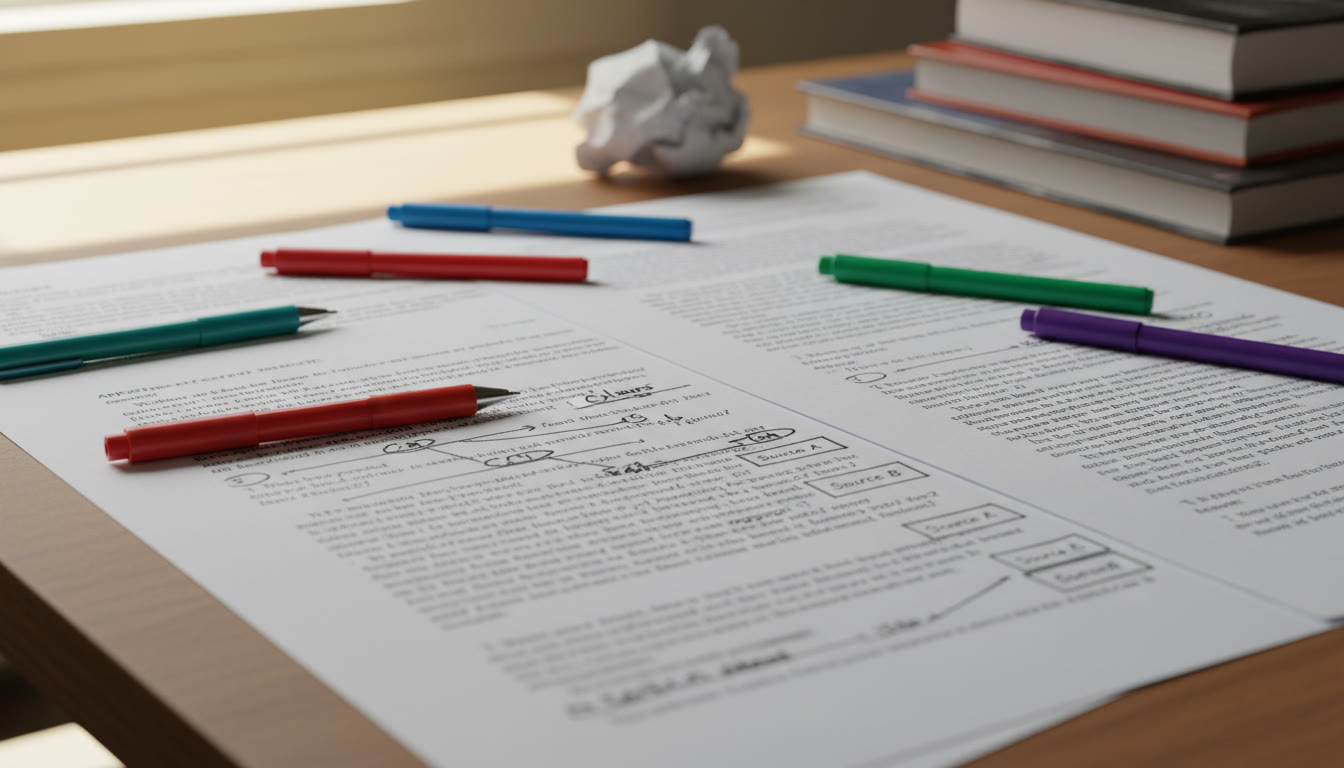
- Step 3 — Annotate with Purpose: For each source, jot one very brief label: “supports X,” “complicates Y,” or “offers counterexample.” These labels become your toolbox during drafting.
- Step 4 — Decide Your Claim: Write a one-sentence thesis that answers the prompt and stakes a clear position. Keep it arguable and specific—avoid vague platitudes.
Crafting a Thesis That Uses Sources, Not Summaries
A strong thesis does three jobs: it answers the prompt, limits the frame (so you don’t wander), and hints at what kinds of evidence you’ll use. Think of the thesis as an argument map for the reader.
Example thesis: “While technological platforms offer unprecedented access to information, their design incentives prioritize attention and convenience over depth, so educators must teach digital literacy that emphasizes critical evaluation and sustained inquiry.”
This thesis is effective because it positions an argument (what should happen), suggests a critique (design incentives), and previews the kind of evidence you’ll use (technology’s affordances and educational response).
Thesis Checklist
- Does it clearly respond to the prompt?
- Is it specific and defensible with the provided sources?
- Does it avoid broad generalizations that invite summary instead of analysis?
Paragraph Structure: Claim, Evidence, Commentary
Every body paragraph should be a mini-argument. Use this structure as your default:
- Topic Sentence (Claim): One clear sentence that advances your thesis.
- Evidence (Selective): Bring in a targeted piece from a source—a line, statistic, or point. Paraphrase or quote briefly.
- Analysis (Commentary): Explain the significance of the evidence—how it supports your claim, reveals a tension, or exposes an assumption.
- Tie-Back: End the paragraph by connecting back to the thesis and preparing the transition.
Remember: the commentary is where synthesis lives. Don’t leave the evidence to speak for itself—interpret it.
How to Use Sources Without Summarizing Them
Here are specific rhetorical moves that transform source material into synthetic ammunition.
- Compare and Contrast: Place two sources in tension—”Source X acknowledges a problem that Source Y assumes away.”
- Qualify: Use a source to narrow your claim—”Although Source A shows that this works in urban settings, the data don’t account for rural barriers.”
- Contextualize: Show how the source’s evidence fits a larger pattern or historical frame that supports your argument.
- Concede and Pivot: Briefly concede a valid point and then explain why your argument still holds—this demonstrates intellectual honesty and complexity.
- Use Authorial Purpose: Ask why a source was written. Is the author persuading, informing, or entertaining? That purpose changes how you treat the evidence.
Mini Example of Synthesis in a Paragraph
Topic sentence: “Design features that prioritize quick clicks can erode deep reading habits, weakening students’ capacity for critical analysis.” Evidence: “A provided study shows average article dwell time falling by 40% over a decade.” Commentary: “That statistic matters not because attention is scarce—attention has always been finite—but because the interfaces that reward skimming reshape what counts as ‘attentive’ behavior, pushing learners toward breadth at the expense of depth. Thus, the problem is structural: without curricular interventions that model and reward slow reading, students will internalize fleeting engagement as the norm.” Tie-back: “Therefore, to preserve analytical rigor, educators must pair technological tools with deliberate pedagogy.”
Using Quotations and Paraphrases: Best Practices
Quotations can be powerful, but overuse leads to summary. Think of quotes as evidence—like a data point. Use them sparingly and always follow with analysis.
- Paraphrase when the idea matters more than the wording.
- Quote when the wording is unique, authoritative, or rhetorically charged.
- Keep quotations short—one or two phrases. The AP rubric favors analysis over long quotation blocks.
Organize With Purpose: Methods of Arrangement
How you order paragraphs affects the clarity of your synthesis. Pick an organization that supports your thesis.
- Strongest-First: Start with your most compelling evidence to grab the reader.
- Problem-Solution: Present a problem revealed by the sources, then move to solutions supported by other sources.
- Compare-Contrast: Use when sources split into clear camps.
- Cause-Effect: Ideal when sources show mechanisms and consequences.
Table: Quick Reference for Moves and Sample Phrases
| Rhetorical Move | What It Does | Sample Phrases |
|---|---|---|
| Compare | Shows similarity or difference between sources | “Similarly,” “In contrast,” “Whereas Source A… Source B…” |
| Qualify | Limits the scope of a claim | “Although the data indicate…, they fail to account for…” |
| Contextualize | Places evidence in a broader frame | “Historically…”, “In contemporary practice…”, “Within this system…” |
| Concede and Pivot | Acknowledges counterpoints then refocuses | “It is true that…, however…”, “While X is valid, Y remains central…” |
| Authorial Purpose | Evaluates the source’s intent | “The author’s aim is to…, which suggests…” |
Common Mistakes That Sound Like Summary
Avoid these traps. They often come from stress, lack of planning, or misunderstanding of the task.
- Paragraph-Per-Source: Long, standalone summaries of each source with minimal connection to your thesis.
- Overquoting: Letting sources dominate your voice.
- Descriptive Transitions: “First, second, third” without analytical linkage. Use transitions that show how pieces relate.
- No Evaluation: Presenting a source at face value without discussing reliability, scope, or bias.
Time-Saving Tactics for Test Day
Under time pressure, efficiency and clarity are your friends. Here’s a compact routine you can run in the first 15–20 minutes.
- Spend 3–4 minutes reading the prompt carefully and drafting a one-sentence thesis.
- Spend 6–8 minutes skimming sources, annotating one-line labels for each (support, counter, evidence type).
- Spend 4–6 minutes outlining three body paragraphs—brief topic sentence and which source piece you’ll use.
- Write for the remaining time, prioritizing analysis and avoiding long source summaries.
One Sample Paragraph (Annotated)
Topic Sentence: “The convenience of digital platforms often disguises their role in shaping priorities, nudging users toward immediacy rather than sustained inquiry.”
Evidence: “Source B’s data on declining article dwell time suggests readers click away faster than before.”
Analysis: “This decline is not a neutral statistic; it indicates that the environment rewards brief engagement. When attention is commodified, content creators design for rapid consumption, and learners internalize that pace as sufficient. Thus, the challenge for instructors is less to eliminate technology than to reorient how it’s used—prioritizing assignments that incentivize revisiting, annotating, and discussing texts over one-off skimming.”
Tie-Back: “Therefore, curricular shifts that promote reflective reading counter the default incentives of many platforms.”
How to Show You’ve Read the Sources—Without Rehashing Them
Graders need to be confident you engaged with the materials. Do this by using them strategically:
- Attribute ideas accurately: “According to Source C…” or “Source C argues that…”—but don’t follow with a paragraph-length paraphrase.
- Use specific evidence: numbers, brief quotes, or unique examples from the text.
- Discuss authorial credibility or limitations: note if the source is anecdotal, empirical, editorial, or historical, and why that matters for your argument.
Polish: The Last 5–7 Minutes
Save time to read through once. Look for:
- Clear thesis restatement (not verbatim) in your conclusion.
- Any paragraph that reads like a source summary—trim or rework the analysis.
- Transitions that help synthesis: “This reveals…, which suggests…” and “Although X notes…, Y indicates…”
- Grammar and sentence-level clarity. Clear prose often scores higher than ornate but confusing language.
Study Plan to Improve Synthesis Skills (Four Weeks)
Improvement comes from deliberate practice. Here’s a short plan you can adapt for study sessions.
| Week | Focus | Activities |
|---|---|---|
| 1 | Understanding Prompts and Sources | Analyze 6 sample prompts; label provided sources; practice writing one-sentence theses for each. |
| 2 | Turning Evidence into Analysis | Write 3 body paragraphs using given source snippets; emphasize commentary over quotation. |
| 3 | Timed Practice | Complete two full synthesis essays under timed conditions; review with rubric. |
| 4 | Feedback and Refinement | Work with a tutor or study partner to get targeted critiques; revise essays and focus on weak areas. |
Working through this plan with someone who can provide focused feedback speeds progress. Sparkl’s personalized tutoring, for example, offers 1-on-1 guidance, tailored study plans, and expert tutors who can target the commentary-writing habit—helping you convert evidence into insight faster.
Final Notes on Voice and Originality
Originality doesn’t mean inventing facts; it means connecting evidence to an argument in a way that reveals thought. Your voice—clear reasoning, honest evaluation, and a confident stance—matters more than flashy vocabulary. The AP rubric rewards complexity and control: show you understand the sources and can use them to illuminate your own claim.
Closing Pep Talk
Don’t fear the synthesis essay. Treat it as a conversation with the sources, not a report on them. When you practice deliberately—planning thesis-first, annotating purposefully, and making commentary your focus—you’ll shift from summary to synthesis naturally. Over time, you’ll learn to see sources as building blocks in an argument you control, not as scripts you must narrate.
And if you want a structured path to improvement, consider pairing practice essays with targeted feedback. Sparkl’s AI-driven insights and expert tutors can help you identify recurring summary tendencies and craft more analytical commentary—so your next essay does exactly what graders want: argues clearly, uses sources wisely, and demonstrates thoughtful synthesis.
Good luck. Keep practicing the art of saying less about what sources say and more about what they mean together. That’s where high-scoring synthesis lives.
























No Comments
Leave a comment Cancel