
“Night Before” Labs: What to Review, What to Skip
Introduction: Calm, Practical, and Effective
It’s late. The kitchen light is on. You have a half-empty mug and a stack of lab notes and handouts spread across your desk. The “night before” lab review is a special kind of stress — small enough to be manageable, big enough to feel important. Instead of trying to memorize every procedure or re-run every calculation, this guide helps you decide what deserves the last-minute attention and what’s safe to skip.

Why a Targeted Night-Before Strategy Works
When the clock is winding down, cognitive bandwidth is limited. You’ll remember and perform best if you use that bandwidth on high-impact items: core concepts, common pitfalls, and the few procedures you might realistically be asked to explain or reproduce. The brain doesn’t benefit much from rote repetition at that point — it benefits from clarity, confidence, and quick checks that reduce error.
How to Decide: High Yield vs Low Yield
Quick decision rule: ask, “If I had to explain this in two sentences, would I be clear?” If yes — high yield. If the explanation is long, obscure, and unlikely to be tested directly — low yield for the night before.
High-Yield Items (Review These)
- Core Concepts and Why They Matter: Be able to state the main idea of each lab (e.g., conservation of mass in chemistry titrations, natural selection mechanisms in ecology labs, Ohm’s law relationships in circuits) and why the experiment demonstrates it.
- Key Procedures and Safety Steps: Know the sequence of major steps and the critical safety checks (e.g., wear goggles, turn off gas before leaving, check for proper calibration of equipment).
- Typical Data Patterns: Recognize expected graphs or outcomes (linear vs. exponential, positive vs. negative correlation), and know one clear explanation for those patterns.
- Sources of Systematic Error: Be able to list 2–3 likely systematic or human errors for each experiment and how they would bias the results (e.g., parallax error biasing measurements high or low).
- Calculations You Might Need: Practice one representative calculation for each lab (molarity, percent composition, slope and intercept from a best-fit line, percent error). Get the units right; units rescue many answers.
- Graphing Intuition: How to label axes, choose scales, spot outliers, and estimate slope by eye if needed.
- Vocabulary that Signals Understanding: A few precise terms that show depth — e.g., “limiting reagent,” “standard deviation,” “control vs. experimental,” “dependent vs. independent variable.”
Low-Yield Items (Skip or Minimize)
- Minute Procedural Details: You don’t need the exact sequence of minor buffer dilutions unless your exam explicitly asks for methods. Focus on the concept of why those steps exist.
- Obscure Derivations: Long algebraic derivations that you won’t be asked to reproduce from scratch can be skimmed. Instead, memorize the final formula and know when to apply it.
- Every Historical Anecdote or Long Background: Background is useful for learning, but not for last-minute points. Keep a one-sentence summary of context if it helps your understanding.
- Deep Dive into Rare Equipment: If you’ve never used a mass spectrometer in lab and it won’t appear on the exam, don’t spend hours on it the night before.
Concrete Night-Before Checklist
Use this as a quick triage to organize the last 3–6 hours before the exam or lab practical.
| Time Block | Focus | Action Items |
|---|---|---|
| 60–90 minutes | Core Concepts & Vocabulary | Write 3–4 bullet sentences per lab summarizing the aim, main result, and one error source. Flashcard quick-check. |
| 45 minutes | Representative Calculations | Do one clean example calculation for each lab; practice units and significant figures. |
| 30 minutes | Graphing & Data Interpretation | Sketch expected graphs and label axes; note how to spot and explain anomalies. |
| 20 minutes | Safety & Procedures | Scan safety steps and any critical checkpoints; memorize the most important sequence steps. |
| 15–30 minutes | Mindset & Logistics | Pack permitted materials, set alarms, light snack, clothes, and plan commute/arrival. |
How to Use the Checklist Efficiently
Set a timer and be literal about each block. If you only have 90 minutes, cut the 60–90 minute block to 45 minutes and keep the rest proportional. The aim is not to over-rotate on one tiny thing — breadth of stable understanding beats obsessive drilling.
Examples by Discipline: What to Review and What to Skip
Below are concrete suggestions tailored to common AP lab subjects. Use these as templates: adopt the ideas that match your course and ignore the rest.
AP Biology
- Review: Experimental design (control vs. treatment), how to read spectrophotometer or rate data, key biochemical pathways relevant to the lab (e.g., enzyme activity vs. temperature/pH), and how to interpret light microscope images.
- Skip: The full biochemical mechanism of an enzyme beyond what matters for interpreting activity curves; long lists of reagents you won’t encounter.
AP Chemistry
- Review: Stoichiometry, limiting reagent logic, titration endpoint interpretation, significant figures, common titration calculations, and how systematic errors affect concentration results.
- Skip: Complex ionic strength derivations or multi-step equilibrium calculations that are unlikely to come up in a straightforward exam context.
AP Physics
- Review: Core equations relevant to the experiment (kinematics, Ohm’s law, Hooke’s law), how to extract slope and intercept changes, units, and how to set up free-body diagrams if applicable.
- Skip: Long derivations of Maxwell’s equations or advanced vector calculus — stick to what’s needed to interpret the experiment.
Quick Tricks to Rescue Your Score
These are small, practical habits that pay big dividends in a lab-style exam or practical.
- Unit-Sanity Check: When in doubt, check units first. If your answer’s units don’t make sense, you probably made an algebra mistake.
- Significance Is Your Friend: Use one extra significant figure than required in intermediate steps; round at the end. This reduces rounding error and often keeps you within tolerance.
- Label Everything: In graphs and diagrams, clear axis labels, units, and legends demonstrate understanding even if a number is slightly off.
- Frame a Smart Explanation: If you’re asked to explain an unexpected result, state the observation first, posit a plausible source of error, and say how you would check or fix it. That structure gets you partial credit.
Mental Prep, Sleep, and Nutrition
You’re not a machine: cognitive performance depends on basic physics. The night before, prioritize sleep and hydration over extra “last-minute” cramming that gives diminishing returns.
Simple Rules
- Get at least 5–7 hours of sleep — more if you can. A well-rested brain remembers and applies knowledge better than an exhausted one.
- Eat a balanced dinner with protein, complex carbs, and vegetables. Avoid heavy fried foods that could make you sluggish.
- Hydrate. Dehydration reduces focus and increases anxiety.
- Limit caffeine late in the evening. A short alertness boost is fine, but don’t jeopardize sleep.
What to Pack and How to Organize Your Bag
Prepare a small kit the night before so you don’t scramble in the morning. Each item reduces stress and improves performance.
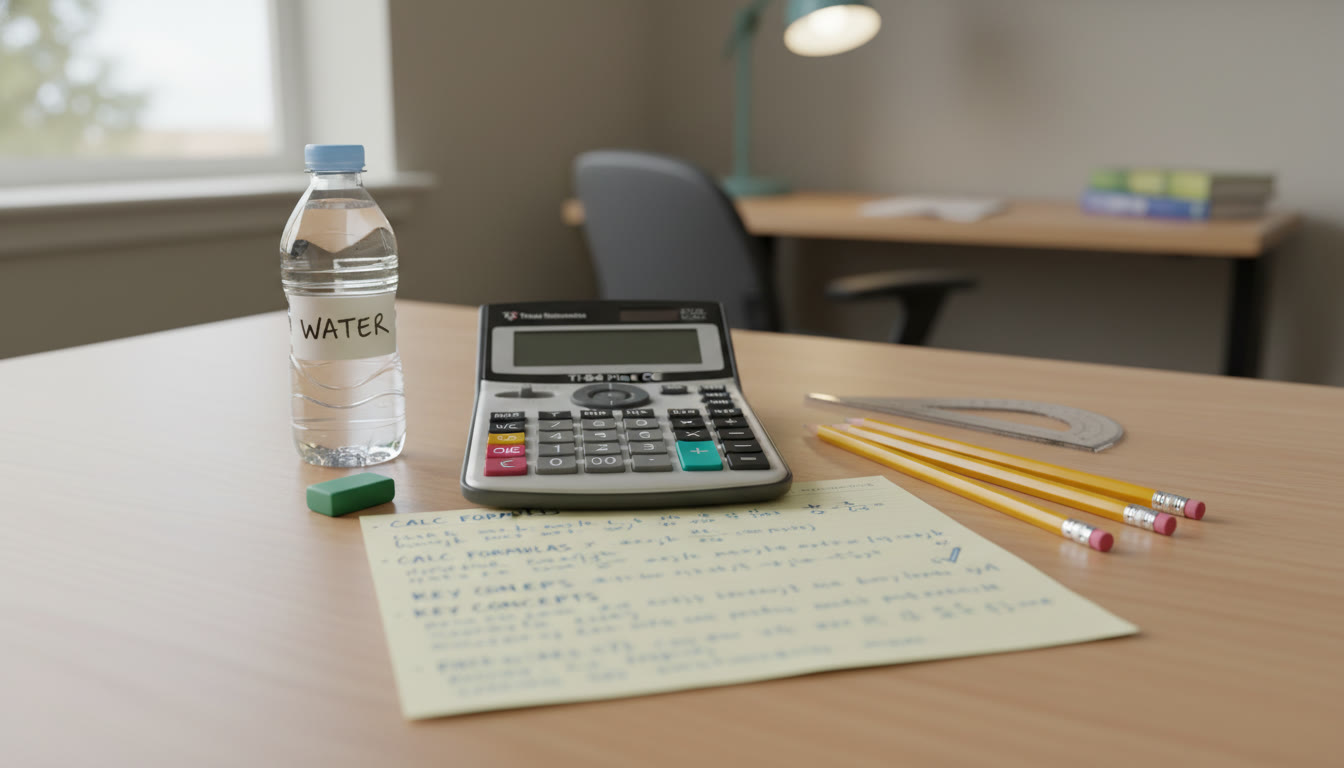
- Two pencils and an eraser (mechanical pencil plus spare lead if you use it).
- Graphing or scientific calculator with fresh batteries — know its basic functions.
- A compact lab notebook or one sheet of well-organized summary notes (if allowed) with formulas, units, and common conversions.
- A snack and water bottle for before the exam (not during exam unless allowed) to steady blood sugar.
- A watch or non-smart timer to manage time during the test.
When You’re in the Exam Room
The transition from waiting room to lab bench matters. Use the first five minutes to orient yourself.
First Five-Minute Routine
- Breathe: two slow breaths to lower heart rate.
- Scan the materials and prompts quickly to form a plan.
- Write down constants, unit conversions, and any quick formulas on scrap paper to free working memory.
- Start with the easy, high-point tasks to secure marks early and build confidence.
How Sparkl’s Personalized Tutoring Can Fit Naturally Into This Plan
Last-minute clarity often comes from targeted guidance. If you’ve been working with a tutor (or are considering one), ask for short, focused practice sessions that mirror the checklist above: a quick review of the core concepts, one representative calculation, and a succinct error-analysis exercise. Sparkl’s personalized tutoring emphasizes 1-on-1 guidance, tailored study plans, expert tutors, and AI-driven insights that can help prioritize which labs deserve deep review and which can be glossed over — precisely the kind of triage you want the night before.
Common Night-Before Mistakes and How to Avoid Them
- Cramming Too Much: Trying to relearn whole chapters is inefficient. Focus on synthesis and application.
- Ignoring Units: This small oversight loses marks. If you’re unsure of a conversion, write the conversion you think is correct and show your work.
- Rushing Safety: Even in an exam, safety matters. If a practical asks for a procedure explanation, don’t shortcut safety steps; examiners expect them.
- Panic Paralysis: If you blank, move to a different question and come back. Momentum reduces anxiety.
Micro-Practice: Three 10-Minute Exercises to Do the Night Before
Each exercise takes about ten minutes and targets high-impact skills.
- Exercise 1 — Explain the Lab in 90 Seconds: Summarize the aim, main measurement, expected result, and one error source. Keep it conversational, as if explaining to a peer.
- Exercise 2 — One Calculation: Do a full calculation with units and significant figures. Check units at the end.
- Exercise 3 — Sketch and Label: Draw the expected graph or apparatus and label the axes, parts, and a likely anomaly. This visual memory often helps in the exam.
When You Absolutely Can’t Sleep
If anxiety keeps you up, use a 20-minute active review: two of the micro-practice exercises, then stop. Meditation or progressive muscle relaxation for 10 minutes often helps more than continuing to study. Remember: quality sleep beats extra passive review.
After the Lab or Exam: Quick Self-Reflection
Within 24 hours, write a 5–10 line reflection: what went well, what surprised you, and one specific thing to improve next time. That feedback loop is powerful for long-term learning and reduces stress before the next assessment.
Final Words: Confidence Over Perfection
The night before a lab-based exam is not the time to chase perfection. It’s a time for tidy thinking, quick checks, and reducing preventable errors. Use the checklist, focus on high-yield items, get decent rest, and approach the exam with the calm of someone who did the smart prep — not all the prep. If you want personalized, focused sessions that target exactly the high-yield items we discussed (for example, a 45-minute tutor-led crash session on lab interpretation and one representative calculation), Sparkl’s personalized tutoring can slot into this plan seamlessly: short, targeted, and designed to maximize the night-before payoff.
You’ve got the tools and a plan. Breathe, prioritize, and let your clear thinking do the work. Good luck — you’ve trained for this.
























No Comments
Leave a comment Cancel