
No-Internet Playbook: The Ultimate Offline AP Study Kit
There are days when the Wi‑Fi cuts out, the app freezes, or you decide — deliberately — to go offline and study without distractions. For AP students, an intentional, well-designed offline study kit can be the difference between frantic, shallow review and calm, deep preparation that actually moves the needle. This playbook shows you how to build a complete, portable, and powerful offline AP study system that fits in a backpack, a locker, or a quiet corner of your desk.
Why an Offline Kit Works (Even in a Connected World)
Online resources are incredible: released questions, video lessons, adaptive platforms. But offline study forces two things that online study often doesn’t: focus and generative practice. When you write by hand, summarize, and test yourself without search bars or autoplay, memory retention improves and your thinking becomes clearer. The offline kit is not a replacement for digital tools — it’s a complementary practice that strengthens core skills, deepens conceptual understanding, and builds exam-ready stamina.
Psychology of Offline Study
- Less distraction — no tabs, notifications, or rabbit-hole videos.
- Active retrieval — handwriting answers, explaining concepts aloud, and building cheat-sheets improve recall.
- Better metacognition — paper lets you see progress at a glance: pages, checklists, and timelines are visible and satisfying.
What to Pack in Your No‑Internet AP Study Kit
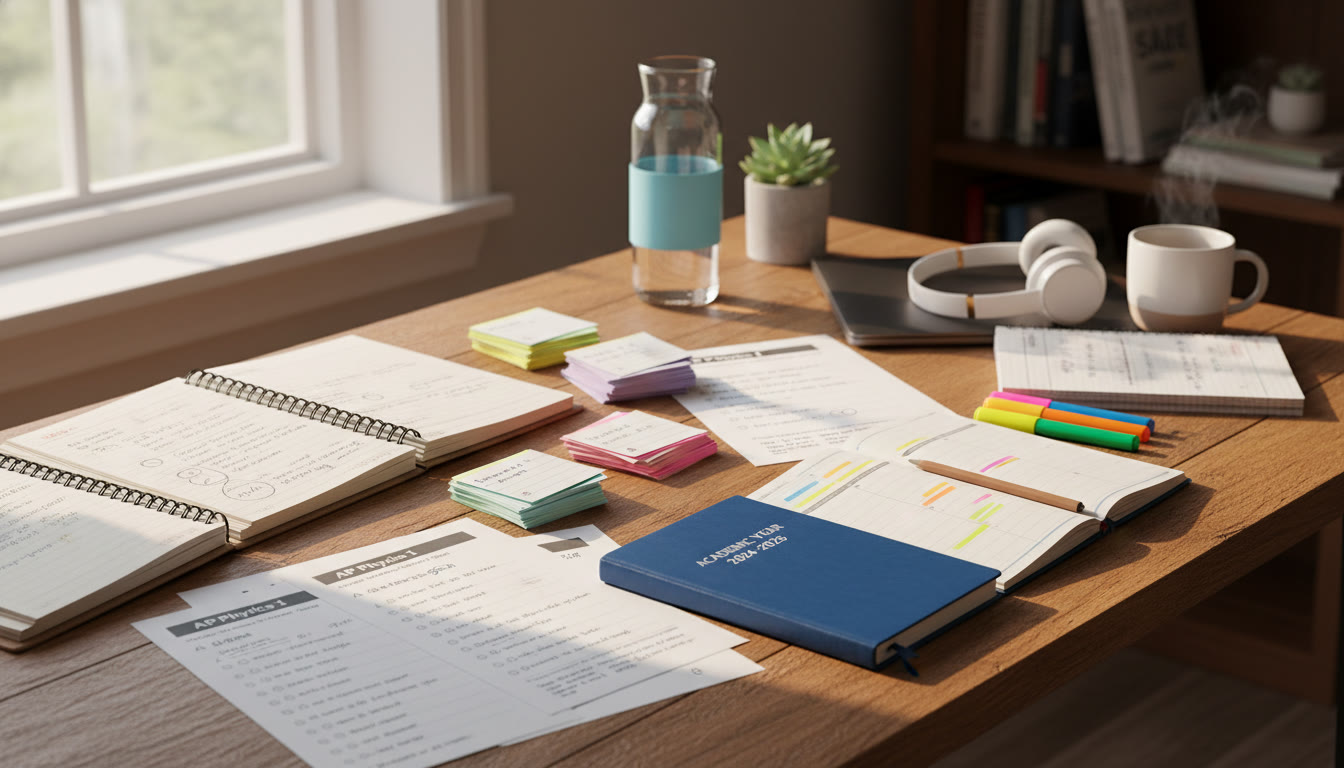
This section lists the physical materials that will make your kit practical and exam-focused. Build one kit for each AP subject if you like, or a single adaptable kit that supports multiple exams.
Core Materials
- One subject-specific spiral notebook (college-ruled) for notes and quick practice.
- Loose-leaf binder or folder for printed practice questions, rubrics, and handouts.
- Index cards (100–200) for flashcards and quick prompts.
- Highlighters (3 colors) and a fine-tip pen set (black, blue, red).
- Graph paper (for math and science subjects) and blank paper for diagrams and planning.
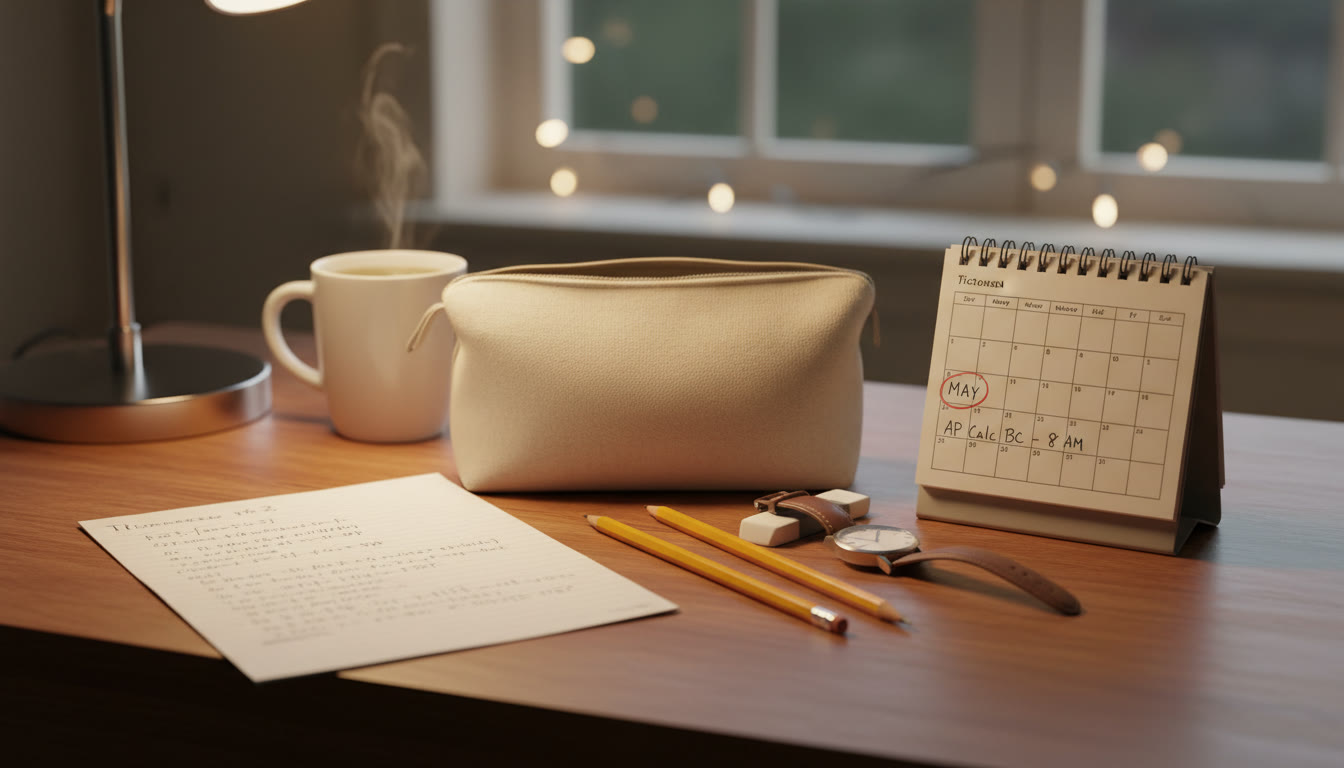
- Physical timer or analog watch to simulate test timing.
- Printed exam outline or Course and Exam Description summary (1–2 pages trimmed to essentials).
Practice Materials
- Printed sets of released multiple-choice and free-response questions grouped by unit.
- Answer keys and scoring rubrics printed and placed in a sealed envelope — open only when timing is complete.
- Mini practice tests: 30–60 minute packets that simulate a focused block of the exam.
- Formula sheet or concept glossary handwritten by you — condensed to one page.
How to Organize the Kit for Maximum Use
Organization is half the battle. A kit is only useful if you can pull the right item quickly and the structure encourages consistent use. Here’s a simple folder system that works in a 2-pocket folder or a compact binder.
Folder Layout
- Left pocket: “Daily” items — index cards for the day’s flashcards, mini practice test, sticky note with a 60‑minute plan.
- Right pocket: “Reference” items — condensed course outline, formula sheet, scoring rubric.
- Center binder: Printed past questions divided by topic with tab separators.
Study Routines: What to Do Offline (and When)
Schedule beats intensity. Use the following templates depending on how much time you have: 20 minutes, 60 minutes, and 3-hour blocks. Each routine mixes retrieval, explanation, timed practice, and reflection.
20-Minute Sprint (Best for Daily Habit)
- 5 minutes — Rapid review of 5–8 flashcards or index-card prompts.
- 10 minutes — One focused practice passage or a short free-response problem done by hand.
- 5 minutes — Correct using the sealed rubric and write one short note: “What tripped me up?”
60-Minute Deep Block (Best for Weekly Study)
- 10 minutes — Quick warm-up and review of yesterday’s mistakes.
- 35 minutes — One timed section or a full free-response question set with a paper timer.
- 10 minutes — Use the rubric to score and annotate; capture two concrete corrections on index cards.
- 5 minutes — Summarize the session in your notebook: small wins and one target for tomorrow.
3-Hour Simulated Exam (Best for Monthly Checkpoints)
Replicate test-day conditions: silence, phone off, and only the allowed materials on your desk. Paper simulation builds endurance and helps you practice pacing.
How to Make Printed Practice Questions Work for You
Printed questions are only as good as the way you use them. Here are techniques to squeeze maximum learning from every printed packet.
Active Markups
- Before you look at options or answers, underline the verbs and key phrases in the question.
- Annotate diagrams, sketch quick models, and write a one-sentence hypothesis of the correct approach before solving.
Error Log Table
Keep an error log in your notebook to identify recurring patterns rather than isolated mistakes. Use a short table like this and update it after each practice block.
| Date | Question Type | Mistake Description | Root Cause | Fix to Try |
|---|---|---|---|---|
| 2025-10-01 | FRQ – AP Biology | Left out key data in explanation | Rushed, no data checklist | Create 3-point data checklist for FRQs |
Handwriting, Summaries, and One-Page Cheatsheets
Condensing a whole unit into one handwritten page is hard in the best way — it forces clarity. Create a “one-sheet” per unit: definitions, formulas, a sample problem, and the top three traps students fall into. Keep these one-sheets in your wallet or folder for last-minute review.
How to Build an Effective One‑Sheet
- Title at the top with the unit and date.
- Left column: 6–8 core concepts or formulas (bulleted).
- Right column: Quick example worked out by hand (3–4 steps).
- Bottom: “Exam Traps” — three quick reminders of common mistakes.
Pairing Offline Practice with Smart Feedback
Feedback is the engine that turns practice into progress. If you’re studying offline, schedule regular feedback loops — either with your teacher, a study group, or a tutor. That’s where Sparkl’s personalized tutoring can fit in naturally: book targeted 1-on-1 guidance to review your error log, get tailored study plans, and receive expert scoring feedback after a simulated paper test. A short tutoring session after a full paper practice can accelerate improvement tremendously because it targets the specific gaps your offline kit exposes.
How to Get the Most From a 1-on-1 Session After Offline Practice
- Bring your error log and a one-sheet; be ready to show two worked problems from your practice packet.
- Ask the tutor to score the paper session with official rubrics and to recommend two habits to apply to the next week’s practice.
- Request a follow-up micro-plan: three 20-minute sprints you will do before the next session.
Offline Time Management and Pacing Strategies
Time pressure is a major exam stressor. Use paper to create pacing bookmarks that you carry into practice sessions until timing becomes intuitive.
Pacing Bookmark Example
- Front of card: Section breakdown (e.g., 60 minutes for MCQ, 90 minutes for FRQ).
- Back of card: Micro-checkpoints (e.g., after 20 minutes, number of MCQs completed).
Study Calendar and Planning — Paper Edition
Digital calendars are great, but a physical, visible calendar on your wall or desk acts as a constant nudge. Use a monthly sheet for macro planning and weekly sticky notes for tactical goals.
Sample Weekly Plan Layout
- Monday: 60-minute deep block — content review + 1 timed FRQ.
- Tuesday: 20-minute sprint — 10 flashcards and a quick problem.
- Wednesday: Peer review session — swap and grade a practice FRQ.
- Thursday: 60-minute deep block — mini test and rubric scoring.
- Friday: Reflection — update error log and create one-sheet.
- Weekend: 3-hour simulated test (monthly) or catch-up.
Group Offline Work: How to Run a Paper-Based Study Group
A well-run study group can be a powerful accountability mechanism. Keep groups small (3–5 students) and focused. Rotate roles: timekeeper, proctor, grader, and explainer. Use printed prompts and a shared error log to track patterns across members.
Structured Study Group Agenda (90 Minutes)
- 0–10 min: Quick check-in and goal setting.
- 10–50 min: Timed practice (everyone completes the same packet).
- 50–70 min: Grade and discuss answers using rubrics; focus on rationale.
- 70–90 min: Create one follow-up action per person and set next meeting.
Testing Without Technology: Handling Graphs, Data, and Diagrams
Some AP exams require complex visual reasoning. Practice sketching clear diagrams by hand and develop shorthand notations. For data-heavy questions, practice organizing information into small tables and labeling axes clearly — these habits translate directly to clearer, higher-scoring responses.
Mini Drill: Diagram Clarity
- Pick a concept (e.g., a supply/demand curve, a cell cycle, or an electromagnetic field diagram).
- Draw it from memory in under 3 minutes; annotate five important labels or steps.
- Compare to a correct diagram and add missing labels to your one-sheet.
Measuring Progress with Paper Metrics
Track progress using simple, paper-friendly metrics: percent correct on timed packets, rubric-based score bands for FRQs, and the number of error-log repeat items. Update a progress chart monthly to visualize growth — it’s motivating and instructive.
Progress Table Example
| Month | Avg MCQ % | Avg FRQ Score (out of) | Top 2 Weaknesses |
|---|---|---|---|
| September | 68% | 10/18 | Time management, Data interpretation |
| October | 74% | 12/18 | Verbally justifying answers, Graph labeling |
When to Go Digital (and How to Combine Approaches)
Offline and online study are complementary. Use offline work for deep practice and retention; use online tools for diagnostic assessments, AP Classroom videos, and large question banks when you want breadth or adaptive review. A healthy cycle is: online diagnostic → offline focused packets → targeted 1-on-1 review (paper FRQs scored by an expert) → online adaptive practice for weak topics.
Final Day Prep: Paper Rituals to Build Confidence
The day before the exam, switch to low-intensity, paper-based rituals: review one-sheet summaries, flip through the error log to affirm fixes, and do one short timed packet to keep the timing muscle warm. Avoid cramming new content. Instead, use offline reflection: write a one-paragraph summary of your exam strategy and pack your kit with only what’s allowed.
Practical Examples: Sample Offline Session for AP English and AP Calculus
Seeing concrete examples makes putting the kit to use simple. Below are two modeled sessions you can replicate.
AP English Language — 60-Minute Session
- 10 min: Quick review of rhetorical terms on index cards.
- 30 min: Timed practice — analyze a 600-word passage and write a 25-minute rhetorical analysis (on paper).
- 15 min: Use rubric to score and write one focused revision paragraph to improve thesis and evidence integration.
- 5 min: Add three new flashcards from the passage (tone words, devices, effective quotes).
AP Calculus — 60-Minute Session
- 10 min: Warm-up with five quick derivative/integral flashcards on index cards.
- 35 min: Complete a timed problem set: two multi-step FRQ-style problems with full work shown on graph paper.
- 10 min: Check solutions using rubric, note any algebra slips in the error log.
- 5 min: Update your one-sheet with a concise trick or identity you used successfully.
Wrapping Up: Turn Offline Habits into Exam-Day Performance
Offline study cultivates the discipline, mental clarity, and stamina you need on exam day. Keep your kit simple, routine-driven, and review-focused. Use index cards and one-sheets to compress content into memorable, portable bites. After each paper practice, use a tutor or teacher check-in to get targeted feedback — a single 30–60 minute Sparkl session after a simulated exam can sharpen your next month of practice by giving you an external, expert read on your error patterns and a tailored study plan that keeps your offline efforts laser-focused.
Parting Practical Tips
- Rotate materials: refresh flashcards monthly to avoid stale review.
- Keep a tiny scissors and tape in your kit to trim printed pages into portable cards.
- Make the kit attractive: a clean, color-coded system is easier to maintain.
- Protect test-day stamina: include a small snack and bottled water in your study rituals to model the exam environment.
Going offline doesn’t mean cutting yourself off from insight or help. It means choosing depth and focus. With this No‑Internet Playbook, your AP preparation becomes more tactile, memorable, and resilient — ready for any classroom, library, or quiet morning at the kitchen table. If you want targeted feedback on your handwritten practice, a short 1‑on‑1 review can convert your mistakes into measurable improvement and craft a tailored study plan that complements your offline kit.
Good luck — study smart, study deep, and trust the work you do away from the screen.





















No Comments
Leave a comment Cancel