
Why Five Works? The Power of a Curated Portfolio
Choosing just five pieces to represent months or even years of work can feel impossible. But that limit is a gift in disguise: it forces focus. Admissions officers, AP readers, and scholarship panels all respond to thoughtfully curated collections. A tight set of five works can tell a clear story—about your growth, your intentions, and the unique perspective you bring to your discipline.
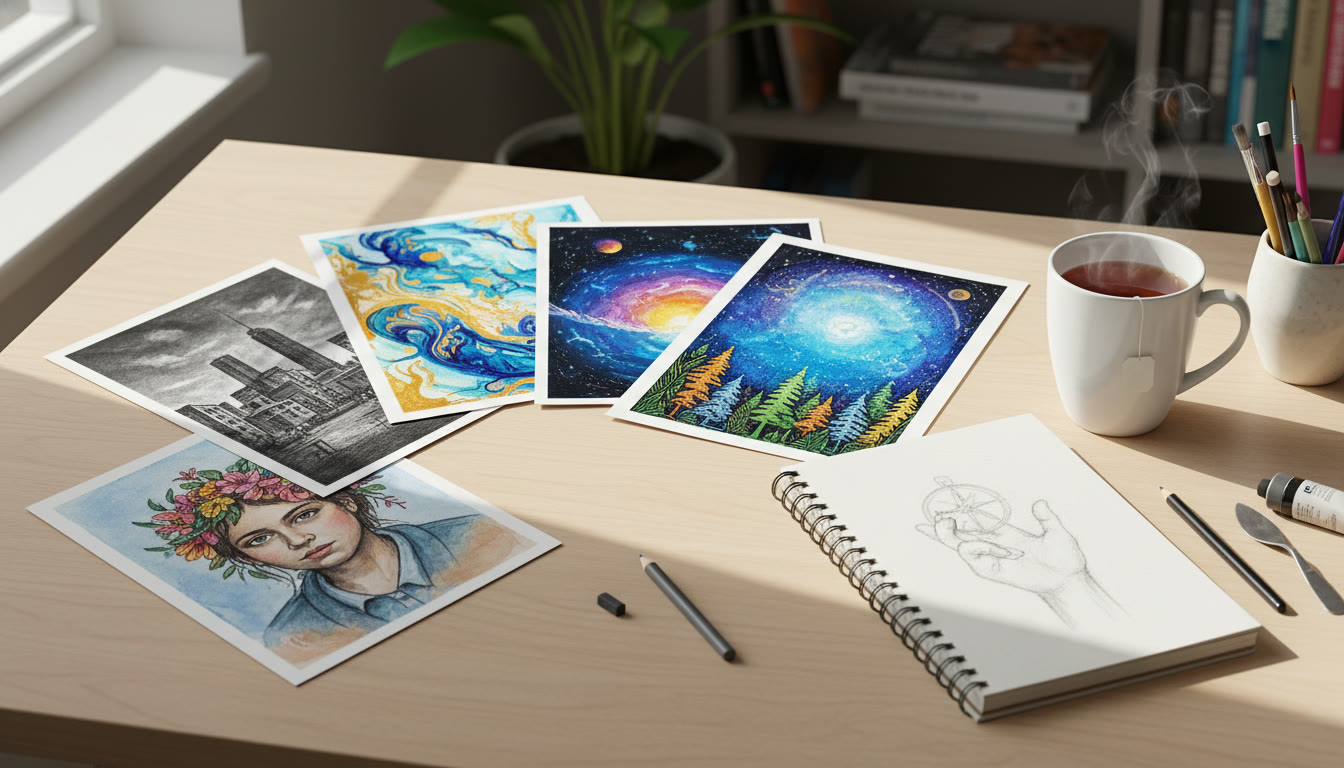
What Makes a Great Five-Work Portfolio?
A compelling five-work portfolio balances several elements. Think of each piece as a chapter in a short book about you.
- Conceptual Variety: Different ideas or themes that collectively show range.
- Technical Proficiency: Evidence that you can handle tools, media, or methods with skill.
- Narrative Arc: A through-line—whether literal or conceptual—that links the works.
- Risk and Originality: At least one piece that takes an intentional creative risk.
- Consistency of Voice: Even with variety, viewers should sense an identifiable perspective.
Step-by-Step Selection Process
Approach selection like an editor. Start broad, then narrow, then refine.
Step 1 — Gather and Inventory
Collect all potential candidates in one place—digital or physical. Create a quick spreadsheet with columns for title, date, medium, dimensions, time spent, concept summary, strengths, and weaknesses. This inventory will make evaluation far less emotional and far more strategic.
Step 2 — Pre-Filter by Objective
Ask: What is the purpose of this portfolio? If it’s for AP Studio Art, your decisions should highlight the chosen concentration (2-D Design, 3-D Design, or Drawing) and the skills AP readers prioritize. If the portfolio is aimed at college admissions broadly, emphasize both technical strength and personal voice.
Step 3 — Identify the Anchor Pieces
Pick one or two anchor works early—pieces that are unmistakably you. These anchors will guide the selection of complementary works that support and contrast them.
Step 4 — Ensure Balance
With anchors chosen, add pieces that fill gaps. If your anchors are conceptually strong but technically uneven, include a very demonstrative technical piece. If everything is moody and monochrome, introduce color or a different medium to show flexibility.
Step 5 — Final Edit and Presentation
With five selected, spend time on presentation: high-quality photos or scans, short explanatory captions, and a clean, consistent labeling system. This final polish often makes the difference between “good work” and “compelling work.”
What to Show: A Practical Checklist
Before finalizing your five works, run each piece through this checklist. If at least one piece fails a crucial criterion, reconsider.
- Does it show technical competence relevant to the medium?
- Does it communicate a clear idea, feeling, or concept?
- Is it distinct from the other selected works (in idea, process, or look)?
- Does it contribute to a narrative about your growth, interests, or perspective?
- Would a reader understand its intent within 15–30 seconds?
- Is the execution clean—well-photographed, titled, and described?
Quick Tip
If you’re stuck between two pieces, ask, “Does this piece make me think of new directions or questions I want to explore?” The piece that sparks future inquiry often has more value than one that simply repeats prior successes.
Portfolio Structure Ideas (Five Models)
There’s no single “right” structure. Below are five effective ways to organize five pieces depending on your goals.
| Model | When to Use | What to Include |
|---|---|---|
| Chronological Growth | You want to show development over time | Early experimental piece → two developmental works → mature technical piece → ambitious final project |
| Theme Exploration | You have a strong conceptual idea | Five variations/angles of the same central theme, each exploring a different technique or scale |
| Technique Showcase | Applying for programs valuing craft | Five pieces that highlight different technical strengths (e.g., composition, color, mixed media) |
| Contrast and Conversation | You want to show range | Pair pieces that contrast in tone, medium, or subject to create dialogue |
| Problem to Solution | You want to emphasize process | Two problem-statement works, two experimentation pieces, one polished solution |
How to Decide Which Model Fits You
Match the model to your end goal. For AP portfolios that require concentration and breadth, a mix of Technique Showcase and Theme Exploration often works best. For college admissions that value narrative and personality, Chronological Growth or Problem to Solution can feel more personal.
Writing Captions and Context: Less Is More
Captions should be concise, illuminating, and specific. Provide a title, medium, date, and a one- to two-sentence contextual note—what you intended and what you learned. Avoid over-explaining; a caption should clarify, not lecture.
Caption Template
Title. Medium. Date. One sentence about intention. One sentence about the result or what you learned.
Example
“Echoed Streets. Oil on canvas. 2024. I wanted to capture urban loneliness through reflected geometry. The finished work taught me to balance negative space with rhythmic line to sustain emotional tension.”
Presentation Matters: Photography, Sequencing, and Flow
Great work can be undermined by poor photography or awkward sequencing. Treat your digital portfolio like an exhibition—flow matters.
- High-Quality Images: Use even lighting, neutral backgrounds, and a consistent crop. Scans are preferable for flat work; for 3-D, include multiple angles but choose the strongest as your primary image.
- Consistent Formatting: Same font, labeling style, and image dimensions across all pieces.
- Sequence Strategically: Start with an attention-grabber, end with your most refined or emotionally resonant piece.
Photo Checklist
- No distracting shadows or color casts.
- Image file size is balanced: high enough quality, but web-optimized for fast loading.
- All works are oriented and scaled consistently so the viewer can compare pieces comfortably.
Common Pitfalls and How to Avoid Them
Students often sabotage strong portfolios unknowingly. Here are pitfalls to watch for—and how to fix them.
- Too Much Repetition: Avoid submitting five versions of the same idea or composition. Instead, show iterations that meaningfully differ.
- Technical Gaps: If a piece shows a clear technical flaw that distracts from the concept, either fix it or replace it with a stronger work.
- Overly Long Explanations: If your caption reads like an essay, shorten it. The art should do most of the talking.
- Ignoring Guidelines: For AP or school-specific submissions, follow image size, file format, and labeling instructions exactly.
Fixing an Almost-Great Piece
If a work is conceptually strong but imperfect technically, consider reworking it—or document the process and include the reworked piece. Showing process (with a strong final image) can actually strengthen your submission.
Examples and Case Studies
Below are three short, fictionalized case studies that show how different students approached their five-work portfolios.
Case Study 1: Maya — AP Studio Art (Drawing Concentration)
Maya had ten strong drawings. She chose:
- A detailed observational portrait showing draftsmanship (anchor)
- An experimental charcoal piece exploring gesture
- A mixed-media self-portrait integrating found materials
- A narrative series image from a longer story (cropped to emphasize composition)
- A bold final piece that used inverted values and was the most conceptually risky
The result: a set that showed technical range, narrative interest, and a consistent voice rooted in portraiture.
Case Study 2: Jamal — College Admission Portfolio
Applying to a small liberal arts program, Jamal wanted to show curiosity. He selected:
- A functional design prototype (photographed in context)
- A documentary photograph series framed as a single, striking image
- A painting exploring color theory
- A sculpture model showing problem-solving
- An experimental digital piece that combined soundwave visuals
Jamal’s five works demonstrated interdisciplinary thinking—a narrative that fit the program’s emphasis on cross-modal creativity.
Case Study 3: Sofia — AP Research / Extended Work
Sofia’s portfolio had to reflect a sustained inquiry. She included:
- An initial study showing the seed of her research
- A mid-term experiment with annotated observations
- A refined visual artifact from her project
- A comparative piece illustrating how her concept evolved
- A final presentation-quality piece summarizing findings
Her portfolio read like a mini-thesis: problem, method, iteration, result, reflection.
Practical Timeline: How to Work Backwards from Deadlines
Start early. A rushed portfolio rarely shows thoughtful curation.
- 8–12 Weeks Before Deadline: Gather all candidates, photograph existing works, start inventory.
- 6–8 Weeks Before Deadline: Narrow to 8–10 pieces, begin refining or reworking key pieces.
- 3–4 Weeks Before Deadline: Finalize five works, photograph/scans, write captions.
- 1–2 Weeks Before Deadline: Proof the presentation, test file uploads, get feedback from a teacher or mentor.
Feedback: Who to Ask and What to Ask For
Get at least two rounds of feedback: one from someone familiar with the discipline (art teacher, mentor) and one from an outsider (friend, family member, admissions advisor) who can speak to clarity of communication.
- Ask an expert: “Which piece best shows my technical strengths? What’s missing?”
- Ask an outsider: “Can you tell me what these five pieces say about me in 30 seconds?”
- Iterate: Use the feedback to tweak sequence, captions, or even swap a piece.
How Personalized Support Helps: A Natural Mention of Sparkl
Students often benefit from targeted, individualized help. Personalized tutoring—like the 1-on-1 guidance Sparkl offers—can accelerate this process by building tailored study plans, offering expert tutors who critique both concept and craft, and providing AI-driven insights that help identify gaps and opportunities in a portfolio. A few focused sessions can turn scattered work into a cohesive, compelling five-piece story.
Final Thoughts: Confidence and Storytelling
Your five-piece portfolio is a concentrated signal of who you are as a maker and thinker. Treat each piece as deliberate evidence: of taste, curiosity, skill, and risk-taking. When you choose pieces because they complement one another and together tell a clear story, you invite viewers into your world. That clarity is memorable.
Parting Reminders
- Start early, iterate often, and keep your presentation clean.
- Balance concept with craft—both matter.
- Ask for feedback from different perspectives—and be prepared to revise.
- Use tools and tutoring thoughtfully to sharpen weaknesses, not to replace your voice.
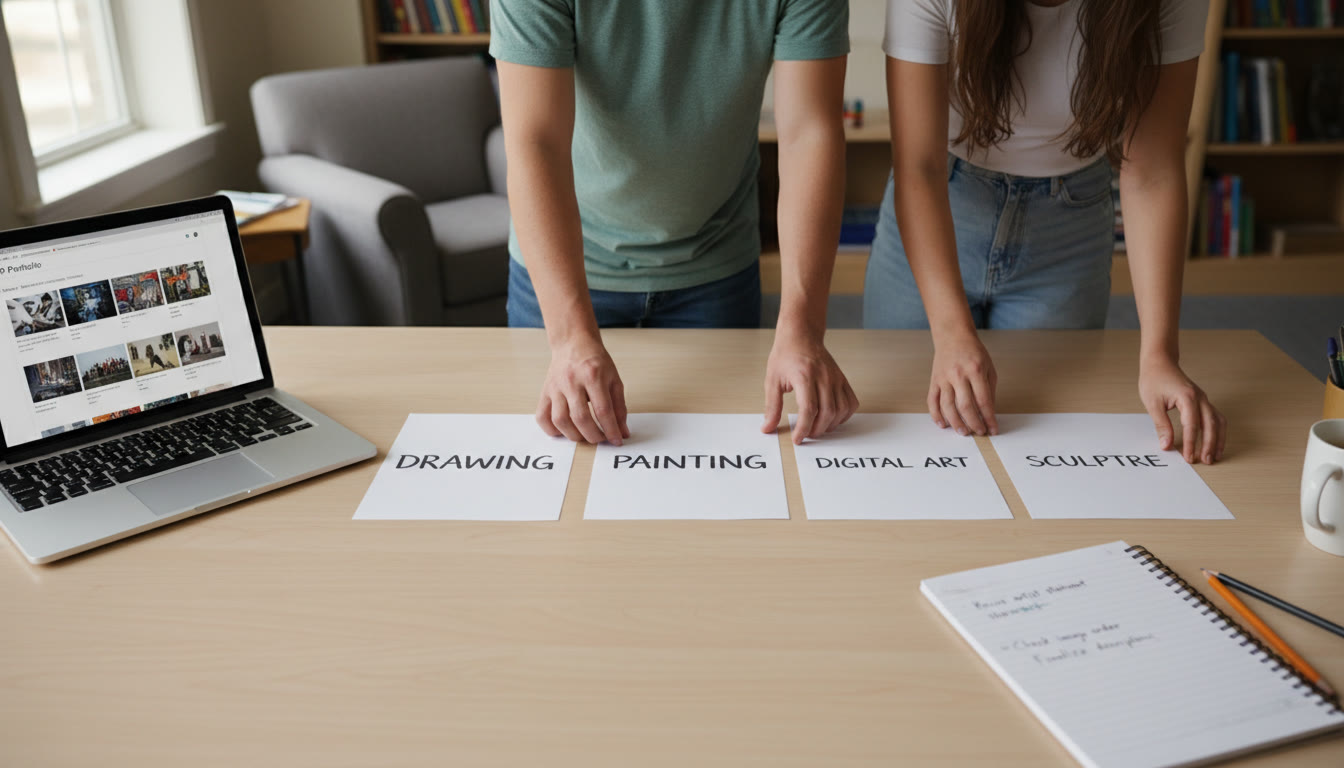
Curating five works is less about selecting the “best” in isolation and more about assembling a convincing argument about who you are. With clear intention, honest self-assessment, and careful presentation, those five pieces will speak louder than ten unfocused ones. Good luck—your best work is waiting to be told the right way.























No Comments
Leave a comment Cancel