

Two-Exam Week: Take a Breath — Then Follow a Plan
Two exams in one week can feel like a sudden storm: overwhelming, noisy, and impossible to get through without getting soaked. But storms pass. With a clear, practical plan for recovery and retention, you can not only survive that week — you can learn smarter and build study habits that stick.
This guide walks you through a focused, human-centered approach to tackle two AP-level science exams in a single week. It balances energy management, active review techniques, targeted practice, and sleep-friendly strategies, and shows where tailored help like Sparkl’s personalized tutoring can fit naturally into your prep.
Why a special plan for back-to-back exams?
Studying for two science exams at AP level (Bio, Chem, or Physics) isn’t just double the work — it’s a test of how your brain stores, retrieves, and consolidates complex concepts under time pressure. Without a plan you’ll likely bounce between topics, cram ineffectively, and lose retention. A two-exam plan helps you prioritize, avoid cognitive overload, and convert short-term memorization into durable understanding.
Principles That Guide This Plan
- Prioritize high-leverage topics: Not all content is equal. Focus on concepts that appear most often in free-response questions and that unlock other ideas.
- Active retrieval beats passive review: Practice recalling — don’t just reread notes.
- Spacing and interleaving: Alternate topics to strengthen retention and transfer.
- Energy management: Study windows timed to your peak focus and built-in recovery periods.
- Application over memorization: Practice applying ideas to unfamiliar setups — the hallmark of AP exams.
72-Hour Pre-Exam Framework (Adaptable for Two Exams)
When two exams fall within a week, you can use a rolling 72-hour framework for each test while overlapping review smartly. The schedule below assumes exams are separated by a few days; adapt timing based on your specific calendar.
| Time Window | Goal | Key Activities |
|---|---|---|
| 72–48 hours before | High-yield review + identify gaps | Target core units, do a timed practice section, list 6 weak spots |
| 48–24 hours before | Intensive correction + targeted practice | Work on weak spots, complete 1 FRQ or problem set, explain answers aloud |
| 24–6 hours before | Consolidation + light retrieval | Short active recall sessions, sleep-focused routine, light review of formulas and core models |
| 6 hours to exam start | Calm readiness | Quick checklist, mental warm-up, hydration, arrival plan |
How to overlap prep for both exams without burnout
When two subjects are different (say AP Biology and AP Chemistry), alternate study sessions so each subject gets concentrated time and then space to rest. For closely related subjects (e.g., Chemistry and Physics), use interleaving to reinforce shared analytical skills while preventing content confusion.
- Morning: Focused deep work on Subject A (90–120 minutes).
- Afternoon: Lighter, active retrieval for Subject B (45–60 minutes).
- Evening: Review flashcards or summary sheets for both — short bursts, 20–30 minutes each.
Concrete Study Blocks and Techniques
1. The 50/10 Block — Deep Focus, Planned Breaks
Work for 50 minutes, break for 10. During the 50, pick one clear objective (solve 8 AP-style problems on equilibrium, or explain Mendelian crosses). During the 10, move, hydrate, and briefly jot any lingering questions.
2. Active Retrieval Sets
Instead of rereading chapters, close the book and write out answers to likely questions. Examples:
- Explain the steps of cellular respiration and where ATP yield differences arise.
- Derive the expression for equilibrium constant from reaction quotient principles and apply it to sample problems.
- Sketch free-body diagrams quickly and list assumptions for motion problems.
Do at least 3 retrieval sets per day per subject during the 48-hour window before each exam.
3. Problem Sets with Intentional Mistake Analysis
Complete timed practice questions, mark mistakes, and spend double the time analyzing why an error happened. Write the incorrect thought next to the correct reasoning—this makes the correction stick.
4. Explain-It-To-Me-Aloud (aka Rubber Duck Teaching)
Teach a concept aloud for 5 minutes as if explaining to a classmate. Explain the logic chain and common misconceptions. If you stumble, that’s your next micro-topic to fix.
Sample 7-Day Micro-Schedule for Two Exams (Exam A: Day 5, Exam B: Day 7)
This example gives rhythm to your week. Adapt durations to your energy and school commitments.
| Day | Morning | Afternoon | Evening |
|---|---|---|---|
| Day 1 | Diagnostic: 45-min practice (Exam A) | Review diagnostic: list 6 gaps | Light review + flashcards (Exam B) |
| Day 2 | Targeted study 1 (Exam A high-yield topic) | Practice problems (Exam B) | Explain-It-Aloud (Exam A) |
| Day 3 | Targeted study 2 (Exam A) | Timed FRQ/Problems for Exam A | Correction analysis + flashcards |
| Day 4 | Light review (Exam A) + mental prep | Restorative activity (walk, short nap) | Final quick facts check for Exam A |
| Day 5 | Exam A — pre-exam warm-up | Recovery: brief rest + 20–30 min walk | Diagnostic: 30–45 min practice (Exam B to gauge next steps) |
| Day 6 | Targeted study (Exam B weak spots) | Timed FRQ/Problems for Exam B | Correction analysis + sparkl planning session if needed |
| Day 7 | Exam B — calm warm-up | Recovery and reflection | Rest and reward |
How to use this with limited time
If you only have 3 full days, compress the same cycle: diagnostic + 2 high-yield days + a day for consolidation and sleep. Prioritize question practice and targeted fixes over broad review.
Study Tools That Actually Help
- One-page concept sheets: Create a single-sheet summary for each major unit — formulas, key graphs, and 3 example problems with annotated solutions.
- Flashcards with a twist: Put the question on one side and the explanation (not just the answer) on the other; add a common misconception in small print.
- Timed practice sessions: Simulate exam conditions for sections of the test, not always the whole thing. Doing a perfect 60-minute section once is more helpful than aimlessly doing 200 untimed questions.
- Study partner swaps: Trade 10-minute mini-lessons on a topic each — teaching cements learning.
Nutrition, Sleep, and Brain Recovery
You can’t out-study poor sleep. Memory consolidation — turning short-term recall into long-term understanding — happens primarily during deep sleep and REM. In a two-exam week, prioritize quality sleep more than extra late-night cramming.
- Aim for 7–9 hours per night in the 48 hours before each exam.
- Use caffeine strategically: a small amount 60–90 minutes before a study session; avoid it after 2 p.m. if sleep is that night’s priority.
- Hydrate and favor protein with complex carbs before exam days to avoid energy crashes.
- Short naps (20–30 minutes) can boost alertness without blunting nighttime sleep.
Exam Day Routines—A Calm Checklist
- Arrive early with required materials and a plan for breaks.
- Before the exam, do a 10-minute mental warm-up: breathe, run through a concept map, and visualize answering questions logically.
- Skim the whole test quickly to allocate time, then attack items in a methodical order.
- If stuck, mark and move on — return with fresh eyes.

Active Retention Techniques for Science Subjects
Concept Mapping
Draw a concept map linking core principles (e.g., energy, equilibrium, systems thinking). The act of mapping helps you see how isolated facts interconnect — and makes transfer during FRQs much easier.
Worked Example Comparison
Take two solved problems on similar-looking topics and compare them side-by-side. Identify where assumptions differ, which formulas apply, and which steps change. This builds pattern recognition.
Predict-Explain-Check Cycle
Before solving a problem, predict the answer (even a rough direction), explain your reasoning in one sentence, then solve and check. The prediction step primes retrieval and makes your brain notice errors.
When and How to Use Personalized Tutoring (Sparkl’s Fit)
Not everyone needs a tutor, but when you do, make it precise and efficient. Sparkl’s personalized tutoring — 1-on-1 guidance, tailored study plans, and AI-driven insights — can be especially helpful when you:
- Have recurring weak spots across multiple topics (e.g., kinetics across Chem and Physics problems).
- Need efficient prioritization during a packed week and want a study plan that adapts to your practice performance.
- Benefit from expert modeling of FRQ answers and targeted exam strategies specific to AP scoring rubrics.
Example of a natural fit: book two short Sparkl sessions after your diagnostic — one to help interpret mistakes and craft a 48-hour targeted plan, and one the evening before the exam to build confidence with last-minute question strategies.
Quick Templates You Can Use Now
48-Hour Emergency Fix Template (Use when you have two days)
- Day 1 Morning: Diagnostic 40–60 minutes (timed) — identify 5 repeat errors.
- Day 1 Afternoon: Deep correction on top 2 errors (50/10 blocks).
- Day 1 Evening: Active recall + 20-minute light review.
- Day 2 Morning: Timed practice section for the same units.
- Day 2 Afternoon: Consult an expert/tutor or do a Teach-Back session.
- Day 2 Evening: Sleep-focused wind-down and flashcard review.
10-Minute Pre-Exam Warm-Up (Do it on the bus or 30 mins before)
- 1 minute: deep breathing and posture reset.
- 3 minutes: mentally list 3 key formulas or models.
- 3 minutes: quick retrieval questions (no notes). Example: List steps of oxidative phosphorylation, or sketch velocity vs. time for constant acceleration.
- 3 minutes: positive framing — one line about what you’ll do if you hit a hard question.
Common Pitfalls and How to Avoid Them
- Cramming without direction: Fix by doing a short diagnostic every day to guide micro-goals.
- Studying while exhausted: Use short, high-quality sessions or nap first; tired study often creates illusions of progress.
- Ignoring FRQ structure: Practice with the rubric in mind and aim for evidence-based answers.
- Over-reliance on passive notes: Convert notes to active tasks — problems, explanations, or concept maps.
Measuring Progress Without Obsession
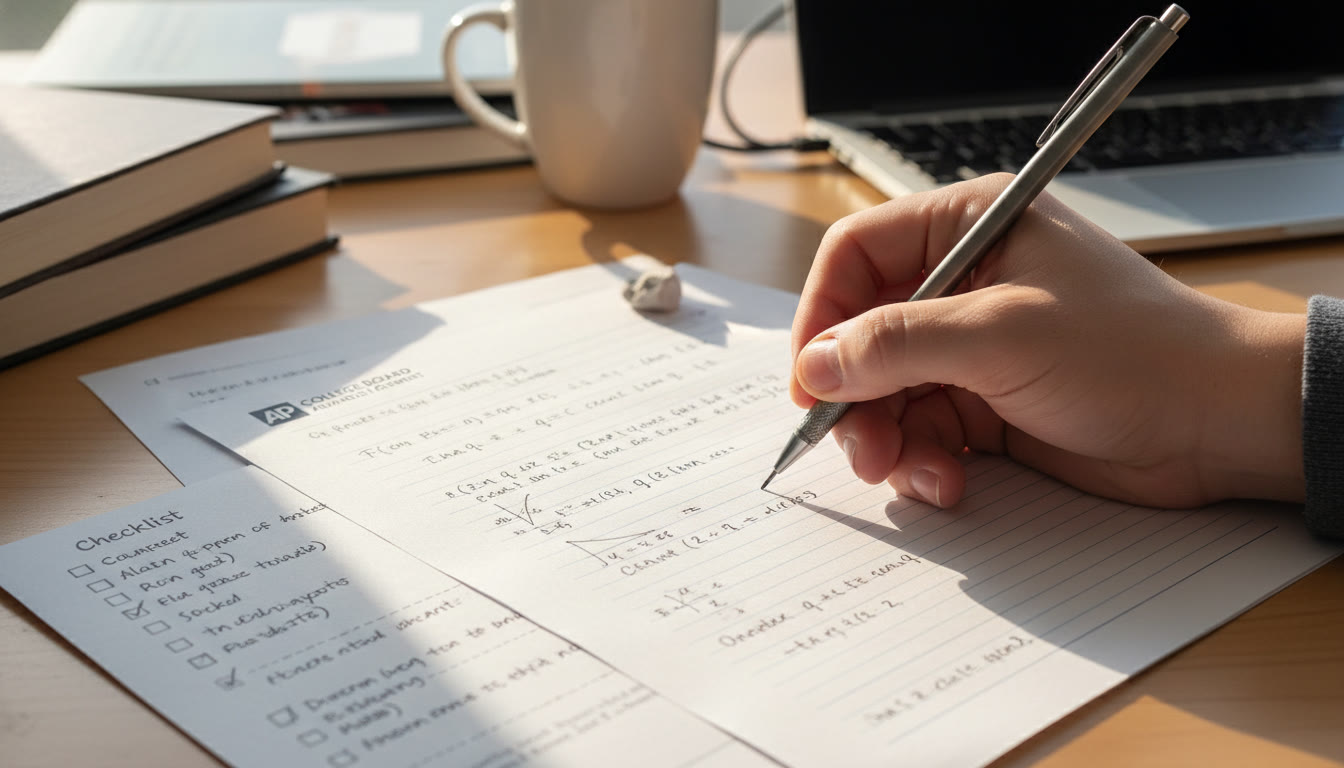
Progress isn’t just about raw scores. Track these metrics:
- Accuracy on targeted question types (e.g., free-response, multi-step problems).
- Time per question under simulated conditions.
- Qualitative confidence: can you explain the solution aloud without notes?
Create a simple table (daily) to track one metric per day — accuracy, time, or confidence — and watch for trends rather than obsessing over a single practice test.
After the Exams: Recovery and Retention
Once both exams are over, give yourself deliberate recovery: unplug for a day, do something creative, and then reintroduce low-pressure review. Retrieval spaced over weeks retains far more than a single massive sprint.
- Week 1 Post-Exams: Light review sessions (30 minutes, twice a week) to keep pathways active.
- Week 3–4 Post-Exams: Attempt a mixed practice set to test transfer and long-term retention.
Final Note — Make This Plan Yours
Two-exam weeks are stressful but also powerful opportunities to learn how you study best. Use the templates and techniques here as a framework — tweak session lengths, swap activities that fit your learning style, and scale up or down based on what works.
If you want targeted, actionable help, a few precision tutoring sessions (for example, with Sparkl’s expert tutors and AI-backed study plans) can shorten the feedback loop and make each study minute more effective. The goal is clarity, not exhaustion — to enter each exam calm, confident, and ready to show what you know.
Take a breath. Plan. Practice with purpose. And remember: exams measure a moment in time, but good habits last a lifetime.



























No Comments
Leave a comment Cancel