

Best Strategy to Score 99 Percentile in JEE Main
Welcome — what this guide will do for you
If you want the kind of plan that converts steady effort into a 99-percentile performance, this article is written for you: practical, human, and intentionally free of hype. You’ll get a clear mindset map, subject-level tactics for Physics, Chemistry and Mathematics, an evidence-driven approach to mocks and revision, and everyday routines that keep you sharp without burning out. Wherever you are in your preparation, these ideas are built to be adaptable — because getting to the top is less about magic and more about exactly where you spend your time and how you learn from every test.

First, understand what 99 percentile actually implies
Percentile is a relative rank, not a fixed mark. A 99 percentile means you scored better than 99 percent of test‑takers in the same exam session. Small raw-mark differences can separate percentiles at the top, so marginal gains — improving accuracy, avoiding silly mistakes, or solving one extra high-value question — can move you significantly upward.
That reality changes the game plan. Rather than trying to “cover everything vaguely,” aim to be exceptional on high-yield topics, ruthlessly reduce careless errors, and make every mock test a learning event. Consistency and precision beat last‑minute cramming.
Core principles that guide every decision
- Quality over quantity: deep, active practice beats passive hours.
- High-leverage topics first: identify subjects that give the most predictable returns and master them.
- Feedback loop: take a mock, analyze mistakes, fix root causes, repeat.
- Exam discipline: timing, negative-marking awareness, and interface familiarity (CBT etiquette) are non-negotiable.
- Personalization: your plan should be tuned to your strengths and recovery points, not an off-the-shelf schedule.
Blueprint: design your personalized study plan
Start by mapping strengths and weaknesses
Create a simple diagnostic: one full-length timed mock plus three short topic tests (one per subject). From that, tag topics as ‘strong’, ‘needs practice’, or ‘weak foundation.’ Your weekly plan should convert as many ‘weak foundation’ tags into ‘needs practice’ (foundation building) within three focused weeks.
Weekly effort table (sample guideline)
| Week Focus | Primary Goal | Hours per Week (guideline) | Expected Outcome |
|---|---|---|---|
| Foundation Repair | Close conceptual gaps | 25–35 | Convert weak topics to workable competence |
| Application & Problem Drill | Apply concepts in varied problems | 30–40 | Faster, more accurate solving |
| Mock Integration | Timed full tests + analysis | 20–30 | Improved test strategy and time sense |
| Revision & Consolidation | High-yield revision and retention | 20–25 | High recall under pressure |
How to prioritize topics (a pragmatic matrix)
Think in three buckets:
- High-weight, high-concept: master deeply (e.g., core calculus techniques, mechanics concepts, physical chemistry basics).
- High-weight, practice-heavy: drill problems until speed with accuracy is automatic (e.g., algebra, electrostatics problem-solving patterns).
- Low-weight, quick-win: tidy these up with short revisions or mnemonics (some bits of inorganic chemistry or straightforward geometry).
Note: JEE Main centers on Physics, Chemistry and Mathematics. If you also prepare for exams including Biology, schedule that separately so it does not dilute your PCM focus.
Practice strategy: make mocks your best teacher
Types of practice and how they fit together
- Full-length timed mocks (3-hour simulations): build stamina, strategy, and CBT familiarity.
- Subject-focused timed sections: train pace per subject and identify slow areas.
- Topic drills: 15–30 targeted questions on one idea to develop pattern recognition.
- Past-paper triage: identify recurring themes and common traps.
How to take a full-length mock
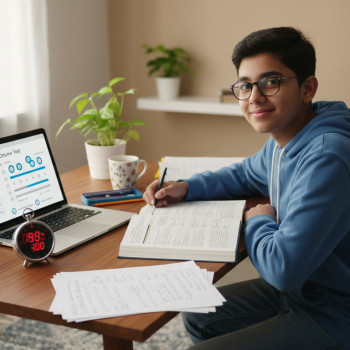
Simulate real exam conditions: strict three-hour timing, identical question order behavior, no phone, and a quiet room. Treat the mock like a real test — mark answers, manage rough work in a fixed corner of a notebook, and avoid mid-test internet searches. This trains both skill and composure.
Post-mock analysis: the three-step audit
- Immediate debrief: within 24 hours, list every question you got wrong and why (knowledge gap, silly mistake, time pressure, misread). Be brutally specific.
- Corrective action: for each cause, write a micro-plan (e.g., for careless errors: adopt a slow first-pass checking routine; for knowledge gaps: create a 2-day repair plan).
- Re-test focused areas: after the repair, take 10–15 targeted questions on the same topic to confirm the fix.
Smart attempt strategy and handling negative marking
Decision rules for attempting a question
Because wrong answers carry penalties, avoid blind guessing. Use this rule of thumb: if you can eliminate one or more options, your chance of a correct guess improves. Make attempt decisions based on confidence thresholds and the time-cost of continued work on that item.
One useful mental checklist when you see a question: (1) Do I recognize the concept? (2) Can I get a clear plan in under a minute? (3) Will attempting it now block me from three easier problems? If the answers are ‘yes, yes, no’ then go for it; otherwise mark and move.
Time allocation within a paper
- First pass: 60–70% of the paper time — solve questions you can do quickly and accurately.
- Second pass: address moderate-difficulty questions, using leftover time efficiently.
- Third pass: spent on high-difficulty remaining questions if time allows — be careful about last-minute guesses.
Subject-wise tactics
Physics — conceptual clarity + structured problem solving
Physics rewards conceptual understanding more than rote steps. Build clear free-body diagrams, identify conserved quantities, and translate words to formal relationships before manipulating equations. When you solve a problem, force yourself to explain the idea in a single sentence — that’s the mental model that sticks. For experimental or measurement questions, practice estimation and unit checks to reduce silly numerical errors.
Chemistry — balance memory with pattern recognition
Chemistry is threefold: physical, organic and inorganic. Physical chemistry is problem-based — strengthen math fluency and get comfortable with derivations and approximations. Organic chemistry rewards mechanism thinking and reaction-pattern recognition; practice synthesis routes and common transformations. Inorganic often demands recall; build compact notes and memory tricks for group-wise properties and key facts.
Mathematics — technique, shortcuts and error-free execution
Mathematics requires both problem recognition and flawless execution. Train algebraic manipulation, graph interpretation, and calculus identities until they are automatic. Avoid algebraic sloppiness; many errors come from sign mistakes or skipped steps. When possible, check answers with quick substitutions or boundary-value checks.

Revision techniques that stick
Active recall and spaced repetition
Passive rereading is the least efficient way to revise. Use flashcards for quick facts and short problems; use spaced repetition to revisit items on an expanding schedule. Every formula sheet should be one page per subject: you must be able to scan it in under two minutes and recall the derivation or use-case for each entry.
Error log and the “fix file”
Keep a dedicated notebook for mistakes. For every wrong question, write the exact cause, a corrected solution, and a one-line summary of how to avoid this in the future. Revisit the log weekly; errors tend to repeat unless actively stamped out.
Daily routine and micro-habits
- Morning: 60–90 minutes of fresh, hard problem-solving (your brain is best here).
- Afternoon: concept review, lighter tasks like reading or watching short concept videos if needed.
- Evening: timed practice or mock segments, followed by analysis of errors.
- Weekly: one full-length mock in realistic conditions and one deep revision day.
Micro-habits such as sleeping 7–8 hours, scheduled breaks, and a short daily mental warm-up before tests (5 minutes of breathing and focus) compound into far better performance than random long study sessions.
Using technology and personalized help wisely
Smart use of technology means tailored practice and data-driven feedback rather than endless video-watching. Personalized 1-on-1 guidance helps when your errors are systematic — a coach can spot patterns you miss and give targeted drills. Platforms that combine expert tutors, tailored study plans, and AI-driven insights can accelerate learning by showing which micro-skills to practice next based on your mock-performance trends. For students who benefit from that structure, Sparkl‘s approach to pairing tutors and personalized analytics is worth exploring as a complement to self-study.
How to pick what help you need
Ask three questions: (1) Is this a skill I can fix with 10–20 focused problems? (2) Do I repeatedly make the same mistake despite practice? (3) Will an external perspective speed up my recovery? If the answer to the last two is yes, a short period of expert guidance can cut months off the timeline.
Common mistakes top performers avoid
- Neglecting mock analysis — taking tests without learning from them.
- Studying every topic superficially instead of mastering high-yield areas.
- Over-relying on guessing when negative marking penalizes wild attempts.
- Letting small careless errors steal critical percentile points — simple checks reduce these greatly.
- Ignoring health and sleep; your speed and clarity decline sharply when tired.
Sample 30-day final-phase schedule (conceptual)
| Days Before Exam | Main Focus | Practice Type |
|---|---|---|
| 30–21 | Finish fixed revision and repair remaining weak topics | Targeted topic drills + 2 full mocks |
| 20–11 | Intensive mock phase and speed work | 3–4 full mocks with detailed analysis |
| 10–4 | Consolidate formulae, short revisions | Light mocks, error-log review, memory work |
| 3–1 | Relaxed review and sleep hygiene | Short practice sets, mental preparation |
Final exam-day checklist and discipline
- Familiarize yourself with the CBT interface before the exam: navigation buttons, marking for review, and on-screen clocks.
- Read instructions carefully; interface mistakes are avoidable and costly.
- Use rough work consistently in one area — don’t scatter notes across the desk; it slows you down.
- Keep calm: if panic hits mid-test, a breathing break for 30 seconds resets focus better than frantic guessing.
A realistic timeline to the 99 percentile
Everyone’s starting line and pace are different. A common path looks like this: diagnose honestly, spend several focused months repairing foundations and building speed, then spend a concentrated window using mocks to tune exam-day behavior. Progress is rarely linear; expect plateaus, then targeted interventions to break them.
Parting academic note
Scoring at the 99 percentile is an outcome of deliberate practice, smart prioritization, and disciplined exam habits. Concentrate on mastering high-leverage topics, make every mock a feedback instrument, and protect your clarity with good sleep and focused routines. Precision in execution — fewer careless errors, sharper time allocation, and disciplined mock-analysis — is the difference that turns strong effort into top-tier performance.




















No Comments
Leave a comment Cancel