

How to Handle Weeks With 4 Deadlines Calmly
There are weeks in the IB Diploma where the calendar feels stacked: the History IA draft, a Science lab write-up, a TOK presentation, and a math assignment all land in the same five days. If you’re reading this with a racing heart and a coffee cup in hand, take a breath—this is solvable. The trick isn’t frantic multi-tasking; it’s clarity, tiny steps, and a plan that respects both the demands of the Diploma and your brain’s need for rest.
This guide is written for students who are navigating the two-year IB journey and want a practical, calm playbook for those crunch weeks. Think of it as a compact roadmap you can apply immediately, and also fold into your broader two-year plan so those intense weeks happen less often over time.

Step 1 — Take stock: fast, honest, and complete
The first five minutes you spend after noticing the cluster of deadlines will determine whether the coming days are chaotic or controlled. Use this rapid checklist and be ruthless about details.
- List every deadline with exact wording: what must be submitted and where (file type, online portal, hard copy, presentation slot).
- Note the true due date and any school internal cut-offs (sometimes schools set earlier dates).
- Estimate how many hours each task will take—be generous. Add a small buffer for edits and tech hiccups.
- Identify dependencies: hand-ins that require feedback, experiments that need data collection, or group work that depends on someone else’s schedule.
- Mark the weighting or impact on your predicted grade (high/medium/low) so you know where to invest effort first.
Example snapshot you might create in five minutes:
- History IA draft — 8–10 hours — teacher feedback needed — high impact.
- Biology lab report — 4–6 hours — data ready — medium impact.
- Math problem set (HL) — 3–5 hours — practice focus — medium impact.
- TOK presentation slides — 2–3 hours — group check-in required — low/medium impact.
Step 2 — Estimate, chunk, and time-box
Large tasks feel scary because the brain imagines the whole mountain. Break every deadline into bite-sized, measurable chunks. For instance, instead of “finish History IA,” list: outline, find quote 1, find quote 2, write paragraph one, draft analysis, revise with rubric. Each chunk should be something you can finish in a single focused work block.
- Time-blocking: plan 1–3 focused blocks per day for high-priority work. Blocks of 50 minutes with 10-minute breaks often balance depth with recovery.
- Pomodoro as a tool: if you prefer shorter sprints, use 25/5 cycles, and combine cycles into longer sessions for deeper work.
- Use a simple visible timer and treat each block as a non-negotiable appointment.
Estimating effort will get better with practice. If you’re unsure, pick a conservative estimate and double it mentally for planning—overestimating gives you breathing room, underestimating creates panic.
Step 3 — Prioritise with context (not just urgency)
Not every deadline demands the same kind of attention. Prioritise by combining urgency with impact: deadlines that are both near and high-impact get top priority. This helps you avoid the trap of doing small, quick tasks while a heavy internal assessment sits unfinished.
Below is a simple table you can adapt for your own week. Fill it in from your Step 1 notes and you’ll have a clear, ranked order of attack.
| Deadline | Type | Estimated Hours | Priority | First Action |
|---|---|---|---|---|
| History IA draft | Internal assessment | 8–10 | High | Outline and collect two key extracts |
| Biology lab report | Lab write-up | 4–6 | Medium | Finish analysis table, write discussion |
| Math HL problem set | Practice/assignment | 3–5 | Medium | Complete three hardest questions first |
| TOK presentation slides | Oral/Group | 2–3 | Low/Medium | Finish slide deck outline |
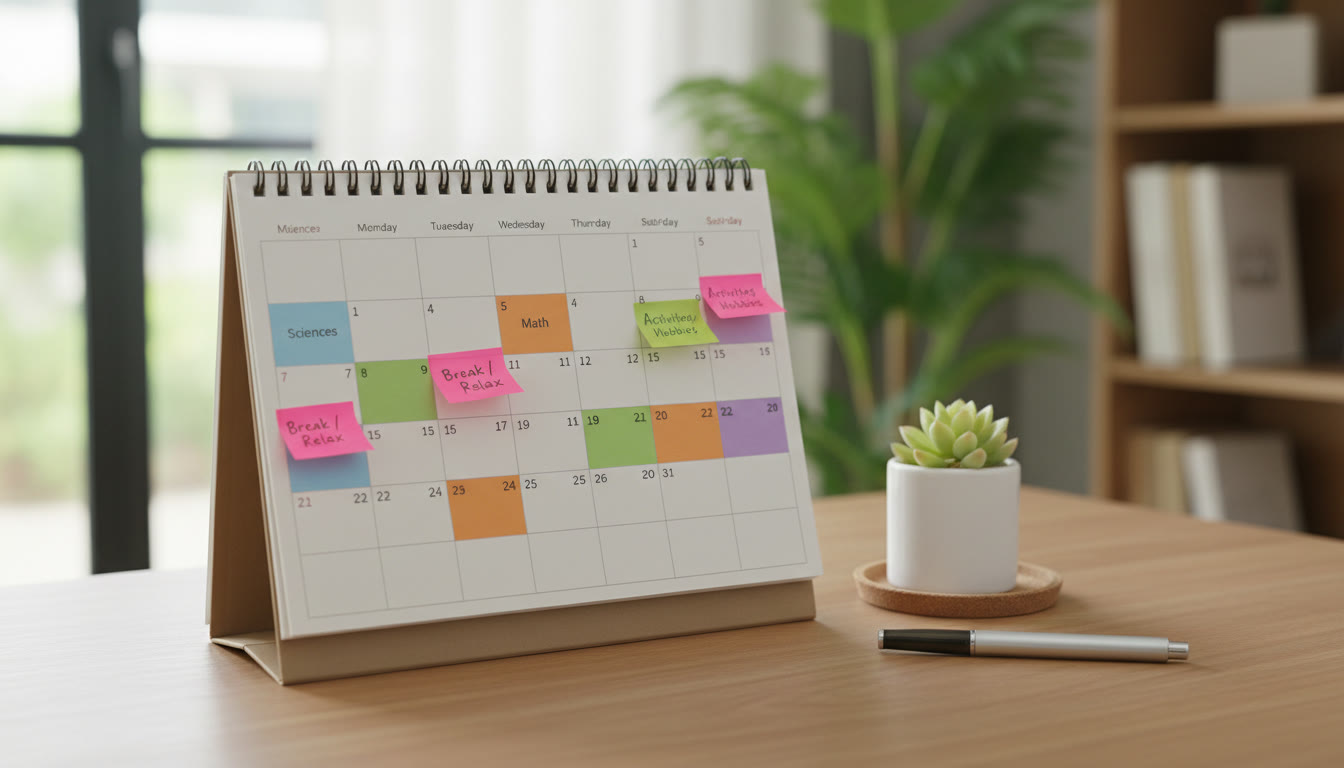
Step 4 — Build a realistic 7-day micro-plan
Now translate priorities into a simple day-by-day plan. Make sure each day contains one clear ‘win’—a chunk you can complete and tick off. Wins matter for momentum.
| Day | Morning | Afternoon | Evening | Mini-goal |
|---|---|---|---|---|
| Day 1 (Mon) | Outline History IA; gather extracts (2 blocks) | Do 1–2 Math HL problems (1 block) | Light review of Biology data | History outline complete |
| Day 2 (Tue) | Write History intro + paragraph 1 | Biology analysis table | TOK slide framework (group check-in) | History paragraph 1 drafted |
| Day 3 (Wed) | History paragraph 2 + evidence (1–2 blocks) | Math HL practice (timed) | Short walk and light review | Two body paragraphs written |
| Day 4 (Thu) | Complete History draft | Biology discussion write-up | Peer review History (if possible) | History draft ready for feedback |
| Day 5 (Fri) | Edit History with rubric | Finalize Biology report | Relaxing activity to recharge | Biology submitted |
| Day 6 (Sat) | Polish TOK slides & rehearse | Finish remaining Math questions | Buffer time for unexpected delays | TOK slides finalised |
| Day 7 (Sun) | Final proofread of History; prepare submission | Final pass on Math | Early night and sleep | All four deadlines complete |
This is an example — shift the blocks to match your personal rhythm. If you’re sharper in the evening, swap heavier work later. The key is that every task maps to a particular block and a mini-goal.
Step 5 — Tactical habits for the crunch
During the week, small process habits save enormous time and sanity. Treat these as tiny rules you follow automatically.
- Single-task fiercely: one block, one task. Avoid jumping mid-block.
- Batch administrative tasks (formatting, citations, slide design) into a single block so creative energy isn’t wasted.
- Use a submission checklist: file name format, rubric tick-list, mentor’s comments applied, backup copy saved.
- Keep communication short and scheduled: email teachers in one brief message or ask for a 10-minute slot instead of long chat threads.
- Carve an immovable recovery block each day—30–60 minutes that is non-study: walk, talk, or cook. It preserves focus for the next block.
Step 6 — Communicate with teachers and teammates clearly
When you’re juggling several major pieces of work, transparent, polite communication reduces friction. Teachers want to see progress, not panic—give them what they need.
- Be specific: “I’ll submit the History IA draft by Friday at 3pm. Could I have 20 minutes of your feedback during break on Friday?”
- If a group task is blocking you, propose a concrete alternative: “I can finish slides by Saturday if we meet for a 30-minute rehearsal on Sunday.”
- Ask for clarification early rather than guessing. A five-minute check can save hours of rework.
Step 7 — Protect sleep, nourishment, and short movement breaks
It’s tempting to trade sleep for work, but performance and long-term retention drop sharply with sleep loss. Keep these non-negotiables:
- Aim for continuous sleep when you can—short naps help but don’t replace consolidated rest.
- Fuel yourself: protein and whole carbohydrates sustain focus better than sugar binges.
- Schedule micro-movement: 5–10 minutes of stretching or a quick walk between blocks resets attention.
Step 8 — Use targeted help when it moves the needle
Sometimes progress stalls because you’re missing one piece of the puzzle: how to structure an argument, how to analyze a data set, or how to tighten math reasoning. Rather than grinding endlessly, get focused help for that exact problem.
For example, a short one-on-one session can turn an unclear paragraph into a clear argument or show how to visualise data quickly for a lab report. If you want personalised sessions, consider structured tutoring that offers 1-on-1 guidance, tailored study plans, expert tutors familiar with IB rubrics, and AI-driven insights to identify weak spots. Sparkl‘s approach often fits students who need a rapid steer without committing to long, unfocused study marathons.
Step 9 — The night-before and submission checklist
On the evening before each due date, run a short, strict checklist to avoid last-minute disasters:
- Open the file and scan for formatting errors: margins, headings, file name conventions.
- Check citations and references against the rubric’s academic honesty expectations.
- Export to the required format (PDF if requested) and ensure the file opens correctly on another device.
- Save at least two backups (cloud + local) and note the submission time so you’re not racing the portal at 11:59.
- If possible, submit early. “Submitted early” is an incredible stress-reducer.
Step 10 — After the week: reflect, file, and re-schedule
Once the week’s done, take a brief post-mortem. What consumed the most time? Which estimates were generous, which were optimistic? Capture two practical changes for your broader two-year roadmap:
- Shift large project milestones earlier. If the History IA cramped your schedule, add an earlier checkpoint in future cycles.
- Reserve recurring weekly blocks for long-term work—use them like insurance against future crunches.
- Record a short note to yourself: what worked, what didn’t, and one specific tool or habit you’ll keep next time.
Quick comparisons: what works for different students
Different brains thrive under different systems. Here’s a quick comparison so you can pick what to try first:
- Perfectionists: Time-box proofreading and set a hard stop—the first pass is for completion, the second for polish.
- Perennially behind: Add two small weekly wins to the start of your plan so momentum builds earlier.
- Group-reliant learners: Schedule short, frequent syncs with teammates and keep shared docs tidy.
- Deep-focus learners: Create longer morning blocks for heavyweight writing and protect them fiercely.
Real-world example — turning one frantic week into a steady two-year rhythm
Imagine a student who always faces four-deadline weeks because they postpone extended tasks until the final months. The long-term fix is to fold major assessments into the two-year roadmap early: split the EE into research, outline, first draft, and revision chunks across multiple months; schedule IA data collection well before draft deadlines; and treat TOK development as an ongoing conversation rather than a last-minute slide assembly. Over time, the distribution of work flattens and the frequency of crushing weeks decreases.
Final actionable checklist you can use right now
- List and rank all deadlines (5 minutes).
- Estimate hours and chunk tasks (15–30 minutes).
- Build a 7-day micro-plan with one clear win per day (15–20 minutes).
- Schedule two recovery blocks and one submission buffer.
- Book a short targeted help session for the single biggest blocker—if needed, get tailored 1-on-1 guidance to clear that bottleneck.
Weeks with several deadlines don’t have to define your IB experience. With a quick audit, sensible prioritisation, clear time blocks, respectful self-care, and targeted support when needed, you’ll find those weeks become manageable—and eventually less frequent as your two-year roadmap smooths the load. Finish the academic work, reflect on the process, and fold the lessons into your planning for the next cycle.























No Comments
Leave a comment Cancel