

Why realistic mock tests are the single most honest mirror for your JEE preparation
When you study on your own, every hour you spend should earn you clearer thinking, faster solving and fewer surprises on an exam day. That’s precisely where full-length mock tests shine: they are not just score-checks, they are training simulations that stress-test your knowledge, your timing and your nerves. Treat each mock like an experiment: run it under realistic conditions, collect data, iterate your study plan, and repeat.

Keep in mind the current exam-style reality: JEE-style testing is MCQ-focused, designed to be completed in roughly a three-hour window, includes negative marking for incorrect choices, and rewards both accuracy and smart time allocation. Because answers are judged as correct or incorrect for most items, partial-credit thinking doesn’t apply — so the way you attempt questions matters as much as whether you know the concept.
Designing a mock schedule that actually improves scores
A mock regimen for a self-learner must be progressive: start with a diagnostic, build frequency as weaknesses become clearer, and peak with fully realistic mocks as you approach the test window. The goal is to convert surprises into predictable performance gaps that you can close methodically.
A phase-wise mock plan (overview)
Below is a concise plan you can adapt to your remaining preparation time. Each phase focuses on a different objective — diagnosis, consolidation, speed, and stress-resilience. Treat the mock count as flexible: quality of analysis beats quantity of half-hearted attempts.
| Phase | Duration | Mocks per week | Primary focus | Outcome goal |
|---|---|---|---|---|
| Diagnostic | 1–2 cycles | 1 | Baseline skills, time profile | Clear map of strengths & weaknesses |
| Foundation consolidation | 2–4 cycles | 1–2 | Close conceptual gaps | Reduce careless errors, improve accuracy |
| Speed and strategy | 2–3 cycles | 2–3 | Pacing, question selection | Increase correct attempts without sacrificing accuracy |
| Peak simulation | Last few cycles | 2–4 (full tests) | Exam-day stamina and mindset | Stress-tested score consistency |
How often should you attempt full-length mocks?
- When starting self-study: one full-length mock every 7–10 days is a useful diagnostic tool.
- When you have steady study momentum: increase to 1–2 mocks per week, focusing each mock on a different pain area.
- Closer to the exam window: peak by taking realistic full-length mocks every 3–4 days, but only if you can do full analysis after each test. Avoid quantity without reflection.
Pre-test checklist: small rituals that shave off mistakes
Preparation before you press the timer is not just revision; it’s logistics. A few small rituals prevent avoidable loss of marks.
- Environment: replicate the exam environment — quiet room, same screen (if online), a chair and table similar to your real exam setup.
- Stationery and system checks: for paper mocks, prepare pencils, erasers and a watch; for online mocks, check browser settings, do a quick network test and close distractions.
- Formula sheet & quick notes: keep a one-page summary (only formulas, constants and tricky sign conventions) for revision the night before, but avoid last-minute cramming.
- Nutrition and sleep: a consistent sleep schedule and a light protein-rich breakfast will sustain focus for a three-hour window.
- Mindset warm-up: before the test, do 5–7 minutes of breathing or light stretching; run through one short numerical to get your brain into problem-mode.
During the mock: practical time-management and question-selection tactics
Think of the three-hour test as a project with three deliverables — speed, accuracy and stamina. Your playbook should aim to maximize expected score (not mere attempts).
First pass, second pass: a two-layer approach
- First pass (0–60% of time): sweep the paper quickly and mark the comfortable questions. Solve those first — easy points build confidence and reduce decision load later.
- Second pass (remaining time): tackle medium-to-hard questions, using time-boxes for each problem. If a question exceeds its time budget, flag it and move on — you can try it later with a fresh approach.
Smart selection beats brute force
Because most items are MCQs with negative marking, avoid blind guesses. Use elimination to increase success probability and convert high-confidence guesses into expected gains. If you can eliminate two distractors out of four choices, you’ve tilted the odds in your favor.
Practical timing guide (flexible)
Rather than locking time to individual questions, use proportional timing: allocate blocks of time to each subject based on your strengths and then subdivide. For many self-studiers, an adaptive split (start equal, then tilt more time toward the subject where you need extra attempts) works best.
After the mock: analysis that actually improves your next score
The post-mock analysis is where most self-study improvements happen. A disciplined analysis converts one mock’s pain into a month’s worth of better practice.
Immediate debrief (within an hour)
- Record your raw feelings: which sections felt rushed, which questions surprised you, where did the timer panic start?
- Don’t deep-dive immediately into solutions for mistakes; instead, flag the questions you will analyze later. Immediate calm helps more accurate recollections.
Detailed analysis (next 24–72 hours)
Use a simple mistake-log to turn errors into actionable tasks. Focus on categories: conceptual gaps, careless errors (misreads, arithmetic slips), strategy errors (wrong order, overattempt), and timeouts. Here’s a compact tracker you can copy into a notebook or spreadsheet.
| Date | Total Score | Physics | Chemistry | Mathematics | Attempts | Correct | Wrong | Accuracy | Key Mistake Types |
|---|---|---|---|---|---|---|---|---|---|
| Mock 1 | — | — | — | — | — | — | — | — | Conceptual / Careless / Timing |
For each wrong answer, write a two-line correction: one sentence on the root cause, one sentence on the fix (e.g., re-derive concept, practice 10 related problems, create a flashcard for a formula). Re-solve incorrectly answered questions after 48–72 hours without looking at the solution to test retention.
From data to hours: how to assign focused practice
After two or three mocks, you’ll have patterns: maybe a particular subtopic in Physics consistently fails, or careless arithmetic in Chemistry adds up. Convert pattern into practice hours: assign short, intense drills (20–40 focused problems) on the weak topic, followed by spaced repetition. Active practice beats passive reading.
Targeted drills and revision techniques that scale for self-study
Targeted practice is surgical, not blunt. Don’t try to re-learn whole subjects at once. Isolate the micro-skill and batch-practice until accuracy improves.
- Concept clinic: pick a recurring weak concept and write a short 5–7 step explanation in your own words; then solve progressively harder problems that apply that concept.
- Time-pressure drills: take 10 similar MCQs and solve them in a compressed time to build rapid recognition and elimination skills.
- Reverse-engineer solutions: for a solved problem, list the critical insight that converts a long approach into a quick trick; those insights are your speed boosters.
- Teach-back: explain a tough problem to a friend or to yourself aloud. Teaching exposes shaky understanding quickly.
If you find occasional outside support useful, Sparkl’s personalized tutoring can blend one-on-one guidance, tailored study plans, expert tutors and AI-driven insights to help structure targeted drills and accelerate recovery from persistent weaknesses.
Common mistakes self-studiers make (and how to avoid them)
- Confusing revision with practice: reviewing notes feels productive but solving tests under time pressure builds exam fitness. Balance both.
- Skipping analysis: a mock without post-mortem is a vanity metric. Record and act on errors immediately.
- Overattempting early: trying to solve every problem in sequence wastes high-value time. Prioritize low-hanging fruit first.
- Ignoring simulated exam conditions: small differences — a phone buzz or a noisy neighbor — can break concentration. Build tolerance by simulating distractions in practice.
- Neglecting mental stamina: a three-hour mock needs sustained focus. Build endurance gradually rather than attempting marathon efforts sporadically.
How to simulate OMR/answer-entry discipline
Even if the official exam uses an online interface, the discipline of careful answer entry applies. Practice transferring answers (paper-to-screen or vice versa), double-checking question numbers before marking and using the mock platform’s flagging features the same way you plan to use them on exam day.
Practical tools and habits that compound over time
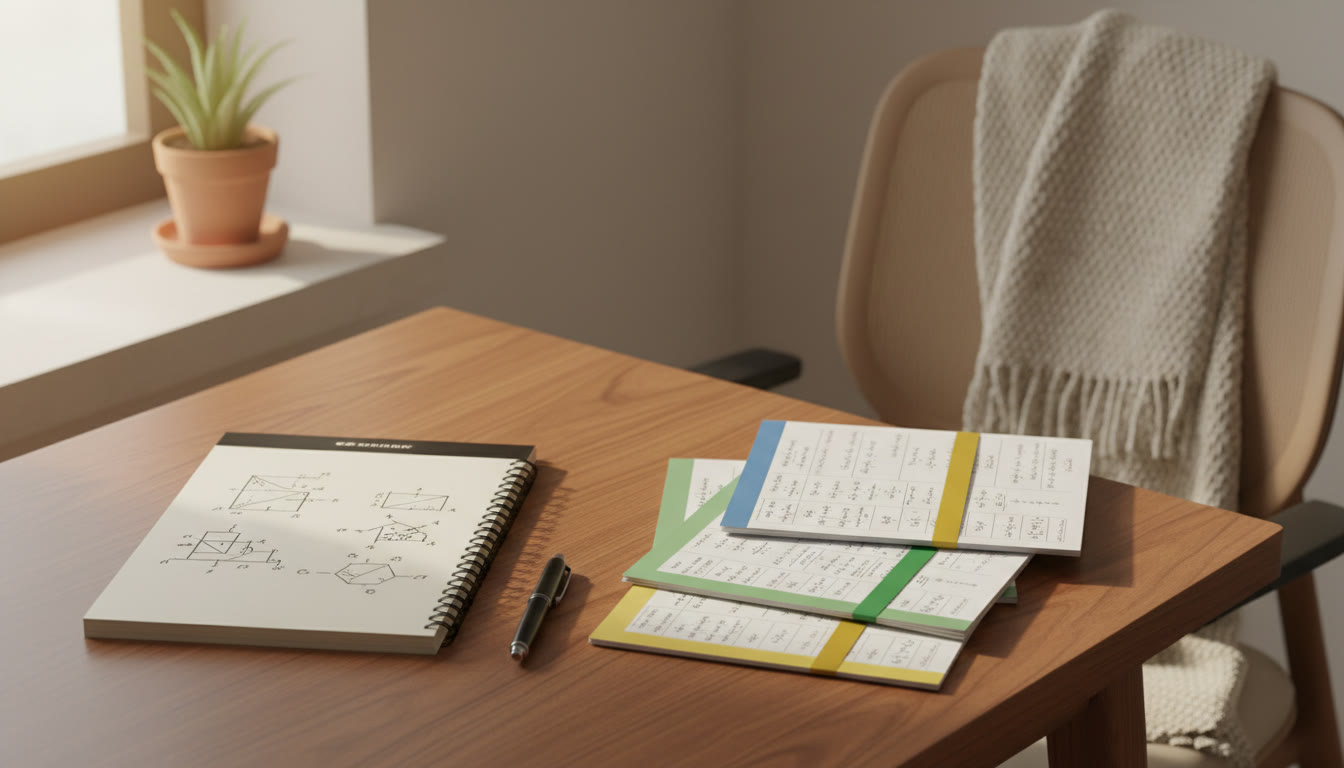
- Mistake notebook: a portable notebook containing just the questions you got wrong, with short corrections and a date-stamp for spaced repetition.
- Weekly review block: one 60–90 minute session per week to revisit the previous week’s mistakes and re-solve them under timed conditions.
- Mini-simulations: between full mocks, do 30–60 minute timed sections to sharpen speed on specific subjects.
- Data tracking: maintain a simple spreadsheet with mock scores and accuracy. Small trends reveal which subject deserves your next week’s focus.
How to interpret mock results without panic or overconfidence
Mental framing matters. A low score on a mock is information, not identity. Treat a poor mock as a prioritized shopping list of topics to work on. Likewise, a very high mock score is validation but not proof — confirm by repeating the same level of performance across two or three mocks rather than assuming consistency.
Use percentiles and trends, not single scores
Single-test volatility is normal. Look at the trend line across multiple mocks: are you improving in accuracy, keeping attempts steady, and closing time gaps? Those three signals together are stronger than any isolated number.
Sample micro-rules to follow during a mock
- Rule 1: Do not spend more than your allotted time on a question during the second pass — if stuck, flag and move on.
- Rule 2: Avoid blind guessing — use elimination or skip. When guessing, prefer questions where elimination yields >50% chance.
- Rule 3: Keep a single-sheet formula list for last-minute glance but resist rewriting long derivations at the last minute.
- Rule 4: When in doubt about a small calculation, reframe the question: is there a way to estimate or test options quickly rather than re-deriving everything?
Closing academic note
Consistent, well-analysed mock practice creates a virtuous loop: the better your analysis, the more targeted your practice; the more targeted your practice, the clearer your mocks become as diagnostic tools; and the clearer your diagnostics, the faster you close the gap between current performance and your target. Build that loop deliberately, and your self-study will convert mock tests from occasional exams into a reliable path for measurable improvement.



















No Comments
Leave a comment Cancel