

Why Mental Health Matters for NEET Aspirants
Preparing for NEET is more than memorizing facts and solving practice papers — it’s a sustained stretch of intense learning under time pressure. That combination makes mental health a core pillar of success, not an optional add-on. When your mind is steady, concepts stick, problem-solving becomes fluid, and exam-day decisions—like whether to attempt a tricky MCQ or to move on—are clearer.

The exam reality you should plan around
NEET is an MCQ-based test across Physics, Chemistry, and Biology. You’ll face a timed, full-length session that mirrors a three-hour mock in seriousness: every minute counts, negative marking punishes random guesses, and OMR discipline is part of the scorecard—sloppiness on the answer sheet can cost you marks even if you solved the question correctly. The syllabus is broad, and the test rewards accurate, practiced recall and smart time allocation rather than last-minute cramming or partial attempts at descriptive answers. Keep these realities visible while you structure your mental-health plan.
Top Mental Health Mistakes to Avoid
Below are the most common mental-health missteps aspirants make, explained in plain language and followed by practical fixes. Read them like checkpoints you can cross off as you build a calmer prep life.
Mistake 1 — Treating preparation like a sprint (Burnout)
It’s easy to fall into the trap of ‘all-nighters’ and marathon study stints after an off day. That approach temporarily increases hours but reduces the brain’s ability to encode information. Burnout shows up as fatigue, irritability, and slow recall—exactly the opposite of what you need on test day.
Quick fixes:
- Use the 52/17 rule or similar time rhythms: focused study blocks with scheduled short breaks.
- Schedule weekly light-days where you review casually rather than drill intensely.
- Replace one all-nighter per month with an organized revision day and sleep well the night before.
Mistake 2 — Sacrificing sleep for perceived study gains
Sleep is not the enemy of study; it is the stage where your brain organizes memory. Cutting sleep to study longer reduces retention, slows reaction time, and magnifies anxiety. For an MCQ-heavy exam where speed and clarity matter, sleep is an exam strategy in itself.
Practical habit: set a consistent wake-up and sleep time that supports 7–8 hours. Use short naps judiciously after intense sessions, not as a substitute for nightly rest.
Mistake 3 — Misusing mock tests (or avoiding them entirely)
Mists arise two ways: doing mocks as an endurance contest without review, or skipping full mocks because they ‘hurt’ your confidence. Both hurt your progress. A full three-hour mock simulates exam pressure, and disciplined review turns mistakes into durable learning.
How to get more from mocks:
- Simulate exact exam conditions: three-hour timer, OMR-style marking practice, silence, and no reference materials.
- After every mock, spend at least as much time reviewing as you spent taking it: identify reasoning errors, concept gaps, and time sinks.
- Track recurring mistakes in a simple error log and target three recurring types each week.
Mistake 4 — Obsessing over negative marking
Negative marking makes many aspirants freeze on unclear options, missing out on questions they could solve with elimination strategies. Panic over losing marks can paradoxically reduce accuracy, because indecision wastes time.
Better approach: train elimination techniques (cross out obviously wrong choices quickly), mark questions to revisit with a clear time budget, and practice educated guessing rules in mocks so that your risk decisions are data-driven, not emotional.
Mistake 5 — Comparing constantly with peers and scoreboard anxiety
Social comparison erodes confidence. Scrolling through success updates or hearing hourly progress reports from friends can create a moving target that distorts your own plan. That fuels perfectionism and paralysis—neither of which helps when you have to answer MCQs under time pressure.
How to shift: keep a private progress file. Compare today’s performance only to your own past performance. If you must compare, turn it into problem-solving: what worked for them that you can practically test in your routine?
Mistake 6 — Ignoring nutrition, movement, and basic self-care
Brains run on glucose, hydration, and circulation. Skipping balanced meals, staring at screens for hours, and never leaving the desk compounds stress and reduces mental agility. Light movement boosts focus and lowers anxiety far better than a second cup of coffee.
Simple wins: maintain a hydration bottle, include a protein-rich snack in study sessions, and schedule two short movement breaks (5–10 minutes) every study block.
Mistake 7 — Isolating and not asking for help
Many aspirants see asking for help as weakness. In reality, timely support—whether subject coaching or mental-health counseling—saves months of ineffective effort and prevents small worries from becoming big blockages.
If anxiety or mood changes interfere with study for weeks at a time, talk to a trusted mentor, counselor, or a qualified tutor who understands both NEET content and exam pressures.
Mistake 8 — Over-reliance on passive strategies (watching videos, re-reading notes)
Passive review feels productive but doesn’t create recall under pressure. MCQs reward retrieval practice—active recall, spaced repetition, and timed problem-solving—not endless passive exposure.
Turn passive moments into active gains: after a video, close your notes and write three questions you’d expect in an MCQ about that topic. Then solve related practice items under timed conditions.
Mistake 9 — Multitasking and poor time management
Switching tasks frequently fragments attention, making study sessions inefficient and exhausting. For exam preparation, concentrated focus on one topic, one question type, or one technique at a time yields better returns.
Practices that help: set named goals per block (e.g., “30 minutes: stoichiometry practice, 15 questions timed”), and keep your phone in another room during focused sessions.
Mistake 10 — Sticking to a plan that isn’t working
Clinging to a rigid plan because it feels ‘disciplined’ can be a form of emotional avoidance. If repeated checks show a strategy isn’t raising your scores, adapt. Flexibility is a mental-health advantage, not a failure.
Make adaptation structured: evaluate after every three mocks, identify two things to change, and test them for two weeks before deciding.
Common Mistakes at a Glance — Table of Problems and Fixes
| Mistake | Why it Hurts Your Prep | Quick Fix | Time to See Improvement |
|---|---|---|---|
| Burnout (All-night study) | Impaired consolidation and decision-making | Structured blocks + weekly rest/light day | 1–2 weeks |
| Poor mock strategy | No transfer of mistakes into learning | Strict simulation + dedicated review session | 2–4 weeks |
| Negative-marking fear | Time loss, indecision | Practice elimination and timed guessing rules | 3–4 mocks |
| Skipping sleep | Reduced recall and speed | Consistent sleep schedule (7–8 hrs) | 1 week |
| Isolation and not seeking help | Problems compound | Talk to a mentor/counselor; consider 1-on-1 support | Variable; immediate relief often possible |
Practical Routines: Daily Templates and Mock-Test Strategy
Routine reduces decision fatigue, and decision fatigue harms both mood and accuracy. Below are templates you can adapt. The idea is to build predictable structure so mental energy is spent on learning, not on organising the day.
Sample study day (balanced)
- Morning (2–3 hours): High-focus concepts or problem sets when your mind is fresh.
- Midday (1–1.5 hours): Lighter review, diagrams, or conceptual maps with a meal break.
- Afternoon (2 hours): Timed practice on MCQs, simulated OMR marking for short sections.
- Evening (1–2 hours): Consolidation and error-log work; finish with a relaxing, non-study activity.
How to treat a full three-hour mock
Treat every full-length mock as a rehearsal for the real event. That means:
- Set up a quiet, uninterrupted environment and keep a clock visible.
- Practice OMR discipline: if you use physical OMR sheets in practice, simulate shading speed and accuracy; if you use online interfaces, mimic the same movement and time pressure.
- Follow your intended exam-day strategy—how you budget time across subjects and when you mark & revisit questions.
- After finishing, relax for at least an hour before reviewing. A calm brain reviews mistakes more constructively than a reactive one.
When to Seek Help (and how tailored support can protect your mental health)
There’s a big difference between normal exam stress that we can manage with routines and persistent symptoms that need stronger support—uncontrolled panic, prolonged low mood, trouble functioning daily. If worries steadily reduce study quality despite changes to routine, seek qualified help.
Academic support that understands both content and stress management can shorten the distance between confusion and clarity. For personalized, subject-level guidance—1-on-1 mentorship, tailored study plans that slot around your mental-health needs, expert tutors who correct technique, and AI-driven insights that show weak topics—consider options that combine academic expertise with emotional support. One such pathway is Sparkl‘s blended offerings: bespoke plans, focused tutor time, and adaptive feedback that treats stress and learning as linked, not separate.
Mindset Shifts and Exam-Day Mental Tactics
Small mindset shifts protect performance more than big promises. Try these practical, test-centered strategies:
- Swap rumination for rehearsal: instead of worrying about possible failures, rehearse calm, constructive responses to things that might go wrong in the test (e.g., a hard patch of questions).
- Normalize imperfect mocks: a lower mock score is data, not destiny. Use the error log to make targeted corrections, then re-test the change.
- Use time-slicing on test day: allocate fixed minutes per question cluster and honor that limit—overrun only when the benefit clearly outweighs the time cost.
- Practice OMR discipline before the exam: small errors on answer sheets are avoidable with rehearsal. Time some practice runs dedicated solely to marking answers cleanly under pressure.
Sample time allocation for a 3-hour mock
| Section | Approx Minutes | Strategy |
|---|---|---|
| Biology | 80 | Attempt high-yield areas first; flag lengthy reasoning MCQs to revisit. |
| Chemistry | 50 | Split inorganic and organic time; quick elimination for options-based items. |
| Physics | 50 | Start with conceptual questions, then numerical problems; skip if algebra-heavy and revisit. |
| Buffer & OMR marking | 10 | Reserve final minutes to ensure answer-sheet accuracy. |
Practical Tips for Daily Mental Health Maintenance
Consistency matters more than intensity. Here are quick, low-effort habits with high mental-health ROI:
- Micro-breaks: 5 minutes every 45–60 minutes for movement and breathwork.
- Active recall first: a quick 10-minute recall session before passive review improves efficiency.
- Limit news and social media during peak study periods—set two short windows for updates so they don’t leak into study time.
- Keep a one-page ‘what-to-do-when’ list for exam day: breathing steps, time check routines, and an answer-sheet checklist.
Examples and Short Scenarios
Real examples make the guidance concrete. Here are two short, relatable scenarios and sensible responses:
Scenario A: The Mock That Crushed Confidence
After a mock, Riya’s score dropped sharply compared to her last attempt. She felt demoralized and nearly skipped the next mock. Instead, she focused on one category of mistakes—conceptual errors in genetics—and spent the next two weeks actively recalling and solving targeted MCQs. By the following mock, she regained confidence and improved her accuracy because she turned a broad panic into specific practice.
Scenario B: The OMR Slip
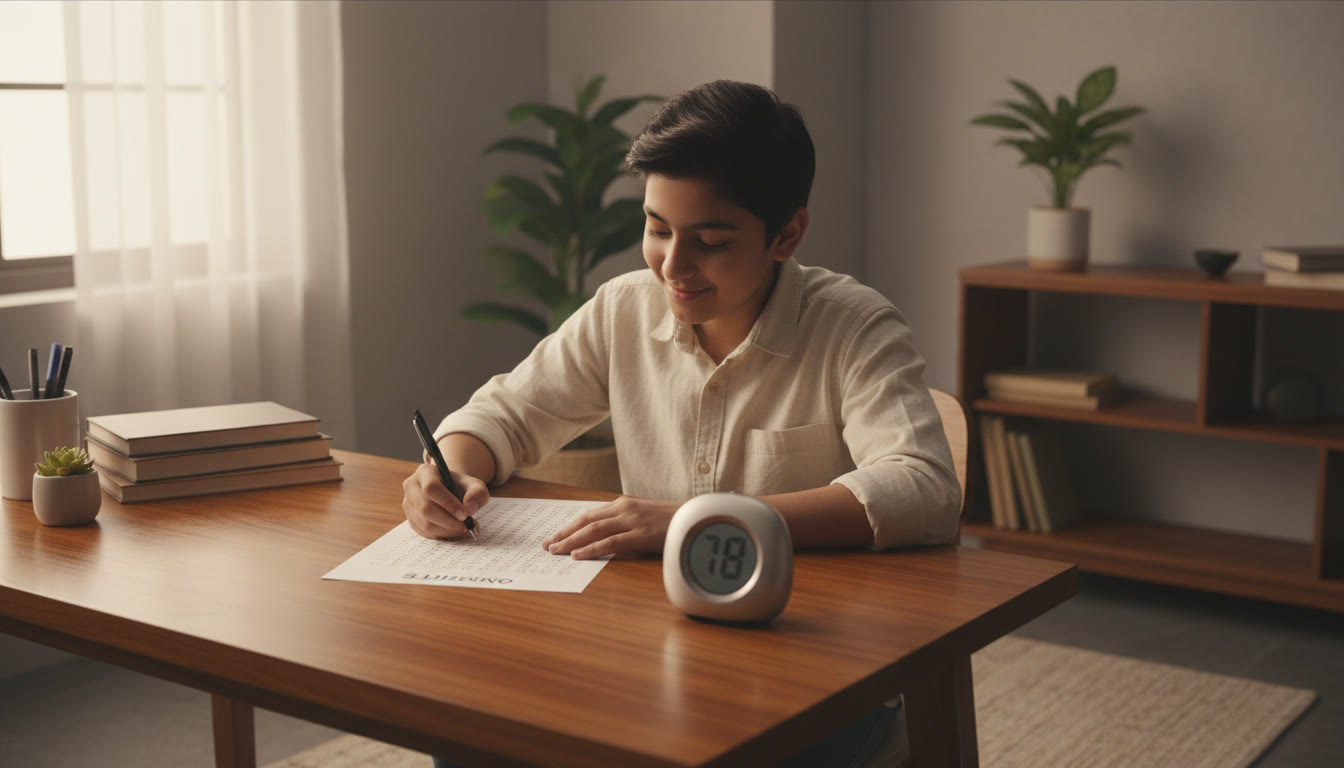
Arjun shaded answers hurriedly in a practice OMR and lost marks. The fix was procedural: he practiced shading 20 answers in a timed window daily and built a final-minute checklist: zero-based row check, double-check subject blocks, and a five-minute buffer. That procedural rehearsal removed the anxiety around answer-sheet mechanics on test day.
How to Track Progress Without Damaging Mental Health
Tracking is essential, but the method matters. Use simple, non-judgmental metrics that reflect learning rather than personality. Examples:
- Error-type frequency (how often does a specific mistake recur?)
- Time per question by topic (are you spending too long on a particular question type?)
- Weekly mood & energy log (one line: good/average/low and a note about cause)
Review metrics weekly and set one small, measurable goal for the next week. Small wins compound without the emotional whiplash of wild score swings.
Final Thoughts
Mental health in NEET preparation is a steady practice: guard sleep, structure mocks with honest review, train for OMR accuracy and negative-marking decisions, and convert panic into precise actions. Avoid isolation, favor active practice over passive repetition, and treat routine adaptation as a strategic strength. With consistent, calm habits and targeted corrective actions, you will protect both your well-being and your score.
















No Comments
Leave a comment Cancel