
IB DP What–How Series: How to Build One High-Impact Project While Surviving IB DP
Between Internal Assessments, Theory of Knowledge, the Extended Essay and the steady stream of assessments, the Diploma Programme can sometimes feel like a juggling act. Instead of scattering effort across many small activities, one focused, well-built project can produce the precise evidence admissions readers value: strong essays, a clear activities narrative, memorable interview answers and transferable artifacts for research assessments. This guide gives you a pragmatic road map to choose, design, document and schedule one high-impact project while protecting your grades and wellbeing.

Why one project beats many half-finished ones
On the surface a long activities list looks impressive. Admissions teams look deeper: they look for learning, consistency and evidence. A single sustained project shows curiosity over time, an ability to iterate, and depth of reflection. It also reduces context switching, which keeps stress manageable and makes your narrative more convincing when you write essays or answer interview questions.
- Coherent story: Admissions readers retain a clear trajectory when you can link an interest to sustained action and evidence.
- Multipurpose artifacts: Data, photos, and testimonials from one project can be adapted for essays, CAS reflections and presentations.
- Authenticity and reflection: Depth produces learning moments you can genuinely reflect upon, which admissions value even more than polished results.
What counts as high-impact in the DP
High-impact does not require public awards or large budgets. In this context, impact means measurable change, a documented learning process and ethical practice. Use the following checklist when evaluating ideas.
- Academic alignment: Connects to at least one subject area so it can inform an EE or IA.
- Clear metrics: Participation numbers, time invested, prototype iterations or pre/post measures.
- Reflection potential: Generates thoughts for TOK, personal statements and supervisor comments.
- Sustainability and ethics: Leaves behind resources, trained volunteers or documented improvements; respects participants.
- Evidence trail: Produces files, photos, signed testimonials and dated logs.
How to choose your single project
Step 1: interest audit
Start by listing three activities that consistently hold your attention outside class. Ask yourself: which topic would I still work on after a long school day? Which teacher or community member could advise me? Would this idea sustain attention for several months? Be honest about motivation; a project that began for the right reasons is easier to maintain.
Step 2: feasibility map
For each idea create a quick feasibility map with columns for resources, permissions, cost, and timeline flexibility. Note whether you need lab access, ethical consent, school approvals, community partners or funding. A great idea without a feasible path is a liability. If something looks risky, consider a scaled pilot that proves the concept quickly.
Step 3: application alignment
Think tactically about where the project will appear in your application. Could it become your EE topic, an IA case, a TOK real-life example, or the backbone of your personal statement? If it can fit at least two of those outputs, it multiplies your efficiency.
Designing the project skeleton
Define a research question and SMART objectives
Transform curiosity into a narrow, answerable question. Rather than aimless goals such as improving school wellbeing, try a focused question like how a peer-led workshop series affects a measurable skill over a semester. From that question write SMART objectives: specific, measurable, achievable, relevant and time-bound. These objectives turn muddled intentions into tasks you can track.
Methodology and academic rigor
Match methods to your question. If you are testing interventions use pre/post measures and control where possible. If your work is creative, document criteria for evaluation and audience response. Keep a dated project journal with steps taken, results and immediate reflections. For code or design work maintain version control with tagged commits; for outreach keep attendance sheets and signed consent where appropriate. These habits make your work defendable and much easier to translate into essays and presentations.
Real-world micro case studies
Concrete examples show how one project fuels many application elements. The names are illustrative and the details simplified, but the structure is what matters.
Case study A: Community tutoring initiative
Idea: Start a peer tutoring program to support younger students in mathematics.
- Design: Pilot a six-week after-school series, create short assessments for baseline and post-program measurement.
- Outputs: Attendance logs, pre/post test spreadsheets, feedback forms, a reflective report linking teaching methods to HL Math concepts.
- Application fit: Personal statement anchor, CAS evidence with logged hours and supervisor statement, potential EE on learning outcomes from peer instruction.
Case study B: Low-cost environmental sensor
Idea: Build and deploy a low-cost sensor to monitor local water quality.
- Design: Prototype in Design Technology or Physics, collect repeated samples, document calibration and error analysis.
- Outputs: Code repository, data spreadsheets, a poster presentation, local partner testimonial.
- Application fit: Technical Extended Essay, IA data to compare lab results, interview material that demonstrates problem-solving and technical communication.
Timeline and workload: a realistic roadmap
Clear phases reduce anxiety. Below is a practical template you can adapt to your calendar and school rhythm. The idea is to protect steady, manageable work rather than binge efforts.
| Phase | Goal | Duration (weeks) | Suggested hours/week | Key outputs |
|---|---|---|---|---|
| Exploration | Test ideas and secure buy-in | 2–4 | 3–5 | Project brief, supervisor sign-off |
| Planning & approvals | Design method and address risks | 2–4 | 3–5 | Detailed plan, consent forms |
| Implementation | Collect data or build the solution | 10–20 | 6–10 | Raw data, prototypes, event logs |
| Analysis & reflection | Interpret results and write reflections | 4–8 | 5–8 | Analysis report, reflective journal |
| Polish & presentation | Finalize deliverables and prepare materials | 2–4 | 3–5 | Final report, slides, media kit |
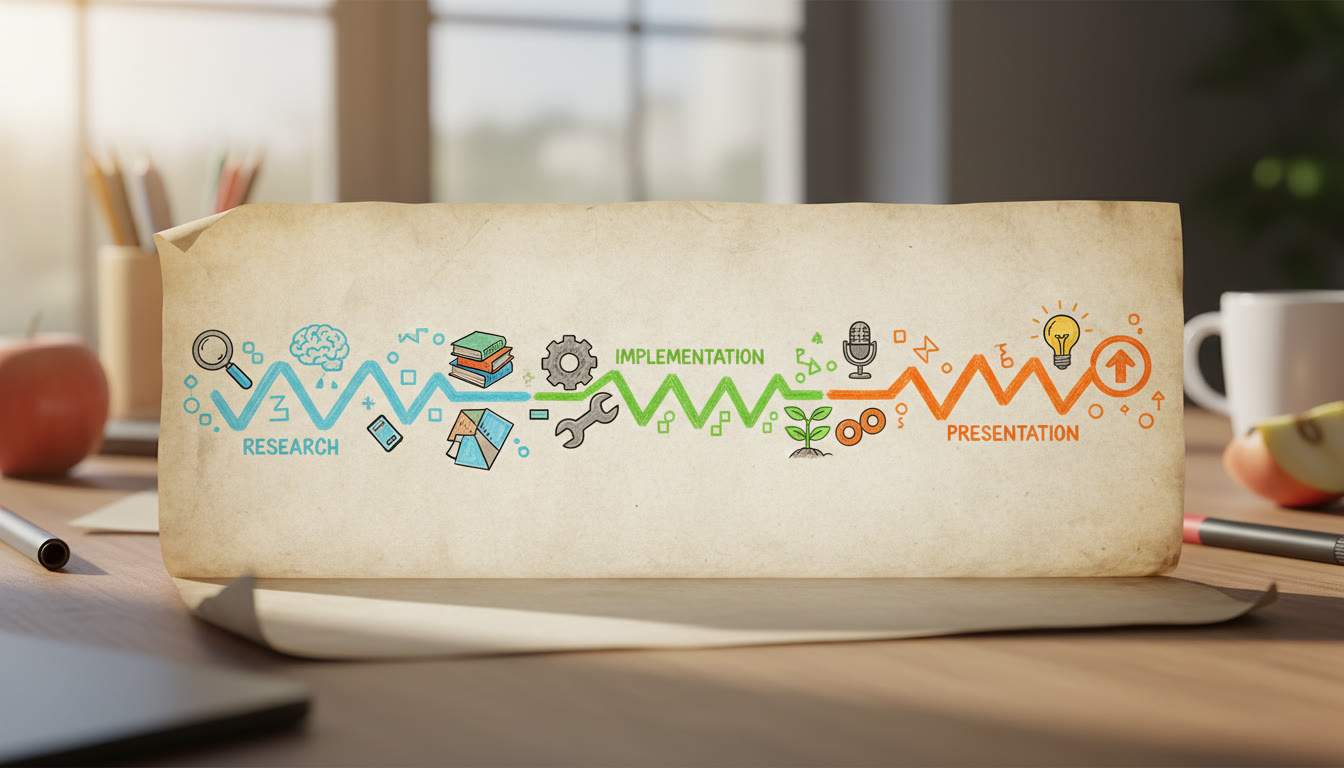
Adjust durations when exams approach: scale down new experiments and focus on documentation and reflection during heavy assessment periods. Short weekly check-ins with a supervisor are worth their weight in clarity; they prevent rework and keep your project aligned with DP academic expectations.
Turning the project into essays, activities and interview fuel
Essays: structure a memorable narrative
A strong essay uses the project as narrative scaffolding. Think of your essay as a small arc: hook, context, action, evidence and reflection. A vivid opening moment anchors the reader, but the most convincing essays demonstrate learning rather than summarize tasks. Use specific metrics and an honest reflection that links the experience to future academic interests.
- Hook: One concise scene or striking fact that opens the essay.
- Context: A sentence or two to situate the problem and your role.
- Action: What you designed, tested or led and why your choices mattered.
- Evidence: Quantitative or qualitative results, and one short direct quote or testimonial if available.
- Reflection: What the project taught you and how it connects to your academic aims.
Sample sentence starters to help you draft and iterate:
- Initial hook: I first noticed the problem when…
- Action shift: To address that, I designed a plan that…
- Outcome: As a result, we observed…
- Reflection: This taught me that rigorous inquiry requires…
Activities and CAS: document outcomes as you go
Tag each logged session with specific CAS outcomes and a one-sentence takeaway. Avoid vague entries like helped at an event. Instead write: co-led three workshops that increased participant test scores on basic numeracy by x points, with reflections on pedagogical adjustments. Keep a short evidence index that links each activity entry to one or two artifacts in your evidence folder.
Interviews: practice crisp, credible answers
Admissions interviews reward clarity and learning. Prepare a 60-second summary that explains the problem, your role and the result. Have a 3-minute expansion that includes one obstacle and what it taught you. Use concrete numbers and be ready to show your evidence folder if asked about specifics. When discussing setbacks, emphasize adaptation and insight rather than blame.
- One-minute answer: problem, your action, key outcome.
- Three-minute answer: same structure with an added obstacle and reflective insight.
- Practice with a mentor who can ask follow-up technical or ethical questions.
Documentation templates and index ideas
Build a short index document in your evidence folder with entries like the following to save time during applications and interviews.
- Project brief 01 2026: one-paragraph summary and link to plan
- Data sheet 03 15: raw measurements and cleaned file link
- Photo set A: process shots and before-after images with dates
- Supervisor statement: signed and dated note on role and contribution
- Reflection log: weekly 300-word entries with learning points
Use consistent file names that start with dates to make chronology obvious. Admissions readers appreciate clarity and reliability; an organized folder signals scholarly habits.
Academic integrity, consent and ethics
Do not fabricate or embellish results. For any human-centered work collect informed consent and anonymize data if required. When collaborating, be explicit about contributions and request brief partner statements where appropriate. Ethical practice increases the credibility of your claims and demonstrates responsible scholarship.
Common pitfalls and fixes
- Overambition: start with a minimal viable pilot, then scale once methods work.
- Poor documentation: set aside 10 minutes after each session to log progress.
- No supervisor feedback: schedule short, regular check-ins that focus on method and rigor.
- Failure to reflect: set up a weekly reflective prompt to capture learning while it is fresh.
- Misalignment with applications: periodically map project outputs to application elements so nothing is left as an afterthought.
Time management and surviving IB DP
Protecting your wellbeing is non negotiable. Use a single weekly slot for project work and treat it like a class. Break tasks into 45 to 90 minute focused blocks, and use a short weekly review to set the next micro-goal. If exams crowd your calendar, switch the project to maintenance mode: document, reflect and prepare artifacts rather than launching new experiments.
Where focused tutoring helps
Targeted coaching can unblock specific hurdles efficiently. For instance, Sparkl‘s personalized tutoring can provide one-on-one guidance, tailored study plans, expert feedback on methodology and mock interview practice. Use tutoring to refine statistical analysis, tighten essay structure or rehearse interview responses rather than as an open-ended time sink.
Sample email to a potential supervisor or community partner
Keep requests concise and evidence-focused. A short template you can adapt:
- Subject line: Request to discuss a student research / community partnership
- Opening: one sentence about your project idea and purpose
- Body: two brief paragraphs outlining methods, timeline and what you are asking
- Close: propose two short windows for a 20 minute meeting and attach the brief project outline
Final checklist before application season
- Assemble an evidence folder with a clear index and dated files.
- Write a 150 to 250 word project summary suitable for activity lists.
- Prepare 60 second and 3 minute oral summaries for interviews.
- Secure supervisor comments that describe your role and the outcomes.
- Quantify impact with conservative, verifiable figures and show sources.
- Cross-link project parts to the Extended Essay, IA or TOK where appropriate.
- Proofread all reflections for clarity and evidence alignment.
The Diploma Programme rewards depth, deliberate practice and honest reflection. By choosing one project that aligns with your curiosity and academic goals, designing it with measurable objectives, documenting process and results, and scheduling steady work into your school rhythm, you create a durable body of evidence for essays, CAS, interviews and research assessments. That single, well-executed project becomes not just an application asset but a meaningful demonstration of inquiry, resilience and intellectual growth.
















No Comments
Leave a comment Cancel