
Understanding the Connection Between Logic Games and SAT Prep
When people talk about “logic games,” many immediately picture puzzles on a rainy afternoon: colored blocks, matching patterns, or the classic grid-based puzzles you find in puzzle books. But beneath the fun lies a set of skills that map directly onto what the SAT rewards: clear reasoning, efficient information organization, flexible strategy, and calm handling of time pressure. If you’ve been prepping for the SAT and felt that a puzzle session helps you think better, there’s a good reason for it — logic games are not just entertainment; they’re practical training for the brain.
Why this matters for the SAT
The SAT tests how well you reason with words and numbers. It’s less about memorizing obscure formulas and more about demonstrating adaptive thinking: seeing structure, eliminating wrong choices, spotting shortcuts, and answering reliably under time constraints. Logic games develop these exact muscles. They force you to parse dense information, deduce consequences, and plan solution paths — all skills that transfer to the Reading, Writing & Language, and Math sections of the SAT.
What Are Logic Games — and What Skills Do They Train?
By “logic games” I mean structured puzzles that present a set of rules and ask you to deduce relationships that must be true, might be true, or cannot be true. Examples range from scheduling problems (who sits where?) to grouping puzzles (which items go together?) and sequencing challenges (what order must events occur?).
Core cognitive skills strengthened by logic games
- Information parsing: extracting relevant details from dense rule statements.
- Deduction: making guaranteed inferences and identifying impossibilities.
- Working memory: holding multiple constraints mentally while you explore options.
- Pattern recognition: spotting recurring structures or common setups.
- Planning and strategy: deciding whether to brute-force test cases or build a diagram and follow implications.
- Time management: pacing yourself through complexity without losing accuracy.
How These Skills Map to SAT Sections
Let’s be explicit: you’re not training specifically for SAT questions when you play a logic game, but you are strengthening transferable reasoning skills. The table below shows practical overlaps.
| Logic-Game Skill | Relevant SAT Section | How it helps |
|---|---|---|
| Parsing complex rule sets | Reading: dense passages; Writing: sentence logic | Improves ability to extract main ideas and detect contradictions quickly. |
| Making strict deductions | Math: problem setup; Writing: grammar logic | Leads to confident elimination of incorrect answers and avoidance of traps. |
| Diagramming and visualization | Math: geometry/algebra; Reading: passage structure | Helps translate word problems into structured representations. |
| Working under time pressure | All sections | Teaches pacing strategies and quick prioritization of questions. |
| Testing hypothetical cases | Math: multiple method checks; Reading: author’s viewpoint analysis | Aids in verifying if an answer satisfies all constraints before selecting it. |
Concrete Ways Logic Games Improve SAT Performance
Let’s move from theory to practice. Here are concrete improvements students report and educators observe after regular logic-game practice.
Faster, cleaner reading of dense information
Logic games train you to read rule-heavy text with intention. Instead of skimming and guessing, you learn to isolate variables and mark what matters. On the SAT, that translates to fewer re-reads of passages and fewer misread questions.
Better answer elimination
Puzzle practice teaches you to see why certain options cannot be true. On the SAT, this habit reduces guesswork. Even if you can’t fully solve a problem, you can often eliminate two or three wrong choices, improving your chances of selecting the right one.
Improved diagramming and setup for math problems
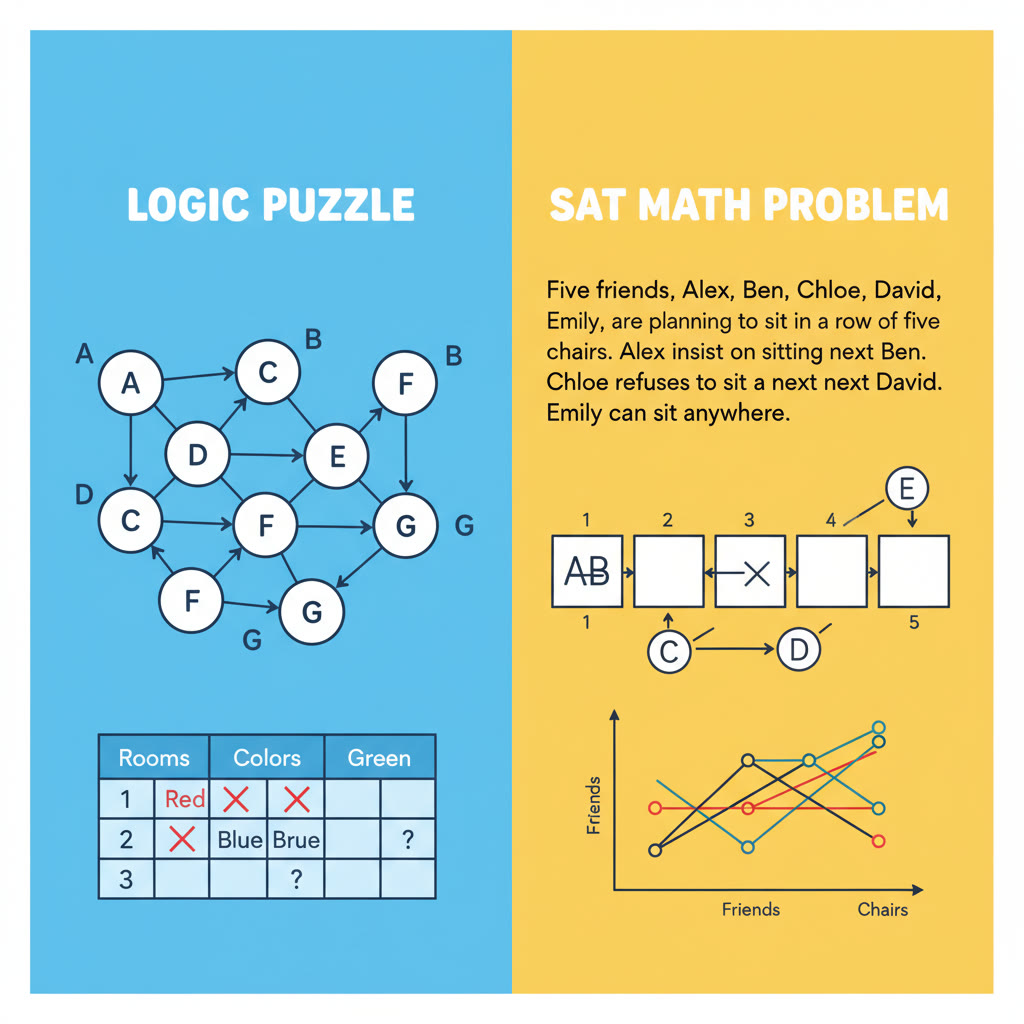
Many SAT math items are ultimately word problems. Logic games habituate you to converting sentences into diagrams — timelines, charts, or variable diagrams — so you enter the mathematical part already organized. Time saved in setup often yields time for checking work.
Steadier nerves and better time control
Facing a well-crafted logic puzzle is a low-stakes exercise in discipline: you sometimes need to resist the urge to jump at an alluring but incorrect path. This patience carries over; during the SAT you’re less likely to panic on a tough question and more likely to apply a calm, methodical approach.
Practical Drills: How to Incorporate Logic Games into SAT Study
Here are study methods you can adopt today. These are designed to be practical, measurable, and repeatable.
Daily 20-minute puzzle sessions
- Spend 20 minutes on a single logic game, alternating between faster solves and deeper analysis days.
- On fast days, aim for speed and note which steps slow you down.
- On analysis days, re-solve the game trying alternate strategies and annotate your reasoning.
Translate practice problems into diagrammed steps
Take 5 SAT math or reading problems and force yourself to produce a diagram or flow chart for each. Time yourself on the first attempt, then redo without time pressure to refine your diagrams. Over weeks you’ll see the diagram step become quicker and more accurate.
Case testing as a math-check technique
In logic games, you often test hypothetical cases to see which assumptions survive. Apply the same idea to algebra or word problems: plug in simple numbers for variables to detect mistakes or verify expressions quickly.
Sample 6-Week Plan: Integrating Logic Games with SAT Prep
This sample plan balances puzzle practice with section-specific study so you keep improving in transferable skills while covering the content the test requires.
| Week | Logic-Game Focus | SAT Work |
|---|---|---|
| 1 | Grouping and simple sequencing — daily 20 min | Diagnostic test; review weak question types |
| 2 | Conditional rules and deduction — daily 25 min | Math fundamentals (algebra/rates); diagram word problems |
| 3 | Multi-layer games (mixing sequencing and grouping) | Reading: practice passage strategies and vocab in context |
| 4 | Timed drills — 2 games in 30 minutes | Writing & Language: grammar rules and sentence logic |
| 5 | Advanced pattern recognition and diagram refinement | Full practice test under timed conditions |
| 6 | Review weakest game types and speed work | Targeted review of missed problems; test-day strategies |
An Example Walkthrough: From Logic Game to SAT Problem
Let’s walk through a short example to make transfer concrete. Suppose you have a logic game with five speakers: A, B, C, D, E, scheduled across five different time slots. Rules might say: “B speaks before C; exactly two speakers speak between A and D; E does not speak first.” You’d quickly sketch a timeline, mark anchor points, and test placements mentally — then derive which positions are possible for each speaker.
Apply that same process to this SAT-style math word problem
“A publisher releases books in sets. If 3 books are released in the first month and each subsequent month they release 2 more than the month before, how many books are released in the 6th month?”
Instead of plunging into algebra immediately, you can list the sequence: 3, 5, 7, 9, 11, 13 — a simple timeline. The 6th month number is 13. That quick sequence-writing mirrors what you do in a sequencing logic game: set up the format, fill the slots, and read off the answer.
Common Pitfalls and How Logic Games Help Avoid Them
Understanding where test-takers commonly trip up helps you avoid the same mistakes. Here are three big pitfalls and the logic-game antidote.
Pitfall: Jumping to equations or answers too quickly
New test-takers often grab for formulas before understanding relationships. Logic games encourage a slower initial step: map the constraints, then act. That habit prevents premature algebra or misapplied grammar rules.
Pitfall: Poor time allocation
Students sometimes invest too much time in one problem. Practicing short logic-game drills trains you to recognize when a problem demands more effort and when to move on. Over time you build a personal sense of timing that’s crucial on test day.
Pitfall: Failing to check special cases
Some SAT problems hinge on exceptions — think “unless” or “except” in wording. Logic games train you to test edge cases systematically so you don’t accept answers that only work under certain hidden assumptions.
Measuring Progress: Metrics that Actually Mean Something
Improvement is measurable. Keep a short log with three metrics after each practice session: accuracy, time per question, and confidence. Over four weeks you should see accuracy climb, average time drop, and confidence become more stable even on harder problems.
- Accuracy: percentage of correct answers in a timed set.
- Speed: average time to reach a confident answer (even if not finished).
- Confidence: subjective rating 1–5; useful to track anxiety reduction.
How Personalized Tutoring (Yes — Sparkl!) Fits Naturally
Some learners thrive solo; others need a navigator. That’s where personalized tutoring makes the difference. Sparkl’s personalized tutoring can integrate logic-game practice into a tailored plan: 1-on-1 guidance to identify weaknesses, tailored study plans that mix puzzles and SAT content, expert tutors who model effective diagramming, and AI-driven insights that highlight patterns in your mistakes. That kind of fit-and-fix approach takes the guesswork out of your practice schedule and accelerates improvement.
What to expect from a guided approach
- Initial diagnostic to identify which logic-game skills transfer most strongly to your SAT gaps.
- Customized drills that balance speed work and deep reasoning.
- Regular reviews using AI-driven insights to focus your next practice cycle.
Quick Practice Pack: Ten Mini-Exercises
Here are ten bite-sized exercises you can do in 10–30 minutes. They’re meant to be quick shots of transferable practice.
- 1-minute diagram: convert one paragraph of a math word problem into a timeline or chart.
- 3-minute elimination: take a multiple-choice Reading question and eliminate two answers with reasoned deduction.
- 10-minute speed game: complete one short logic game focusing on completing the setup in under 10 minutes.
- 5-minute hypothetical test: pick an algebra expression and plug in easy numbers to check answers.
- 15-minute mixed set: 5 reading items, 5 math items; record time and accuracy.
- 7-minute backwards check: after solving a problem, reverse the steps to see if your answer still fits all constraints.
- 4-minute vocabulary in context: identify the precise meaning of a single tricky word in one sentence.
- 8-minute grammar logic: diagram a sentence to reveal which clause a comma modifies.
- 12-minute pacing drill: simulate a mini-section of the SAT and force one-minute checks every five questions.
- 6-minute reflection: write down exactly what slowed you down and one concrete change for next time.
Final Thoughts: Playfully Serious Practice
Logic games are deceptively playful. They let you practice concentrated reasoning in a context free from many test-day anxieties. The rewards are practical: better parsing of SAT passages, cleaner setups on math problems, stronger elimination instincts, and steadier timing. If you build a consistent practice habit and integrate those sessions with focused SAT content study, you’ll likely see measurable improvements.
If you want structure, pairing your personal practice with guidance makes a difference. Sparkl’s personalized tutoring can help weave logic-game practice into a tailored plan that fits your schedule and addresses your unique weaknesses. The combination of playful practice and targeted instruction is a potent recipe for progress.
Quick checklist before your next practice session
- Decide whether today is a speed day or analysis day.
- Pick a focused 20–30 minute block and eliminate distractions.
- Keep a notebook for diagrams, not just final answers.
- Record one measurable metric: accuracy, time, or confidence.
- Reflect for five minutes: what changed and what you’ll try next time.

Parting Advice
Think of logic games as a gym for your reasoning muscles. Short, deliberate practice builds endurance, clarity, and tactical flexibility — qualities that the SAT tests in different clothes. Keep the practice playful but purposeful: set clear goals, measure progress, and adapt. Whether you go it alone or bring in personalized tutoring, the steady application of these techniques will make the test feel less like a guessing game and more like a familiar puzzle you know how to solve.
Good luck, and enjoy the process. The best test prep is the kind that teaches you to enjoy thinking better — both on test day and beyond.






















No Comments
Leave a comment Cancel