
From Classroom Equations to SAT Confidence: Why School Math Matters
It’s tempting to think of school math and SAT Math as two different beasts. One lives in your homework binder, the other on a high-stakes test bubble sheet. But the truth is simpler and more encouraging: the math you do every day in class is the very foundation of SAT success. This post walks through that connection—how school topics map to SAT question types, practical ways to use classroom work as SAT practice, and smart habits to turn knowledge into speed and accuracy on test day.
What the SAT Math Section Actually Tests
Before we connect classroom topics to the exam, let’s quickly review the structure you’ll face. The SAT math content is built around a handful of core areas:
- Algebra (linear equations, inequalities, systems)
- Advanced math (functions, quadratic and higher-degree equations)
- Problem solving and data analysis (ratios, percentages, statistics, interpreting graphs/tables)
- Geometry and trigonometry (angles, area, coordinate geometry, basic trig)
Typically the test includes a No-Calculator section and a Calculator-allowed section (historically 20 and 38 questions respectively, summing to 58). The scoring range for the Math section is 200–800. The important part is: you won’t need exotic math. You’ll need clear thinking and quick, reliable application of familiar ideas.
Big Idea: Skills Over Memorization
School math offers the content; the SAT demands fluency. That means:
- Knowing when to apply a concept (not just what it is).
- Turning word problems into equations swiftly.
- Using number sense to check reasonableness under time pressure.
Think of your classroom lessons as drills for pattern recognition. A teacher’s nightly algebra worksheet is practice identifying linear structure. A geometry proof builds spatial reasoning you’ll use on coordinate geometry problems. The connection is direct—if you practice with intention.
Mapping School Topics to SAT Question Types
The clearest way to see how classroom math helps is a topic-by-topic map. Below is a compact table linking common school lessons to the SAT question styles they prepare you for, plus a quick practice action you can take.
| School Topic | SAT Question Types | Practice Action |
|---|---|---|
| Linear equations & inequalities (Algebra I) | Function interpretation, linear models, solving for variables, word problems | Turn two real-life sentences into a single linear equation; solve and check with a number plug-in |
| Quadratics & polynomials (Algebra II) | Quadratic formula, factoring, graphs of parabolas, maximum/minimum problems | Practice factoring and use vertex form to answer max/min questions |
| Functions (notation, transformations) | Function composition, inverse relationship, rate of change | Sketch simple function transformations and verify outputs for sample inputs |
| Proportions, ratios, percentages | Mixture problems, scaling, percent increase/decrease | Convert a classroom word problem into ratio form and solve with unit analysis |
| Statistics & probability | Interpreting mean/median/mode, reading box plots, conditional probability | Create small data sets and practice computing summary statistics and interpreting graphs |
| Geometry (area, volume, angle relationships) | Coordinate geometry, figure properties, area/volume calculations | Translate geometric information into coordinates or algebraic expressions |
| Basic trigonometry | Right triangle trig, function values from angles, modeling periodic situations | Memorize common trig ratios and practice using them in right-triangle contexts |
Practical Ways to Use Classroom Work as SAT Training
Here are intentional moves you can make so homework becomes SAT prep—not just busywork.
1. Translate Word Problems into SAT-Style Equations
Many school word problems are simpler than SAT word problems, but the skill is the same: extract variables and relationships. When homework asks, “If Sarah has three more than twice the number of apples Joe has…” practice labeling variables (S = 2J + 3), solve, and then rephrase the solution in a sentence. On the SAT, practice like this speeds you up because the labeling becomes automatic.
2. Practice Small Steps Under Time
You don’t need to time every homework problem, but occasionally set a 5–8 minute window for 3–4 problems. This builds the muscle for fast reading, quick set-up, and smart estimation. Time practice also exposes the difference between careful classroom work and exam-ready speed: you’ll spot which steps you can shortcut safely.
3. Build a Formula Sheet from Class Notes
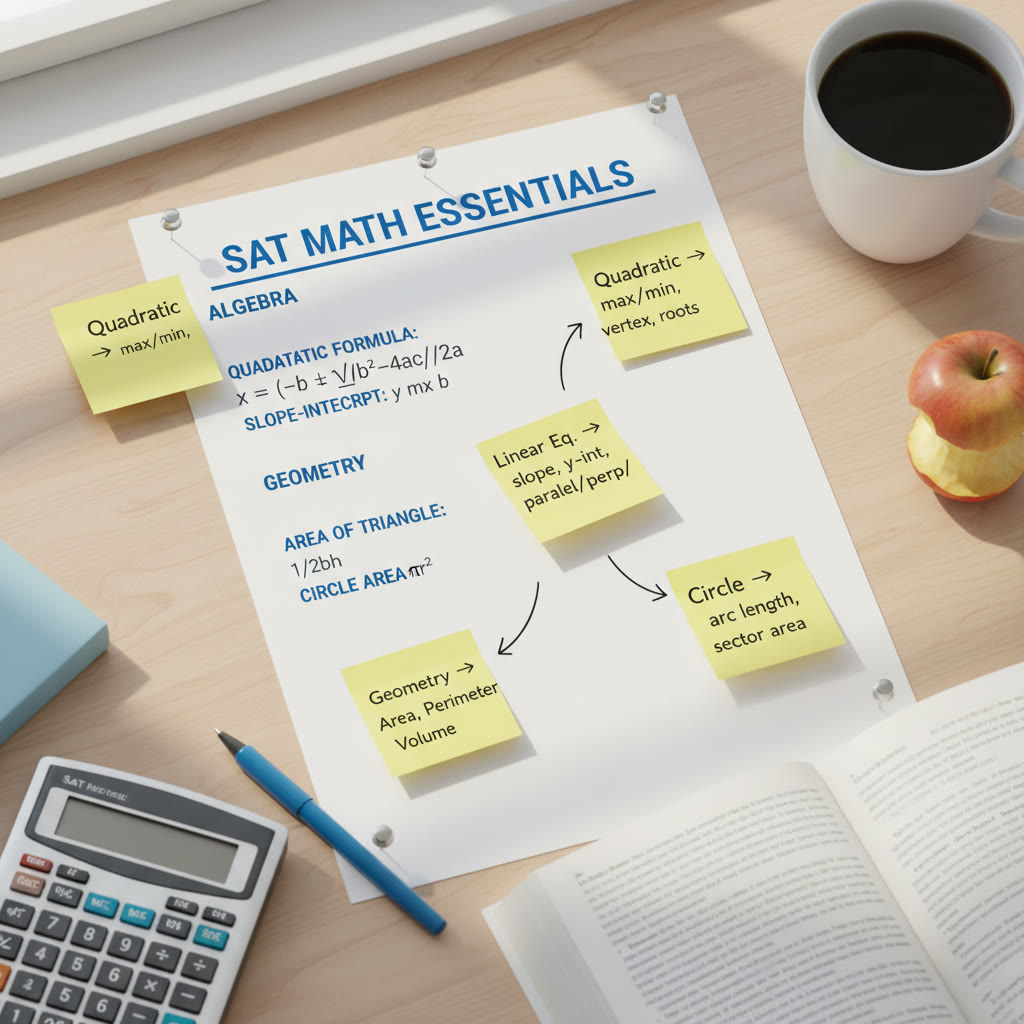
Rather than rote memorization, create a compact formula sheet from your class notes that you update weekly: distance-rate-time, quadratic formula, area formulas, common trig ratios, standard deviation formulas, and so on. Don’t just write formulas—add a one-line note on when to use each. This helps you move from passive memory to active use.
4. Convert Classroom Proofs into Shortcuts
Geometry proofs teach logical structure. On the SAT you rarely write full proofs, but the ability to chain relationships is essential. When you complete a proof in class, practice summarizing the key relationships in two lines. For example: if two chords in a circle intercept congruent arcs, their inscribed angles are equal—now ask, how could that reduce unknowns in a coordinate-geometry problem?
5. Use Mistakes as Targeted Practice
Instead of only redoing homework problems you got wrong, analyze why you got them wrong. Was it a careless arithmetic slip? Misread question? Missing step in algebra? Classifying mistakes converts random errors into predictable areas of focus—perfect for a tutoring session with a 1-on-1 mentor who can help correct the pattern.
Examples: Classroom to SAT — Worked Problems
Examples make the bridge concrete. Below are two short walk-throughs showing how a typical school lesson turns into an SAT approach.
Example 1: Algebra (Linear Modeling)
Class problem: “A phone plan charges a $15 monthly fee plus $0.07 per minute. If Sam’s monthly bill was $43.85, how many minutes did he use?”
Classroom set-up: Let m = minutes. 15 + 0.07m = 43.85. Solve: 0.07m = 28.85, m = 412.14 → likely 412 minutes, rounding if necessary.
SAT-style twist: “A company advertises a similar plan and shows a graph of cost vs. minutes. If the graph shows a linear relationship and passes through (0, 15) and (500, 50), which equation models the cost?”
Translation: slope = (50 – 15)/(500 – 0) = 35/500 = 0.07. Equation: C = 15 + 0.07m. That’s the same algebra but disguised graphically. Classroom experience with linear modeling makes the slope-intercept connection instant.
Example 2: Geometry (Coordinate Geometry)
Class problem: “Find the midpoint of the segment joining (2, -1) and (8, 5).” You compute ((2+8)/2, (-1+5)/2) = (5, 2).
SAT-style twist: “If the area of a rectangle with vertices at (2, -1), (8, -1), (8, 5), and (2, 5) is halved by connecting a diagonal, what are the coordinates of the center point that would act as the centroid for any sub-rectangle created by that diagonal?”
Translation: Recognize the center is the midpoint (5, 2), and halving the area is consistent with diagonal partitioning. Knowing midpoints and symmetry from class makes this almost immediate.
Smart Study Plan: Turning School Year into SAT Momentum
You don’t need to reinvent every night of study. Here’s a sample 8-week block that blends schoolwork with SAT practice. This schedule assumes you’re also attending class and doing assigned homework—these actions convert that work into test prep.
| Week | Focus | Weekly Actions |
|---|---|---|
| 1–2 | Foundations: linear equations, ratios, and algebra basics |
|
| 3–4 | Quadratics, functions, factoring |
|
| 5–6 | Geometry and coordinate geometry |
|
| 7–8 | Statistics, probability, mixed review |
|
Weekly Micro-Routine (daily 30–60 minutes)
- 15–30 minutes: school homework completed with SAT framing—label variables, note likely answer choices.
- 15–30 minutes: focused practice from an SAT question set (mixed topics), timed or untimed depending on the week.
Test-Day Strategies Rooted in Classroom Habits
Many classroom habits are directly useful on test day. Here are several to adopt.
1. Show Short Work, Not Long Proofs
When teachers ask for full reasoning, you write step-by-step proofs. On the SAT, write concise, correct steps that get you to the answer and make it easy to double-check under time pressure.
2. Use Plugging-In and Backsolving
Many algebra problems lend themselves to plugging answer choices back into the equation. This is a trick often encouraged by teachers in test-prep contexts; it’s efficient and reliable when variables are messy. Classroom homework is a good place to practice deciding when plugging-in is faster than algebraic manipulation.
3. Develop Strong Number Sense
School drills on estimation and mental arithmetic pay off. If you can eyeball that an answer must be between two values, you avoid long algebra and can eliminate wrong choices quickly.
4. Keep an Error Log
A teacher-review habit—tracking recurring mistakes—translates perfectly. On test day, having reinforced common pitfalls in practice reduces panic when a tricky twist shows up.
When Personalized Help Accelerates Progress
Many students reach a point where classwork and solo practice are necessary but not sufficient. That’s where personalized guidance helps. A 1-on-1 tutor can translate curriculum gaps into a prioritized plan: strengthening weak algebra while maintaining geometry skills, for example. Sparkl’s personalized tutoring offers benefits such as tailored study plans, expert tutors who explain how classroom topics map to SAT questions, and AI-driven insights that pinpoint recurring errors. When a specific pattern keeps costing time—say, misreading inequalities—a targeted tutoring session can erase that pattern faster than extra hours alone.
How to Use Tutoring Efficiently
- Bring school tests and hard homework to sessions; they’re a goldmine for targeted review.
- Ask for model solutions and common shortcuts for the same problem types.
- Use AI-driven feedback (when available) to track error patterns across weeks.
Final Checklist: Turn Classroom Mastery into SAT Scores
Here’s a compact checklist to use the week before your SAT or as a monthly routine during the school year.
- Review your formula sheet and make sure each formula has a one-line use case.
- Convert 10 recent homework problems into SAT-style prompts and time yourself on five of them.
- Do one mixed-practice set focusing on commonly missed question types from your error log.
- Practice mental calculations for the No-Calculator style questions—focus on fraction arithmetic and percent estimation.
- Schedule a short tutoring check-in if recurring errors persist; ask for a two-week plan to address them.

Parting Thought: Your Classroom is an SAT Lab
It’s easy to underplay the power of steady classroom work. But those nightly problems, the proofs, the group projects—each is training in reasoning, representation, and explanation. Instead of seeing the SAT as a separate exam to conquer, try viewing it as a curated challenge that rewards the same habits good math classes build: precision, flexible thinking, and clear setup.
If you pair those habits with intentional SAT practice—timing, targeted review, and, when useful, personalized tutoring—you’ll find the test becomes less about learning new math and more about demonstrating what you already know. Sparkl’s personalized tutoring can be a nudge in the right direction, offering 1-on-1 guidance, tailored study plans, expert tutors, and AI-driven insights to make your classroom knowledge sing under test conditions.
Keep practicing with purpose: turn a school problem into an SAT problem, time yourself, analyze the mistake, and repeat. That loop—small, consistent, and smart—creates big score improvements. You already have the tools from class. Now use them intentionally, and the SAT will stop feeling like a mountain and start feeling like a routine you can master.























No Comments
Leave a comment Cancel