
The quiet superpower: why a 5-minute reflection can change your SAT prep
When you think about SAT preparation, images of practice tests, flashcards, and late-night review sessions probably come to mind. Those are important. But there’s another habit—quiet, fast, and surprisingly potent—that too many students overlook: daily reflection. Spend five minutes at the end of your study session asking a few simple questions, and you’ll soon study smarter, not just longer.
This post walks you through why reflection matters, how to make it a sustainable habit, a ready-to-use template, and a sample week to follow. Along the way you’ll see small examples and comparisons that make the practice feel doable. If you use tutoring support, reflection pairs beautifully with structured help—Sparkl’s personalized tutoring, with 1-on-1 guidance, tailored study plans, expert tutors, and AI-driven insights, can help turn your reflections into concrete improvements.
Why reflection matters more than you think
Reflection is the act of stepping back and asking, “What worked? What didn’t? What will I do tomorrow?” It is not a replacement for practice; it’s the amplifier. Consider these simple benefits:
- Metacognition: Reflection trains you to think about your thinking. You notice patterns—like consistently misreading certain question types—and can address them.
- Memory consolidation: Summarizing what you learned helps lock it into memory. Turning fragmented practice into organized knowledge reduces revision time later.
- Efficient troubleshooting: Instead of repeating the same mistakes, reflection directs attention to root causes—timing, careless errors, or missing content knowledge.
- Motivation and momentum: A quick note of progress—”I improved from 20 to 25 on grid-in accuracy”—is a tiny win that fuels consistency.
A realistic reflection routine: 5 minutes, every day
If you’re already juggling classes, activities, and life, the idea of adding another habit might feel heavy. That’s why the best reflection routines are both minimal and structured. Here’s a routine you can start tonight:
- Set aside exactly 5 minutes after your study block.
- Use three quick prompts: What did I do? What went well? What will I change tomorrow?
- Record one action item—something concrete you can do in the next session (e.g., redo a problem set, change a timing strategy, ask your tutor about a grammar rule).
Five minutes is short enough to be consistent. Consistency is what creates meaningful learning over weeks and months.
Example: Maya’s 5-minute reflection
Maya studied 60 minutes of Math practice today. Her reflection looked like this:
- What I did: 15 practice problems (algebra & functions), timed sections.
- What went well: Accuracy on algebra improved; pacing felt better on first 10 questions.
- What I’ll change: Slow down for data interpretation questions; revisit exponential functions tomorrow.
- Action item: Ask my Sparkl tutor to review one sticky exponential problem and send a quick targeted worksheet.
Small, specific, and actionable—this is the flavor of a reflection that builds skill.
Daily reflection prompts you can rotate
To keep reflections from getting stale, rotate between short prompts. Pick one set per day and stick to it for a week before switching. Here are six prompt sets you can use:
- Performance check: What did I practice? What score or accuracy did I get? Where did I waste time?
- Emotional check-in: How did I feel during practice? Was anxiety affecting performance? What calmed me?
- Strategy focus: What test-taking strategy did I try? Did it save time or accuracy?
- Knowledge gap: What concept confused me? Can I find a resource to clarify it?
- Habit audit: Was my study environment focused? Any distractions to remove?
- Small reward: What should I celebrate? How will I acknowledge progress?
Where to keep your reflections: digital or analog?
Both work. The important thing is consistency and review. Here’s a quick comparison to help you choose.
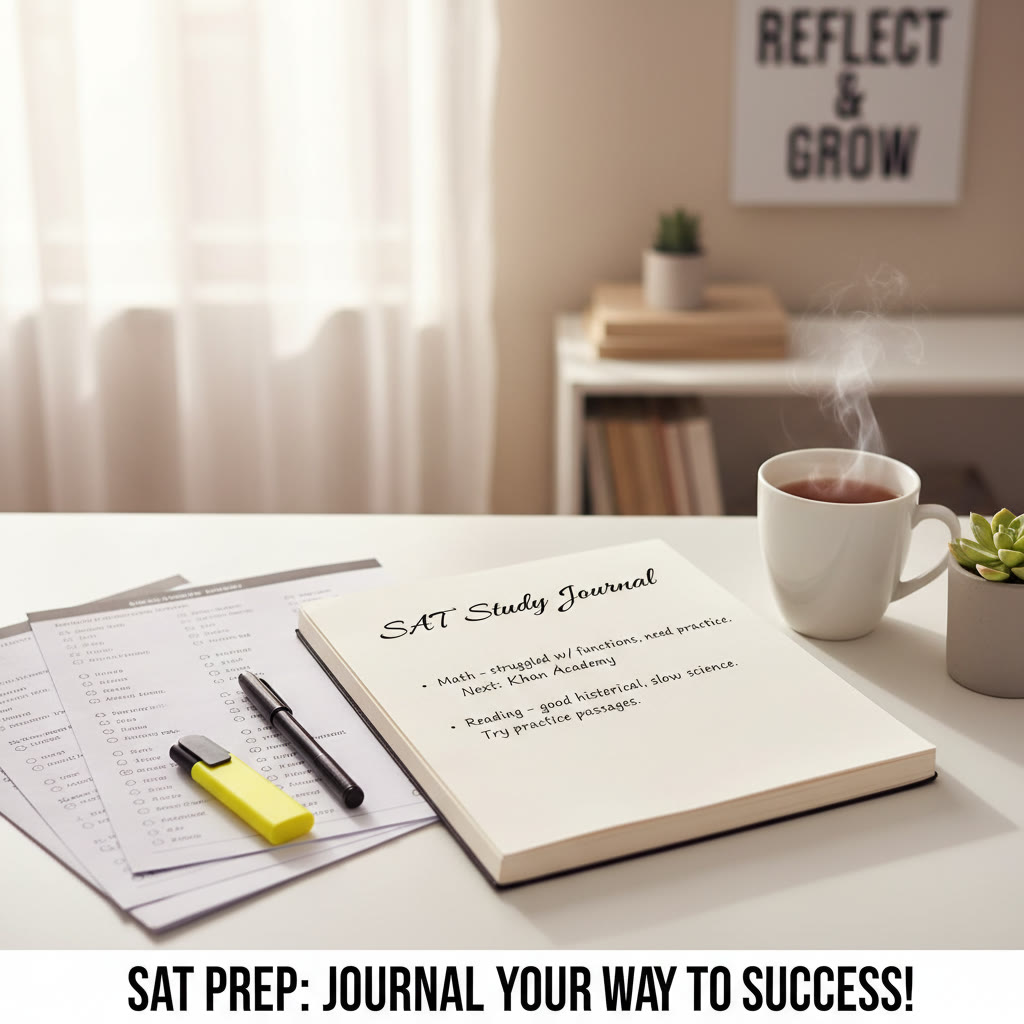
- Paper notebook: Tactile, fast, and limited distractions. Good for students who find typing invites multitasking.
- Simple note app: Searchable and portable. Use headings by date so you can review patterns quickly.
- Spaced-review + tutor integration: If you have tutoring—Sparkl’s personalized tutoring with tailored study plans and AI-driven insights—link your reflections to your next session. Your tutor can review patterns and set targeted work for you.
A practical reflection template (use it daily)
Copy this template into your notebook or note app. Keep it short—one to three lines per prompt.
- Date:
- Block length (minutes):
- What I worked on:
- One win (specific):
- One mistake or confusion (specific):
- Action for next session (concrete):
- Confidence level (1–10):
Sample filled template
Here’s how a filled entry might look for a 45-minute Reading session:
- Date: April 10
- Block length: 45
- What I worked on: Passage-based inference questions, Section 2
- One win: Correctly inferred author attitude in 4 of 5 questions by annotating tone words.
- One mistake: Misread a timeline detail; lost a point to a careless timeline misread.
- Action: Practice two timeline questions from problem set tomorrow and time myself for that passage type.
- Confidence: 7
Use a weekly table to see progress
Daily notes are powerful, but patterns emerge when you review them weekly. The table below is easy to scan and helps you spot consistent strengths and weaknesses.
| Date | Minutes | Topic | Key Win | Repeated Mistake | Action for Next | Confidence |
|---|---|---|---|---|---|---|
| Mon, Apr 7 | 60 | Math—Algebra | Improved equation setup | Sign errors | Redo 5 sign-error problems | 7 |
| Tue, Apr 8 | 45 | Reading—Inference | Picked tone more reliably | Timeline confusion | 2 timeline practice passages | 6 |
| Wed, Apr 9 | 30 | Writing—Punctuation | Mastered comma rules in context | Underlined too much | Practice selective underlining | 8 |
| Thu, Apr 10 | 50 | Math—Functions | Better at interpreting graphs | Algebra manipulation slow | Timed equation drills | 7 |
| Fri, Apr 11 | 40 | Practice Test (half) | Great pacing | Careless reading on Q12 | Reread question stems | 6 |
At the end of the week, scan the table quickly. If one mistake repeats—like sign errors—focus your next week on targeted practice and ask your tutor for strategies. Reflection makes those trends visible.
How to turn reflection into an action loop
Reflection is useful only if you convert insight into action. Follow a simple loop:
- Observe (daily reflection): Note wins and mistakes.
- Plan (weekly review): Choose 1–2 focused actions for the week.
- Execute (daily practice): Implement those actions during sessions.
- Check-in with help: If you have tutoring, discuss those actions in your next 1-on-1 session so your tutor can tailor guidance and offer AI-driven insights or extra targeted drills.
This loop keeps you from spinning your wheels. Each week you test whether a small change actually improves scores or confidence.
Real-world example: from habit to score gain
Sam noticed he repeatedly missed questions in the last quarter of practice tests. His reflection revealed fatigue and unclear timing strategies. He tried a two-part action plan: practice shorter timed blocks to build endurance and implement a “skip-and-mark” rule for time-sinks. After three weeks, his correct answers in final sections improved by 12 percentage points. The change didn’t require extra hours—only strategic adjustments informed by daily reflection.
Make reflection stick: tips from habit science
Turning a new routine into a habit isn’t magic; it follows reliable patterns. Here’s how to stack reflection onto things you already do:
- Anchor to an existing habit: Do your reflection immediately after you put away your textbook or when you close your laptop.
- Make it easy: Keep a dedicated notebook or a one-note template; don’t reinvent the structure each time.
- Celebrate tiny wins: End each reflection with a short positive note—”I tried a new strategy today”—to create positive reinforcement.
- Limit friction: If a paper notebook is easier, use it. If you prefer digital, create a one-click note template. The barrier to entry must be near zero.
- Use reminders—but phase them out: Start with an alarm. Once it becomes routine, stop the alarm and rely on the anchor.
When to ask for help and how reflection directs that help
Not every confusion needs a tutor. But reflection clarifies when expert help accelerates progress. If you find the same concept confusing after three focused attempts, or your confidence keeps falling, schedule targeted help. With Sparkl’s personalized tutoring, you can bring your reflections to a 1-on-1 session. A tutor can:
- Interpret patterns in your reflections and create a tailored study plan to address root causes.
- Use AI-driven insights to identify which practice items are most likely to move your score.
- Provide expert explanations and alternate strategies when your attempts stagnate.
Reflection makes tutoring sessions more efficient because your tutor can focus on the exact sticking points you’ve recorded, rather than guessing where to start.
Advanced reflection techniques for the committed student
If you’ve been reflecting for a month and want to squeeze more mileage, try these upgrades:
- Pair reflections with data: Track score and time on specific question types over weeks and plot trends.
- Experiment deliberately: Try two strategies for a week each (e.g., different annotation techniques) and compare outcomes in your reflections.
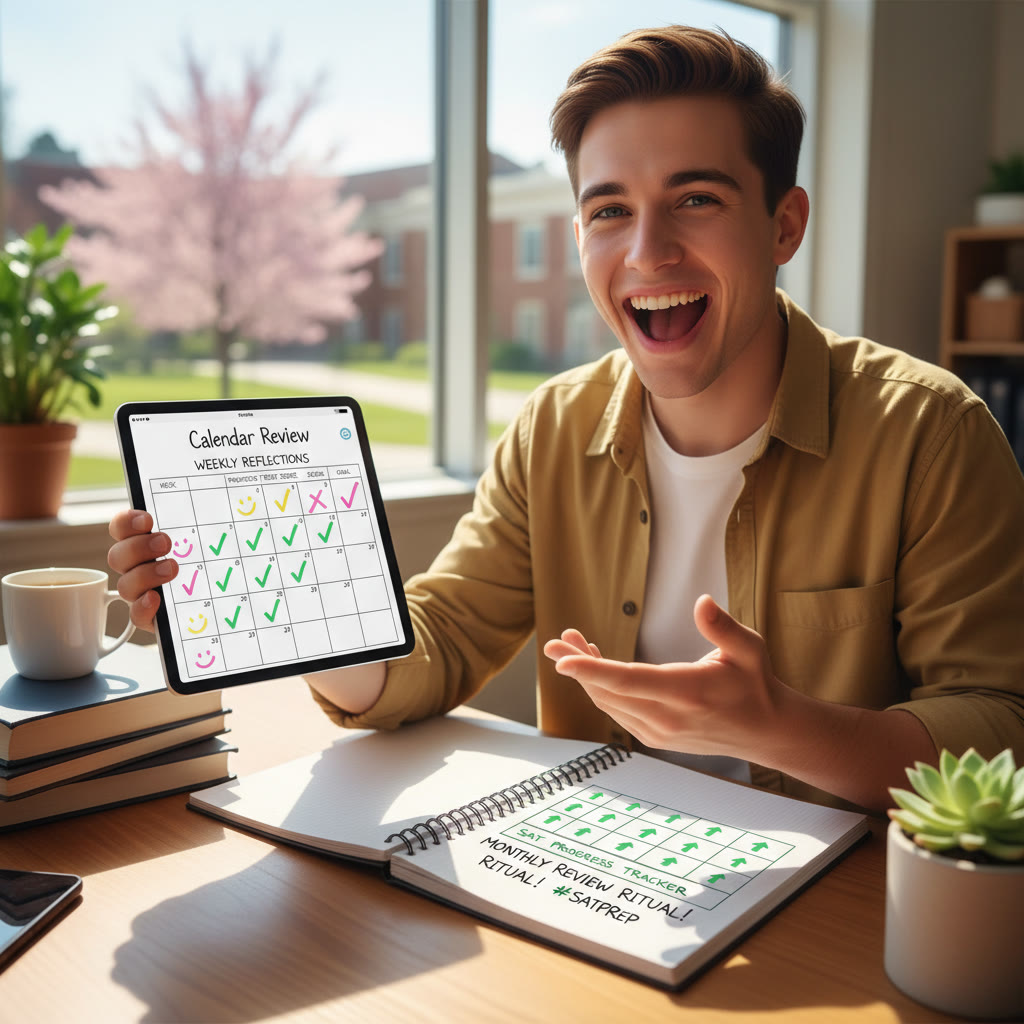
- Do a monthly deep-dive: Once a month, write a longer reflection (15–30 minutes) reviewing themes, planning the next month, and celebrating progress.
- Share reflections with a tutor: Ask for direct feedback on your reflections. Tutors can spot biases in your self-assessment and provide reality checks.
Comparison: passive review vs. reflective review
Passive review is re-reading notes. Reflective review is asking questions about performance and planning changes. Passive review feels productive but often yields small gains. Reflective review forces actionable decisions (change timing, revisit concept, ask a tutor). If you have limited study hours, prioritize reflection-driven practice.
Common obstacles and simple fixes
Every habit faces resistance. Here are common obstacles students hit and straightforward ways to fix them:
- “I forget”: Anchor the reflection to the end of your study block and set one short reminder for two weeks.
- “It takes too long”: Cut the template to three lines. One win, one mistake, one action.
- “My notes are messy”: Use a structured template or checklist to force uniformity; tidy once weekly instead of every day.
- “I don’t know what to change”: Use your reflections to create one measurable action (e.g., “redo 10 algebra problems timed”). If unclear, bring the reflection to your tutor for diagnosis.
Putting reflection into a 4-week plan
Here’s a compact 4-week approach to make reflection a lasting part of your SAT prep.
- Week 1 — Start small: 5-minute reflections after three study sessions. Use the basic template and anchor it to an existing habit.
- Week 2 — Build consistency: Aim for daily reflections. Use the weekly table on Sundays to summarize patterns.
- Week 3 — Focus actions: Pick two recurring mistakes and make them the main goals for the week. Add a short mid-week check.
- Week 4 — Integrate tutoring: Share summaries with your tutor or use Sparkl’s personalized tutoring to convert reflections into a tailored study plan with AI-driven insights and expert feedback.
End-of-month ritual
At the end of the month, spend 20 minutes reviewing your daily entries. Ask: Did my confidence improve? Did scores shift? What habits supported growth? This ritual turns scattered notes into a coherent growth story.
Final notes: reflection is fuel for focused practice
If you want a single takeaway, here it is: practice without reflection is rehearsal; practice with reflection is improvement. The difference is intention. Five minutes of daily reflection refocuses your efforts so each study block has direction.
Whether you prefer a neat notebook or a quick digital note, make your reflection specific, short, and action-oriented. Use weekly tables to spot trends and convert those trends into targeted practice. When a problem persists, bring your reflections to a 1-on-1 tutor—Sparkl’s personalized tutoring, with tailored study plans, expert tutors, and AI-driven insights, is designed to make those moments hyper-efficient and targeted.
Start tonight. Open a fresh notebook or a new note. Write the date. Spend five focused minutes. Note one win, one mistake, and one action. Keep doing it. In a month, you’ll be surprised at how many tiny, consistent decisions add up to a real score difference.
Good luck—and remember, improvement rarely happens in a single dramatic session. It creeps forward through tiny intentional steps. Reflection is the compass that keeps every step pointing toward your target.























No Comments
Leave a comment Cancel