
How to Build a Retake Strategy With Limited Time Before Deadlines
Staring at a calendar with an SAT deadline looming can feel like standing at the base of a steep hill with a heavy backpack. You know the destination — a higher score — but the path forward seems cramped by time. The good news is that limited time is not the same as no time. With a calm plan, smart priorities, and focused practice, you can make meaningful score gains even in a few weeks.
This guide walks you through a practical retake strategy designed for the clock. Youll get step-by-step planning, section-specific tactics, sample schedules, and a straightforward way to decide where to invest your energy. Along the way Ill show how to get the most from resources like 1-on-1 tutoring, tailored study plans, and AI-driven insights from Sparkl when it fits naturally into your timeline.
Start With a Clear, Honest Baseline
Before adjusting anything, know exactly where you stand. That means taking or reviewing a recent full-length practice test and treating it like the real thing. Time it, simulate test conditions, and score it properly. What you need from the baseline:
- Overall score and section scores
- Time management patterns for each section
- Types of questions missed: careless mistakes, content gaps, timing errors, or question type confusion
- A short list of the most frequent error types across the test
Why this matters: without a precise baseline, any plan is just wishful thinking. A practice test gives you targets you can measure against, and anchors your timeline in reality.
Set a Realistic Target
Pick a numerical goal that is ambitious but achievable. If you scored 1100, a jump to 1300 in two weeks is unlikely. But a focused 50 to 100 point gain is often realistic. Use your baseline to pick a target per section, not just an overall number. For example:
- Reading: +3 correct per passage
- Writing: reduce grammar mistakes by 40 percent
- Math: convert a couple careless errors into correct ones and master one weak topic
Targets like these are actionable and easier to chase than vague notions like get better at math.
Map Your Limited Time: A Weekly Priority Framework
When time is tight, triage is everything. Use this framework to allocate study time each week. You can adapt the total hours to your availability, but keep the proportions:
- 40 percent: Targeted practice on high-value weaknesses
- 30 percent: Full or section-length practice tests under timed conditions
- 20 percent: Review and error logging to fix repeated mistakes
- 10 percent: Strategy, timing drills, and mental prep
If you have 20 hours in a week, that becomes 8 hours targeted, 6 hours practice tests, 4 hours review, and 2 hours strategy and rest. That balance ensures youre learning, testing, and correcting in loops.
Quick Table: Example 3-Week Plan When Time Is Tight
| Week | Focus | Sample Hours | Key Goals |
|---|---|---|---|
| Week 1 | Baseline, diagnose, and start targeted practice | 15-20 | Identify top 3 weak areas, begin daily practice, 1 full test |
| Week 2 | Intensive drilling on weaknesses, timing drills | 12-18 | Turn weak topics into reliable procedures, 1 full test |
| Final Week | Polish, rest, and simulation | 8-12 | 1 or 2 light tests, sharpen timing, sleep and logistics locked |
The numbers above are flexible. Short on one week? Shift focus without changing priorities. The idea is to cycle between practice and review with increasing refinement each week.
Section-Specific Tactics for Maximum Return
Each section demands a different, high-leverage approach. Here are targeted strategies you can implement quickly.
Reading: Prioritize Passage Strategy and Trap Awareness
- Do a rapid passage read that focuses on structural clues and the author s stance. Dont try to memorize details on the first pass.
- Practice question triage: which questions are evidence-based, which ask main idea, and which require inference. Answer in that order: main idea and structure questions first, detail questions next, and hard inference last.
- Use annotation shorthand: circle transition words, underline topic sentence, and bracket the conclusion. This saves time and reduces rereading.
- Drill with passage summaries: after each practice passage, write a one-sentence summary. This habit trains you to capture the core quickly.
If you find many wrong answers are from misreading answer choices, create a mini error log of misleading wording and revisit it weekly.
Writing and Language: Master Patterns, Not Memorization
- Learn the high-frequency grammar rules tested: subject-verb agreement, pronoun clarity, parallel structure, and commonly confusing comma rules.
- Practice with short, timed sections of 15 questions so you get used to pacing and sentence-level analysis.
- For passage revision questions, read the sentence in context. Often the best answer is the one that preserves clarity with concision.
Because the Writing section tends to test patterns, deliberate practice on 10 to 20 focused questions can produce fast gains.
Math: Focus on Error Types and Strategy Choices
Math improvements late in the game come from reducing careless errors, mastering a handful of weak topics, and streamlining your approach to common problem types.
- Make an error log split by type: arithmetic, conceptual, setup, or algebraic manipulation. Triage your practice toward the largest buckets.
- For calculator and no-calculator portions, practice mental math and estimation to avoid overreliance on the calculator for simple arithmetic.
- Learn two high-leverage tactics: backsolving answers and plugging in numbers. These save time on algebraically ugly questions.
- When timing is an issue, practice pacing by doing groups of questions in 10-15 minute blocks to simulate section cadence.
Practice Tests: Quality Over Quantity
With limited time, every full test should teach you something specific. Treat tests as experiments, not just score generators.
- Before a practice test, set a hypothesis: what will I test this time? For example, see if my new timing strategy reduces careless errors in Math.
- After the test, spend twice as much time reviewing as you spent taking the test. Identify recurring errors that cost you points.
- Use tests to calibrate stamina and timing. If you lose focus in the last 20 minutes, your plan should include short endurance-building practices.
How to Review a Practice Test Efficiently
Review in three passes.
- Pass 1: Correct vs incorrect. Note patterns at the section level.
- Pass 2: For each incorrect question, write the precise reason it was wrong. Avoid vague notes like careless or didnt know; be specific.
- Pass 3: Create 2–3 repair actions per recurring error. For a frequent algebra mistake, schedule targeted algebra drills and a timed set of 10 similar problems.
Make an Error Log Your Best Friend
An error log turns random mistakes into a curriculum. It should be short, consistent, and action-focused. Every entry should answer:
- Which question and why I missed it
- What rule or concept fixes it
- How I will practice that rule in the next 48 hours
Review the log weekly and mark entries as solved only after you can solve similar items correctly three times in a row under time pressure.
Use Tutoring and Technology Smartly
When time is short, the right help accelerates improvement. Personalized, 1-on-1 tutoring or a tailored study plan can cut through guesswork and aim your work at the highest payoff areas. If you choose tutoring, make these requests:
- Ask the tutor for a short diagnostic and a 2-3 week focused plan
- Request targeted problem sets that mirror your weakest question types
- Schedule short, frequent check-ins to keep momentum and accountability
Services that offer AI-driven insights can also speed things up by quickly analyzing practice test patterns and suggesting personalized drills. For example, Sparkl s personalized tutoring blends 1-on-1 guidance, tailored study plans, expert tutors, and AI-driven insights to identify your top weaknesses and recommend a compact practice schedule. When integrated naturally into a short timeline, that combination can help you avoid wasted study time.
Sample Micro-Schedules for Different Time Budgets
Pick the template closest to your availability and adapt. Consistency matters more than total hours.
Option A: 3 Weeks, 12 Hours Per Week
- Mon 1.5h targeted practice (Math or Reading)
- Tue 1.5h grammar or review
- Wed 2h practice test section + review
- Thu 1.5h targeted practice
- Fri 1.5h timing drills and error log
- Sat 3h full practice test or two sections back-to-back
- Sun rest or light review 0-1h
Option B: 2 Weeks, 8 Hours Per Week
- Three 1.5h focused sessions on top weaknesses
- One 2h practice test on weekend
- Regular 15-minute error log review each night
Final Week: Taper, Simulate, and Rest
The final week is not for cramming new content. It is for consolidation, timing, and mental readiness.
- Do 1 or 2 light, timed practice tests early in the week
- Spend short sessions fixing only the most stubborn errors
- Practice test-day logistics: what youll bring, how youll get there, and when youll wake up
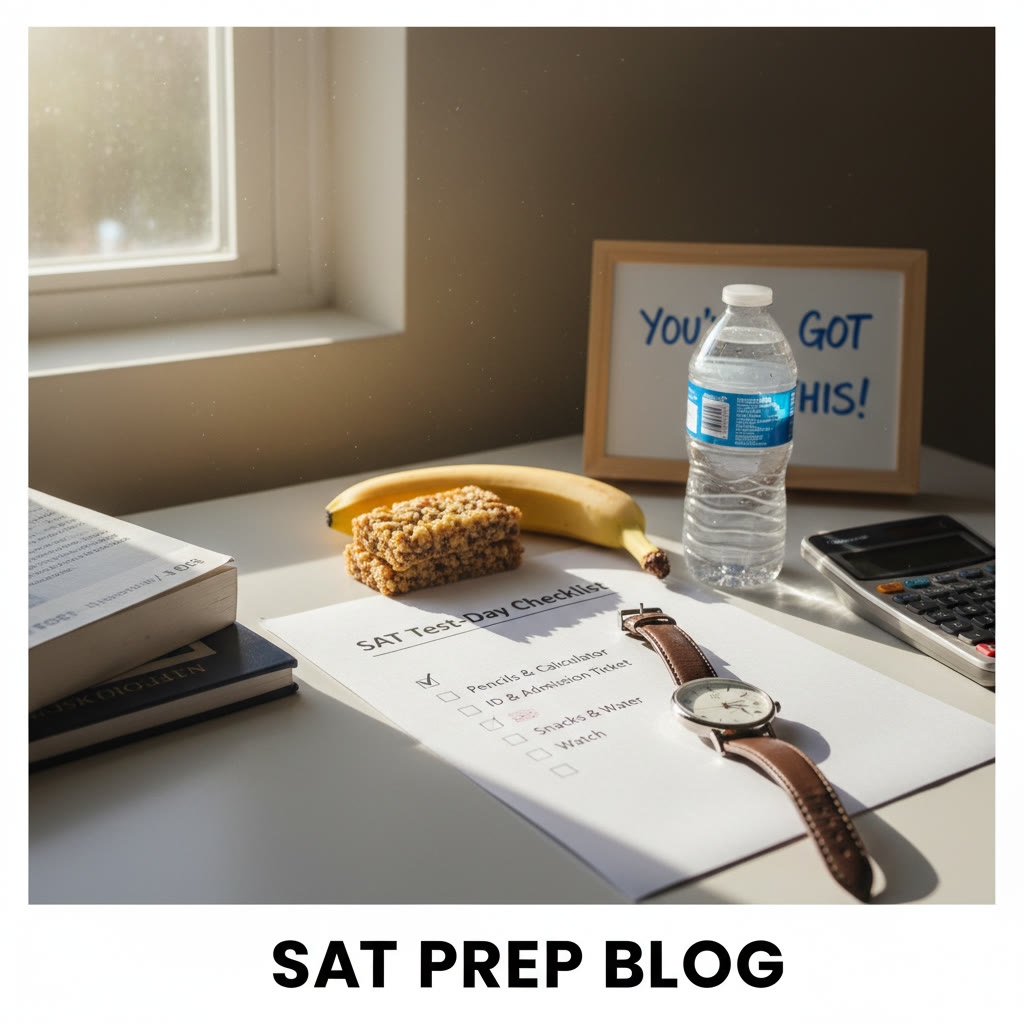
- Prioritize sleep, hydration, and a simple routine for the morning of the test
A common mistake is to overpractice in the last 48 hours and burn out. Instead, shorten sessions, do easy wins, and rehearse the mental game: calm breathing, realistic expectations, and a flexible mindset.
Test Day Tactics to Protect Your Score
Small choices on test day compound into big differences. Use these practical tips to safeguard the gains you earned.
- Eat a balanced breakfast with protein and complex carbs. Avoid heavy, unfamiliar foods.
- Bring a watch with no smart features for pacing. Put it face down and check it at planned intervals.
- First pass mindset: answer easy and medium problems quickly, mark hard ones for a second pass.
- For guessing, eliminate wrong answers and make an educated guess. There is no penalty for wrong answers on the modern SAT.
- If anxiety spikes, breathe using a 4-4-4 rhythm: inhale 4, hold 4, exhale 4. Three cycles reset focus.
Real-World Example: From Panic to Plan in Three Weeks
Alex had six weeks until the next SAT but only three weeks to study effectively due to extracurricular obligations. Baseline: 1180 with a weak math section and scattered careless errors. Her priorities were clear: stop careless mistakes in math, and build pacing for Reading.
Week 1: One full practice test, error log established, algebra and arithmetic drills prioritized. She used three 1-hour tutoring sessions focused on algebra problem setups and timing. Week 2: Targeted question sets and timed reading passages, a second full test. Mistakes in Algebra word problems dropped by half. Final week: two light tests and a focus on rest. Result: +80 overall, with math improving by 60 points and reading pacing steadier.
Two factors were key: honest baseline and focused practice on high-value weaknesses. Her tutor kept sessions tight and functional, and AI-driven practice modules suggested problems that matched her error profile, saving time on irrelevant material.
Final Checklist Before You Start Your Retake Push
- You have a recent timed practice test and a clear target per section
- Your schedule reflects triage priorities: drills, tests, review, strategy
- You maintain an active error log and commit to specific repair actions
- You know how you will use any tutoring or tech resources to maximize impact
- Your test-day logistics and sleep plan are written down and rehearsed
Closing Thought
Limited time increases the importance of choices. Small, deliberate adjustments beat frantic, unfocused effort. Use practice tests as experiments, make an error log your syllabus, and prioritize the highest-return work first. If you bring in support, choose focused 1-on-1 guidance and targeted study plans to accelerate progress. Services that combine expert tutors with AI-driven insights, like Sparkl s personalized tutoring, can be particularly useful when every hour counts because they reduce friction in diagnosis and drill selection.
Above all, be kind to yourself. A retake is an opportunity to learn how you study as much as it is a chance to gain points. With a calm plan and steady execution, you can make the most of the time you have and head into test day confident and prepared.























No Comments
Leave a comment Cancel