

Why a Study–Sleep–Exercise Cycle Beats All-Nighters
If you’ve ever pulled an all-nighter to cram for a practice test, you know the immediate cost: foggy thinking, shaky timing, and the gnawing feeling that you didn’t really learn anything. That’s because studying in isolation—without adequate sleep or movement—short-circuits the brain’s ability to consolidate knowledge and retrieve it under pressure. Creating a deliberate cycle that links study, sleep, and exercise is not trendy advice; it’s a practical strategy grounded in how memory, attention, and motivation actually work.
The three pillars and why they belong together
- Study: Encodes the information. Active, focused practice (not endless passive review) builds the neural traces you need for recall.
- Sleep: Consolidates memories. The brain replays and stabilizes what you’ve learned during deep and REM sleep.
- Exercise: Primes attention and mood. Short bouts of aerobic or resistance exercise increase blood flow, neurotransmitters, and the brain chemicals that support learning.
Together they form a virtuous cycle: deliberate practice builds memory traces; sleep strengthens and integrates them; exercise sharpens the brain for the next focused study session.
What Science Says: Quick, Actionable Evidence
You don’t need to be a sleep researcher to use these findings. Here are the takeaways that matter for SAT prep:
- Sleep after learning improves retention. Even a nap can boost memory for facts and problem-solving strategies.
- Spaced practice beats cramming. Distributing study sessions across days and weeks helps long-term recall.
- Brief aerobic exercise (20–30 minutes) increases attention and reduces anxiety—perfect before a timed practice section.
Think of these principles as rules of the road. Follow them, and your study time becomes more efficient and less stressful.
Designing Your Own Study–Sleep–Exercise Cycle
This isn’t a one-size-fits-all schedule. Instead, use these building blocks to design a cycle that fits your school hours, chronotype (are you a morning person or a night owl?), and upcoming test dates.
Step 1: Audit your current routine
Spend three days noting when you study, sleep, eat, exercise, and how alert you feel on a scale of 1–5. This gives you realistic starting points and helps you spot low-hanging fruit: perhaps a 30-minute walk after school could replace an hour of distracted scrolling.
Step 2: Choose study blocks with purpose
Not all study time is equal. Plan blocks with a clear focus and a method:
- Active practice (45–60 minutes): Work on timed SAT sections, problem sets, or practice passages. Use a timer and simulate test conditions when you can.
- Review and correction (20–30 minutes): Analyze mistakes immediately—what type of error was it? Calculation, reading misinterpretation, timing, or strategy?
- Spaced review (15–30 minutes): Use flashcards or quick drills for vocabulary, formulas, and key concepts.
Step 3: Schedule sleep to consolidate
Quality matters more than mythical “8 hours” rigidity. Aim for a consistent sleep window aligned with your school schedule. For most teens, 7.5–9 hours is ideal. Key rules:
- Keep a regular bedtime and wake time—even on weekends as much as possible.
- Avoid heavy studying in the hour before bed; instead, review summaries or do light recall work.
- If you’re sleep-deprived, prioritize a full night of sleep rather than a late-night cram session.
Step 4: Use exercise as a cognitive tool
Exercise is not just for fitness; it’s study fuel. Use brief, well-timed sessions:
- Before study sessions: 10–20 minutes of light cardio (jog, jump rope, cycling) can sharpen focus.
- Between blocks: 5–10 minutes of movement or mobility to reset attention.
- Before a practice test: 20–30 minutes of moderate aerobic exercise to reduce test anxiety and improve reaction time.
Sample Daily Cycles: Morning vs Evening Person
Below are two sample daily cycles. Use them as templates and adapt to school timing and commitments.
Morning person sample day
- 6:00–6:30 AM: Short run or dynamic mobility + light breakfast.
- 6:45–8:00 AM: Focused study block (math practice or reading passages).
- 8:15 AM–3:00 PM: School (use small study moments for spaced review—flashes or key formulas).
- 3:30–4:00 PM: Active recovery/walk; snack.
- 4:00–5:00 PM: Practice test section or tutoring session.
- 5:30–6:00 PM: Strength or interval workout.
- 7:00–8:00 PM: Light review and planning for tomorrow.
- 10:30 PM: Wind down routine and sleep by 11:00 PM.
Evening person sample day
- 8:00–8:30 AM: Easy wake-up, light breakfast.
- 9:00 AM–3:00 PM: School.
- 4:00–4:30 PM: Exercise (aerobic burst) to prime afternoon study.
- 5:00–7:00 PM: Focused study block (take a 10-minute break every 50 minutes).
- 8:30–9:30 PM: Second study block for lighter tasks—review errors and flashcards.
- 11:30 PM–12:00 AM: Wind down and sleep (aim for consistent sleep time).
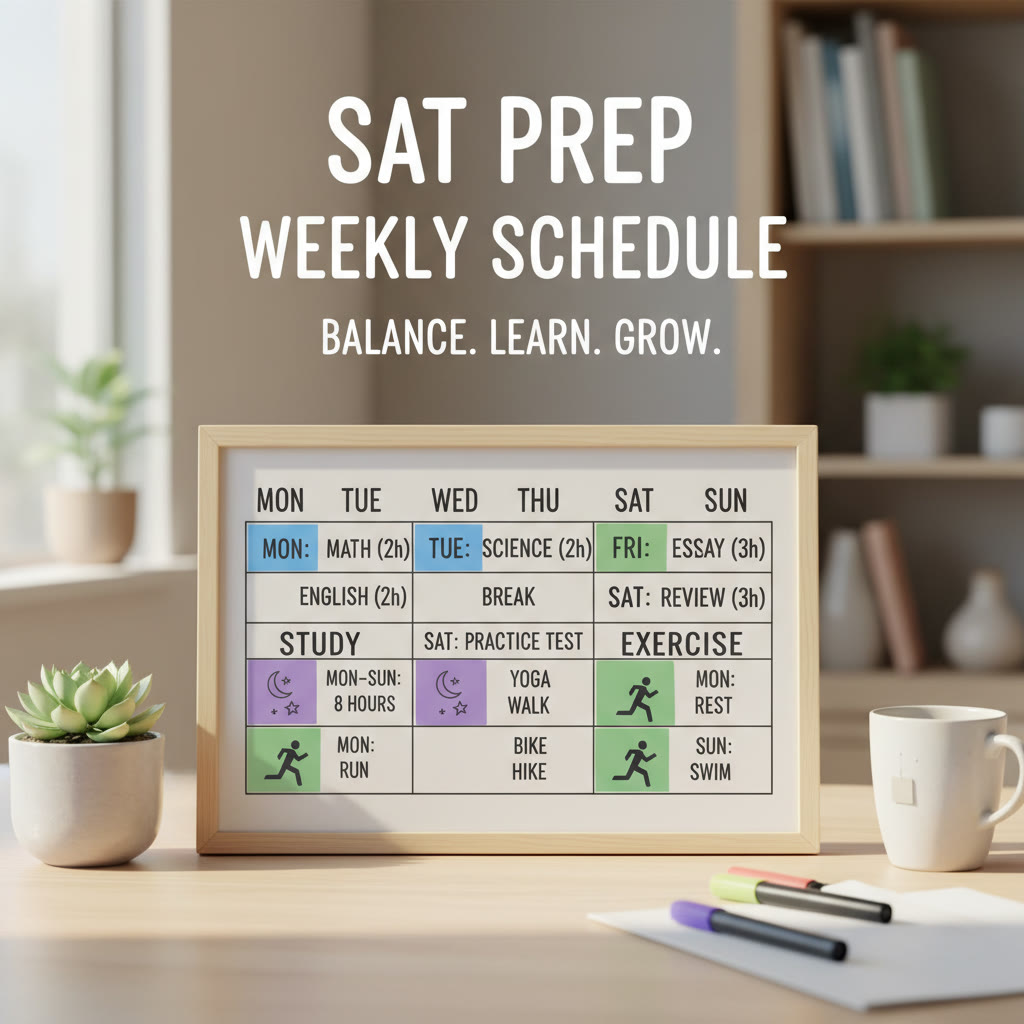
Weekly Sample Schedule: A Table You Can Copy
This sample week balances hard study, sleep prioritization, and exercise. Tweak it around sports, school, or family commitments.
| Day | Morning | Afternoon | Evening | Sleep Goal |
|---|---|---|---|---|
| Monday | 20 min jog + light review | School + 15 min spaced review | 60 min math practice, 20 min correction | 8 hr (11:00 PM–7:00 AM) |
| Tuesday | Stretch & flashcards | School + vocab flash review | Timed verbal section + analysis | 8 hr |
| Wednesday | HIIT 20 min | School | Mixed practice (math + reading), 30 min review | 8–8.5 hr |
| Thursday | Easy bike + flashcards | School | Full practice test (timed) or simulated section | 8 hr |
| Friday | Walk + summary review | School | Light study, plan weekend deep work | 8–9 hr |
| Saturday | Longer workout + breakfast | Full practice test + deep review | Recovery and light reading | 9 hr |
| Sunday | Active recovery, short study | Targeted weak-skill drills | Plan next week, early bedtime | 8–9 hr |
How to Use Practice Tests Within the Cycle
Practice tests are your diagnostic engine. They should be scheduled when your brain is operating near optimum—after good sleep and not immediately after heavy exercise (unless it’s light and stress-relieving).
- Schedule full-length practice tests once every 1–2 weeks when you’re in a stable routine.
- Do practice sections (30–60 minutes) more often—twice per week—to refine pacing.
- After each test, allocate a review block that day or the next morning—corrections while memory is still fresh are more powerful.
Tracking Progress: What to Measure and Why
Data keeps you honest and makes small changes visible. Track these weekly:
- Practice test score and section breakdowns.
- Hours of sleep and subjective sleep quality.
- Exercise frequency, type, and perceived energy.
- Focus ratings for study blocks (1–5 scale).
Over a month, you’ll see patterns: maybe your math accuracy is highest two days after a solid 8.5-hour night, or your reading speed spikes on days you do a morning run. Use those patterns to refine your cycle.
Common Obstacles—and How to Beat Them
1. “I don’t have time for exercise or sleep.”
Time is finite, but efficiency wins. Swap passive screen time for a 20-minute run and reclaim attention for study. A 25–40 minute blocked study session with high focus is often more productive than three distracted hours.
2. “I feel guilty sleeping instead of studying.”
Sleep is an investment—not wasted time. The hour you gain in recall and problem-solving after good sleep can be more than the value of late-night cramming. Treat sleep like test prep homework.
3. “I study better late at night.”
If you’re naturally an evening person, honor that within reason—keep a stable sleep schedule, and place your heaviest study block when your alertness peaks. Avoid pushing bedtime later than you can consistently recover from.
Personalization: Make the Cycle Yours
No two students are identical. Maybe you thrive on early-morning math and need an evening reading block, or you ace vocabulary after a nap. Personalization makes the cycle stick.
- Keep a two-week experiment window for any new routine—habits need time to stabilize.
- Adjust exercise timing if it interferes with sleep—move intense workouts earlier in the day if you have trouble falling asleep.
- Use short naps (20–30 minutes) strategically after heavy study blocks, especially if total nightly sleep is below ideal.
Working with a coach or tutor can accelerate personalization. Sparkl’s personalized tutoring offers 1-on-1 guidance, tailored study plans, and expert tutors who help you align study topics, practice tests, and recovery strategies with your schedule. Their AI-driven insights can highlight patterns in your performance—like which time of day your reading comprehension is strongest—so you spend less time guessing and more time improving.
Putting It Together: A Two-Week Kickstart Plan
Try this focused two-week plan to make the cycle a habit. The goal is not perfection—it’s consistency.
- Week 1: Establish sleep and study blocks. Keep exercise light and frequent (3–4 short sessions). Use two focused practice sections and one simulated test.
- Week 2: Increase intensity: add one longer practice test, longer review sessions, and one longer workout (20–30 min). Track performance and sleep quality daily.
At the end of two weeks, review your tracking data. Which days produced your best practice scores? When did you feel most alert? Use those answers to lock in a sustainable weekly plan.
Nutrition and Recovery: Small Inputs, Big Return
Food and hydration are the subtle support system for your cycle. Small, consistent habits boost energy and cognitive function:
- Breakfast: include protein and whole grains for sustained focus.
- Snacks: fruit, nuts, or yogurt avoid blood sugar crashes during long study blocks.
- Hydration: keep a water bottle nearby—mild dehydration impairs attention.
- Evening: avoid heavy meals right before bed; include calming rituals to signal sleep time.
Real-World Examples: How Students Succeeded
Emma, a high-school junior, struggled with timing on the Reading section. After tracking her alertness, she learned that short morning jogs followed by a 45-minute reading block produced her best scores. With the help of Sparkl’s personalized tutoring, she received a tailored plan to focus on passage mapping in those morning windows and monitored her improvements with AI-driven insights. After six weeks she cut her reading section time per passage while increasing accuracy.
Marcus had trouble remembering math formulas under pressure. He adopted a cycle where intense practice sessions were followed by naps or full nights of prioritized sleep. Brief resistance workouts three times a week reduced his anxiety levels and improved his concentration. Within two months his problem-solving speed increased enough that he moved from struggling with time to confidently completing sections early.
Checklist: Launch Your Cycle Tonight
- Create a three-day audit of current sleep, study, and exercise.
- Pick two focused study blocks per weekday and one longer weekend session.
- Decide on daily wake and sleep times and commit to them.
- Schedule 20–30 minute exercise sessions at least 3 times a week.
- Plan your first timed practice test after one week of consistent routine.
- Consider 1-on-1 guidance—Sparkl’s personalized tutoring can help tailor the plan and provide expert tutors and AI-driven insights to accelerate improvement.
Final Thoughts: The Long Game Matters More Than a Single Night
SAT success is rarely about a single hero move. It’s about accumulating small, well-chosen actions that compound: focused study, reliable sleep, and regular movement. This study–sleep–exercise cycle turns your prep into a sustainable lifestyle rather than a frantic sprint. Be patient, track what matters, and iterate.
When you align your practice with how your brain actually learns and recovers, you’ll find yourself answering questions calmer, faster, and with more confidence. And if you want help building a plan that fits your life—one that adapts as you improve—consider adding personalized coaching in the form of Sparkl’s 1-on-1 guidance and tailored study plans. The right support speeds progress and keeps you on track when life gets busy.




























No Comments
Leave a comment Cancel