
Why a Weekend Reset Routine Matters More Than You Think
Weekdays are full of classes, homework, clubs, and everything else that competes for your attention. Weekends, when used well, become the secret weapon for steady SAT improvement. A “weekend reset” is not about cramming; it’s a deliberate, restorative couple of days that combine focused study, practice tests, recovery, and planning. Think of it as tuning your engine: a little maintenance every weekend prevents breakdowns on the big day.
What a weekend reset actually does for your SAT prep
- Gives space for long, focused practice sessions that you can’t fit into a school night.
- Creates a repeating rhythm so skills build cumulatively instead of randomly.
- Lets you simulate test conditions periodically without disrupting your weekdays.
- Reduces weekday stress by front-loading the heavy lifting and planning.
Before we build the routine, remember the SAT is 3 hours long (without the optional essay): Reading (65 minutes), Writing & Language (35 minutes), and Math (80 minutes: 25 minutes no-calculator and 55 minutes with calculator). Your weekend routine should give you repeated practice on those rhythms while protecting sleep, recovery, and perspective.
Core Principles to Shape Your Weekend Reset
Base your weekend plan on these evidence-backed principles so your time translates into real score gains.
1. Spaced practice beats marathon cramming
Studies of learning show that spreading practice over time strengthens long-term retention. Use your weekends to review and reinforce what you studied during the week, and to space out high-quality practice.
2. Active recall and interleaving are more effective than passive review
Active recall (testing yourself) and interleaving (mixing problem types) build stronger retrieval pathways than rereading notes. A weekend reset should prioritize practice tests, timed section drills, and flashcard-style recall over passive reading.
3. Calibration through realistic practice
Taking timed sections or full-length tests under realistic conditions trains pacing, endurance, and test-day mindset. Use weekends to calibrate timing and to analyze mistakes.
4. Recovery is part of study
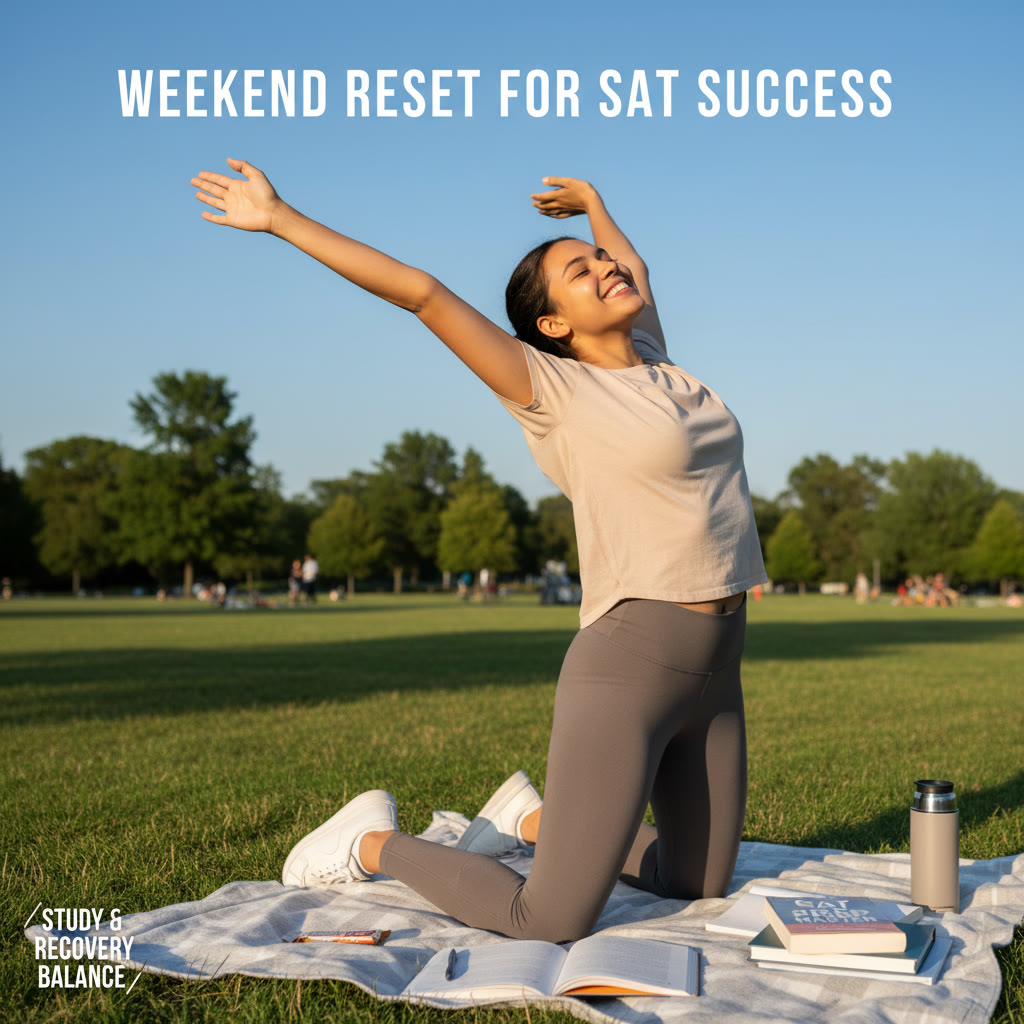
Sleep, movement, nutrition, and social connection improve cognitive performance. A reset weekend balances practice with rest, so your brain consolidates learning instead of burning out.
Designing Your Weekend: Two Templates to Fit Your Life
Not every weekend will look the same. Here are two practical templates you can adapt: “Deep Practice Weekend” for when you have more time or a test approaching, and “Maintenance Weekend” for steady progress during busy periods.
Template A — Deep Practice Weekend (best 6–8 weeks out from test)
- Saturday morning: Full-length practice test (3 hours) under timed conditions.
- Saturday afternoon: 60–90 minute debrief—review every missed question, update your error log, categorize mistakes (content gap, careless error, timing, misread).
- Sunday morning: Targeted math drills (2 blocks of 50 minutes with 10-minute breaks): one block for algebra/linear equations, one for geometry/function practice.
- Sunday afternoon: Reading & Writing combo—timed passage sets + grammar drills (90–120 minutes), then a 30-minute vocabulary/active recall session.
- Evening: Light review and rest—prepare a prioritized plan for the upcoming week based on your error log.
Template B — Maintenance Weekend (for busy students or long-term prep)
- Saturday: Two focused 60-minute study blocks (one math, one reading) with deliberate practice tasks (timed sets, problem correction).
- Sunday: One full timed math or reading section to stay calibrated + 45 minutes of reviewing mistakes and flashcard review.
- Both days: Short daily rituals—15 minutes of journaling about strategy and sleep/wake consistency check.
Sample Schedules (Weekend-by-Weekend)
Here are concrete schedules you can copy and tweak. Mix and match blocks depending on your priorities and energy.
| Time | Deep Saturday | Maintenance Saturday |
|---|---|---|
| 8:00–11:00 AM | Full-length practice test (3 hrs) | Sleep in / light review (optional 30 min) |
| 11:00–12:30 PM | Break + lunch | Math focused session (60 min) |
| 12:30–2:00 PM | Test debrief: error log + categorize mistakes | Short break + grammar drills (30–45 min) |
| 2:00–4:00 PM | Targeted practice on weak topics (2 x 50 min) | Practice passage (timed reading) + review |
| Evening | Light review + plan next week | Rest and social time |
The same approach can be mirrored or inverted for Sunday depending on whether you prefer to take the test on Saturday or Sunday. The key is regularity and reviewing mistakes right after practice.
How to Structure Each Study Block
Quality beats quantity. Here’s how to make each block count.
Warm-up (10–15 minutes)
- Quick review of flashcards or error logs targeting the day’s topics.
- Set a clear goal (e.g., “I will complete 12 algebra problems with fewer than 2 careless errors”).
Work phase (40–60 minutes)
- Timed problem sets or passage practice. Mimic actual section timing where possible.
- Use active strategies: self-explain problems, annotate passages, verbalize reasoning.
Debrief (20–30 minutes)
- Correct mistakes immediately and write a 1–2 sentence explanation for each error.
- Tag mistakes in an error log (content, strategy, careless, timing).
- Plan one micro-action for the week (e.g., “review quadratic formula flashcards 3x” or “do 10 grammar questions daily”).
Tools and Techniques to Include in Your Weekend Reset
Use these tried-and-true study tools to get the most from your weekend.
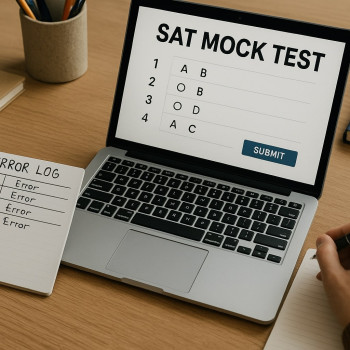
- Error Log: A running document that records question type, mistake cause, and corrective action. This is the single best way to convert practice into targeted improvement.
- Timed Sections: Practice under real timing. If you can’t take a full test, take a timed Reading section or math block.
- Flashcards & Spaced Repetition: Use flashcards for vocabulary, formulas, or common grammar rules with spaced-review scheduling.
- Mixed Practice: Combine question types to build transfer—don’t just do a list of similar problems.
- Simulated Test Conditions: Silence notifications, use a timer, and take breaks exactly as on test day to practice pacing and endurance.
Nutrition, Sleep, and Movement: The Often-Missed Wins
Weekend study without recovery is less efficient. Here’s how to tune the body for a sharper mind.
- Sleep: Aim for 8–9 hours the night before both days you do heavy practice. Sleep consolidates memory.
- Hydration: Drink water regularly; even mild dehydration reduces cognitive function.
- Balanced meals: Combine complex carbs (whole grains), protein, and healthy fats for sustained energy. Avoid sugar spikes before a long test simulation.
- Movement breaks: Short walks or stretching between blocks boost blood flow and focus.
Data-Driven Improvement: Track, Analyze, Adjust
A routine without feedback is just busy-ness. Keep metrics and use them to iterate.
Basic metrics to track each weekend
- Practice test score (section scores and total)
- Error categories from your log (content vs careless vs timing)
- Time per question or passage
- Sleep hours and subjective energy score
Regular analysis helps you spot trends like a persistent timing drag in Math or consistent weakness in inference questions on Reading. That’s where personalized instruction can accelerate progress.
How Sparkl’s personalized tutoring fits naturally
When your weekend error log shows repeated patterns, a focused coach can help break the cycle faster. Sparkl’s personalized tutoring offers 1-on-1 guidance, tailored study plans, expert tutors, and AI-driven insights that pinpoint recurring weaknesses and suggest specific exercises to fix them. Think of Sparkl as a coach who translates your weekend data into smart next steps—whether it’s a concentrated week on data interpretation or a set of targeted drills to reduce careless errors.
How to Adapt the Weekend Reset to Your Score and Schedule
Your starting point changes what your weekend should prioritize. Here’s a quick guide.
If you’re just starting (baseline <= 1000)
- Focus on fundamentals: core algebra, grammar rules, and reading strategies.
- Use weekends for structure: one full diagnostic every 2–3 weeks, then targeted practice blocks.
- Keep sessions shorter and consistent to build stamina without burning out.
If you’re in the middle (1000–1300)
- Increase timed practice to improve pacing. Full-length tests every 1–2 weeks are useful.
- Use weekends to close topic gaps and reduce careless errors.
- Consider occasional 1-on-1 sessions (like Sparkl’s) to refine strategy and prioritize content.
If you’re aiming top (1300+)
- Use weekends for precision work: fine-tune timing, advanced question strategies, and high-difficulty problem sets.
- Simulate test-day conditions frequently and review with a coach to squeeze out points.
Examples: Turning a Weekend into a Score-Gaining Machine
Real students get better by repeating a simple weekly loop: practice, analyze, correct, repeat. Here are two short examples.
Case study 1: Maya — from 1050 to 1230 in four months
Maya used a maintenance weekend schedule but added a key tweak: every Saturday she did a short, timed reading passage set and logged inference errors. She spent Sunday afternoons doing targeted grammar drills and used her error log to guide weekday short sessions. After three months she brought down careless errors and after four months added 180 points. Periodic check-ins with a Sparkl tutor helped her design drills for stubborn question types and gave her personalized pacing strategies.
Case study 2: Marcus — building endurance
Marcus’s issue was endurance: his scores dropped in later sections. He switched to a deep-practice weekend monthly where he took a timed full-length test and followed it with a recovery day—light review, movement, and sleep optimization. He also tracked energy in his notes. Within two months his late-section decline flattened and remained consistent through the test.
Common Pitfalls and How to Avoid Them
- Overdoing it: Long, unfocused hours create fatigue. Use clear goals and timed blocks.
- Skipping the debrief: Many students practice but don’t analyze mistakes. Review immediately and record corrective actions.
- Ignoring mental health: Stress and isolation hurt performance—schedule fun and social downtime.
- Failing to adapt: If a routine isn’t producing results after 3–4 weeks, change it. That’s where an outside coach or data-based platform like Sparkl’s can be useful to recalibrate your plan.
Weekend Reset Checklist
Use this checklist before you start each weekend to ensure efficiency and focus.
- Do I know the specific goals for each study block?
- Is my error log up to date and ready to guide priorities?
- Have I scheduled a timed practice (section or full test) this weekend?
- Do I have a recovery plan: sleep schedule, meals, movement?
- Have I planned one micro-action for the week to address my biggest recurring mistake?
Small Rituals That Make Your Weekend Sustainable
Little habits build momentum. Try adding these rituals:
- Start with a 5-minute goal-setting session and end with a 5-minute reflection.
- Use the same physical setup for practice tests so your brain learns context cues.
- Keep a short motivation list—why are you taking the SAT? Keep it visible.

Final Thoughts: Make the Weekend Yours
A weekend reset routine for SAT prep is not a rigid prescription, it’s a framework. The magic comes from consistent, reflective practice—regular testing under real conditions, careful analysis of errors, targeted corrective work, and attention to recovery. Tailor the templates above to your energy patterns, calendar, and goals. If you need help turning your data into a smart, actionable plan, Sparkl’s personalized tutoring—with 1-on-1 guidance, tailored study plans, expert tutors, and AI-driven insights—can be a practical way to accelerate improvement without adding confusion.
Start small this weekend: pick one timed practice block, commit to reviewing mistakes right away, and set a micro-action for the week. Repeat. The compounding effect of thoughtful weekends will get you farther than any single marathon study day. You’ve got this—one deliberate weekend at a time.

























No Comments
Leave a comment Cancel