

Introduction: Why a Motivation Wall Works
Studying for the Digital SAT can feel like a long road — full of practice tests, tricky passages, and moments when motivation dips. That’s exactly why a “Why I’m Preparing” motivation wall is such a powerful tool. It’s not just decoration: it’s a daily, visual reminder of purpose. Put simply, it converts abstract reasons into concrete, emotional anchors that nudge you back into focused work when distractions or doubt appear.
This blog will walk you through building a motivation wall that’s practical, personal, and sustainable. You’ll get creative prompts, layout templates, a sample weekly schedule, and ideas to keep the wall fresh through months of prep. And if you want guided support turning your goals into a study plan, Sparkl’s personalized tutoring (1-on-1 guidance, tailored study plans, expert tutors, and AI-driven insights) can help you translate what’s on the wall into action steps.
Step 1 — Decide the Purpose: What Your Wall Will Do for You
Not every wall needs to be the same. Before you buy supplies or print photos, decide which of these roles you want your wall to play. You can mix and match three or four roles, but clarity here makes the design and content choices easier.
- Goal Anchor: A place to display long-term goals (college lists, scholarship targets, career dreams).
- Daily Motivation: Short reminders that pull you into study mode every morning.
- Progress Tracker: Visual proof of improvement (practice test score charts, streak calendars).
- Study Toolbox: Quick tips, formulas, and strategy reminders for the Digital SAT format.
- Emotional Support: Quotes, photos, or letters that remind you who you’re doing this for.
Quick exercise
Take 3–5 minutes and write down: one academic goal, one emotional reason, and one practical goal (for example: “Get 1400+,” “Make my family proud,” “Earn scholarship to reduce tuition”). These three items should be highlighted on the wall.
Step 2 — Choose a Spot and Format
Your space matters. Choose a spot you see several times a day — above your desk, on a bedroom wall near the door, or even the inside of your closet door. The format can vary by room size and personality:
- Full-wall collage: For maximum visual impact — lots of sections and materials.
- Bulletin board: Easy to update with pins and index cards.
- Poster board: Portable and compact; great for dorm rooms.
- Digital wall: A rotating desktop wallpaper or a pinned note on your tablet if physical space is limited.
Materials checklist
- Poster board or corkboard
- Index cards, Post-its, colored paper
- String or washi tape for dividers
- Markers, pens, highlighters
- Push pins or removable adhesive
- Printed photos or small mementos

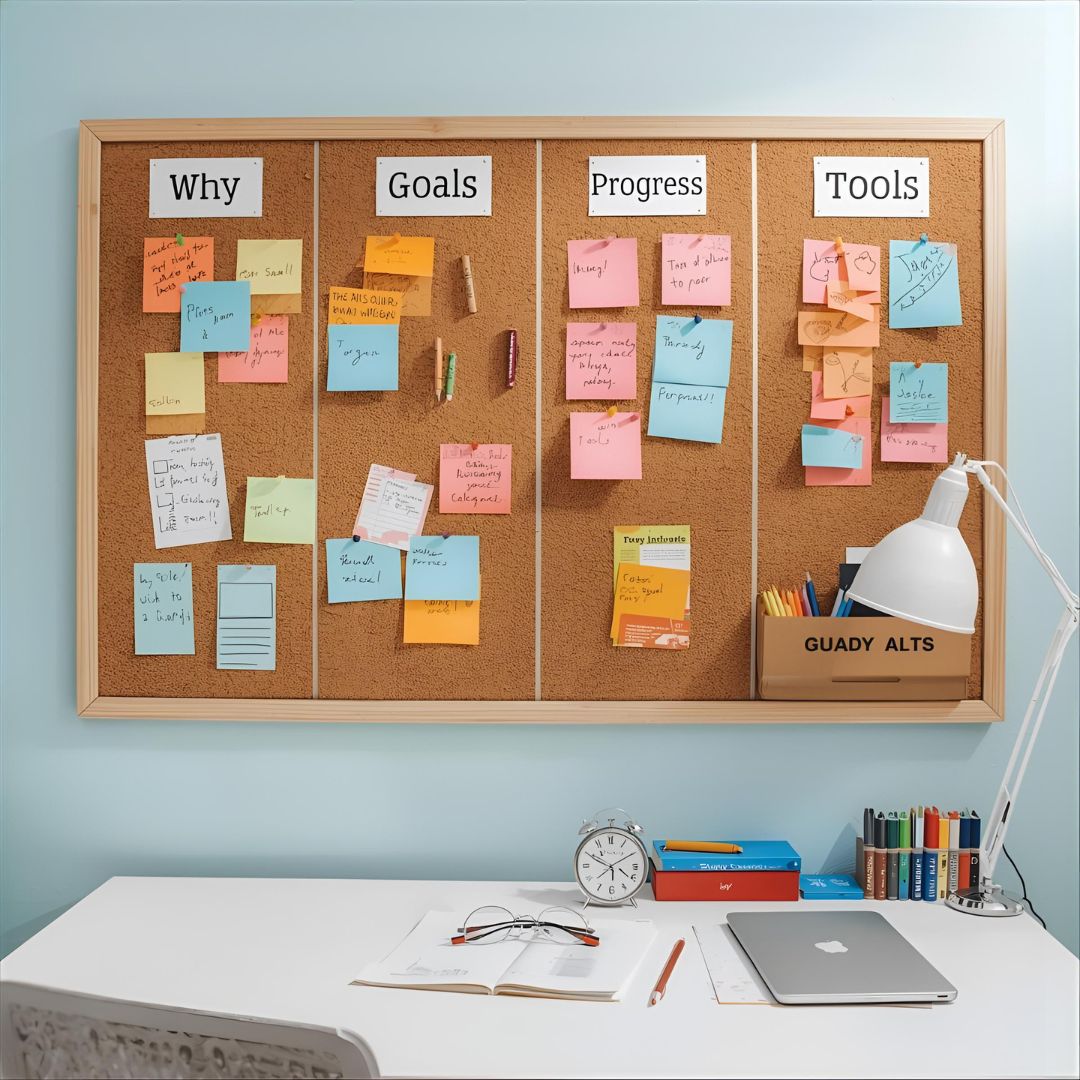
Step 3 — Design the Sections
Now design the layout. Think of your wall like a one-page dashboard. Keep sections clean so your eyes find what they need quickly.
Suggested sections and what to put in them
- Center — “Why I’m Preparing”: A headline that lists your top 3 reasons in big, bold handwriting. Keep it specific and emotional.
- Top-left — Target Goals: Scores, colleges, scholarship amounts. Use a table format to keep this organized (example below).
- Top-right — Timeline & Milestones: Key dates (target test date, practice test benchmarks, application deadlines).
- Bottom-left — Strategy Reminders: Short tips for Reading, Writing & Language, and Math (format reminders for Digital SAT included).
- Bottom-right — Progress Trackers: A score chart and streak calendar for practice tests and timed practice sessions.
- Side pocket — Quick Resources: Flashcards, formula list, and a small pocket with prioritized practice problems.
Example table for the “Target Goals” section
| Target | Numeric Goal | Deadline |
|---|---|---|
| Overall Score | 1400 | Dec 2025 test |
| Evidence-Based Reading & Writing | 700 | Nov 2025 practice test |
| Math | 700 | Nov 2025 practice test |
| Scholarship Target | $10,000 | College apps 2026 |
Step 4 — Create Emotional Anchors
Numbers motivate, but emotions sustain effort. Emotional anchors turn your study routine into something meaningful.
- Write a short paragraph in your own voice titled “Why This Matters” — paste it where you’ll read it each morning.
- Add photos of people, places, or things you’re working for: a parent, a classroom you want to join, a campus you love.
- Include a short voice note or QR code to a 30-second recorded pep talk you made for yourself.
Prompt to write your “Why” paragraph
Answer these lines in one to three sentences and post the result at the center of your wall: “I am studying for the Digital SAT because…” “When I see my score goal, I imagine…” “If I reach this score, I will be able to…” Keep it personal, specific, and vivid.
Step 5 — Add Practical Digital SAT Tools
The Digital SAT format influences how you should study. Your wall should include quick reminders of format, timing, and on-screen tools so that those habits become instinctive.
- Timing reminders: e.g., number of sections, time per section, recommended pace per question.
- On-screen tools: Notes about using highlighting, flagging questions, using the built-in calculator in allowed sections, and navigating passages efficiently.
- Strategy cards: One-sentence strategies like “In Reading: read intro + first and last sentences of paragraphs for structure” or “In Math: eliminate impossible answers before calculating.”
Mini card examples to pin
- “Pause 3 seconds before answering: is there a trap word?”
- “Scan math problems for shortcut patterns (ratios, linear equations, common quadratics).”
- “If stuck >1.5 min, flag and move on — return with fresh eyes.”
Step 6 — Track Progress Visually
Tracking is the part that turns hope into measurable improvement. A few visual trackers on your wall will keep practice tests meaningful rather than demoralizing.
Simple trackers to add
- Score chart: A line graph or column chart where you update your composite score after each practice test.
- Skill mini-trackers: Small bars for “Command of Evidence,” “Heart of Algebra,” or “Data Interpretation” that you color in as you improve.
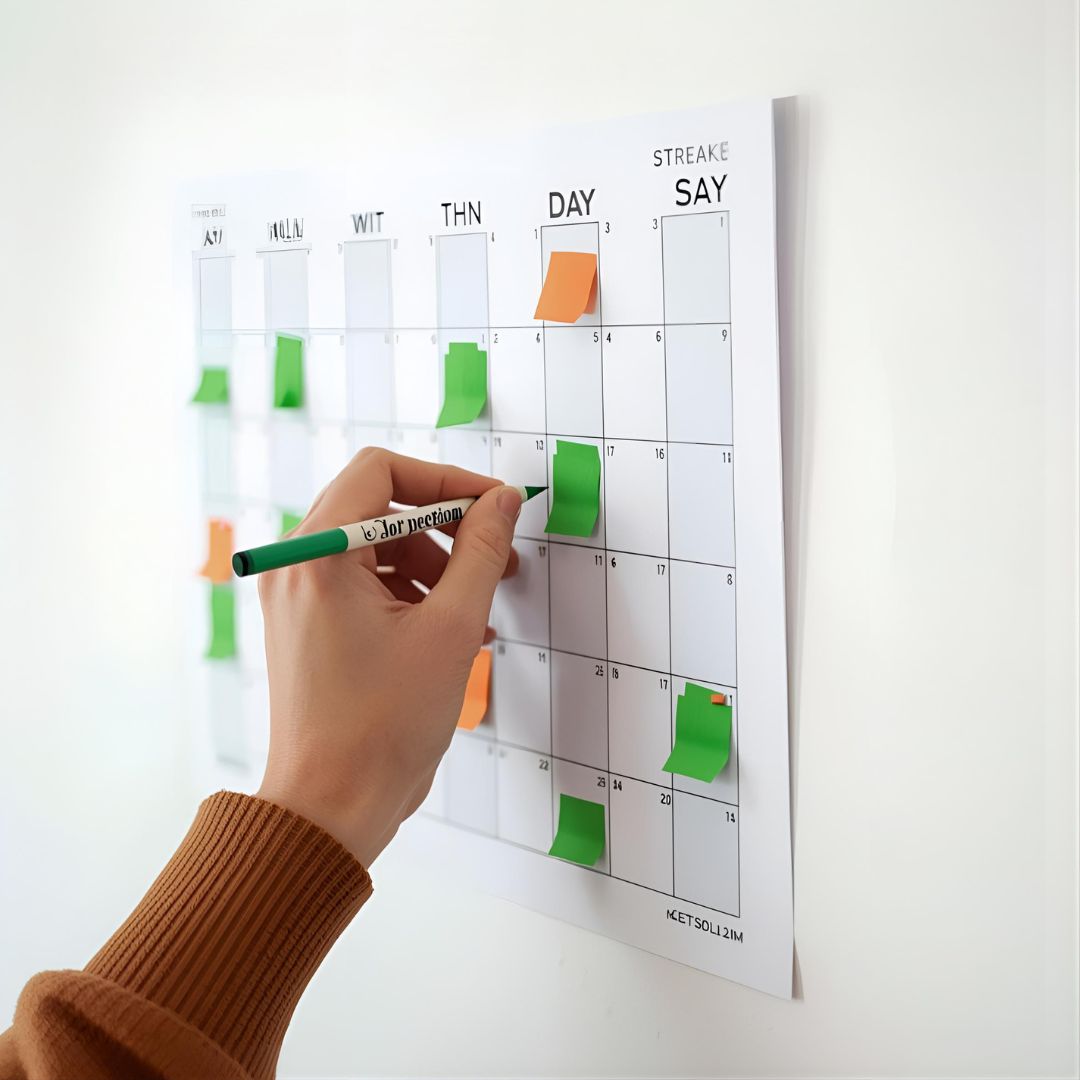
- Streak calendar: Mark green squares for days you complete a focused 45–60 minute study session.
Step 7 — Plan Weekly and Monthly Refreshes
A wall is only as good as your maintenance plan. Designate short refresh rituals so the wall evolves alongside your prep rather than becoming wall art that collects dust.
Refresh rituals
- Every morning (2 minutes): Read your “Why” paragraph and mark today’s focus (e.g., practice reading, timed math problems, or review mistakes).
- Weekly (15–30 minutes): Update score trackers, swap in a new quote, and add one small victory note from the previous week.
- Monthly (30–60 minutes): Re-evaluate goals: if your practice tests show consistent gains, raise the mini-targets; if not, adjust study techniques or schedule a mock test.
Step 8 — Celebrate Milestones
Celebration is a study tool. If you treat milestones as trivial, you’ll be less likely to push through the hard stretches. Make small rewards visible on the wall.
- Attach a small envelope with a treat (movie night voucher, coffee date, or a small purchase) to each milestone box.
- Use colorful stickers or ribbons to mark big wins — the physical act of placing a sticker reinforces achievement.
- Create a “Wins” column where you paste short sticky notes listing what you did well on each practice test.
Step 9 — Use Social Accountability
Studying solo is noble, but accountability boosts consistency. Make space on your wall for accountability commitments.
- Write a short commitment note to a parent, mentor, or friend — their name and a check-in cadence (weekly or biweekly).
- If you work with a tutor, set a visible target discussed during sessions (for example: “This month: improve heart-of-algebra accuracy by 10%”), and update it after each session.
If you choose to pair this with guided support, Sparkl’s personalized tutoring offers 1-on-1 guidance and tailored study plans that can be synchronized with your wall milestones so you’re not guessing how to improve between tests.
Step 10 — Keep It Real: What to Avoid
A few practical pitfalls can turn a brilliant wall into background noise. Avoid these common mistakes:
- Too much info: If you can’t scan it in 5–10 seconds, it’s too crowded.
- Vague goals: “Do better” is not a target. Use numbers and dates.
- Perfectionism: A messy, updated wall beats a perfect, unused one.
- Infrequent updates: Don’t let the wall become a museum piece. Weekly updates keep it alive.
Practical Example: A 12-Week Wall Plan
Below is a sample timeline for how a motivation wall can be used across a 12-week prep cycle. This shows what to add and when so that the wall evolves with your study.
| Weeks | Wall Focus | Action Items |
|---|---|---|
| Weeks 1–2 | Set baseline | Take diagnostic test, set score goals, create “Why” paragraph, pin initial trackers. |
| Weeks 3–6 | Skill building | Add strategy cards, start streak calendar, record mini-skill goals, schedule Sparkl tutoring sessions if wanted. |
| Weeks 7–9 | Practice under pressure | Start timed full-section practices, update score chart, add short-term rewards on milestone envelope. |
| Weeks 10–12 | Polish & test week | Final practice tests, revise target numbers, reduce new learning, focus on review and rest strategies. |
Personalization Ideas to Make the Wall Your Own
Make the wall as personal as possible — that’s what gives it staying power. Here are ideas that work well for different personality types.
If you’re a planner
- Include a visible timeline with every practice test date written in pen.
- Use color-coded sticky notes for daily tasks.
If you’re creative
- Add hand-drawn icons for each section of the test.
- Use mood photos and collaged textures for emotional anchors.
If you’re analytics-driven
- Keep the score chart granular — track subscores by question type.
- Create a mini dashboard that shows time-per-question averages for each section.
How Tutors (and AI) Can Help Your Wall Stay Actionable
A motivation wall looks great, but sometimes students need help turning that motivation into measurable improvement. That’s where a tutor or an AI-assisted coach becomes valuable. A tutor can:
- Help you set realistic benchmarks for each month.
- Teach targeted techniques to improve weak areas shown on your wall trackers.
- Provide accountability by reviewing progress at regular intervals.
When paired with structured supports like Sparkl’s personalized tutoring — which includes 1-on-1 guidance, tailored study plans, expert tutors, and AI-driven insights — your wall becomes part of an adaptive system: the wall shows the “what” and the tutoring shows the “how.”
Quick Templates You Can Copy
Here are three compact templates for different spaces. Each one is easy to print and pin up.
Poster-board template (for full wall)
- Center: “Why I’m Preparing” (3 sentences)
- Left column: Goals table + Timeline
- Right column: Progress trackers + Streak calendar
- Bottom: Strategy cards
Bulletin-board template (for small spaces)
- Top row: Mini “Why” paragraph
- Middle row: 3 index cards — Reading, Writing, Math strategies
- Bottom row: Small pocket with flashcards and a weekly goal card
Digital template (for phone/tablet)
- Morning notification with your “Why” paragraph
- Home screen widget showing current practice streak
- Document with quick strategy cards and recent practice test scores
Final Checklist Before You Start
Use this checklist to make sure the wall is ready to support you.
- Have you written a clear, specific “Why” paragraph?
- Are your score goals numeric and dated?
- Is there a visible tracker you will actually update regularly?
- Did you include at least one emotional anchor and one practical tool?
- Do you have a refresh ritual scheduled (daily, weekly, monthly)?
Closing Thoughts: Small Rituals, Big Gains
A motivation wall is deceptively simple. It’s not a magic fix; it’s a habit architecture that turns vague ambition into daily practice. The wall reduces friction: when you sit down to study, you know what to do and why you’re doing it. That clarity saves time, reduces stress, and increases the likelihood that practice translates into higher scores.
Start small, allow the wall to grow with you, and treat it as a living tool. If you pair the wall with expert support — like occasional sessions from Sparkl’s tutors who can help you turn wall goals into a tailored study plan — you’ll be far more likely to meet and exceed the scores you aim for. Most importantly, the wall should ultimately remind you of something simple: this is not just about a number on a test. It’s about opening doors and building the life you want — one focused study session at a time.
Ready to build yours?
Pick a spot, gather materials, and spend 30–60 minutes creating the first version. Update it weekly, celebrate the small wins, and watch your momentum grow. Good luck — you’ve got this.























No Comments
Leave a comment Cancel