
Why a Growth Mindset Matters More Than Tricks
When you think about SAT success, your mind probably jumps to flashcards, formulas, and full-length practice tests. Those things are important, absolutely. But underneath every high-score story is a quieter ingredient: the belief that your abilities can improve with effort. Psychologist Carol Dweck calls this a growth mindset. Students with a growth mindset see the SAT not as a single immutable gatekeeper, but as a challenge that rewards practice, reflection, and smart strategy.
If you’ve ever felt crushed by a low practice score or paralyzed by the idea that “I’m just bad at math,” the good news is simple: those are thoughts, not facts. With techniques you can learn and habits you can build, your score can change significantly. This post gives you a practical, human-centered guide to developing that mindset and translating it into measurable SAT gains.
Understand What a Growth Mindset Actually Is
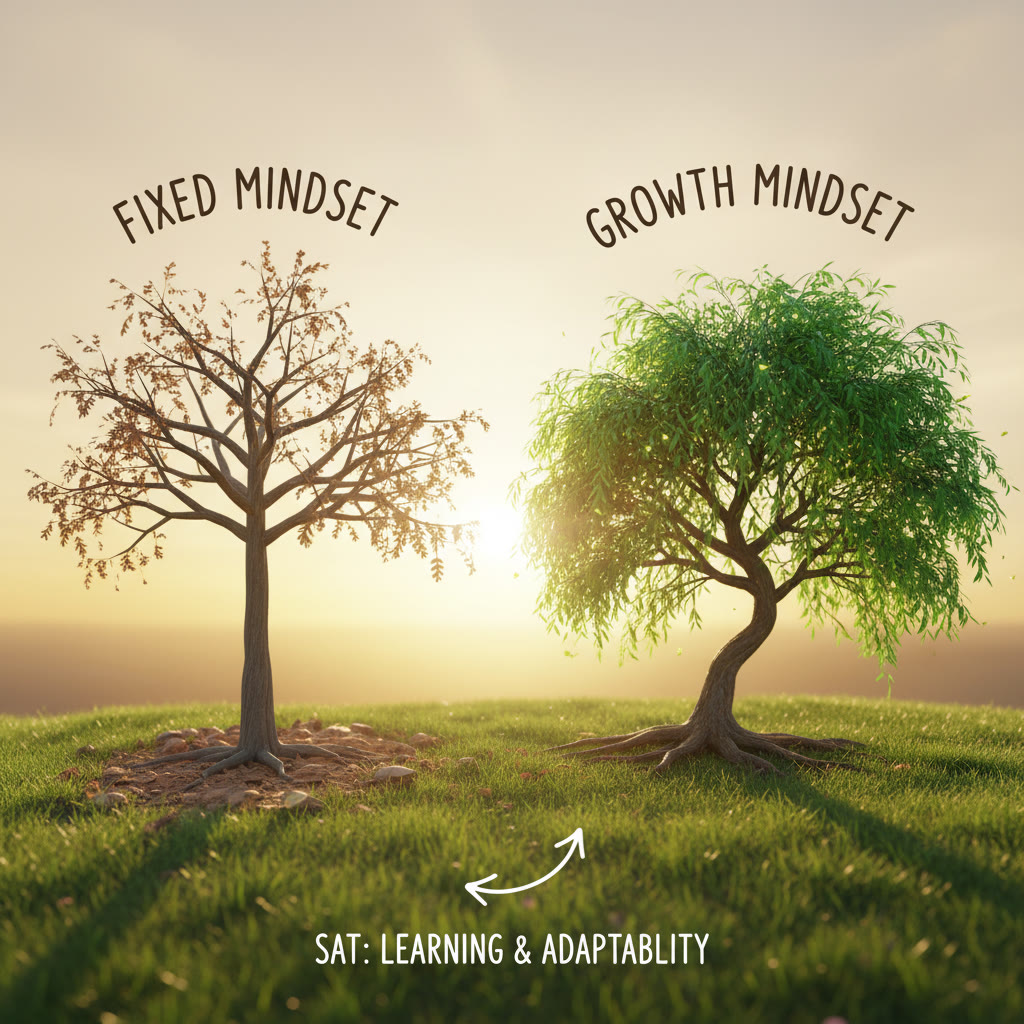
A growth mindset means you view abilities as improvable. Contrast that with a fixed mindset where abilities are seen as static—something you either have or you don’t. The difference affects how you react to setbacks:
- Fixed mindset reaction: “I got a 620 on practice; I’m not cut out for the SAT.”
- Growth mindset reaction: “I got a 620 on practice; here are specific mistakes to fix before next time.”
This may sound like mere semantics, but it changes the next action. One thought leads to giving up; the other leads to a plan. And plans beat random studying every time.
How a Growth Mindset Looks on a Day-to-Day Basis
On a practical level, a growth mindset shows up as habits and responses:
- You seek feedback and actually use it.
- You prefer hard practice that targets weak spots over easy repetition.
- You frame mistakes as data—information about what to change—not as proof of inability.
- You set process goals (hours of deliberate practice) not just outcome goals (scores).
These shifts turn study time into learning time.
Step-by-Step Plan to Build a Growth Mindset for the SAT
1. Reframe Errors as Discoveries
Mistakes are the SAT’s gift to you: they tell you exactly which rule or skill you haven’t mastered yet. Try this practice after each practice test or problem set:
- Record the mistake: what went wrong and why.
- Write the correct reasoning in one sentence.
- Plan one targeted drill to avoid the same mistake next time.
When you treat errors as experiments, anxiety fades and curiosity grows.
2. Break Skills into Micro-Goals
The SAT is a big mountain. Your job is to climb it one step at a time. Instead of “get better at reading,” choose micro-goals like:
- Improve evidence-based reading: identify the line number for the main claim in 8 of 10 practice questions.
- Improve algebraic manipulation: complete a 10-minute a-day equation drill for a week.
Micro-goals are easier to track and celebrate, and they rewire your brain to notice progress.
3. Adopt Deliberate Practice
Deliberate practice is focused, effortful work on skills just beyond your comfort zone, with immediate feedback. For the SAT, that might mean:
- Timing individual sections and then analyzing pacing errors.
- Working a set of geometry problems where you only allow yourself to use a particular theorem.
- Practicing editing passages but forcing yourself to justify each change in writing.
Deliberate practice is more valuable than passive review. An hour of targeted practice yields more learning than three hours of unfocused study.
4. Use an Error Log and Reflect Weekly
Create a simple error log: date, question type, mistake cause (concept, careless, timing), correction, and follow-up drill. Every week, scan the log and pick two recurring themes to practice. Reflection is where growth happens—many students practice but don’t pause to translate mistakes into plans.
5. Embrace Productive Discomfort
Growth requires discomfort—struggling with a problem, slowing down to parse a passage, staying calm when you see a novel question type. Label that feeling: “This is productive discomfort.” Naming it reduces stress and helps you keep going.
Practical Routines That Reinforce a Growth Mindset
Routines make attitudes tangible. Here are routines that repeatedly nudge you toward growth thinking.
Daily Routine
- 20–40 minutes of focused practice on one micro-skill (no digital distractions).
- 10 minutes of error log updates and a quick reflection sentence: “Today I learned…”
- Brief stretch or breathing exercise to reset after intense focus—mindset thrives when your body is calm.
Weekly Routine
- One timed practice section under test-like conditions.
- Post-section review with an error-log deep dive.
- One session to practice strategies (e.g., process of elimination, backsolving) without worrying about speed.
Monthly Routine
- A full-length practice test to measure trends, not single scores.
- Set a process goal for the next month based on the trend (e.g., “reduce careless errors by 30% on Math”)
- Check in on mental habits: are you blaming, avoiding, or planning?
Sample 8-Week Growth-Oriented SAT Study Plan
The following table illustrates how you might structure concentrated work with a growth mindset. Notice the balance: focused skill blocks, deliberate practice, and regular reflection.
| Week | Focus | Practice Type | Goal |
|---|---|---|---|
| 1 | Reading: Main idea & evidence | Short passages + error log | Identify evidence line in 9/10 questions |
| 2 | Writing: Punctuation & expression | Grammar drills + timed sections | Cut grammar errors by half |
| 3 | Math No Calculator: Algebra basics | Problem sets with step-by-step write-ups | Solve algebra problems without calculator in under 2.5 min |
| 4 | Math Calculator: Functions & geometry | Targeted drills + formula review | Improve accuracy on geometry problems |
| 5 | Full Strategy: Pacing & skipping smartly | Section simulations | Reduce timing errors by 30% |
| 6 | Mixed practice & error log consolidation | Mixed sets + reflection | Target two recurring weaknesses |
| 7 | Timed full sections | Three practice sections + review | Maintain accuracy under timed pressure |
| 8 | Test simulation & calm routines | Full-length test + mindfulness prep | Execute test plan with controlled anxiety |
Mindset Tools: What to Say to Yourself
What you say matters. The inner monologue either builds you up or tears you down. Swap out these phrases:
- Instead of “I’m not good at this,” try “I’m not good at this yet.”
- Instead of “That was dumb,” try “That was a useful mistake; what did it teach me?”
- Instead of “I don’t have time,” try “I can make time for one focused session today.”
Language shapes behavior. These subtle shifts reinforce the idea that effort leads to growth.
Study Strategies That Pair Well With a Growth Mindset
A growth mindset becomes powerful when combined with evidence-based learning techniques. Here are a few you can adopt immediately:
- Spaced repetition: Review a concept several times over increasing intervals to move it into long-term memory.
- Interleaving: Mix problem types in a practice session so your brain learns to identify cues and choose the right method.
- Active recall: Test yourself without looking at notes; retrieval practice strengthens memory.
- Feynman technique: Explain a difficult concept in simple language to confirm true understanding.
These techniques help you learn faster and help your growth mindset by making progress visible.
Real-World Examples and Short Stories
Consider Maya, a student who started with a 580 practice score. She believed she “wasn’t a math person.” Instead of avoiding math, Maya kept an error log, practiced algebra micro-skills for 30 minutes daily, and sought feedback. After eight weeks, not only did her score rise to 700, but she reported feeling more confident because she could point to specific improvements—faster equation solving and fewer careless sign errors. The score reflected a process, not luck.
Or take Jamal, who plateaued for months. He introduced deliberate practice: timing single passages and forcing himself to explain evidence choices in one sentence. That tiny change helped him move from guessing the answer to justifying it. He didn’t just memorize strategies—he built reasoning habits.
How to Use Feedback Without Getting Discouraged
Feedback is gold, but only if you interpret it constructively. When you get a wrong answer, resist immediate emotional reactions. Instead:
- Identify the root cause (knowledge gap, misread, calculation error, or time pressure).
- Decide on one focused drill geared to that cause.
- Test the drill in a small session and see if the error reduces.
Over time, the pattern of fewer repeated mistakes is proof that your practices are working. Those small wins build momentum.
Test Day: Bringing Growth Mindset to the Exam Room
The test day is a mindset test as much as a knowledge test. Use these pre-planned strategies to translate your growth mindset into calm performance:
- Start with a brief breathing routine to settle nerves.
- Set a process intention: “I will read carefully and mark problems to return to.”
- If you hit a hard question, label it: “This is a challenge, not a threat.” Move on and return later—avoiding sunk-cost thinking.
- Celebrate small wins during the test (finished a section early, caught an algebra sign error) to keep spirits up.
These habits keep you strategic rather than emotional under pressure.
How Tutoring and Guided Feedback Accelerate Growth
People often plateau because they practice the wrong things. Expert guidance helps you focus where growth is fastest. That’s where tailored support becomes powerful: targeted feedback shortens the path from mistake to mastery. For many students, working with a coach or tutor removes guesswork—you’re not just practicing; you’re practicing the right things.
Sparkl’s personalized tutoring blends 1-on-1 guidance, tailored study plans, and expert tutors with AI-driven insights to highlight blind spots quickly. That combination lets you spend more time on high-leverage skills and less time on surface-level review. Tutors also model a growth mindset: they reframe setbacks, give precise feedback, and teach habits that make improvement predictable.
Measuring Progress Without Obsessing Over the Score
Scores matter, but single numbers can mislead. Focus on trends and process metrics:
- Number of recurring error types reduced.
- Time saved per problem type.
- Accuracy on targeted drills.
- Calmness and clarity during timed sections.
Celebrate when these process metrics improve. They are the fingerprints of a true growth trajectory.
Common Pitfalls and How to Avoid Them
Even with the best intentions, students stumble. Here are common traps and how to handle them:
- Perfection paralysis: Trying to perfect every question kills momentum. Aim for steady improvement, not perfection.
- Random practice: Without a plan, you’ll make minimal gains. Use error logs and micro-goals to focus sessions.
- Ignoring mental skills: Test anxiety and pacing ruin scores. Practice under realistic pressure and add calming routines.
- Comparing prematurely: Compare your progress to your past self, not to your peers.
Final Checklist: Your Growth-Minded SAT Prep Kit
- An error log you update after every practice.
- Weekly reflection time (15–30 minutes).
- Micro-goals that break skills into measurable steps.
- Deliberate practice sessions (short, focused, feedback-driven).
- Monthly full-length tests to check trends.
- A calm test-day routine and a plan for hard questions.
- If you want extra structure, consider 1-on-1 guidance—Sparkl’s personalized tutoring can help tailor study plans and deliver expert feedback to accelerate growth.
Parting Thought: Growth Is a Habit, Not a Moment
Developing a growth mindset isn’t a dramatic switch. It’s a series of tiny bets on effort and reflection—showing up for ten focused minutes, chasing the cause of an error instead of panicking, choosing to learn from a tough section. Over time, those small decisions add up into a big change: better scores, yes, but more importantly, the confidence that when you tackle a hard problem, you’ll get better.
Approach SAT prep like a scientist: test hypotheses, collect data, adjust methods, and repeat. Combine that approach with the emotional resilience of a growth mindset and you’ll not only be ready for the SAT—you’ll be ready for the next challenge after it. Good luck, and remember: the path up the mountain is built one steady step at a time.



























No Comments
Leave a comment Cancel