
Introduction: Why SAT Stress Isn’t Just “Bad Nerves”
Let’s be honest—feeling jittery before the SAT is normal. It’s a high-stakes test with implications for college admissions, scholarships, and long-term plans. But stress is not a single villain; it’s a complex, sometimes useful signal. When harnessed correctly, it can sharpen focus and motivate action. When ignored or mismanaged, it burns energy, erodes confidence, and sabotages performance.
This guide walks you through healthy, practical ways to manage SAT prep stress. You’ll find science-backed tactics, real-world examples, sample schedules, and quick tips you can apply right away. And if you ever need extra support, Sparkl’s personalized tutoring and benefits—like 1-on-1 guidance, tailored study plans, expert tutors, and AI-driven insights—can be a calm, effective partner in your journey.
Understand What Stress Is and Why It Happens
The biology behind test anxiety
Stress activates the body’s alarm system: your sympathetic nervous system. Cortisol and adrenaline surge, your heart rate rises, and your breathing changes. In short bursts, that response can boost alertness. But prolonged activation interferes with memory retrieval and logical thinking—the exact skills you need on the SAT.
Common psychological patterns
- Catastrophizing: imagining the worst-case scenario (“If I fail, everything’s ruined”).
- Perfectionism: feeling like anything less than perfect is unacceptable.
- Comparison: measuring yourself against peers or glossy success stories.
- Overwhelm: too many tasks with unclear priorities.
Recognizing these patterns is the first step. They’re not facts—they’re thoughts you can label and adjust.
Daily Habits That Reduce SAT Stress
Sleep: not negotiable
Sleep consolidates memory and sharpens reasoning. Aim for 7–9 hours nightly. The night before long study sessions or practice tests, prioritize earlier sleep rather than late cramming; that extra rest often yields higher scores than an extra hour of study.
Nutrition: fuel for the brain
Steady blood sugar equals steady focus. Build meals around complex carbs (whole grains), lean proteins, healthy fats, and colorful vegetables. A sample breakfast: oatmeal with nuts and a piece of fruit. Avoid heavy sugary drinks right before a practice test; they can create energy crashes.
Movement: 20–40 minutes of intentional activity
Exercise releases endorphins and reduces anxiety. You don’t need mega-workouts; brisk walking, cycling, a quick HIIT routine, or a short yoga flow before study can improve mood and concentration.
Micro-breaks and the Pomodoro approach
Work in focused bursts—25–50 minutes—followed by short breaks. Use breaks to stand up, stretch, or do a breathing exercise. This keeps the brain fresh and prevents the drained feeling that comes from marathon study sessions.
Study Strategies to Prevent Burnout
Quality over quantity
Two hours of active, targeted study beats five hours of passive reading. Active methods include:
- Practice problems under timed conditions.
- Explaining concepts aloud as if teaching someone else.
- Spacing study sessions over days (spaced repetition).
- Mixing subjects to build retrieval strength (interleaving).
Design a realistic practice-test schedule
Taking a full-length practice test every week or two is helpful, but cram-free. Analyze only one or two key weaknesses after each test, then design two small goals for the next week. This focused loop reduces feelings of helplessness and makes progress measurable.
Use targeted review, not blanket coverage
Rather than redoing everything, target patterns: weak grammar rules, algebra skills, or reading-comprehension techniques. Each weak spot you fix multiplies returns in future practice.
Mindset and Cognitive Tools
Label thoughts, don’t believe them automatically
When a worry pops up—”I’m going to forget everything”—label it: “That’s a worrying thought.” This small act separates you from the thought and lowers its power. Over time, labeling trains the brain to respond rather than react.
Set process goals instead of outcome goals
Outcome goals focus on scores. Process goals focus on actions: “I will complete three timed math sections this week” is a process goal. These are more controllable and reduce anxiety about unknown outcomes.
Visualization and practical rehearsal
Visualization isn’t magic; it’s rehearsal for performance under pressure. Spend five minutes imagining walking into the test center, sitting down, and calmly working through the first section. Pair visual rehearsal with deep breathing to link calm physiology to confident imagery.
Practical Techniques for Test Day Calm
Breathing and grounding techniques
- Box breathing: inhale 4, hold 4, exhale 4, hold 4. Repeat four times.
- 5-4-3-2-1 grounding: identify 5 things you see, 4 you can touch, 3 you hear, 2 you smell, 1 you taste (or a remembered taste). This pulls attention into the present.
Simple warm-up routine for the first 10 minutes
Arrive early to the test center. Use the first five minutes to rhythmically breathe and scan your checklist. Use the next five minutes to preview the first section’s format and briefly remind yourself of one test strategy. Small rituals like these create calm and predictability.
When Stress Turns Into a Roadblock
Recognize signs of chronic stress or burnout
If studying becomes dread, concentration collapses, or sleep and appetite are disrupted for weeks, you might be approaching burnout. Symptoms to watch for include persistent fatigue, irritability, and a sense of helplessness.
Practical recovery steps
- Take a planned break: a day unplugged from SAT work to reset.
- Reduce intensity: substitute practice tests with light review and strategy work for a week.
- Reach out: talk to a counselor, teacher, or a trusted tutor about workload and feelings.
Recovery is not a setback; it’s a strategic recalibration that protects your long-term performance.
How to Build a Stress-Resistant SAT Prep Plan
Step 1: Audit your starting point
Take one timed practice test to identify baseline strengths and weaknesses. Don’t treat the score as destiny; treat it as data.
Step 2: Prioritize three focus areas
Pick three things to improve each study cycle—two content skills and one test strategy or habit. For example: algebra error patterns, sentence structure, and timed pacing for Reading sections.
Step 3: Block time and protect rest
Create study blocks no longer than 90 minutes and schedule at least one full rest day a week. Protecting downtime reduces chronic stress and improves long-term retention.
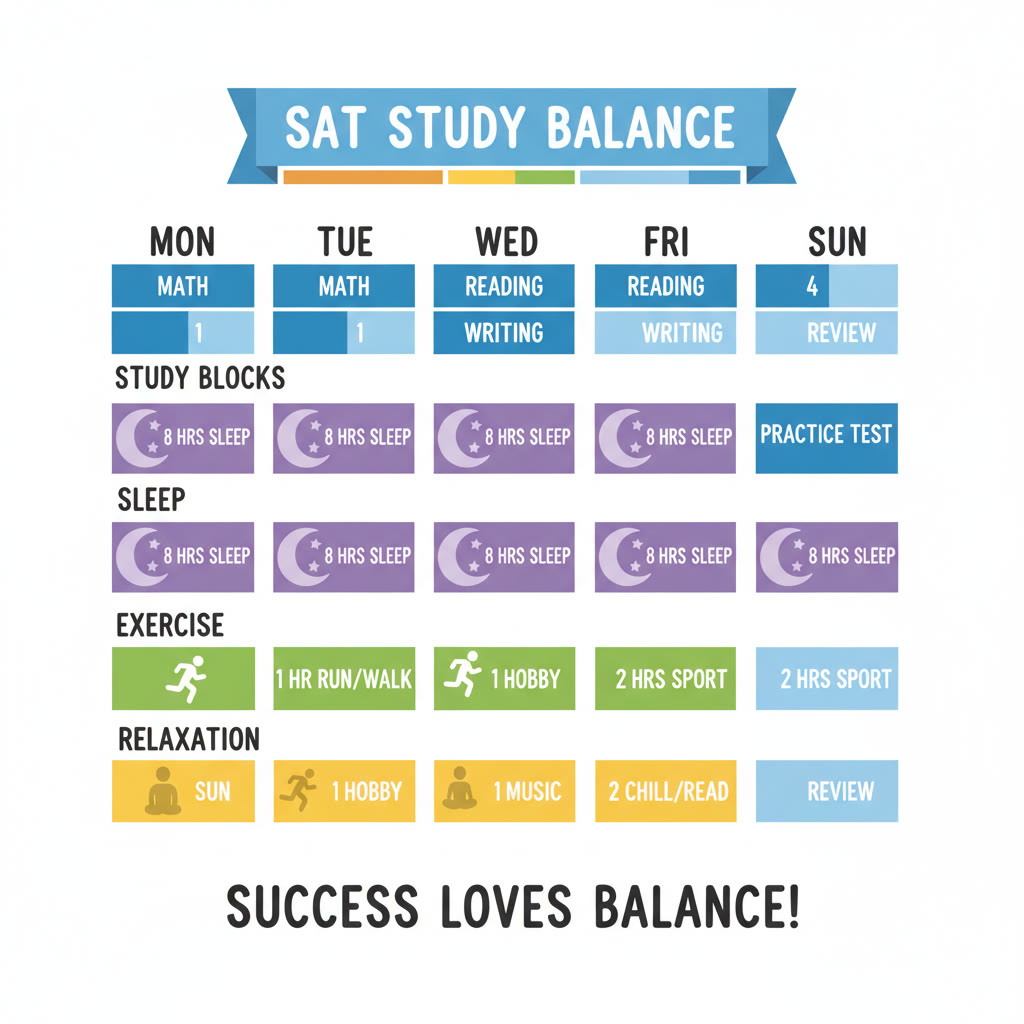
Sample weekly plan that balances practice and recovery
| Day | Study Focus (60–90 min blocks) | Stress-Reduction Activity |
|---|---|---|
| Monday | Math: Problem sets on linear equations | 20-min walk or yoga |
| Tuesday | Reading: timed passage practice | Breathing exercises (10 min) |
| Wednesday | Writing: grammar drills and explanations | Social time with friends |
| Thursday | Mixed sections: timed sets | Light stretching and early bed |
| Friday | Review errors and create mini-goals | Hobby time (music, art, reading) |
| Saturday | Full-length practice test (timed) | Active recovery: team sport or long walk |
| Sunday | Light review and strategy planning | Day off from intensive studying |
Tools and Supports That Lower Stress
Practice tests and accurate feedback
Practice is calming when it’s deliberate and diagnostically useful. Use tests to find patterns, not to punish yourself. Focus on two to three improvements per cycle and celebrate small wins.
Tutoring and coaching
One-on-one support can dramatically reduce uncertainty and confusion. Sparkl’s personalized tutoring and benefits—like 1-on-1 guidance, tailored study plans, expert tutors, and AI-driven insights—help many students translate anxiety into structured progress. A tutor can show which errors are one-off slips and which require a targeted skill plan, helping you spend study time wisely and feel more in control.
Study groups and accountability partners
Working with peers can normalize the process and reduce isolation. Keep group sessions short and focused: one student explains a concept, another quizzes, and a third reviews timing strategies. That social support often lightens the emotional load of prepping alone.
Real-World Examples: What Works for Different Students
Case study 1: Sam, the perfectionist
Sam spent hours redoing sections until they were flawless, then felt burned out. After shifting to process goals—three timed sections per week and two micro-goals per test—Sam improved accuracy and regained time for rest. The result was a steadier mood and a 60-point increase in composite score over two months.
Case study 2: Aisha, the procrastinator
Aisha avoided practice tests because she feared failure. Her tutor suggested starting with 30-minute timed sections and celebrating small steps. Pairing short practice bursts with accountability check-ins built momentum. Over time, Aisha moved to full-length tests and reported less dread and better concentration on exam day.
Case study 3: Miguel, the sleep-deprived crammer
Miguel thought more hours meant better scores. After tracking performance, he discovered that scores dipped after nights with under 6.5 hours of sleep. He prioritized sleep and swapped late-night study for shorter morning sessions. His jitteriness decreased and test-day focus improved noticeably.
Final Checklist: Calm, Confident, and Prepared
- Set clear, small process goals for each study cycle.
- Include sleep, food, and movement in your prep plan.
- Schedule regular full-length practice tests with focused review goals.
- Practice breathing and grounding techniques for test day.
- Use targeted help—tutors, coaches, or personalized programs—when patterns persist.
- Plan at least one day off each week to recover mentally.
Quick Reference: Stress-Busting Toolbox
| Problem | Action | Timeframe |
|---|---|---|
| Racing thoughts before a section | Box breathing for 2 minutes | Immediate |
| Consistent algebra errors | Targeted 20-min drills, tutor review | Weekly until improved |
| Procrastination around practice tests | 30-minute timed practice, accountability partner | Daily, then build up |
| Feeling overwhelmed | Take a planned day off and re-prioritize 3 goals | Immediate |
Wrapping Up: Stress Is Manageable—and Useful
SAT stress doesn’t have to be paralyzing. When you treat it like information—an indicator that something needs adjustment—you can respond with habits that build resilience and sharpen performance. Adopt sleep, nutrition, and movement as baseline defenses. Use focused, active study instead of passive marathon sessions. Practice simple breathing and grounding techniques for immediate calm. When needed, bring in support; Sparkl’s personalized tutoring and benefits can offer targeted explanations, tailored study plans, and AI-driven feedback that turn worry into progress.
Most importantly, be kind to yourself. Progress is rarely linear. There will be hard practice tests and frustrating weeks, but each small, consistent choice moves you closer to the outcome you want. Treat preparation as training for both knowledge and calm. You’ll not only walk into test day more prepared—you’ll walk in steadier, more confident, and ready to perform.
























No Comments
Leave a comment Cancel