
Introduction: Yes, You Can Make Real Progress in 30 Days
Thirty days sounds tight. Maybe it feels panic-inducing. But with a clear plan, focused practice, and some smart trade-offs, you can raise your confidence and scores meaningfully. This guide walks you through a gentle, realistic 30-day schedule, offers practical strategies for Reading, Writing, and Math, and shows when to bring in extra help. Along the way you’ll find examples, comparisons, and small rituals that make studying less like a grind and more like steady progress.
Why a 30-Day Plan Works (If You Do It Right)
Short timelines force clarity. When you only have a month, you stop wasting time on low-impact actions and focus on what’s proven to move the needle: targeted practice, timing drills, review of mistakes, and simulated tests. In thirty days you can:
- Identify and fix the most frequent errors you make.
- Build test-taking stamina with realistic practice tests.
- Learn key strategies and shortcuts that save time during the test.
- Polish timing and pacing so you finish calmly.
Think of 30 days as triage plus targeted treatment. You won’t master every obscure question type, but you can close the biggest gaps and gain the most points.
Start Smart: Day 1 Diagnostic and Goal Setting
Begin with a real diagnostic test under timed conditions. Use an official full-length SAT practice test if you can. The goal isn’t to feel defeated — it’s to map pain points. Track:
- Section scores and raw mistakes.
- Types of errors: careless, timing, conceptual, or interpretation.
- Time spent per question on average.
Set a realistic target: a score you can reach in 30 days with disciplined practice. Base it on the gap between your diagnostic and typical progression — a 30–150 point increase is common for focused month-long plans, depending on starting place and hours committed.
Blueprint: A 30-Day Weekly Structure
Break the month into four weeks with escalating intensity. Each week combines concept work, strategy drills, and one full-length practice test. Below is a simple blueprint you can adjust to your schedule.
| Week | Primary Focus | Daily Time | Key Activities |
|---|---|---|---|
| Week 1 | Diagnostic review, fundamentals, pacing | 1–2 hours | Review diagnostic, focused concept sessions (grammar rules, algebra), daily 30-minute timed drills |
| Week 2 | Strategy building and targeted practice | 1.5–2.5 hours | Practice passages, math problem sets, timing techniques, error logs |
| Week 3 | Simulated testing and weak-spot remediation | 2–3 hours | 2 full-length tests this week, in-depth review of missed questions, targeted mini-lessons |
| Week 4 | Polish, pacing, and test-day readiness | 1–2 hours (taper week) | One final full test, light review, strategy checklist, rest and sleep routines |
Daily Micro-Structure (Example)
- Warm-up: 15 minutes of quick drills (grammar or algebra flashcards).
- Core study: 45–90 minutes focused on one section (Reading or Math) with timed practice.
- Review: 20–40 minutes analyzing mistakes and logging them.
- Cooldown: 10 minutes of light reading or relaxation practice.
How to Organize Practice: Quality Over Quantity
Not all practice is equal. The best practice loops include: attempt → check → analyze → correct → re-test. Resist the temptation to do endless problem sets without review. The most valuable minute is the one you spend understanding why you missed a question.
Keep an Error Log
After every practice block, record each missed question with a short note: error type, why you missed it, and a quick strategy to avoid it next time. Over weeks, patterns emerge. Maybe commas trip you up, or you consistently run out of time on grid-in math. Tackle the frequent items first.
Reading and Writing: Practical Tactics That Save Time
Reading and Writing rely on comprehension, pattern recognition, and elimination. Here are concrete moves to improve faster.
Reading
- Skim strategically: For long passages, read the first paragraph and last sentence sentence of each paragraph to grasp arc and tone, then tackle questions.
- Underline carefully: Mark names, dates, relationships, and contrast words (however, but, although).
- Answer evidence questions second: If the SAT asks for a line support, choose the answer that matches your interpretation, then choose the evidence that most directly supports it.
- Practice active reading: Summarize paragraphs in one short phrase in the margin of your scratch paper.
Example: On a passage about public parks, note “parks = urban renewal + community benefit” after reading. That quick summary helps answer inference questions faster.
Writing and Language
- Master common grammar rules: subject-verb agreement, pronoun clarity, verb tense consistency, modifiers.
- Look for conciseness: The SAT prefers clear, direct phrasing over wordiness.
- Read the whole sentence: Some answer choices look right until you consider the sentence context.
Drill rule banks during week 1 and then return to small timed sets to build automaticity.
Math: Strategy, Not Just Speed
Math items reward correct reasoning and clean work. In 30 days you can shore up algebra, problem solving, and the most common geometry and data concepts that appear on the test.
Smart Math Habits
- Estimate first: If an answer can be quickly estimated, use that to eliminate choices.
- Plug in numbers: For abstract or parameterized problems, substitute simple numbers to test structurally.
- Use the answer choices: Work backward from an answer when appropriate, especially in multiple choice.
- Practice mental math: Fraction, percentage, and quick algebra manipulations will save time and reduce small arithmetic errors.
Example: For a problem asking “If x is 60% of y and y is 50% of z, what fraction is x of z?” You can compute mentally: x = 0.6y, y = 0.5z so x = 0.6(0.5z) = 0.3z → 3/10.
Timed Practice Tests: The Core of the Last Three Weeks
Take full-length, timed practice tests under realistic conditions. Treat them like the actual exam: start with the timer, use scratch paper, and follow the break schedule. After each test, spend more time reviewing than you did taking it. A thorough review is where the score improvement happens.
Test Review Checklist
- Identify careless errors vs. concept errors.
- Group missed questions by type (e.g., comma splices, quadratic setup).
- Rewrite the correct solution and note the key insight that would have led you to it quicker.
- Schedule a mini-lesson for each recurring topic you miss.
What to Do in the Final Week: Taper and Focus
The last week is about consolidation, not cramming. Reduce study hours slightly to avoid burnout and prioritize:
- One final full-length test early in the week, with a careful review.
- Targeted review sessions on your top 5 recurring errors.
- Light timed practice to keep your rhythm.
- Sleep, hydration, and a short physical routine to manage nerves.
Avoid learning new heavy topics in the final 72 hours. Instead, drill what you already know and remove friction from test-day logistics.
Sample 30-Day Calendar (Quick Reference)
| Day | Focus | Activity |
|---|---|---|
| 1 | Diagnostic | Full practice test, score, error log |
| 2–7 | Foundations | Grammar rules, algebra review, short timed drills each day |
| 8–14 | Strategy | Section strategies, targeted problem sets, one mini-test |
| 15–21 | Simulate | Two full tests, deep reviews, remediate weak spots |
| 22–29 | Polish | Final full test, focused reviews, timing drills, light practice |
| 30 | Rest & Test Ready | Light review, sleep early, pack test essentials |
When to Ask for Help (And How Sparkl Can Fit In)
Some students thrive on self-study; others make faster gains with expert guidance. If after one week your diagnostic review shows persistent patterns you can’t fix on your own, that’s a sign to bring in support. Sparkl’s personalized tutoring can be especially helpful in short timelines for reasons like:
- 1-on-1 guidance that targets your specific error patterns instead of generic lessons.
- Tailored study plans that compress high-impact practice into limited hours.
- Expert tutors who quickly diagnose misconceptions and model problem-solving shortcuts.
- AI-driven insights that highlight weaknesses and track progress across your 30-day journey.
When time is short, a tutor can help you avoid dead-ends, practice the right things, and build confidence faster than trial-and-error alone.
Test-Day Logistics and Mindset
Preparation isn’t just academics. Test day is about logistics and mental habits that reduce friction and keep you calm.
Checklist the Night Before
- Admission ticket or confirmation, photo ID, calculator with fresh batteries, extra pencils, snacks, and water.
- Lay out comfortable clothes and plan transportation to arrive early.
- Sleep at least 7–8 hours; avoid late-night cramming.
Mental Routine for the Morning
- Have a balanced breakfast with protein and slow carbs.
- Do 5–10 minutes of breathing or light stretching to center yourself.
- Use positive self-talk: “I prepared well. I will pace myself.”
Common Mistakes Students Make in a 30-Day Push
- Skipping review: Doing problems without analyzing mistakes.
- Mixing too many new strategies at once: change only one habit at a time.
- Neglecting sleep and health: reduced cognition kills accuracy and timing.
- Over-reliance on shortcuts without understanding: they often fail on tricky problems.
Practical Mini-Drills You Can Do Anywhere
When time is short, small drills add up. Do these during commutes or breaks:
- Grammar flashcards: 5 cards in 5 minutes.
- Mental math set: 10 quick fraction/percent conversions in 10 minutes.
- One short reading passage: summarize it in one sentence and answer 3 questions.
Realistic Expectations: What Improvement Looks Like
If you commit to 1.5–3 hours per day for 30 days with disciplined review and at least 3 full-length tests, expect a meaningful jump. The actual points depend on your starting score and how well you identify and fix high-frequency errors. Students who concentrate most hours on their weakest section typically see larger gains there — which is why a tailored plan matters.
Closing Advice: Keep Curiosity and Momentum
Thirty days is short but powerful. Use the timeline to focus, not to freak out. Be kind to yourself: small, consistent improvements matter more than last-minute panic. Keep an error log, simulate tests under realistic conditions, and practice the pacing that lets you finish confidently.
If you find yourself stuck on certain question types or you want a compact, individualized plan, Sparkl’s personalized tutoring can offer fast, targeted support: one-on-one sessions to shore up trouble spots, tailored study plans to maximize every hour, and AI-driven insights that help you focus on what actually moves your score. When time is tight, smart help is an efficient shortcut.
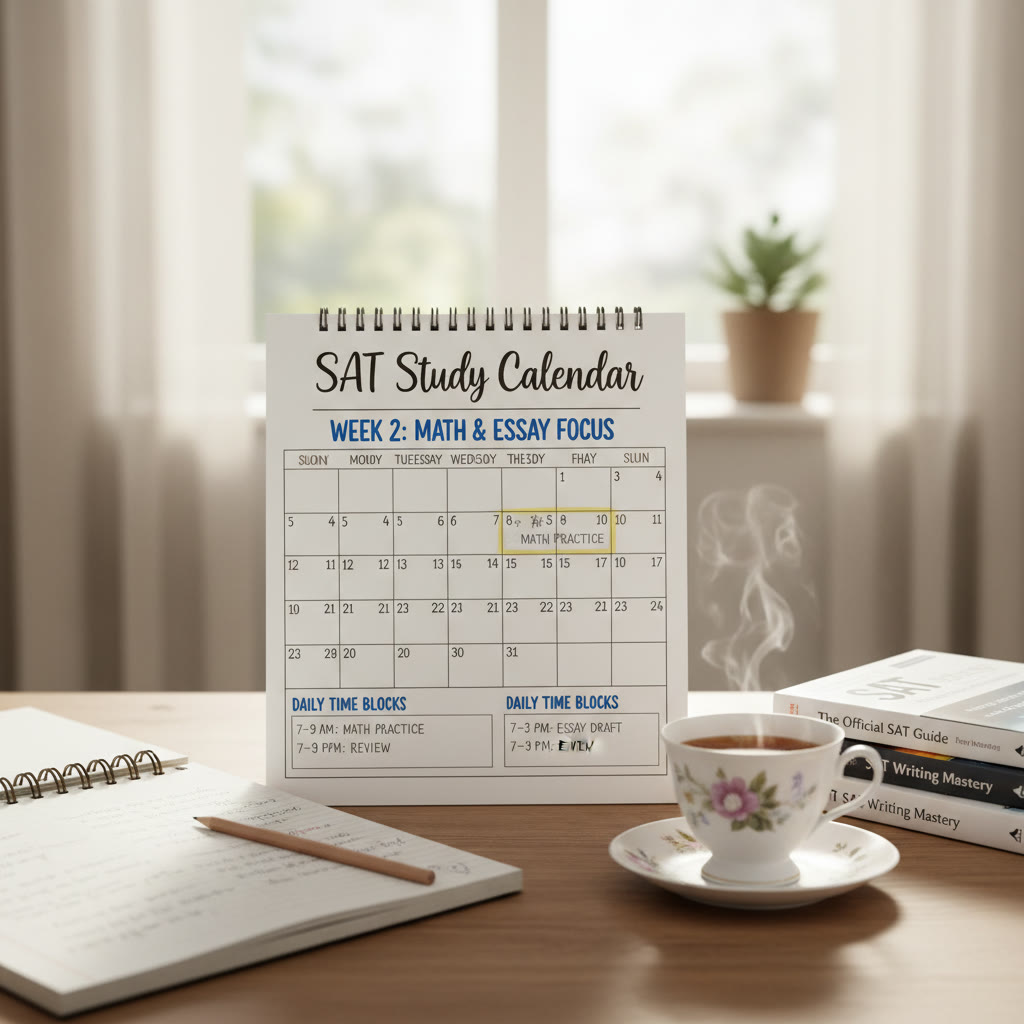

Final Checklist: Your 30-Day Survival Kit
- Day 1 diagnostic and error log started.
- Weekly schedule printed or saved on your phone.
- At least three full-length practice tests scheduled across the month.
- Targeted mini-lessons planned for recurring error types.
- Rest, nutrition, and a clear test-day routine ready to go.
Parting Thought
A month of steady, intentional work can leave you calmer, sharper, and measurably better on test day. Follow the plan, learn from mistakes deliberately, and don’t be afraid to ask for focused help if you need it. With clarity, a few good strategies, and consistent practice, you can make 30 days count.




















No Comments
Leave a comment Cancel