
How to Prepare for the SAT With Just Weekend Study
Life is busy: classes, part-time jobs, sports, family commitments. If weeknights are full and you can only dedicate two concentrated days to SAT prep, that doesn’t mean defeat — it means smart strategy. This guide shows you how to turn weekends into high-impact study sessions that raise your score, preserve your energy, and keep your sanity.
Why weekend-only prep can work
There’s a myth that effective SAT preparation requires daily drills. In reality, focused, intentional practice beats scattered effort. Weekends give you longer uninterrupted blocks for deeper learning: uninterrupted reading, full math problem sets, and timed section practice. When you structure those blocks well, the weekend model can produce dramatic gains.
What to know about the SAT before you begin
Before you design a weekend routine, understand the test’s shape. The SAT has two main sections: Evidence-Based Reading and Writing (EBRW) and Math. The optional Essay has been discontinued for most uses; double-check your colleges’ requirements, but plan primarily for EBRW and Math.
- Evidence-Based Reading and Writing: tests critical reading, command of evidence, grammar, and expression of ideas.
- Math: covers algebra, problem solving & data analysis, and some advanced topics. There are calculator and no-calculator portions.
- Scoring and timing: 1600 total (800 EBRW + 800 Math). Timing is tight: practicing under timed conditions is essential.
Principles for efficient weekend study
Let these operating rules guide your weekends:
- Quality first: choose focused activities (timed practice, error analysis, targeted drills) rather than mindless question volume.
- Active learning > passive reading: do problems, then teach back the solution or write a short explanation.
- Spacing and repetition: revisit tough concepts on subsequent weekends to move them into long-term memory.
- Consistent analysis: every practice test or timed section must end with an error log and a short plan for next weekend.
Designing your timeline: how many weekends do you need?
The right number of weekends depends on starting point and target score. Here are three common scenarios and realistic timelines when studying only on weekends:
- Casual booster (1–2 months): already scoring near your target, need to polish timing and reduce careless errors.
- Solid improvement (3–4 months): mid-range starting score, aim to improve 80–150 points with consistent weekend work.
- Major overhaul (5–6+ months): starting from lower baseline, need extensive content work and many full practice tests.
Whatever your timeline, plan checkpoints every 4–6 weekends: take a full practice test, measure progress, and adjust focus areas.
Sample 12-week weekend plan (a practical template)
This sample assumes you can commit both Saturday and Sunday for focused study. Tailor the blocks to your energy levels and test date.
| Weeks | Saturday (3–4 hours) | Sunday (3–4 hours) | Goal |
|---|---|---|---|
| 1–2 | Diagnostic test (timed, full or two sections) + error log | Review diagnostic, identify weak topics, targeted drills | Baseline & prioritization |
| 3–4 | Focused EBRW practice: 2–3 passages, vocab-in-context, grammar drills | Targeted Math: algebra fundamentals, number properties, timed problem sets | Build foundations |
| 5–6 | Timed section simulation (Reading or Math no-calculator) + review | Targeted mixed practice (cross-topic application) | Improve pacing |
| 7–8 | Full practice test every other weekend | Deep error analysis + strategy refinement | Evaluate progress |
| 9–10 | Advanced problem sets (data analysis, difficult passages) | Timed mini-tests (one section) + rapid review | Harden stamina |
| 11–12 | Final practice tests and light review | Relaxation strategies, test-day checklist | Peak performance |
This table is a framework — if you’re short on time, compress two weeks into one and be sure to keep the pattern of practice → review → targeted drills.
How to structure each study day
Structure prevents wasted hours. Aim for 3–4 focused blocks with short breaks. Here’s a sample Saturday:
- Block 1 (60–90 min): Timed practice (one full section) — mimic test conditions as closely as possible.
- Break (15–30 min): Move, hydrate, clear your head.
- Block 2 (60 min): Deep review of mistakes — rework every incorrect question until you can explain the right approach.
- Break (10–15 min)
- Block 3 (45–60 min): Targeted drill on weak area (e.g., algebra equations or passage inference).
On Sundays, switch to a skill-building focus — vocabulary in context, grammar patterns, and untimed deep problem solving that builds conceptual clarity.
Reading and Writing: weekend strategies that actually stick
When you have two long days, you can train for comprehension and precision instead of speed alone.
Active reading practice
Instead of passively skimming passages, annotate with purpose. Identify the main idea in one sentence, note the author’s tone, and circle transitions that reveal structure. After each passage, summarize it aloud in 30 seconds.
Question triage
Not every question is a sprint. Use a three-tier system:
- Tier 1: Quick (<60s) — detail or vocabulary-in-context questions you can answer confidently.
- Tier 2: Medium (60–150s) — inference or evidence questions that require referring back to the text.
- Tier 3: Deep (150s+) — complex evidence-chain questions; come back to these after clearing easier ones.
Writing and language
Practice common grammar patterns: subject-verb agreement, parallel structure, pronoun clarity, and concise sentence construction. Create short drills: take five sentences and rewrite them to eliminate redundancy, then check correctness under the test’s choices.
Math: weekend moves for faster improvement
Mathematics benefits from concentrated practice because you can work through entire problem sets and then revisit similar problems to build pattern recognition.
Solidify the foundations
Use one weekend block to shore up algebraic manipulation, equation solving, and basic functions. When a concept is shaky, drill it until your steps become automatic — mental fluency reduces mistakes under pressure.
Master the no-calculator sections
No-calculator portions reward clever shortcuts and number sense. Practice these under real conditions so you develop the habit of looking for factorization, divisibility, and estimation shortcuts before reaching for a calculator.
Calculator strategy
Learn when and how to use a calculator efficiently — set it for fractions, use memory where helpful, and avoid over-reliance. Many errors come from careless calculator entry; double-check your inputs on tricky computations.
Common problem types to prioritize
- Linear and quadratic equations
- Systems of equations and inequalities
- Functions and interpreting graphs
- Ratios, proportions, percent, and unit conversions
- Data interpretation and statistics
The most important habit: review like a detective
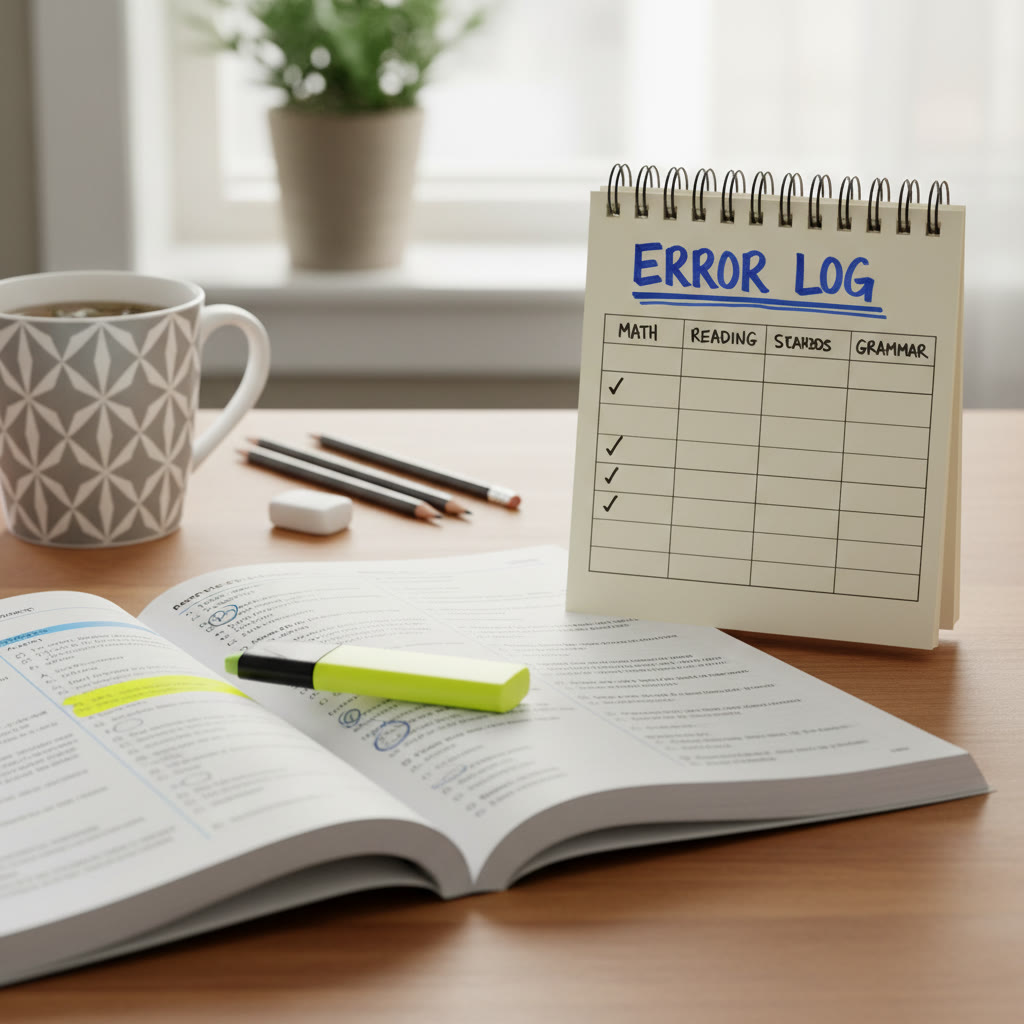
Practice without review is like running without a map. After each timed section or practice test, create an error log. For every wrong answer, record:
- Question type and content area
- Why you missed it (content gap, misread, careless error, timing issue)
- A specific action to fix it (drill type, concept review, or strategy change)
Return to your log each weekend and pick at least three recurring themes to tackle with targeted exercises.
Practice tests: how often and how to use them
Full-length practice tests are your single best predictor of progress. But they’re only useful if you analyze them.
- Frequency: once every 2–3 weekends during the middle of your plan; weekly during the final 3–4 weekends.
- Simulate test day: full sections, minimal breaks, and the same time of day as your planned test.
- Immediate follow-up: within 24 hours, complete a thorough error log and identify three priority weaknesses.
Practice test score table: understanding progress
Track metrics to measure growth beyond the raw score. Use a simple table to capture trends.
| Practice Test # | EBRW | Math | Total | Major Weaknesses |
|---|---|---|---|---|
| 1 (Baseline) | 520 | 490 | 1010 | Reading timing, Algebra I |
| 4 (Mid) | 580 | 540 | 1120 | Complex evidence questions, ratio problems |
| 8 (Pre-test) | 620 | 600 | 1220 | Minor careless errors |
This is a sample tracking method — your numbers will differ, but the goal is to spot patterns, not obsess about one-off scores.
Energy, focus, and test-day stamina
Weekend-only study can feel intense. Build stamina gradually: start with two-hour focused blocks and stretch to four-hour blocks over several weekends. Practice taking breaks that restore attention — short walks, breathing exercises, or light stretching. Sleep is non-negotiable; deep study with poor sleep yields poor retention.
Healthy rituals for weekends
- Begin with a 5-minute plan: write goals for the day and the metrics you’ll check.
- Hydrate consistently and snack on protein/complex carbs for steady energy.
- Finish each day with a quick reflection: what worked, what was frustrating, and the one change for next weekend.
When personalized help accelerates progress
Even with disciplined weekend study, targeted guidance can multiply your gains. Sparkl’s personalized tutoring is a natural fit for weekend learners because it can provide:
- 1-on-1 guidance to zero in on stubborn weak spots quickly.
- Tailored study plans that map weekend sessions to the skills you most need.
- Expert tutors who show efficient shortcuts and thinking patterns for the SAT.
- AI-driven insights to track progress and adjust practice targets between sessions.
Imagine one Saturday a month with an expert tutor diagnosing your error log, or a weekly 45-minute check-in to reset priorities — these interventions make each weekend more productive.
Micro-tactics that add up
Little habits yield big returns if you stick with them:
- Create a one-page cheat sheet of common grammar rules and math formulas and glance at it before each session.
- Use tiny time blocks during the week (10–15 minutes) for vocabulary or quick mental math to preserve momentum between weekends.
- Adopt a “teach it” approach: explain a tough problem or passage to a friend or yourself aloud; teaching cements understanding.
- Practice eliminating wrong answer choices quickly — narrowing choices often yields the correct answer faster than solving from scratch.

Common traps and how to avoid them
Weekend-only learners can fall into a few predictable traps:
- Marathon without review: doing many practice tests but never analyzing mistakes. Fix: allocate one full block solely for error analysis.
- Ignoring pacing: getting every question right in practice but not under timed conditions. Fix: do timed mini-sections regularly.
- Shifting goals: chasing every new tip or strategy. Fix: commit to a plan for at least four weekends before changing course.
Final checklist for each weekend
- Start with a clear objective for the day (e.g., “reduce algebra mistakes by practicing 20 targeted problems”).
- Simulate testing conditions at least once every other weekend.
- Keep and update an error log; pick 2–3 recurring issues to fix.
- Finish with a short plan for the next weekend: what to keep, what to change.
Wrapping up: weekend study, but make it powerful
Preparing for the SAT with only weekend study is not about doing more — it’s about doing smarter. Use structured blocks, prioritize review, and practice under realistic conditions. Track your progress with practice tests and an honest error log. When you add occasional targeted help, such as Sparkl’s personalized tutoring — whether an expert tutor walks through your errors or AI-driven insights help pick the next practice focus — your weekends become even more productive.
Start this weekend: take a short diagnostic, jot down three clear priorities, and commit to a repeatable routine. With intentional Saturday and Sunday work, measurable improvements follow. You don’t need daily marathon sessions — you need focused, reflective practice. That’s the secret to turning two days into a test-winning strategy.
One last thought
Remember, progress is cumulative. Celebrate small wins: a faster reading pace, fewer algebra mistakes, a clean error log entry. Those small wins add up faster than you think. Good luck — and make this weekend count.


















No Comments
Leave a comment Cancel