
Why your commute can be the secret weapon in SAT prep
Imagine shaving off a week of study time or closing a stubborn 20-point gap without carving out extra hours from your already tight schedule. For many students, the daily commute is a stretch of untapped minutes—15 or 45 at a stretch—that, when used smartly, add up into powerful, low-friction study sessions. This blog is a friendly, practical guide to turning those minutes into real SAT gains: micro-lessons, listening strategies, focused drills, and a sample weekly plan you can start tomorrow.
Why commute study actually works
Here’s the practical science: small, consistent practice sessions improve retention through spaced repetition and reduce cognitive fatigue that often comes with marathon study blocks. Commuting is predictable—same route, same length—making it easy to build habits. You’ll also leverage different modes of cognition: audio processing on the train, flashcard recall while walking (safely and with awareness), and short, focused mental math in quiet waiting-room moments. The trick is matching the activity to the context.
Assess your commute: one simple three-question test
Before you plan anything, be honest with yourself. Not every commute is conducive to the same activities. Ask yourself:
- How long is my average single trip? (Under 10 mins, 10–30 mins, over 30 mins)
- Am I a passenger, a driver, or walking/cycling?
- How noisy or distracting is my route?
Your answers determine the types of tasks that will work best—audio materials for drivers, flashcards and reading for passengers, and mentally rehearsed strategies for short walks. Recognizing constraints up front saves time and prevents wasted attempts at unsuitable activities.
Designing a commute-friendly SAT routine
The core idea is to treat commute time as a deliberate study block with a purpose. Instead of aimlessly scrolling, plan short, achievable activities with clear goals. Below is a straightforward structure you can adapt:
- Warm-up (2–5 minutes): quick review—vocab flashcard, a grammar rule, or mental arithmetic
- Core activity (10–25 minutes): listening to a critical reading passage, doing targeted math drills, or working through strategy-focused audio
- Wind-down (2–5 minutes): reflection, jotting down a take-away, or scheduling the next focused session
Even a 15-minute commute can fit that pattern: 3–10–2, which will feel short but meaningful.
Activity choices by commute type
If you’re driving
Safety first: you can’t read or tap screens while driving. But you can do excellent prep with audio-focused work.
- Listen to recorded SAT reading passages read aloud (ideally at normal speed first, then slowed for strategy)
- Audio explanations of math problem-solving steps—follow along mentally and rehearse the logic
- Pretend you’re the teacher: summarize the passage or explain a math problem out loud (use hands-free devices)
If you’re a passenger on public transit
This is prime real estate for reading and short problem-solving. You can combine digital and analog tools:
- Work through a short Reading section passage on your phone or tablet
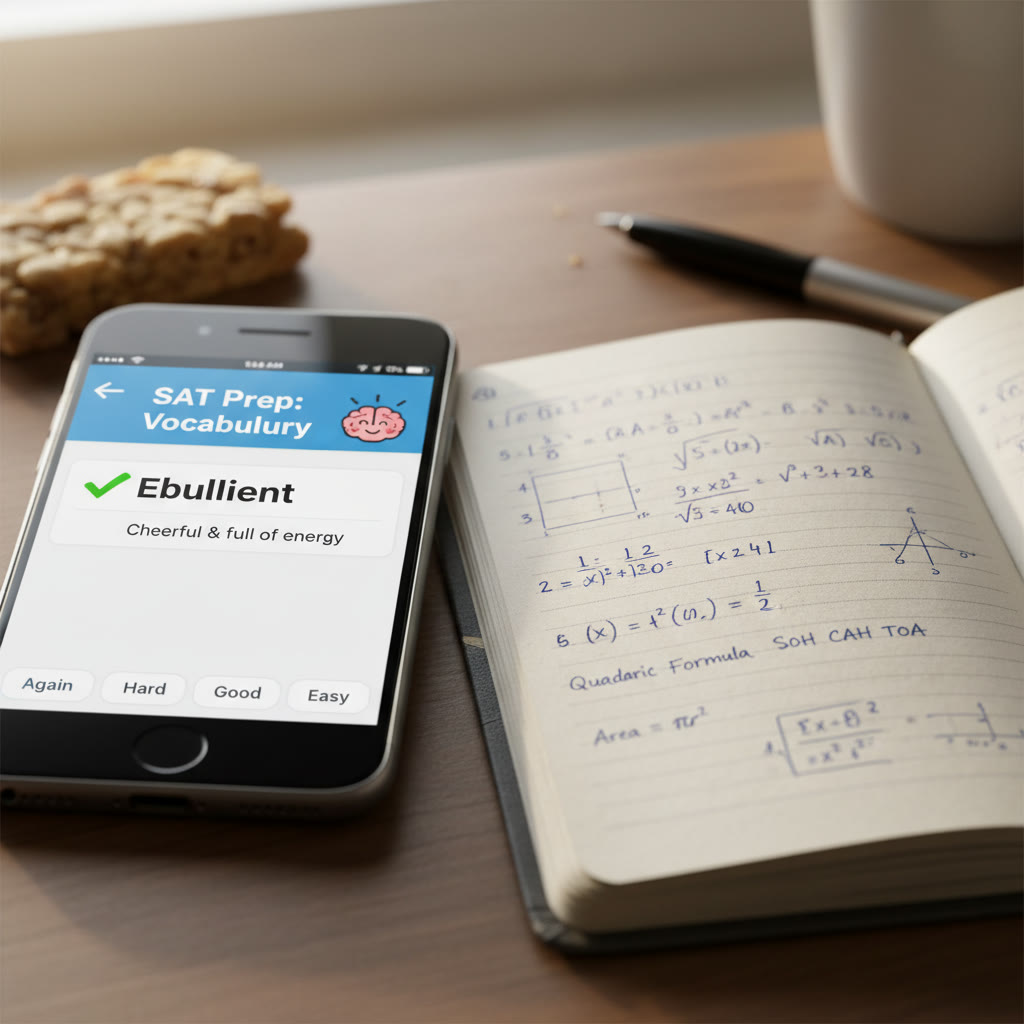
- Use flashcard apps for vocab and math formulas (spaced repetition is key)
- Sketch quick math setups on a small notebook—practice translating word problems into equations
If you’re walking or biking
For active commutes, prioritize listening and lightweight recall that doesn’t require prolonged visual attention:
- Vocab audio lists and sentence completion practice
- Strategy podcasts where you think through a problem mentally
- Quick mental math challenges—multiplication ladders, fraction conversions, percent estimates
Practical micro-sessions you can use right away
Below are ready-made micro-sessions tailored to 10, 20, and 30-minute commutes. Pick one per direction and repeat regularly—consistency beats randomness.
10-minute micro-session (quick and focused)
- 1 minute: Quick breathing and focus reset
- 4 minutes: Vocabulary review—5 flashcards using spaced-repetition app or paper cards
- 4 minutes: One reading passage review (skimming the main idea and one inference question)
- 1 minute: Note down one strategy to use later
20-minute micro-session (balanced skills)
- 2 minutes: Goal set (which skill to target today)
- 10 minutes: Math practice—3 targeted problems (algebra, geometry, data interpretation)
- 6 minutes: Reading passage or grammar drill
- 2 minutes: Self-check and plan follow-up
30-minute micro-session (deep but still mobile)
- 3 minutes: Warm-up vocab and mental math
- 18 minutes: Full reading passage (timed) with two questions answered and flagged for review
- 7 minutes: One or two math problems with written setup if possible
- 2 minutes: Reflection and scheduling the next focused session
Examples and exercises you can try now
Practice examples make the approach concrete. Here are two brief in-commute exercises you can use immediately—no paper required for the first, small notebook recommended for the second.
Listening + recall (for drivers)
Listen to a 3–4 minute recorded passage. Immediately after, summarize the main idea and three supporting details out loud. Then, ask yourself: what’s one inference the passage implies but does not state? This trains active listening and inference—skills the SAT values.
Mental math triage (for passengers or walkers)
Imagine a problem: “A jacket that is normally $80 is discounted by 25% and then the purchase price has a 6% sales tax. What is the final price?” Solve mentally and say each step aloud: 25% off is $20 off, so $60; 6% of $60 is $3.60, final price $63.60. Practicing step breakdowns like this improves speed and reduces careless errors.
Tools that make commute study frictionless
Use tools that match your situation. The wrong app or deck can turn a productive trip into wasted time.
- Audio recordings of passages and teacher explanations (download for offline use)
- Spaced-repetition flashcard apps (customize decks for your weaknesses)
- Note app with voice-to-text—quickly capture insights or problems to review later
- Small pocket notebook for math setups—compact and non-distracting
How to measure progress without guesswork
Progress isn’t a feeling—it’s data. Keep a simple log of what you did on each commute and what result you got when you tried similar problems in focused study. Over time, you’ll see trends: certain activities yield steady improvements, others plateau.
| Commute Length | Recommended Activity | Weekly Frequency | Expected Outcome (4 weeks) |
|---|---|---|---|
| Under 10 minutes | Vocab flashcards, 1 quick question | Daily | Noticeable vocab retention and faster recall |
| 10–30 minutes | 1 reading passage or 3 math problems | Daily | Improved timing and reduced careless errors |
| 30+ minutes | Full passage + review, multi-step math | 3–5x per week | Higher consistent section scores, strategy fluency |
Sample week: fitting commute work into a broader study plan
Pair commute sessions with one longer, focused study block per week. Here’s a realistic sample schedule that balances small wins and deep practice.
- Monday commute (20 min): Reading passage (timed) + review in evening
- Tuesday commute (15 min): Vocab flashcards + 3 math problems
- Wednesday commute (30 min): Listening to strategy audio + summarize aloud
- Thursday commute (20 min): Writing/grammar drills and error pattern review
- Friday commute (10 min): Light review—flashcards and mental math
- Weekend: Two-hour focused session with full practice sections incorporating errors flagged during the week
That weekend deep work is where the commute investments pay off: you’ll come with a list of weaknesses and fewer fresh mistakes, making your long session more efficient.
How to turn commute gains into sustained score improvements
Here’s a simple formula: daily micro-practice + weekly focused review + corrective feedback = progress. Feedback can come from self-checks, scored practice tests, or mentor guidance. This is where personalized tutoring really shines: a tutor can turn pattern notes from your commute log into a targeted plan. For example, Sparkl’s personalized tutoring blends 1-on-1 guidance, tailored study plans, expert tutors, and AI-driven insights to identify where those commute minutes will have the biggest score payoff. That kind of directed feedback prevents you from practicing the wrong things repeatedly.
Common pitfalls—and how to avoid them
- Doing low-value tasks: Don’t confuse activity with progress. If you’re reviewing cards you already know perfectly, switch to weaker items.
- Overloading yourself: Commute practice is additive, not a replacement for deliberate focused sessions. Keep long practice for your weekly block.
- Failing to record errors: A quick note on your phone about recurring mistakes turns scattered practice into targeted work.
- Ignoring safety: If you’re driving, keep your eyes on the road. Use audio methods and voice notes instead.
Real student example: how 20 minutes a day paid off
Jada was juggling school, a part-time job, and a 35-minute bus ride each way. She started listening to one recorded reading passage each morning and did flashcards on her way home. She also kept a tiny notebook for two math problems each evening. Within six weeks she went from struggling with inference questions to feeling confident enough to time herself during practice sections. Her practice didn’t come from magic—it was deliberate repetition, error logging, and targeted review. With occasional check-ins from a Sparkl tutor, she refined which question types to prioritize and gained 80 minutes of weekly focused study time from smart commute use alone.
Motivation strategies to keep the habit alive
Habits form when the friction is low and the reward is immediate. Commute study lends itself to both.
- Make it automatic: have a dedicated playlist or playlist folder for SAT audio
- Track streaks: celebrate the number of consecutive commute sessions
- Mix rewards: a favorite song after a session, or a small treat at the end of the week
- Share goals: tell a friend or tutor what you’re doing—accountability helps
Wrapping up: start small, stay consistent, and iterate
Your commute isn’t lost time—it’s the most stable, recurring opportunity to practice in bite-sized, effective ways. Start with a single tweak: one passage, three flashcards, or one math problem per commute. Keep a brief log, review weekly, and adjust. If you want faster, targeted improvement, mixing in periodic 1-on-1 guidance helps focus those tiny wins into real score increases. Tutors—like the expert educators at Sparkl—can provide tailored study plans and AI-driven insights that make every minute count. The key is consistency: those small minutes compound.

Practice is not about the grand gestures but the daily nudges that push your skills forward. Your commute is a map of those nudges—start turning movement into momentum today.
Quick checklist to start tomorrow
- Pick one micro-session length that fits your commute
- Download audio or set up a flashcard deck for that activity
- Carry a tiny notebook or enable voice notes for quick error logs
- Schedule one weekly deep study session to consolidate commute gains
- Consider occasional 1-on-1 guidance to refine your plan
Final thought
Time is rarely the problem—alignment is. Shift intention into your routine and you’ll be surprised how quickly the minutes add up. Use your commute not as lost time but as steady, reliable practice. With small habits, focused review, and smart feedback, that daily transit becomes a quiet engine of improvement for your SAT goals.


















No Comments
Leave a comment Cancel