
Why journaling can transform your SAT prep
When you think of SAT preparation, images of practice tests, math problems, and vocabulary flashcards probably come to mind. But there is another tool, quiet and deceptively simple, that can make all of that effort more effective: journaling. If you write for fifteen to thirty minutes a day with intent, you can reduce anxiety, clear mental clutter, tune your focus, and turn messy feelings into an actionable plan. Journaling is not about writing an essay or being poetic; it’s about making your internal world legible so your external work gets sharper.
An accessible practice with measurable benefits
Research on expressive writing shows that putting thoughts into words reduces cognitive load and improves problem-solving. For SAT students, that means fewer intrusive worries during a timed section and more mental bandwidth for reasoning. But beyond research, journaling is practical. It gives you a place to capture mistakes, notice patterns, and track progress. Those small wins add up: less anxious nights before test day, clearer study sessions, and a stronger ability to recover after a tough practice test.
Different kinds of journal entries (and when to use them)
Not every entry needs to be long. Different entries serve different purposes. Here are reliable formats you can rotate through depending on your needs that day.
- Morning pages: Free-writing for 10 minutes to clear your head before studying.
- Study log: Record what you worked on, what went well, and what needs follow-up.
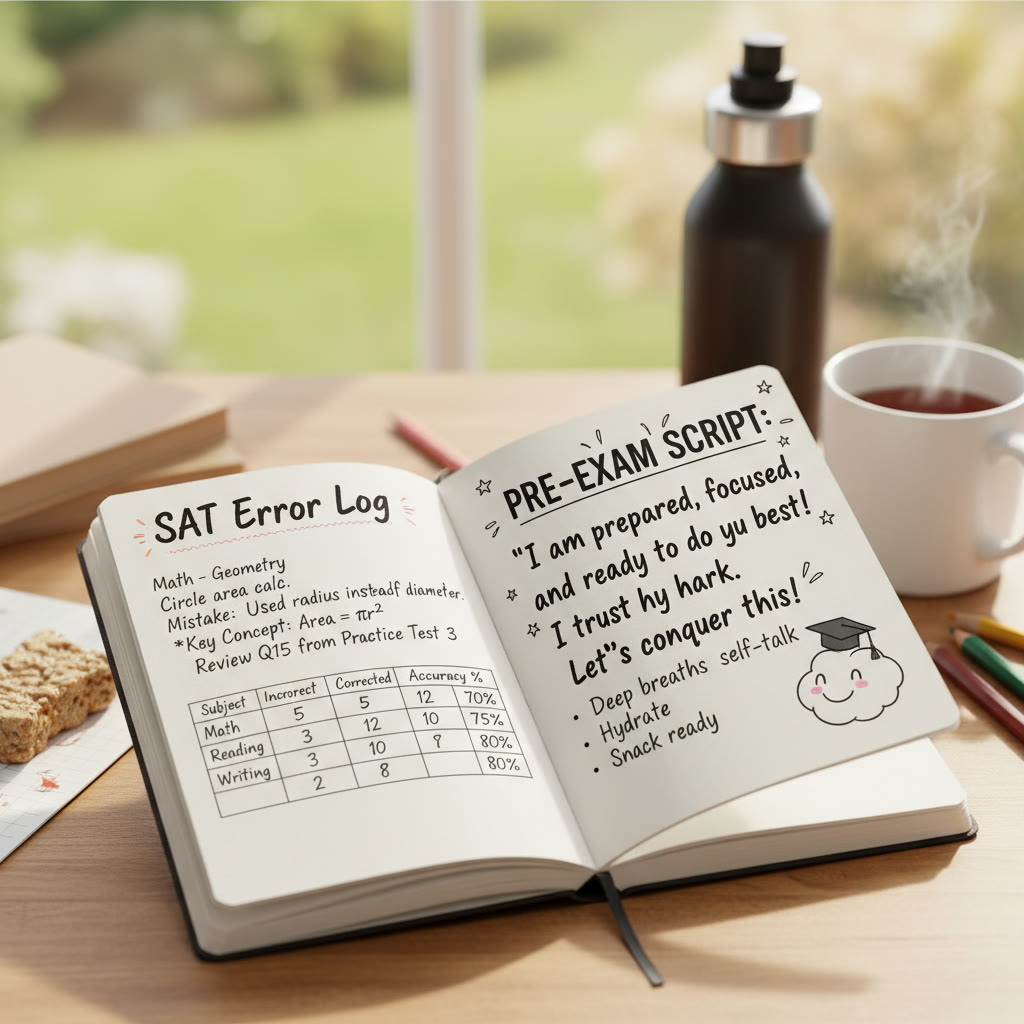
- Error journal: A focused page that captures repeated mistakes and strategies to avoid them.
- Worry dump: A structured way to extract anxieties and reframe them.
- Pre-exam script: A short, calming script you read before a practice test or the SAT to center yourself.
- Weekly review: A summary of progress, habits, and adjustments for the week ahead.
How to choose which one to write
Use the study calendar as your guide. On heavy study days, keep entries brief: a short log plus one reflection. On days after a full-length practice test, do an error journal and a worry dump. The goal is to create a rhythm, not a chore.
Practical journaling templates you can start using today
Below is a simple table you can copy into your notebook. Use the time estimates as a guideline — the first week you may take longer, but you will get faster.
| Entry Type | Purpose | Time | Sample Prompt |
|---|---|---|---|
| Morning Pages | Clear mental clutter and set priorities | 10-15 min | What is taking up the most attention right now? What one study goal would make today feel successful? |
| Study Log | Track progress and next steps | 5-10 min | What did I practice? What improved? What do I need to revisit? |
| Error Journal | Identify patterns in mistakes and create solutions | 10-20 min | Which question did I miss? Why did I miss it? What strategy will prevent this? |
| Worry Dump | Externalize anxieties and reframe them | 5-10 min | Write your worries, then write a one-sentence realistic alternative for each. |
| Pre-exam Script | Calm nerves and set focus | 3-5 min | I am prepared; I will apply my strategies and recover from mistakes calmly. |
Example entry: Error journal for Reading
Instead of simply noting that you missed Question 13, write: “Question 13: assumed author’s tone was sarcastic; evidence shows a measured critique. Mistake type: misread nuance. Strategy: underline adjectives and check context sentences 2 and 3 before choosing answer.” That small habit prevents future repeat errors because it forces you to turn vague failure into observable data.
Short daily routine: weave journaling into your study plan
You don’t need a large block of time to get the benefits. Here is a compact routine that fits into a typical school day and makes sense even when you’re juggling classes, activities, and homework.
- Morning (10 min): Morning pages. Clear the head, set one daily study goal.
- During study sessions: Keep a running study log. After each Pomodoro, put one sentence about progress.
- After practice tests (20 min): Error journal for the sections that need the most work.
- Evening (5–10 min): Worry dump and a short gratitude sentence to close the day.
Why this rhythm works
The morning pages give your day direction. The study log maintains momentum and provides feedback loops. Post-test work converts emotions into strategy. Ending with a gratitude sentence reduces rumination and improves sleep quality — both crucial for memory consolidation.
Prompts that actually help — not cliches
Good prompts lead to useful answers. These are focused prompts you can rotate through, depending on the entry type, that generate clarity rather than vague reassurance.
- What specific step did I take today that moved me closer to my target score?
- What question or concept repeatedly caused me to hesitate? What resource will I use to fix it?
- Which thought is most distracting when I do practice tests? What facts counter that thought?
- If I had to teach this concept in five minutes, what would I emphasize?
- What is one small routine change tomorrow that could improve focus?
Managing test anxiety with structured writing
Anxiety often feels like a flood of what-ifs that sap working memory. Journaling stops that flood by externalizing the what-ifs and giving them a label. Once labeled, they are easier to re-evaluate and deprioritize. Use these techniques in your worry dump entries:
- Label the worry: “I’m afraid I’ll run out of time on Math.”
- Check the evidence: “I ran out of time on two practice sections last week because I rushed questions I didn’t need to. I can fix this by pacing and skipping hard problems earlier.”
- Make a small, testable experiment: On the next timed section, implement the skip-and-return strategy and note the outcome in your journal.
A short cognitive reframing exercise
Write the worry as a headline, then write a balanced headline below it. For example:
Worry headline: “If I don’t get a 700, I won’t get into a top college.”
Balanced headline: “A high score helps applications, but colleges look at other evidence too; improving my weak areas now will increase my chances.”
This practice reduces catastrophizing and replaces it with a problem-solving mindset.
Tracking progress like a strategist
Journaling is also a low-tech dashboard. Over time, your notebook becomes a record of what improved and what didn’t. That information is gold when you need to pivot your study plan. Use weekly reviews to synthesize patterns and plan adjustments.
- Highlight recurrent mistakes. If passive voice errors crop up consistently in Writing, dedicate a session to that topic.
- Note timing issues. If you run out of time on Reading, track how many questions you skip per section.
- Record energy and sleep patterns. If your concentration dips after a late-night study session, that’s actionable data.
Sample weekly review checklist
- What practiced strategies worked? Why?
- What mistakes repeated? What will I change next week?
- Was I consistent in my schedule? If not, why not?
- One measurable goal for next week (example: improve geometry question accuracy by 15%).
Using journaling with tutoring and feedback
Journaling pairs powerfully with guided instruction. If you work with a tutor, you can use your journal to communicate efficiently. For example, an error journal entry becomes a clear starting point for a tutoring session: “I miss question types X, Y, Z; here are samples.” That saves time and lets the tutor tailor the session precisely. Sparkl’s personalized tutoring, with 1-on-1 guidance and tailored study plans, fits very naturally into this approach: you bring documented learning data to each session and get targeted feedback. Tutors can also help you build a journal template that matches your learning profile, and Sparkl’s AI-driven insights can highlight trends you might miss on your own.
How to share journal insights with your tutor
Pick two entries before a tutoring session: a brief error journal and a weekly review. Your tutor will appreciate the clarity and can recommend micro-practices or concept drills that match your needs. Over a few weeks, you’ll be able to measure the impact of those interventions directly in your notebook.
Real-world examples: short stories that feel like your day
Imagine Mia. She had a 600 baseline and a mountain of anxiety about reading passages. She started a simple routine: 10 minutes of morning pages, a 5-minute study log after each practice passage, and an error journal entry after every practice test. In her weekly review, she saw a pattern: she lost points on inference questions because she jumped to conclusions too early. With that data, she practiced a targeted strategy and, within a month, improved her reading score significantly. Her journal kept the momentum: on tough days it showed how far she had come; on good days it showed exactly what to repeat.
Or consider Jamal, who combined short worry dumps with a pre-exam script before full-length tests. The script was just three lines he wrote once and repeated aloud before each test. The ritual anchored him and reduced his panic recoveries when he hit a difficult section. He said the journal turned his nervous energy into a practice routine.
Quick troubleshooting: common barriers and fixes
- “I don’t have time.” Fix: Limit entries to one to two focused prompts and five minutes. A tiny habit is better than none.
- “My writing is messy or boring.” Fix: You are the only reader. Focus on clarity, not style.
- “I forget to journal.” Fix: Put your notebook with your test materials or phone alarm; attach it to an existing habit like breakfast.
- “I feel worse after writing my worries.” Fix: Always end worry entries with one practical next step and a realistic counter-thought.
Sample 4-week journaling plan for SAT students
Below is a simple progression to build the habit and make it strategic.
- Week 1: Start Morning Pages and Study Log. Aim for consistency rather than depth.
- Week 2: Add Error Journal after any full-length practice test and try one worry dump per day.
- Week 3: Introduce weekly reviews and an evolving pre-exam script. Note patterns and adjust study focus.
- Week 4: Combine your notes with targeted practice. Bring your most revealing entries to a tutoring session for personalized feedback.
What success looks like at the end of a month
Instead of vague improvement, you will have a notebook full of clear actions: the mistakes you fixed, the timing tweaks that worked, and a set of rituals that calm you. That clarity is the hidden engine behind steady score gains.
Two image ideas to include in your study space

Final notes: keep it simple and compassionate
Journaling is not another item to add to an already overloaded to-do list. Think of it as a small investment that improves the return on all your other work. Fifteen minutes of honest, focused writing can save you hours of inefficient practice by making your study choices clearer.
If you pair journaling with tailored instruction, like Sparkl’s personalized tutoring and its 1-on-1 guidance, you magnify the returns. Your journal becomes a map, and the tutor helps you pick the fastest path forward. Whether you’re aiming for a modest bump or a big leap in score, the combination of data-driven study and reflective writing gives you both the plan and the calm to execute it.
Start tonight: get a simple notebook, set a five-minute alarm, and write one sentence about what you want to achieve with your SAT score. That sentence is a tiny compass. Over time, your journal will become the clearest evidence you have of how far you have come and how much further you can go.
Study well, write honestly, and remember: clarity is a habit. Your notebook is where you build it.




















No Comments
Leave a comment Cancel