
What the SAT Measures — and Why You Should Care
If the SAT feels like a mysterious gatekeeper, you’re not alone. But the test isn’t a random quiz designed to trip you up. The Digital SAT is a carefully structured snapshot of certain academic skills that colleges find predictive of first-year success. Understanding exactly what it measures — and what it doesn’t — gives you power: the power to study smarter, reduce anxiety, and show colleges the clearest version of your academic potential.
A short, honest answer
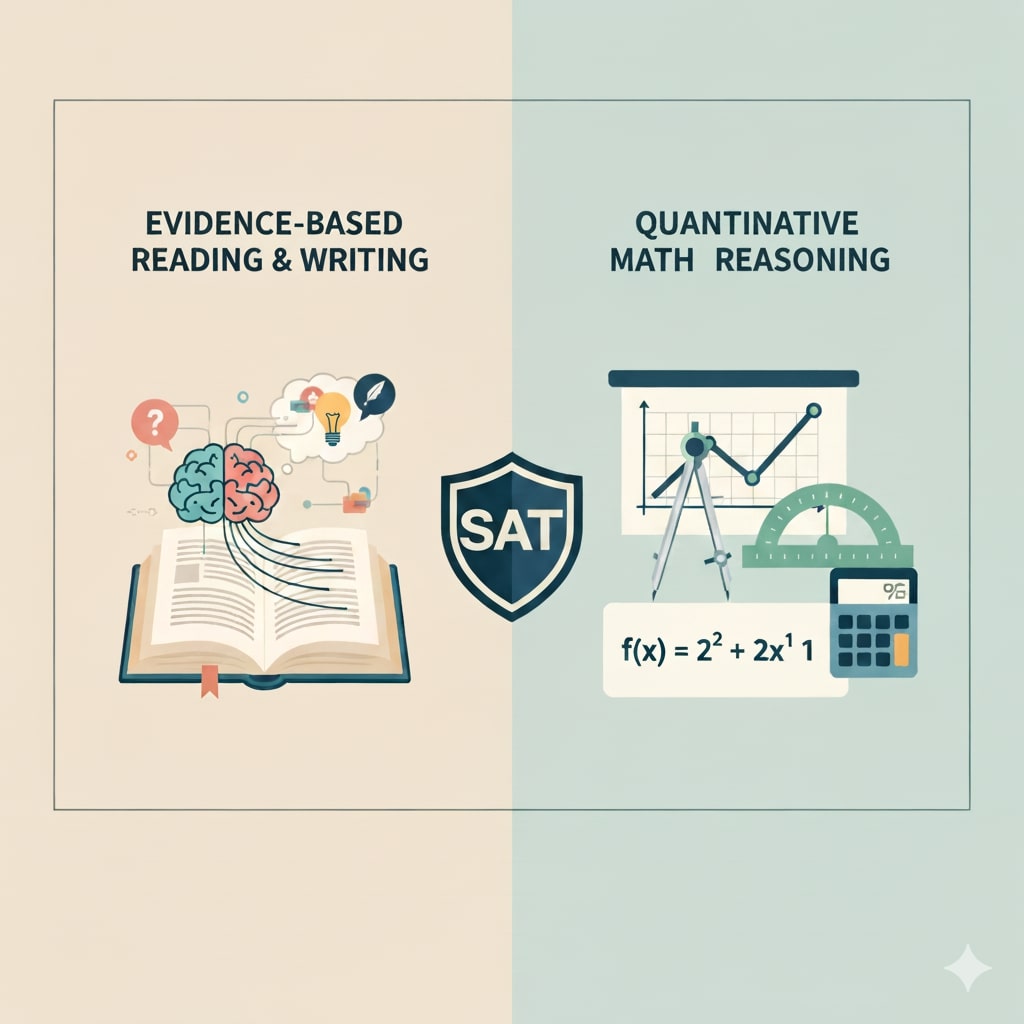
The SAT measures evidence-based reading and writing, and quantitative (math) reasoning — not how many memorized trivia facts you know. It tests how well you can read complex passages, reason with data, solve math problems that reflect real-world scenarios, and communicate ideas clearly. Think of it as a spotlight on the habits and skills that help students succeed in college-level courses.
Breaking Down the Components: Reading & Writing, Math, and More
Let’s unpack each part of the Digital SAT in plain language, with concrete examples so the mechanics stop feeling abstract.
1) Evidence-Based Reading & Writing (EBRW)
At its heart, EBRW is about comprehension, reasoning, and clear expression. Instead of memorizing obscure words, you’ll be judged on how you:
- Analyze arguments in passages from literature, history, social studies, and science.
- Interpret evidence and use it to answer questions or evaluate claims.
- Revise and edit short written passages for clarity, logic, and correct grammar.
Example: You might read an excerpt from a 19th-century essay and be asked to identify the author’s main claim, the evidence supporting it, and a sentence that weakens that evidence. That tests critical reading — not nostalgia for the old SAT vocabulary lists.
2) Math (Quantitative Reasoning)
The math section focuses less on rote formulas and more on problem solving: modeling situations with equations, interpreting graphs and tables, and using algebra, geometry, and basic statistics. Calculator use is permitted where appropriate in the Digital SAT, but the real point is reasoning through the steps.
Example: Instead of an isolated algebraic trick, you might analyze a chart showing population growth and write an equation that models the trend, then interpret what a parameter in the equation means in the real world.
3) What the SAT doesn’t measure
Importantly, the SAT isn’t a personality test. It doesn’t directly measure creativity, leadership, grit, or extracurricular commitment — even though colleges value those qualities. Nor does it perfectly capture subject mastery from every classroom. A fair SAT score is one piece of a bigger application puzzle.
Why Colleges Use the SAT: Predictive Power and Common Ground
Why do admissions teams still care about these scores? The answer is twofold: comparability and predictive utility.
Comparability: High schools vary widely in curriculum and grading. A standardized score provides a common metric that helps admissions officers assess applicants from diverse backgrounds.
Predictive utility: Research shows that SAT scores, especially when combined with high school GPA, help colleges predict first-year performance in many programs. That’s why the SAT remains a useful tool for placement, advising, and scholarship decisions.
How SAT scores are used beyond admissions
- Course placement: Some universities use SAT math or EBRW subscores to place students into appropriate entry-level courses.
- Scholarships: High SAT scores can unlock merit-based aid.
- Self-knowledge: A score report can highlight academic strengths and gaps to help you choose classes and study priorities.
Skills That Translate: From Test Questions to Classroom Success
What makes the SAT more than a hoop to jump through is that many of its demands reflect real academic tasks:
- Reading dense material and extracting main ideas — useful for history and science classes.
- Interpreting data and graphs — essential for STEM and social science coursework.
- Building coherent written arguments — central to college writing assignments.
When you practice for the SAT, you’re also practicing the classroom skills that will make your first semester smoother.
A real-world comparison
Imagine you’re given two interns. One scores high on the SAT — they tend to quickly parse technical memos and create clear summaries. The other has lower SAT scores but great people skills. Both could be valuable, but for a task that requires quick interpretation of dense reports, the SAT-high intern may get up to speed faster. That’s the practical advantage colleges consider.
How the Digital Format Changes Things — and What Stays the Same
The move to a digital SAT changed delivery but not the fundamentals of what’s measured. The test is shorter, adaptive within sections, and delivered on devices using secure software. That changes strategy more than substance.
Adaptive testing: what it means for you
The test can adjust difficulty based on how you perform in the first part of each section. That means early questions matter: do them carefully. But it also means there’s less room for panic if you miss one—focus on steady accuracy and timing.
Practical effects of the digital switch
- Shorter test sessions — fewer hours spent on test day.
- Built-in tools like a digital ruler or scratch space change how you work problems.
- Faster score reporting in many cases, so you can plan applications sooner.
Concrete Strategies: Study the Skills, Not the Myths
Here are actionable ways to target what the SAT measures — tailored to how students actually learn and perform under pressure.
Reading & Writing strategies
- Practice passage mapping: after one read, jot a quick one-line summary of the main idea and each paragraph’s purpose.
- Train evidence-based answering: when a question asks why a sentence is included, locate the evidence in the passage before choosing.
- Revise with intention: for grammar and expression questions, identify why a choice improves clarity or logic, not just because it ‘sounds right.’
Math strategies
- Build number sense: mental math and estimation keep you from getting stuck on arithmetic.
- Translate words to equations: practice turning real situations into mathematical models.
- Use the tools: on the digital test, use the graphing and ruler features to check work quickly.
Time management and test-day calm
- Work backward from the end of each section: know how many minutes per question you can afford and practice that pace.
- Practice with full-length digital practice tests to adapt to the screen and interface.
- Use breathing techniques and short mental resets between sections to lower stress and boost focus.
How to Turn Your Score Report Into a Study Roadmap
Your official SAT score report is more than a number — it’s a diagnostic tool. Look beyond the composite score and examine subscores and question types to spot patterns.
| Score Area | What It Tells You | Next Step |
|---|---|---|
| EBRW Subscore | Strength in passage comprehension and evidence usage | Target complex passages; practice identifying evidence quickly |
| Math Subscore | Comfort with algebra, modeling, and data interpretation | Drill problem types that caused mistakes; refine equation setup skills |
| Question-Type Insights | Whether errors are conceptual, careless, or timing-related | Fix by concept review, timed practice, or accuracy-focused warmups |
Use that map to build targeted study blocks: short, focused sessions that improve your weakest habits while maintaining strengths.
Study Plans That Reflect What the SAT Actually Measures
A good study plan is not a generic schedule; it’s a personalized program that aligns practice with the skills tested. Here’s a simple three-phase template you can customize.
Phase 1 — Diagnostic & Foundation (2–4 weeks)
- Take a full-length digital practice test to get a baseline.
- Analyze the score report: identify two primary weaknesses to address first.
- Build daily micro-lessons: 30–50 minutes focused on targeted skill work.
Phase 2 — Skills, Strategy, and Volume (4–8 weeks)
- Alternate targeted practice with timed sections.
- Do one full digital practice test every 2 weeks and review every missed question.
- Increase stamina with longer study days once per week.
Phase 3 — Polishing and Test Readiness (2–4 weeks)
- Simulate test day exactly: same start time, breaks, device setup, and snacks.
- Focus on fine-tuning timing, accuracy, and confidence-building techniques.
- Reduce new content; emphasize review, question analysis, and light practice.
How Personalized Tutoring Amplifies What the SAT Measures
Self-study works for many students, but targeted tutoring can fast-track improvement because it addresses the specific skills the SAT measures. One-on-one guidance helps you convert a score report into a realistic plan and stay accountable while practicing with purpose.
For example, Sparkl’s personalized tutoring blends expert tutors with tailored study plans and AI-driven insights to focus on the exact question types and thought patterns you struggle with. That approach helps students fix root causes — like misreading evidence or habitually setting up equations incorrectly — rather than just memorizing tricks.
Benefits of targeted, personalized support
- One-on-one guidance that matches your learning pace and style.
- Tailored study plans that prioritize your weakest skills without neglecting strengths.
- Expert tutors who model problem-solving approaches and explain the reasoning behind every step.
- AI-driven insights that track patterns over time and suggest precise next steps.
Common Myths and Honest Truths
There’s a lot of folklore about the SAT. Let’s bust a few myths and replace them with practical truth.
Myth: The SAT tests intelligence.
Truth: It tests specific academic skills and test-taking strategies. With focused practice, most students can improve significantly.
Myth: You either have a ‘SAT brain’ or you don’t.
Truth: Skills tested by the SAT are learnable. Reading strategies, data interpretation, and math modeling improve with deliberate practice.
Myth: Memorizing rules and trick questions is enough.
Truth: Rote memorization helps a little, but the SAT rewards reasoning, flexibility, and the ability to apply knowledge in novel contexts.
How to Measure Progress Beyond a Single Test
Improvement on the SAT is about trends, not one-off scores. Use practice-test trajectories, error-type analysis, and comfort with timing as your real metrics.
- Track average improvement across three practice tests rather than fixating on an outlier.
- Monitor reduction in careless errors and increase in correctly answered harder questions.
- Assess confidence: are you ending sections with time to spare and fewer second-guessing moments?


Test Day: Bring the Skills You’ve Built — and Leave the Panic Behind
On test day, the most important thing isn’t doing every problem flawlessly — it’s executing the reliable habits you practiced. Here’s a compact checklist to make the most of your preparation.
- Device prep: make sure your testing device and Bluebook app are functioning, fully charged, and that you practiced on a similar setup.
- Warm-up: do a short timed section or quick math drills to get into test mode.
- Strategy reminders: keep a short list of your go-to strategies on scratch paper (e.g., ‘read the question stem first for data items’, ‘map passage before answering’).
- Recovery plan: if a question stalls you for more than a minute, mark it, move on, and come back if time allows.
Wrapping Up: Why What the SAT Measures Matters to You
The SAT is less a mysterious oracle and more a practical tool. It measures reading, reasoning, and quantitative thinking — skills that matter in college and beyond. Learning to meet its demands helps you grow as a thinker, a problem solver, and a communicator. More than that, approaching the test as a set of learnable skills makes preparation less stressful and more empowering.
If you want to accelerate progress, consider adding personalized tutoring to your plan. Thoughtful, one-on-one work — for example, Sparkl’s blend of expert tutors, tailored study plans, and data-driven insights — can target your weak spots efficiently and build the test-smarts that last into college and career studies.
Quick Resources and Next Steps (A Practical To-Do List)
Here’s a short, actionable checklist to turn this article into your next 30 days of progress:
- Take one full-length digital practice test within the next week to establish a baseline.
- Create a two-week micro-plan that focuses on your two weakest question types.
- Do a timed practice section every three days and analyze every missed question.
- Schedule at least two one-on-one tutoring sessions to address sticky misconceptions; ask for targeted practice problems and immediate feedback.
- Simulate test day two weeks before your real test: device, timing, breaks, and environment.
Final thought
Preparing for the SAT is an investment in a set of skills that help you not just get into college, but actually thrive once you’re there. Treat the test as training rather than luck, and you’ll gain confidence along with a better score. The skills you practice now — clear reading, logical reasoning, and thoughtful problem-solving — will be useful long after a number has faded from a score report.
Good luck — and remember: the SAT measures skills you can improve. With deliberate practice, smart strategy, and the right support, you’ll be ready to show colleges the best version of your academic potential.


















No Comments
Leave a comment Cancel