

Why analytical thinking matters more than memorization on the Digital SAT
When you think of SAT prep, flashcards, formulas, and vocabulary lists probably come to mind. Those are useful tools, but they’re not the whole story. At the center of consistent SAT improvement is a skill that shines through both the Reading & Writing and Math sections: analytical thinking. On the Digital SAT, which tests reasoning in new, adaptive formats, being able to analyze, infer, and connect dots calmly and precisely matters more than ever.
This article walks you through why analytical thinking is the secret ingredient to higher scores, how it appears on the Digital SAT, and practical ways to develop it—plus study routines and a sample weekly plan you can adapt. I’ll also highlight how targeted, personalized tutoring—like Sparkl’s 1-on-1 guidance, tailored study plans, expert tutors, and AI-driven insights—can fit into a smarter strategy when you want efficient, accelerated progress.
What do we mean by “analytical thinking” for the SAT?
Analytical thinking is the mental toolkit you use when you:
- Break a passage or problem into smaller parts to see how they connect.
- Distinguish relevant evidence from noise.
- Make logical inferences rather than jumping to conclusions.
- Test a hypothesis quickly and adjust when the data (or text) contradicts it.
On the SAT, that looks like identifying the role of a paragraph in an argument, choosing evidence that best supports a claim, decoding the structure of a multi-step math problem, or interpreting a graph and determining whether a conclusion is justified. It’s less about memorizing every grammar rule or formula and more about applying what you know in a thoughtful, evidence-based way.
How analytical thinking appears across the Digital SAT
Reading and Writing: evidence, inference, and structure
In the Reading & Writing modules, analytical thinking is about command of evidence and inference. Questions often present a short passage or paired passages and ask you to:
- Identify the central idea or author’s purpose.
- Choose the sentence or phrase that best supports an interpretation.
- Evaluate whether a claim follows logically from the passage’s facts and tone.
Successful students practice locating the most relevant line or paragraph quickly and keeping a mental map of the passage’s structure: thesis, supporting points, counterargument, and conclusion. That mental map is an analytical shortcut that saves time and reduces guesswork.
Math: reasoning with context and data
Math questions test quantitative reasoning—not just computation. You’ll often face:
- Problem-solving and data analysis items requiring interpretation of tables, graphs, or experiments.
- Multi-step algebra or geometry problems that require planning, not just plugging values into formulas.
- Questions that hide a simpler path if you reframe the problem (for instance using ratios instead of algebraic expansion).
Analytical math thinking is recognizing what the question actually asks, choosing an efficient approach (estimation, algebra, or a diagram), and checking that your result makes sense in context.
Why the digital format increases the value of analytical thinking
The Digital SAT’s interface and adaptive modules reward quick, evidence-based decisions. Instead of memorizing endless rules, students who read purposefully, test assumptions, and verify answers under time pressure tend to perform steadily. Analytical thinking helps you move deliberately when the clock is ticking and the screen changes your testing rhythm.
Concrete examples: how analytical thinking turns into correct answers
Example 1 — Reading: spot the best supporting evidence
Imagine a short passage arguing that urban green spaces improve mental health, with one paragraph listing a study result and another giving personal anecdotes. The question asks: “Which statement most strongly supports the author’s claim that green spaces reduce stress?”
Analytical approach:
- Ignore anecdotes (they’re persuasive but weaker evidence).
- Scan for specific quantitative results—percentages, sample sizes, observed reductions in stress scores.
- Choose the option tied to the empirical study rather than a general statement.
Outcome: You select the choice backed by the study—an evidence-based decision rather than a gut reaction.
Example 2 — Math: choose the smarter path
Problem: A recipe calls for 3/4 cup sugar to make 12 cookies. How much sugar for 30 cookies?
Analytical approach:
- Recognize proportional scaling: scale factor = 30/12 = 2.5.
- Multiply: 3/4 * 2.5 = (0.75 * 2.5) = 1.875 cups = 1 7/8 cups.
Outcome: A quick ratio rather than constructing complex algebra. Analytical thinking saves time and reduces arithmetic errors.
Practical ways to build analytical thinking for the SAT
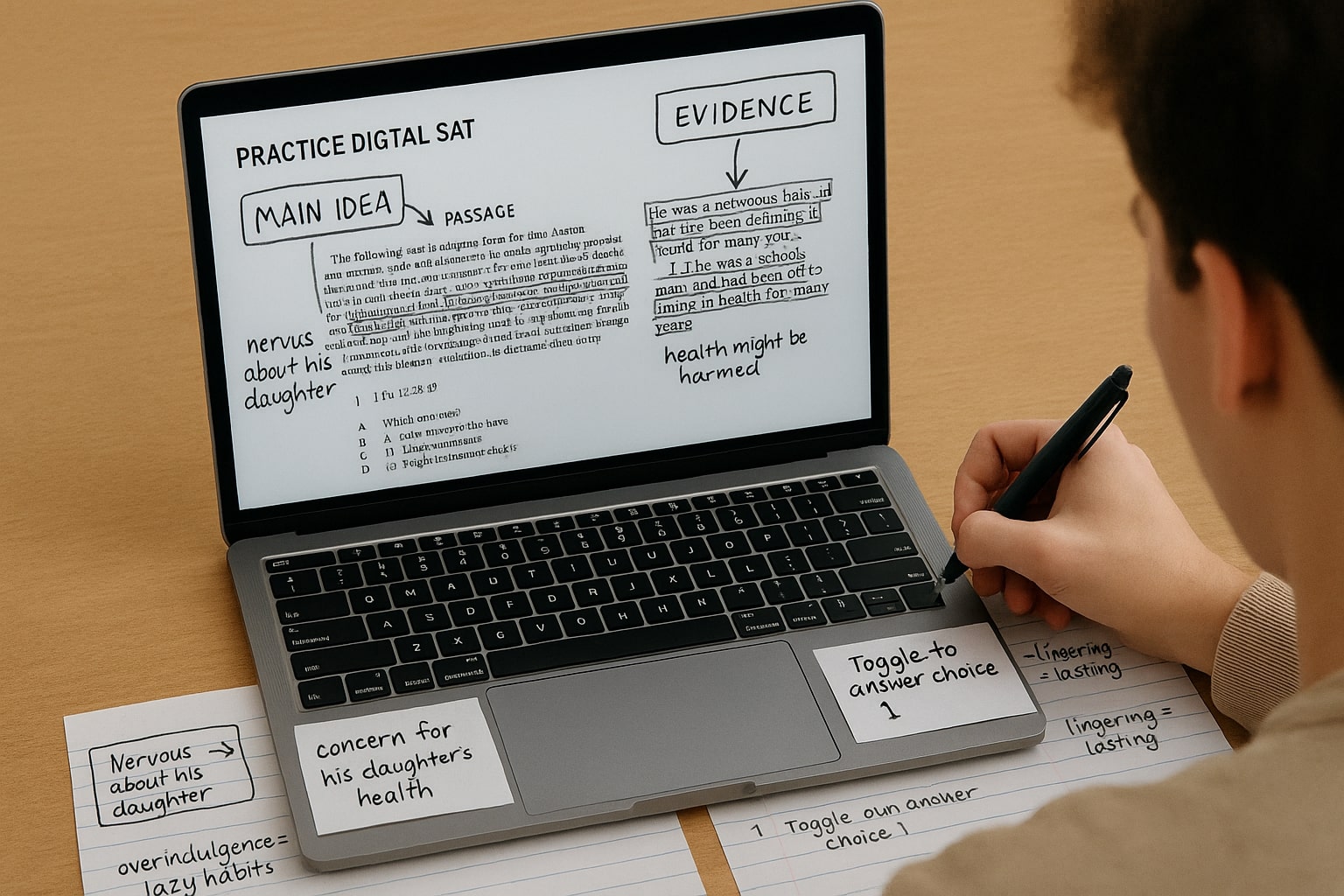
Daily micro-practices (15–30 minutes)
Consistency beats marathon sessions. Try daily micro-practices focused on analysis:
- Reading: one short article or passage—summarize the thesis and two supporting points in one sentence each.
- Writing: edit a paragraph for clarity and logical flow—identify the sentence that should come first or be cut.
- Math: solve one data-analysis question and explain your reasoning in two sentences.
Active reading strategies
Don’t passively read passages. Use these habits:
- Annotate the main idea and the author’s tone in the margin of the passage.
- Circle transition words that reveal structure (however, therefore, meanwhile).
- Before answering, paraphrase the question in your own words: “What exactly is this asking me to find?”
Approaches for math reasoning
Mathematical analysis on the SAT is often pattern recognition plus logical checks:
- Draw a quick diagram for geometric or rate problems.
- Estimate first—does the answer make sense? If not, rethink the setup.
- When faced with multiple approaches, pick the simplest and test it on an easy number.
Practice that mirrors real test demands
Work with full, timed practice modules occasionally to force analytical thinking under pressure. After each practice, do a two-step review:
- Error analysis: For each mistake, write the specific reasoning error—misread question, faulty assumption, calculation error, or missed context.
- Pattern spotting: Do errors cluster around certain question types? If so, design targeted practice for those types.
Sample weekly plan to grow analytical thinking (repeat for 8–12 weeks)
The plan below balances focused skill work, timed practice, and review.
| Day | Focus | Time | Goal |
|---|---|---|---|
| Monday | Reading: evidence identification | 45 min | Annotate 3 passages; summarize evidence for main claims |
| Tuesday | Math: data analysis & ratios | 45 min | Complete 8 data-analysis problems; explain answers in writing |
| Wednesday | Writing: structure & grammar in context | 45 min | Edit 5 paragraphs for cohesion and evidence use |
| Thursday | Mixed timed set | 60–90 min | 3-section timed practice; immediate error log |
| Friday | Target weak spot | 45 min | Redo errors from Thursday with different strategies |
| Saturday | Full practice test (or module) | 2–3 hrs | Simulate test day; review thoroughly |
| Sunday | Reflection & rest | 30–45 min | Update study plan based on performance; light reading |
How to analyze mistakes like a detective
Mistake review is where analytical thinking grows fastest. Follow a brief forensic checklist after any practice:
- Step 1 — Classify the error: careless, conceptual, or timing.
- Step 2 — Recreate your thought process: what did you assume? where did you stop verifying?
- Step 3 — Identify the evidence you missed: a sentence in the passage, a graph label, or a constraint in the problem.
- Step 4 — Build an action: a micro-drill or note to prevent this specific error next time.
This approach keeps you from repeating the same mistake; it changes study time from passive review into strategic improvement.
Small changes that produce big improvements
Here are compact habits that sharpen analysis quickly:
- Speak your reasoning out loud for one problem a day—this makes flawed logic audible and easier to fix.
- When uncertain between two answer choices, write a one-line explanation for each and compare which one is better supported by evidence.
- Use estimation or dimensional checks in math to detect improbable results before you finish.
When and how personalized tutoring accelerates analytical thinking
Most students hit a plateau because their practice lacks feedback. That’s where personalized tutoring shines: focused feedback trains you to recognize analytic patterns faster. A tutor can:
- Diagnose why you repeatedly miss a certain item type (for example, inference questions that require reading beyond a single paragraph).
- Design a tailored plan that builds analytic skills gradually instead of throwing practice tests at you without structure.
- Model clear analytical thought processes in real time and give corrective prompts during practice.
For instance, Sparkl’s personalized tutoring blends 1-on-1 guidance with tailored study plans, expert tutors who show you how to think through problems step-by-step, and AI-driven insights to pinpoint weak spots. That combination speeds learning by turning blind practice into intentional skill training.
Measuring progress: what improvement looks like
Analytical thinking growth shows up in predictable ways on practice tests:
- Fewer careless errors because you verify each step.
- Improved accuracy on inference and data-analysis items.
- Faster recovery from a tricky question—the ability to move on without losing momentum.
Here’s a simple rubric to track your analytical skill over time. Use it each week when you review practice tests.
| Metric | Initial (Week 1) | After 4 weeks | After 8–12 weeks |
|---|---|---|---|
| Error classification clarity | Vague or inconsistent | Mostly consistent | Clear; actionable fixes |
| Inference question accuracy | Below target | Near target | At or above target |
| Time to identify evidence | Slow or uncertain | Improving | Confident and quick |
Common misconceptions about analytical thinking and the SAT
Myth: It’s an innate talent you either have or you don’t
Reality: Analytical thinking is a skill you can practice. Like playing an instrument, it improves with targeted repetition and feedback.
Myth: More hours = better thinking
Reality: Unguided hours can cement bad habits. Intentional practice with analysis, review, and corrective feedback is far more effective. That’s why a mix of self-study and occasional expert coaching can be a high-leverage approach.
Myth: You have to sacrifice content mastery
Reality: Content knowledge and analytical thinking are complementary. Understand the grammar, formulas, and definitions—but train yourself to apply them analytically so they translate to correct answers under pressure.
Test-day mindset and tactics grounded in analysis
On test day, analytical thinking is as much about calm and process as it is about raw reasoning. Try these tactics:
- Before answering, restate the task: “Find the best evidence” or “Solve for x and check units.”
- If stuck, eliminate obviously wrong choices; analyze why the remaining choices differ.
- Use the digital tools intentionally—flag a tough question, return with fresh eyes, and avoid losing time on a single item.
Final thoughts: make analytical thinking your superpower
The SAT is less an obstacle to memorize and more a set of puzzles that reward careful, evidence-based thought. If you shift your study from rote memorization to building analytical habits—annotating passages, checking assumptions, estimating answers, and reviewing mistakes like a detective—you’ll find your scores improve in a steady, resilient way.
If you want to accelerate that change, consider blending self-study with targeted tutoring. Personalized approaches—like Sparkl’s 1-on-1 tutoring, tailored study plans, expert tutors, and AI insights—help transform scattered practice into strategic skill-building. The result? Fewer repeated mistakes, clearer thinking under pressure, and scores that reflect real, transferable ability.
Start small: pick one analytical habit from this article, practice it for a week, and notice how your clarity and confidence grow. With intentional practice and the right feedback loop, analytical thinking won’t just help you on the SAT—it will help you think better everywhere.




























No Comments
Leave a comment Cancel