
Why Reading Speed Matters in SAT Success
Imagine you’re halfway through a long, dense passage about 19th-century social movements, your pencil poised over the first question. Your heart ticks a little faster because you know you’ve only got a couple more minutes before the clock forces you to decide: reread carefully, or answer quickly and hope your first impression is right? That moment — the tug-of-war between slow, careful reading and the pressure to move — is where reading speed becomes more than a bragging point. It becomes a strategy.
When I coach students for the SAT I don’t celebrate raw speed for speed’s sake. I celebrate the kind of speed that preserves understanding: fast enough to get through material and answer questions with confidence, slow enough to avoid careless mistakes. In this post we’ll unpack why reading speed matters, what realistic goals look like, practical exercises to build efficient reading, and how to balance pace and accuracy on test day. I’ll also explain how targeted help — like Sparkl’s personalized tutoring with 1-on-1 guidance, tailored study plans, expert tutors, and AI-driven insights — can accelerate improvement where it counts.
A quick snapshot: the SAT Reading test and the clock
Before we dig into technique, here’s the pragmatic baseline most students will find useful. On the traditional SAT format many students are familiar with, the Reading Test contains 52 questions to be completed in 65 minutes — an average of roughly 75 seconds per question. Those questions are grouped around passages: typically five passages (one of which may be a pair of shorter passages). That means you’re responsible for reading several dense texts and then answering comprehension, evidence, and inference questions under a hard time limit.
Knowing the structure matters because it sets the stage for a practical goal: you need to read, think, and answer in a way that fits the time available. Hint: you won’t get there by skimming everything or by reading every sentence three times.
Why speed is a strategic advantage (not an end in itself)
Speed matters for three main reasons:
- Time for reflection: Faster initial reading leaves time to analyze tricky questions and compare answer choices carefully.
- Lower cognitive overload: Spending less time hunting through the passage reduces the mental cost of holding facts in memory — you make fewer mistakes when you can keep important details fresh.
- Flexibility: A steady pace gives you options: recheck answers, prioritize tougher questions, and avoid panicking as minutes tick away.
Crucially, speed should not come at the cost of comprehension. The best SAT readers are fast readers who are also deliberately engaged: they preview structure, latch onto main ideas, and read with a purpose. That’s where small habits make a big difference.
How much speed is enough? Realistic targets
Let’s be practical. What should you aim for in terms of words per minute (wpm)? Typical careful readers read about 200–300 wpm. For the SAT you’ll want to be in an effective range — not rocket-fast, but efficient and purposeful. A useful target is:
- Initial reading pace: roughly 250–350 wpm for SAT passages, while annotating key ideas.
- Target total passage + question time: about 12–14 minutes per long passage (including answering related questions).
Why that range? It lets you read a 650-word passage in about 2–3 minutes for the initial pass, leaving time (typically 9–12 minutes) to answer 10–12 questions thoughtfully. The numbers change with passage length and question difficulty, but this gives a practical time budget you can practice against.
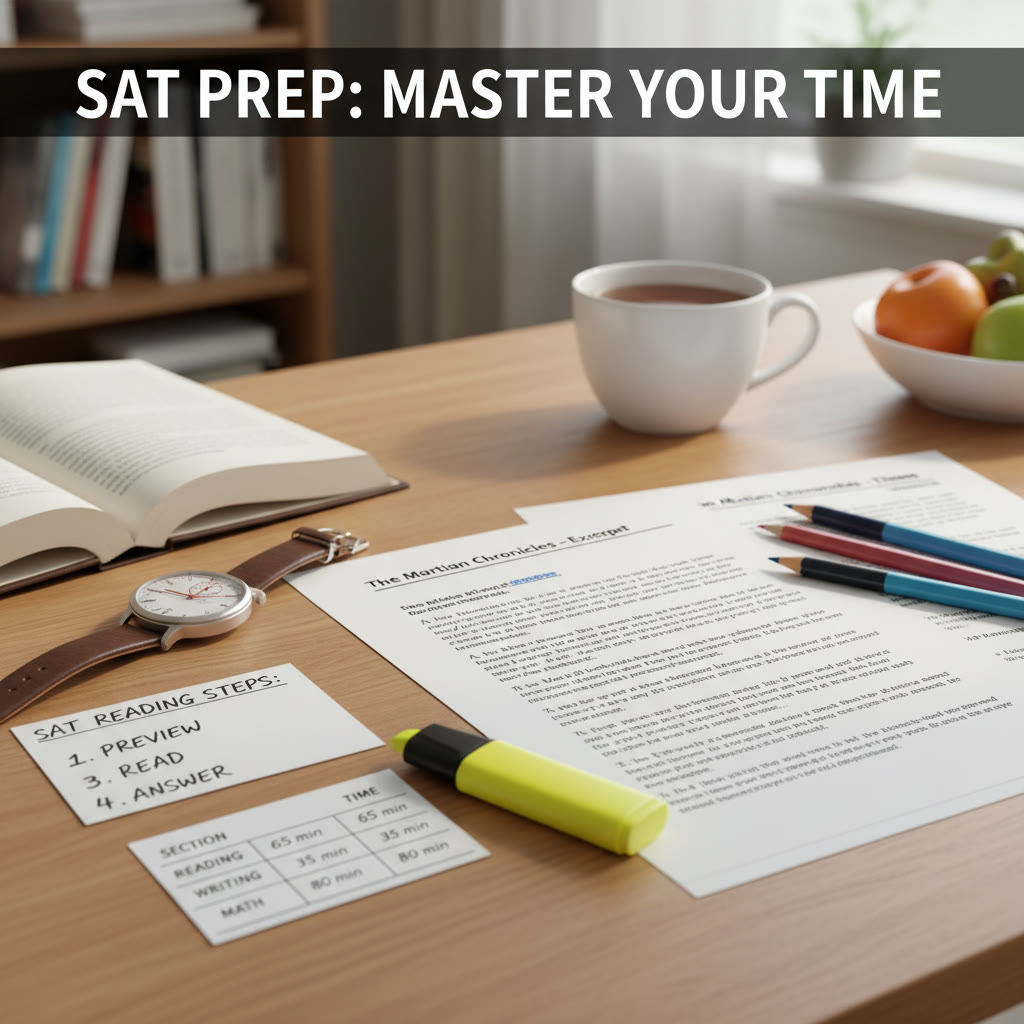
Time-allocation table: how you might budget 65 minutes
| Passage type | Avg. words | Suggested read time | Suggested question time | Total suggested |
|---|---|---|---|---|
| Long single passage (literary/humanities) | 650–750 | 2.5–3.5 min | 9–11 min | 12–14.5 min |
| Science/social science passage | 550–700 | 2–3 min | 8–10 min | 10–13 min |
| Paired short passages (each) | 350–450 | 1–1.5 min | 4–6 min | 5–7.5 min |
| Reserve (review / tough questions) | — | — | — | 6–8 min buffer |
This table is a framework: use it to guide practice so you don’t get trapped in a single passage for 20 minutes. Practice with a timer and adjust the numbers to match your natural strengths.
Concrete reading-speed techniques that preserve comprehension
Speed without strategy is careless. Here are practical techniques that increase effective speed while keeping comprehension high.
- Preview the passage quickly: Read the first paragraph and the topic sentence of subsequent paragraphs, plus the concluding paragraph. This gives a skeleton of the author’s argument before you dig into details.
- Passage mapping: After the preview, jot a two-line summary in the margin: main idea, author’s stance, and the function of the passage (e.g., “argues tech harms learning; uses study & anecdote”).
- Read with questions in mind: If you glance at the question stems first, you’ll know what to look for. But don’t attempt to answer everything from memory — use the question preview selectively for inference-heavy items.
- Active annotation: Circle transition words (but, however, moreover), underline claim statements, and mark evidence. Your annotations should be light — ticks, short phrases, or arrows — to save time.
- Skim where appropriate: For long descriptive sections that supply context but not testable claims, read faster. Slow down for pivot sentences where the author changes viewpoint or draws a conclusion.
- Eliminate early: Use process-of-elimination ruthlessly. Cross off answers that contradict the passage quickly; this buys time and reduces second-guessing.
Mini-exercise: make your reading active (3 steps you can practice today)
Try this with a timed 600–700-word article:
- Step 1 — Preview (60–90 seconds): Read the first paragraph, glance at paragraph openings, and read the last paragraph. Jot a one-sentence summary.
- Step 2 — Focused read (2–2.5 minutes): Read fully while underlining the author’s main claim and two pieces of evidence.
- Step 3 — Answer practice questions (8–10 minutes): Time yourself answering 8–12 questions related to the passage; note which questions required you to go back to the text and why.
Repeat this routine three times per week. The repetition trains both speed and the habit of targeted rereading — you learn when a quick reference to the text is enough and when you need a deeper scan.
The myth of extreme speed-reading and why it can fail you on the SAT
People talk about speed-reading as if you can skim and retain everything. The reality is: many speed-reading methods trade depth for breadth. On the SAT, several question types require close attention to nuance, tone, and structure — things that vanish if you only skim for keywords.
Rather than chasing radical wpm gains, focus on “purposeful speed”: read quickly enough to build a coherent model of the passage, then use targeted rereads for evidence-based or inference questions. That combination beats raw skimming almost every time.
Practice plans and drills: build speed without sacrificing understanding
Here’s a sample 6-week plan to build effective SAT reading speed. Aim for 4–6 short sessions per week rather than one marathon study block.
- Weeks 1–2: Baseline and consistency
- Timed single-passage practice 3x/week. Focus on preview + mapping. Do 20–30 minute sessions.
- Daily 10-minute vocabulary-in-context study: learn words by reading sentences, not lists.
- Weeks 3–4: Targeted speed drills
- One “fast read” session: read a passage in 50–70% of your usual time, annotate lightly, then answer questions with full accuracy focus.
- One “deep read” session: slow down to examine author’s structure and argument to solidify comprehension.
- Weeks 5–6: Test simulation and strategy refinement
- Full timed reading section once per week to train stamina.
- Work with a tutor (or Sparkl’s personalized tutoring) to review weak areas — tutors can build a tailored study plan, offer 1-on-1 guidance, and use AI-driven insights to highlight which question types cost you the most time.
Balancing accuracy and speed on test day: practical rules
On test day you’ll need simple, reliable heuristics. Try these:
- Triage first: If a passage’s questions feel straightforward, answer them quickly. If a passage looks dense or is a topic you know will slow you, mark it and come back after you clear the easier ones.
- Answer in passage order when it helps: Many questions refer to near-miss lines; answering in order means you often don’t need to hunt around.
- Be ruthless with time: If a question is taking longer than 90–120 seconds, mark it and move on. You can always return with fresh eyes.
- Use elimination early: Eliminating two bad choices from four gives a 50% shot — often better than a slow, uncertain attempt to find the perfect answer.
- Reserve review time: Keep 6–8 minutes as a buffer at the end to revisit flagged questions instead of continually making tiny time adjustments.
How tutoring and smart feedback speed up improvement
Speed improvements are rarely linear. Students plateau because they practice the wrong habits. That’s where targeted feedback becomes valuable. A tutor can spot persistent problems — like overreading quotations, missing signal words, or mismanaging time on paired passages — and correct them quickly.
Sparkl’s personalized tutoring can be a useful piece of that puzzle: with 1-on-1 guidance, expert tutors help build tailored study plans and demonstrate efficient reading techniques in real time. When combined with AI-driven insights that show which question types take you the longest, tutoring becomes more efficient — you spend practice time on the problems that truly matter.
Test-day habits that preserve your reading speed
Technical skill matters, but a few practical habits make a big difference on test day:
- Start calm: Use the first minute to breathe and set a simple plan: preview the first passage quickly and set a target read time.
- Pencil discipline: Keep annotations sparse and purposeful. A tidy margin with a two-word summary beats a messy, time-consuming scrawl.
- Pace check: At the midpoint of the section, glance at your watch. Are you on track with your planned time per passage? If not, adjust — don’t panic.
- Nutrition and rest: Deep reading demands focus. Sleep well the night before and eat a balanced breakfast. Low blood sugar or drowsiness can wreck both speed and judgment.
Examples: two student scenarios and what they teach us
Scenario A — Maya is naturally fast but makes careless mistakes. She skims and relies on intuition. Her improvement came when she introduced a 30-second passage map and the habit of always underlining the author’s claim. Her speed dropped briefly, but accuracy rose and total section time fell because she spent less time chasing answers.
Scenario B — Jamal reads slowly and comprehends well, but runs out of time. He practiced weekly timed passages with a tutor who taught previewing and question triage. Gradually Jamal shaved 30–45 seconds off his read time while maintaining comprehension, which gave him time to revisit two tough questions at the end of the section — enough to improve his score noticeably.
Both stories show that the right technique matters more than a single metric like wpm. You want efficient reading that supports accuracy.
Measuring progress: metrics that matter
Don’t get hung up on raw wpm. Track these metrics instead:
- Time per passage (initial read)
- Percentage of questions answered correctly on first try
- Number of questions requiring a full reread of the passage
- Score improvement on timed full-sections over weeks
Sparkl’s AI-driven insights can help compile these metrics automatically, highlighting trends and suggesting where to focus. When you pair that with one-on-one tutoring, you get a feedback loop that makes practice smarter, not just longer.
Final thoughts: make speed work for you
Reading speed matters because it gives you time — time to think, time to double-check, and time to handle the SAT’s pressure. But speed without strategy is a trap. The goal is purposeful speed: a balanced reading approach that maintains comprehension while trimming wasted time.
Start small, practice consistently, and measure progress with the right metrics. Use drills that force you to alternate between fast and deep reading, and be ready to change habits that don’t serve you. If you want personalized help, consider working with an expert tutor; Sparkl’s personalized tutoring, for example, offers tailored study plans, 1-on-1 guidance, expert tutors, and AI-driven insights to make sure your practice is focused on high-impact improvements.
Above all, remember: the SAT rewards smart practice. Build techniques that give you clarity under the clock, and you’ll find your score follows. Now pick a passage, set a timer for two minutes, and try a preview + map. You’ll be surprised how much sharper your reading becomes in just a few focused sessions.
























No Comments
Leave a comment Cancel