
Why Test Familiarity Builds Speed on the SAT
Imagine approaching a test that feels like a friend instead of an enemy. Your hands settle at the page, your heart rate drops, and problems start to feel solvable. That sense of calm, clarity, and speed doesn’t come from raw talent alone — it comes from familiarity. Knowing the structure, the common traps, and the rhythm of the SAT gives you a huge advantage. This post explores why test familiarity builds speed, breaks down how it helps in each SAT section, and offers practical exercises, a timing table, and thoughtful ways to practice so you move faster without sacrificing accuracy.
What I mean by “test familiarity”
Test familiarity is more than having done a few practice tests. It’s a layered understanding that includes:
- Knowing the format: question types, timing, and scoring behavior.
- Recognizing recurring phrasing and common distractors.
- Feeling comfortable with the pacing and transitions between questions and sections.
- Having practiced the cognitive routines—how you read, mark, and decide.
When all these layers come together, your brain doesn’t need to spend time decoding what is being asked. That saves precious seconds on every question, and those seconds stack up to big gains.
How familiarity speeds up thinking: the science and commonsense
Speed in standardized testing is as much cognitive economy as it is quickness. Two psychological ideas explain why familiarity helps:
1. Pattern recognition reduces decision time
Experts across fields (chess, music, medicine) get faster because they recognize patterns. On the SAT, many questions follow patterns—certain phrasing, typical wrong answers, or algebraic structures. Once you’ve internalized those patterns, you bypass slower, step-by-step problem solving and jump to a near-instant recognition of the right pathway.
2. Cognitive load decreases
New tasks use up working memory. Familiar tasks move into long-term memory as routines. The less working memory you spend on deciphering instructions or layout, the more you can allocate to reasoning the problem. That frees up both speed and accuracy.
Section-by-section: what familiarity looks like and concrete speed hacks
Every SAT section rewards familiarity in different ways. Below I’ll outline real strategies and examples you can practice to build speed where it matters.
Reading: recognize question types and skim smarter
Reading speed isn’t just words-per-minute; it’s targeted reading. Familiarity helps you predict the kind of evidence the question will require.
- Recognize question stems: “Main idea,” “Inference,” “Author’s tone,” and “Evidence” each demand different reading strategies. If you see “Inference,” you know to avoid adding outside knowledge; if you see “Evidence,” scan for the exact line citation.
- Learn fast annotation marks: underline thesis sentences, circle dates and names, and flag transitions. Your eyes should be trained to go to the likely sentence types quickly.
- Practice passage templates: literary passages often have character conflict arcs; science passages typically have hypothesis, method, result, and implication. Knowing the template lets you find answers faster.
Example drill: time yourself on 4 single passages, but stop and note the question type before reading questions. Over time, you’ll start predicting answers earlier and skipping nonessential sentences.
Writing and Language: learn the grammar hot spots
Grammar rules don’t change. Familiarity here is literal—memorize common error types and train a checklist you can run quickly.
- High-yield grammar: subject-verb agreement, pronoun clarity, parallelism, verb tense consistency, and comma usage.
- Style and concision: if an answer shortens a sentence while preserving meaning, it’s usually preferable.
- Process habit: read the sentence in context, apply your checklist, eliminate distractors.
Example drill: create flashcards of the top 20 grammar traps and practice 10 questions a day until you can name the rule instantly. Instant rule recall saves time in test conditions.
Math (No Calculator): make mental math efficient
No Calculator tests arithmetic fluency and algebraic reasoning. Familiarity here is about choosing the fastest method that still gives a correct answer.
- Know numeric patterns: special products, fraction-decimal relationships, common factor shortcuts.
- Recognize when algebraic manipulation is faster than plugging numbers, and when quick substitution or estimation wins the race.
- Practice mental arithmetic daily. Faster basic calculations shave seconds off every problem.
Example drill: time yourself solving 15 No Calculator questions by doing them one way (algebraically), then the next day try different approaches (plugging in, estimating). Compare times and map which strategies work best for which question types.
Math (Calculator): reduce dependency and avoid wasted steps
Even with a calculator allowed, not every problem needs it. Overusing it can slow you down—typing, re-keying, and re-checking take time. Familiarity helps you know when to compute mentally and when to use a calculator efficiently.
- Use calculators for messy arithmetic and large numbers; avoid it for clean algebraic manipulations where rearranging is faster.
- Memorize keystrokes or sequences for common functions on your calculator model so execution is fluid.
- Work on reading comprehension for graphs and tables—often the speed advantage comes from interpreting rather than calculating.
Practical practice routines that build real familiarity
Familiarity is built through deliberate, structured practice — not passive repetition. Here are routines that make your practice smart instead of just long.
1. The Staggered Practice Loop
Alternate between deep-focus sessions and light-review sessions:
- Deep-focus (3–4 days/week): Full sections under timed conditions, then detailed review of every mistake.
- Light-review (2–3 days/week): Quick drills—20–30 minutes—targeting patterns you missed in deep-focus sessions.
- Reflection day (1 day/week): Look at trends: Are inference questions slow? Are certain algebra topics repeatedly missed? Adjust next week’s drills.
2. The ‘Pattern Spotter’ Drill
After any practice set, categorize mistakes by type. Make a one-page list of the five most common question patterns you miss. On your next practice day, do 20 questions intentionally chosen to address those patterns. This focused repetition builds recognition.
3. Timing mini-sprints
Speed training is like athletic interval training. Run through tight bursts under stricter time constraints to force faster decision-making.
- Example: For Reading, give yourself 18 minutes for a single long passage (instead of 22).
- For Math, pick five multi-step problems and do them in 12 minutes to train efficiency under pressure.
Sample timing table: where seconds add up
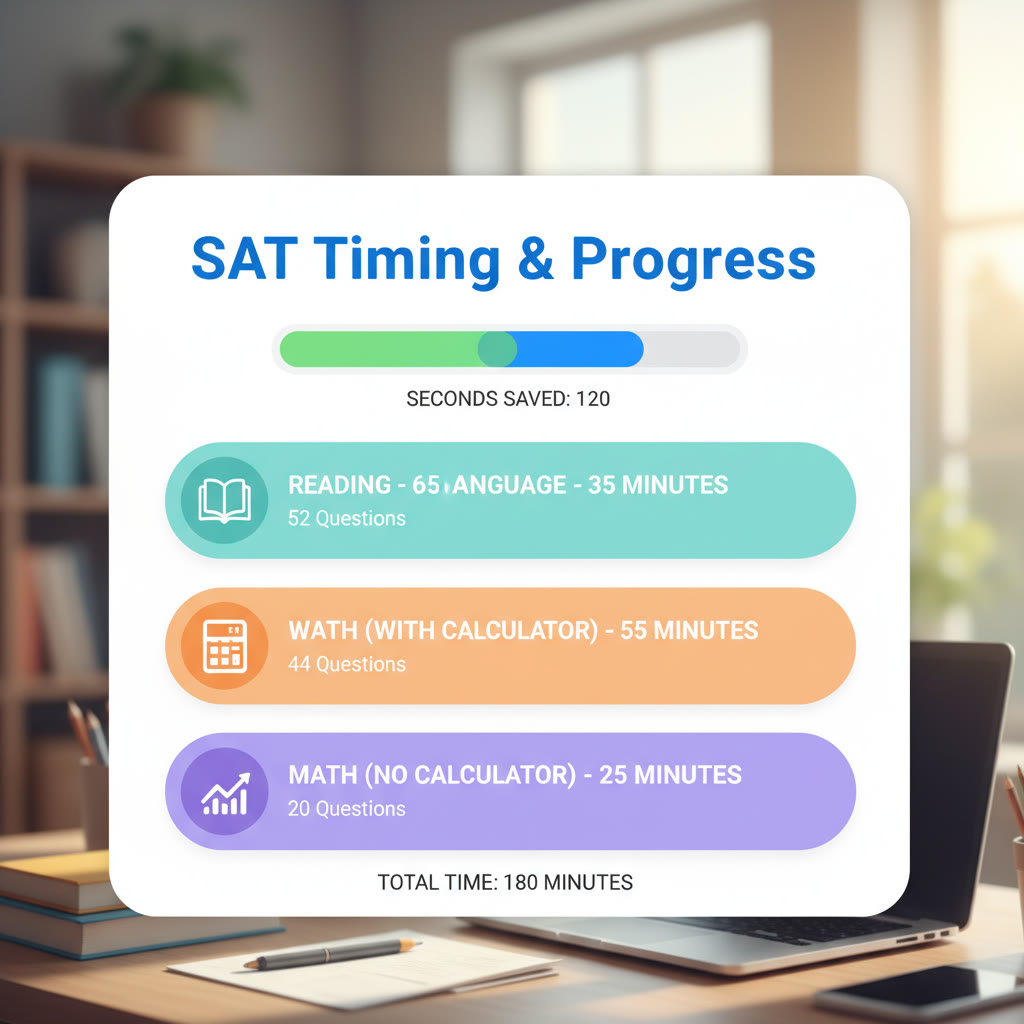
Here’s a realistic view of time per question, and how shaving seconds matters. These are example benchmarks to help you plan practice goals.
| Section | Questions | Total Time | Average Time per Question | Goal: shave | Time Saved per Section |
|---|---|---|---|---|---|
| Reading | 52 | 65 minutes | ~75 seconds | 10 seconds | ~8.6 minutes |
| Writing & Language | 44 | 35 minutes | ~48 seconds | 6 seconds | ~4.4 minutes |
| Math No Calculator | 20 | 25 minutes | ~75 seconds | 10 seconds | ~3.3 minutes |
| Math Calculator | 38 | 55 minutes | ~87 seconds | 8 seconds | ~5.1 minutes |
Combined, shaving just a few seconds per question can give you 20+ extra minutes across the test — time you can use to double-check, tackle harder problems, or simply reduce stress. Those seconds are the direct payoff from improved familiarity.
Real-world examples: students who sped up with focused familiarity work
I’ve seen readers apply these ideas and get concrete gains. One student I worked with was stuck on Reading: she read everything carefully but slowly. We shifted her practice to the Pattern Spotter Drill and timed mini-sprints. Within six weeks she went from 70 seconds per question to 55 seconds while improving accuracy. How? She learned to identify question types while skimming, and she practiced targeted inference and evidence questions until the phrasing felt familiar.
Another student used Sparkl’s personalized tutoring and benefits to shorten his learning curve. With 1-on-1 guidance and a tailored study plan, his tutor mapped high-frequency question types to efficient strategies. The tutor used AI-driven insights to track which mistakes repeated and adjusted practice sets. Over two months his calculator-section speed and confidence rose significantly — not by rushing, but by making every move more intentional.
Common pitfalls: familiarity doesn’t mean complacency
Familiarity is powerful, but it can breed overconfidence. Watch for these traps:
- Assuming you know the answer without validating. Pattern recognition should speed up the first step, not skip verification.
- Over-relying on one strategy. If you always plug in numbers for algebra, you may waste time on problems where algebra is faster.
- Practicing without review. Repetition without analysis cements habits — both good and bad.
Balance familiarity with disciplined verification: a quick, reliable check for every answer will keep accuracy high as your speed increases.
How to measure progress practically
Make your improvements visible with simple metrics:
- Average time per question by question type (track weekly).
- Percent correct in timed mini-sprints vs. full sections.
- Number of question patterns identified and corrected in a week.
Keep a short practice journal. Note one insight from each practice session. After a month, you’ll see patterns — where time was wasted, which question types you’ve tamed, and where you still need work.
How tutoring accelerates familiarity-building
Targeted external support shortens the time it takes to become genuinely familiar. A thoughtful tutor helps you in three main ways:
- Diagnosis: quickly reveal which question patterns you stumble on and why.
- Accountability and structure: keep the practice loop honest and efficient.
- Technique refinement: show you the best approach for each problem type and correct bad habits early.
Sparkl’s personalized tutoring and benefits can fit naturally into this approach for students who want guided acceleration. With 1-on-1 guidance, tailored study plans, expert tutors, and AI-driven insights, Sparkl can identify pattern-level weaknesses and customize drills that build familiarity faster than unguided practice. This doesn’t replace focused work, but it multiplies the impact of each practice hour.
Sample weekly plan to build familiarity and speed
This plan blends full-length sections, focused drills, and reflection. It’s flexible: swap sections based on your weak spots.
- Monday: Reading deep-focus (one full Reading section timed) + review errors and categorize patterns.
- Tuesday: Math No Calculator mini-sprints (3 sets of 15 questions) + mental math drills.
- Wednesday: Writing & Language targeted practice (25 focused grammar questions) + flashcard review.
- Thursday: Math Calculator full section timed + keystroke practice on calculator.
- Friday: Short mixed drill (30 minutes) focusing on your top 5 problem patterns from the week.
- Saturday: Full practice test simulation every other week; otherwise light review and corrections.
- Sunday: Reflection and plan adjustment. Log improvements and set micro-goals for the week.
Quick tips to make familiarity stick
- Rotate question sources: exposure to varied official and realistic practice sets prevents overfitting to one wording style.
- Simulate test conditions occasionally: the SAT’s environment is part of the pattern; practice with noise, timing, and breaks that match the real test day.
- Use error logs visually: create a chart of error types and color-code how often each appears. Visual feedback accelerates learning.
- Teach someone else: explaining a rule or strategy aloud often reveals your blind spots and solidifies recognition.
Image ideas

Final thought: speed comes from confidence, not panic
Speed on the SAT isn’t about racing blindly — it’s about moving with confidence. Familiarity creates that confidence. By recognizing patterns, reducing cognitive load, and practicing with intention, you reclaim minutes that make the difference between a stressed guess and a calm, correct answer. If you want to accelerate that process, consider coaching that zeroes in on pattern-level weaknesses; Sparkl’s personalized tutoring and benefits — including 1-on-1 guidance, tailored study plans, expert tutors, and AI-driven insights — can help you build familiarity more efficiently without wasting time on the wrong drills.
Takeaway checklist
- Identify the 5 most frequent question patterns you miss.
- Run timing mini-sprints twice a week to build speed under pressure.
- Keep an error log and review it weekly to turn mistakes into familiar territory.
- Consider 1-on-1 help if you want faster, personalized progress.
Familiarity is a quiet advantage. It transforms the test from unpredictable to known, and that transformation is the root of speed. Start small, practice deliberately, and watch the seconds you save turn into confidence and higher scores.






















No Comments
Leave a comment Cancel