
Why tracking your SAT score progress is more than numbers
Think back to the last time you set a goal and checked on it. Maybe it was saving money, training for a 5K, or learning a new piece on the piano. That small act of checking — opening an app, glancing at a spreadsheet, jotting a note — often boosts your drive. The SAT is no different. When students track their SAT score progress thoughtfully, a few powerful things happen: the fog of uncertainty clears, effort feels meaningful, and confidence grows in manageable steps.
This post walks through the psychology behind score tracking, practical ways to track progress, a ready-to-use sample tracker, and how to interpret the data without getting lost in numbers. Along the way you’ll see how Sparkl’s personalized tutoring and features like 1-on-1 guidance, tailored study plans, expert tutors, and AI-driven insights can fit naturally into a tracking routine and make each check-in more productive.
The motivational science: why tracking works
Tracking isn’t magic — it’s a simple application of well-studied behavioral principles.
1. The goal-gradient effect
As you get closer to a goal, your effort tends to increase. Score tracking shows tangible distance traveled. Seeing a steady +20 or +30 over several weeks makes the end goal feel within reach and fuels faster, smarter work.
2. Immediate feedback and correction
Practice tests are your experiments. Tracking gives fast feedback about what’s working and what isn’t. If your math section is rising while reading stalls, you can reallocate study time; if both plateau, change the method — maybe switch to targeted error logs or timed drills.
3. Small wins build self-efficacy
Psychologists call it self-efficacy: confidence that you can achieve. Small, documented improvements — a few points on a practice section, fewer careless errors — compound into a belief that you can reach a big target like 1300 or 1450.
What to track (and what to ignore)
Not all metrics are equally useful. The trick is to track things that inform action.
Essential SAT metrics
- Official-style composite score (400–1600)
- Section scores: Evidence-Based Reading and Writing (EBRW) and Math (each 200–800)
- Subscores and domain-level data (e.g., algebra, data analysis, command of evidence, vocabulary in context)
- Time management markers: number of untimely skips, questions left unanswered
- Percent of question types missed (e.g., geometry, grammar, paired passages)
- Practice-test conditions (full length, timed, strict vs. relaxed)
What to avoid obsessing over
- Single practice test score taken under odd conditions — use trends, not outliers
- Raw question counts without scaling context — the SAT scales raw to section scores
- Percentiles from different years or datasets — they change slightly over time
How to build a motivating score-tracking system
Make your tracking system simple, visual, and action-focused. If it takes more time to update the tracker than to study, it won’t last. Here’s a practical step-by-step.
Step 1 — Start with a diagnostic
Take a full-length, timed diagnostic that mimics test conditions. This gives you the baseline and context for choosing a realistic target. Record your composite, each section score, and notes about pacing issues or question clusters where you struggled.
Step 2 — Set a concrete, measurable target
Break the big goal into micro-goals. Instead of saying “get better at math,” aim for “increase math from 560 to 660 in 10 weeks” and list weekly checkpoints like +10 points every two weeks.
Step 3 — Choose your cadence
How often should you test? A common effective rhythm for most students is:
- Full-length practice test every 2–3 weeks
- Short timed sections or mixed practice twice per week
- Daily review of error logs and flashcards
These frequencies balance measurement sensitivity with study time.
Step 4 — Measure both performance and process
Track not only scores but study actions: hours spent, problem types practiced, and number of review sessions. This allows you to correlate study behavior with score gains.
Sample tracking table: a 12-week improvement plan
Here is a sample table you can copy into a spreadsheet. It shows a realistic, steady-improvement trajectory for a student starting around 980 aiming for 1250 in three months.
| Week | Composite | EBRW | Math | Focus | Notes |
|---|---|---|---|---|---|
| Baseline (Week 0) | 980 | 490 | 490 | Diagnostic | Time pressure in Math; misses on paired passages |
| Week 2 | 1010 | 500 | 510 | Timed practice, error log | Improved pacing in math |
| Week 4 | 1040 | 520 | 520 | Reading strategy, algebra review | Fewer careless errors |
| Week 6 | 1080 | 540 | 540 | Targeted drilling, mixed timing | Solid gains on data interpretation |
| Week 8 | 1120 | 560 | 560 | Full-length test cadence | Confidence increases; fewer breaks in focus |
| Week 10 | 1180 | 590 | 590 | Advanced problem sets | Approaching target; tweak pacing |
| Week 12 (Target) | 1250 | 630 | 620 | Final polished practice | Ready to re-test or sit the real SAT |
How to read the table
Notice that the plan mixes test frequency, focused skills work, and steady increases rather than dramatic jumps. Consistency is the secret: steady accumulation of corrected errors and timed practice moves the needle more reliably than frantic cramming.
Tools and formats for tracking that actually stick
Pick a tracking format that fits your personality.
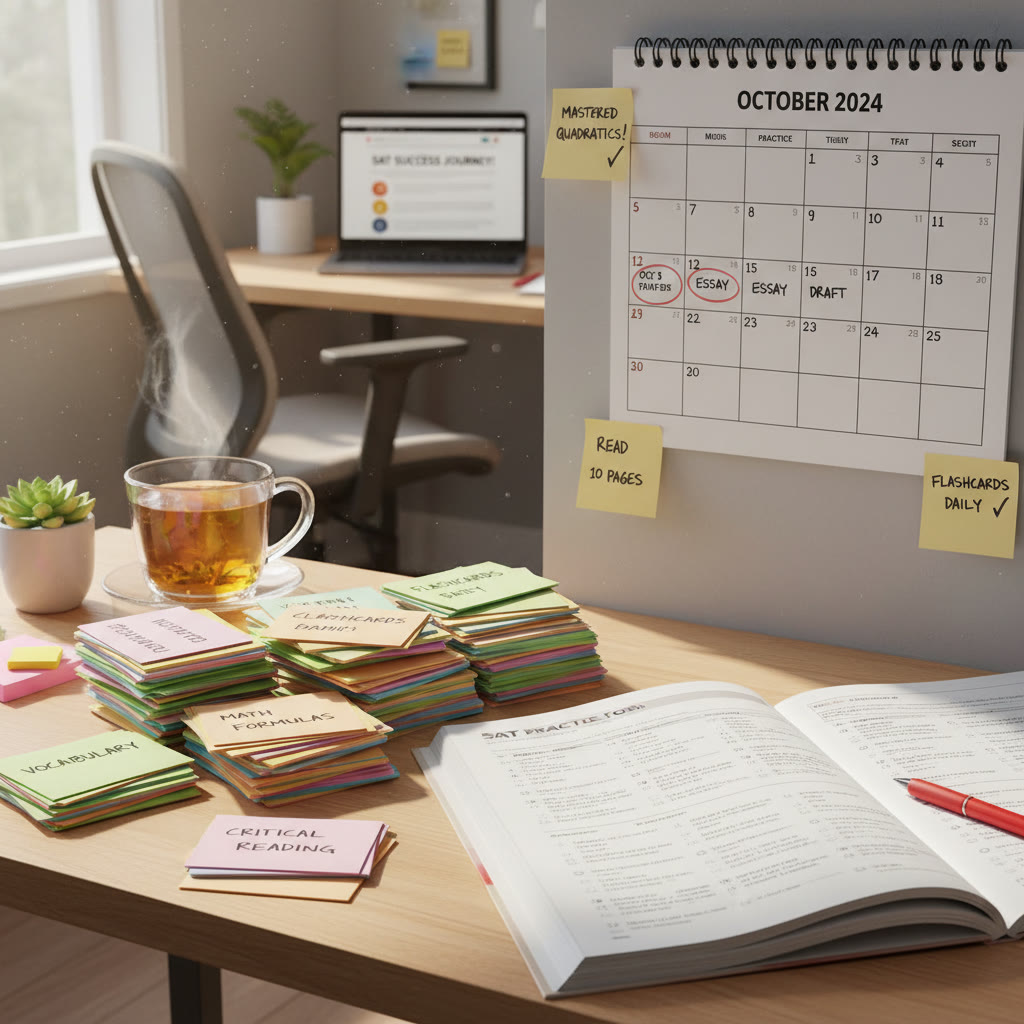
Low-tech: notebook and sticky notes
Some students prefer pen-and-paper. A simple paper log can be powerful: write your baseline scores at the top, list weekly focus areas, and mark small wins. The physical act of writing makes progress feel real.
Spreadsheet: flexible and visual
Create a spreadsheet with columns for date, composite, section scores, study hours, and a short note. Add a line graph of composite score and separate lines for each section. Graphs turn abstract numbers into a story.
Apps and dashboards
Several study apps let you track performance over time and visualize trends. If you work with a coach or a program like Sparkl, you can combine their AI-driven insights and expert tutor feedback with your own tracker so the data drives individualized adjustments.
Common pitfalls and how to avoid them
Pitfall 1: reacting to single-test noise
One bad or great test doesn’t define your trajectory. Treat individual scores as data points in a trend. If you see sudden change, ask: was the test timed correctly? Were you sick or distracted? Disaggregate cause from chance.
Pitfall 2: tracking without action
The worst tracker is a spreadsheet of regrets. Each tracked item should suggest an action: practice a concept, review mistakes, adjust time-per-question. If your tracker doesn’t guide your next move, redesign it to include action steps.
Pitfall 3: chasing diminishing returns
At some point, small score increases require disproportionate effort. That’s normal. Use a tutor or mentor to decide whether another 20 points is worth the trade-offs. With Sparkl’s 1-on-1 guidance, you can see where targeted changes produce the best payoff.
Examples of meaningful micro-metrics to log
These micro-metrics are the feedback loops that turn hours into improvements:
- Average time per question by section
- Number of questions reviewed in your error log each week
- Percentage of previously incorrect question types answered correctly on retest
- Number of stamina-preserving strategies used in a test (short breaks, breathing techniques, skipping strategy)
- Count of vocabulary words reviewed via spaced repetition
How tutors and AI-driven insights accelerate progress
Tracking shines brightest when paired with experienced feedback. Tutors help you interpret patterns, prioritize weaknesses, and maintain accountability. AI tools add scale: they quickly analyze thousands of questions, detect patterns in errors, and suggest micro-lessons.
Where 1-on-1 tutoring fits
A tutor takes the numbers in your tracker and translates them into tailored next steps: a custom set of practice problems, a pacing drill for section-specific timing, or a review session focused on concepts that repeatedly appear in the error log. Sparkl’s personalized tutoring combines these elements — expert tutors who interpret your tracker and craft a tailored study plan — giving you both human insight and structure.
Where AI-driven insights help
AI can surface patterns you might miss, like a recurring misread phrasing in reading passages or weaker performance on linear algebra. When the algorithm flags a pattern, a good tutor can turn that into a simple, targeted routine. Together, human tutors and AI-led analysis shorten the path from data to improvement.
Real-world context: how admissions officers see progress
Colleges care most about the final official score you submit, but sustained improvement tells a story. Admissions readers see applicants who invest in growth — consistent upward trends and clear effort — as resilient and coachable. Documenting progress can also help you write a compelling narrative in application essays about learning habits and perseverance.
Case study sketch: Maya’s jump
Maya started with a 1040 diagnostic. She tracked scores every two weeks, logged time spent on Algebra and paired passages, and noted each mistaken question type. Her tracker revealed high variability in reading but steady gains in math. With targeted practice — focused on structuring passage notes and eliminating careless math errors — Maya improved to 1240 over three months. The tracker showed where wins came from: consistent 30-minute sessions focused on error correction and two full tests a month to calibrate pacing.
Quick templates you can copy tonight
Use one of these simple templates and adapt it.
Weekly tracker (spreadsheet columns)
- Date
- Composite score
- EBRW
- Math
- Hours studied
- Main focus this week
- Top two errors fixed
- Next action
Error-log entry
- Question ID or description
- Type (e.g., algebra, sentence structure)
- Why I missed it
- Correct approach
- Date reviewed and outcome on retest
Final tips to keep motivation high
- Celebrate small wins. A consistent +10 points deserves recognition.
- Keep records brief. One-sentence notes beat long journals you never read.
- Find an accountability buddy or tutor for weekly check-ins.
- Balance measurement with joy. Practice should feel purposeful, not punitive.

Wrapping up: tracking turns effort into progress
Tracking SAT scores is less about obsessing over digits and more about turning blurred effort into focused progress. A well-designed tracker clarifies what works, keeps you motivated through visible wins, and helps you allocate effort where it pays off. Combine your tracker with thoughtful practice, timed tests, and occasional tutor check-ins and you’re building a system that reliably converts time into score gains.
If you want a partner in that process, consider how a tailored approach can speed things up. Sparkl’s personalized tutoring offers one-on-one guidance, tailored study plans, expert tutors, and AI-driven insights that slot neatly into a tracking routine — turning your data into a smarter, faster plan of action without adding extra busywork.
Start with one diagnostic, pick one small habit to log today, and let the momentum of measured progress carry you forward. The numbers won’t just show your growth — they’ll help you build it.
























No Comments
Leave a comment Cancel