

Why Medical and Allergy Preparedness Matters for AP Test Day
AP exam day is high-stakes for many students: months of learning, practice, and stress boil down to a few hours. Add a surprise allergic reaction, a forgotten medication, or poor planning for a chronic condition, and even the most prepared student can feel derailed. Being medically prepared doesn’t mean obsessing over hypotheticals — it means practical steps that give you calm, control, and the best chance to perform at your true level.
This guide walks you through everything you need to know — from what to bring and what the College Board allows, to effective coordination with your school’s SSD office, and simple day-of strategies to reduce risk. I’ll share real-world examples, a clear checklist you can print, and a sample medication table to keep things tidy. Where it fits naturally, I’ll note how Sparkl’s personalized tutoring and 1-on-1 planning can help you integrate medical prep into your exam strategy so you can focus on answers, not anxieties.
Key Principles Before the Exam
1. Plan early and document everything
Medical preparedness is mostly an organizational problem. If you have a chronic condition, allergy, or require special medication, start the conversation with your school’s SSD (Services for Students with Disabilities) coordinator as early as possible. Most accommodations must be approved in advance, and some setup (like permission to bring food or medicine into the test room) requires formal documentation.
2. Know the rules — and how exceptions are made
The College Board has clear policies about what can and cannot be in the testing room. Many common items — including food or medication — are normally prohibited unless explicitly approved as an accommodation. That’s why an SSD authorization letter is more than a formality; it’s permission that prevents your score from being jeopardized because you needed to bring an EpiPen or a bottle of inhaler into the room.
3. Keep plans simple and redundant
Redundancy reduces stress. If you rely on allergy medication or an inhaler, pack two (one in your bag and one with a trusted adult, if allowed). Make copies of any SSD letters and keep contact numbers handy. On test day, the fewer surprises the better.

Before You Register: Medical Documentation and Accommodations
When to contact SSD
If you have a documented medical condition, receive accommodations at school (IEP or 504 plan), or take prescription medication you’ll need access to on test day, contact your SSD coordinator during the registration or ordering period. Starting early avoids rushed last-minute approval requests.
Common accommodations that matter for medical/allergy needs
- Permission to carry and use medication during testing (e.g., inhalers, EpiPens).
- Extra breaks or the ability to leave the room to manage symptoms or take medication.
- Multiple-day testing or extended time for students with medical treatments that interfere with stamina.
- Private or separate testing rooms to reduce allergen exposure or for medical privacy.
These accommodations must be requested by your SSD coordinator and approved by the College Board’s SSD office ahead of time. Keep your SSD Eligibility Letter with you on exam day — it’s your proof of approval and often required by the test center.
Packing Checklist: What to Bring (and What to Avoid)
Medical and allergy essentials
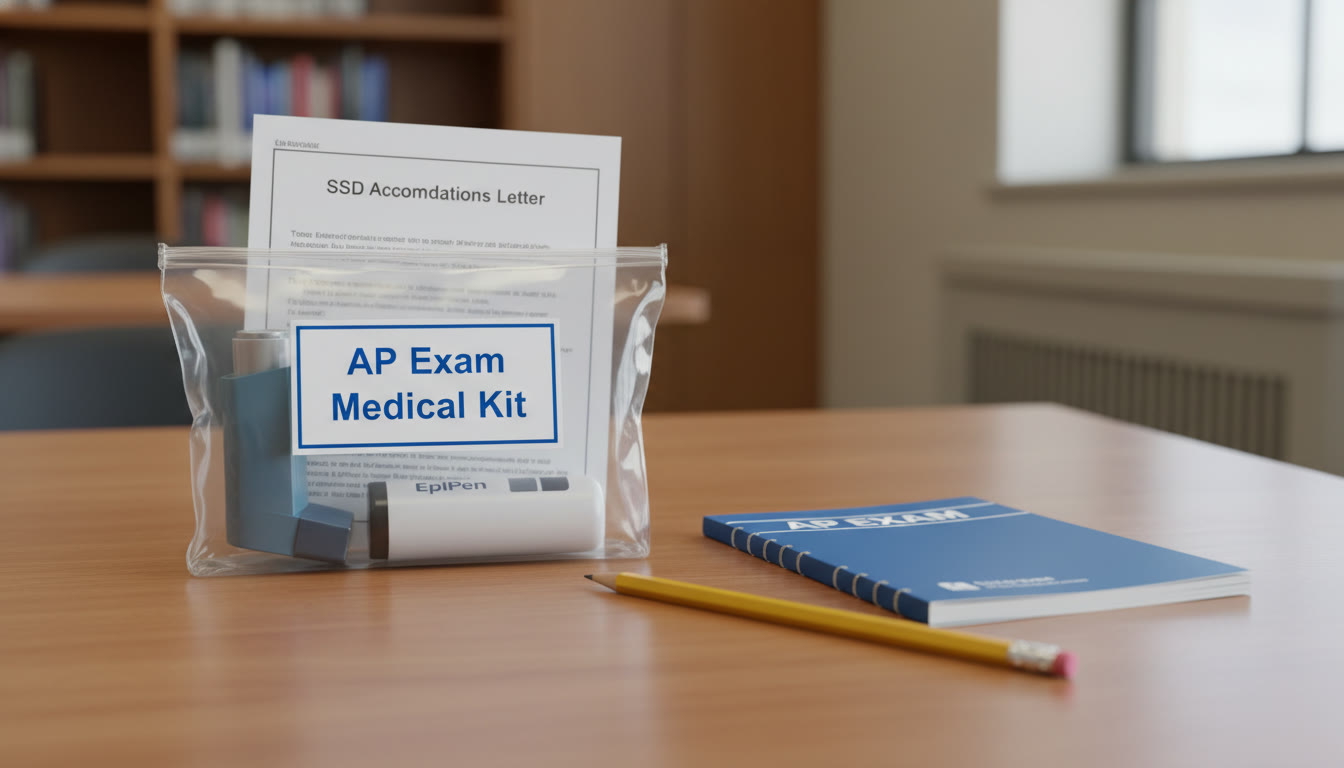
- SSD Eligibility Letter (if you have approved accommodations) — carry a printed copy.
- Prescribed medication in original labeled packaging (inhaler, EpiPen, insulin, etc.), plus the doctor’s note if possible.
- Over-the-counter allergy meds you regularly use (antihistamines) — only if approved by SSD or left in a sealed bag according to proctor instructions.
- Emergency contact numbers written on paper (school health office, parent/guardian, physician).
- Small first-aid items as permitted (bandage, allergy wipes) — confirm with your AP coordinator ahead of time.
General test essentials
- Student ID or school ID.
- Two pencils and an eraser (for paper administrations) or charged device and charger if taking a digital exam — check device rules in advance.
- A simple analog watch (non-smartwatch) to track time.
- Comfortable layers of clothing (testing rooms can be unpredictable).
What not to bring without approval
- Food and beverage — disallowed unless approved as an accommodation. Even water is often restricted during testing unless SSD allows it.
- Large medical devices or items that could be considered electronic unless approved (some insulin pumps and monitoring devices may require documentation).
- Smartwatches, phones, or any device that connects to the internet — these are strictly prohibited.
Day-Of Strategies to Minimize Risk and Anxiety
The morning routine
Start the day with predictable habits. Eat a familiar breakfast that won’t trigger allergies. Take routine medications as you normally would, and double-check your emergency meds are in your bag. If your condition is temperature-sensitive, dress in layers so you can adapt.
Arrive early and check in with the test proctor
Arrive at the test center early to reduce stress and to confirm any special arrangements. Bring your SSD Eligibility Letter and politely inform the proctor of any medication you need to keep with you. Extra time at check-in means fewer surprises once testing begins.
Managing mild allergic symptoms during the exam
If you’ve properly documented your needs, you should be allowed brief breaks to use medication. Practice calm, focused breathing techniques beforehand to help control anxiety-induced symptoms. If you start to feel symptoms escalate, notify the proctor immediately — your health comes first.
When an emergency happens
If a serious allergic reaction occurs (difficulty breathing, swelling, hives combined with systemic symptoms), call for medical help immediately and follow the plan from your SSD coordinator and school health office. Don’t worry about lost testing time during an emergency; health always takes priority.
Sample Medication & Emergency Information Table
Keep a concise table like the one below on paper in your bag so proctors and caregivers can quickly scan essential information.
| Item | Why It’s Needed | Where It Is | Emergency Steps |
|---|---|---|---|
| Albuterol Inhaler | Relieves asthma symptoms | Small pouch in backpack | Use 2 puffs, wait 4 minutes; call proctor and school nurse if no improvement |
| Epinephrine Auto-Injector (EpiPen) | Treats anaphylaxis from severe allergic reaction | With student and backed up at school office | Inject, call 911, notify proctor and parent/guardian |
| Daily Antihistamine | Controls baseline allergic symptoms (hay fever, etc.) | Kept in backpack, taken morning of exam | Take as usual. For severe symptoms, follow EpiPen protocol |
| Insulin (if applicable) | Blood sugar control for diabetes | School nurse or student’s secure pouch (per SSD plan) | Check blood glucose; treat hypoglycemia with glucose gel or snack; notify proctor |
Tips for Students with Food Allergies
Food allergies require both planning and clear communication. If you usually need to eat or take medication during the test, you’ll want pre-approval. If you don’t have an accommodation, remember the standard rule: food and drinks are usually not allowed in the test room.
Practical steps
- Request permission for snacks or drinks through SSD if you need them during breaks.
- Pack allergy-safe snacks in sealed bags and keep one with a proctor or in a designated area if the rules require it.
- Label everything clearly. Many schools will be willing to work with you to provide a safe, separate testing area if cross-contamination is a risk.
Communication: Who to Tell and What to Say
At school
Talk to your school’s AP coordinator and SSD coordinator. They manage the logistics around testing accommodations and will know the College Board processes. Share your SSD Eligibility Letter, the medication table, and any specific instructions from your doctor.
At home
Make sure a parent or guardian knows the test arrival time, the location, and how to reach you if needed. Having a simple plan — like a phone call at a specified time after the test — can ease both your and their worries.
Simulate Test-Day Conditions in Practice
Run low-stakes simulations where you practice everything that will happen on exam day: waking up with the same routine, taking the same medicines, bringing your SSD letter, and using the medication packing checklist. If you practice taking an inhaler, for example, you’ll be faster and calmer doing it for real. Teachers, tutors, or a school nurse can role-play the proctor interaction so the real check-in feels familiar.
How Personalized Tutoring Can Help Your Medical Prep
Preparing academically is obvious — but well-run tutoring can also help you prepare practically. Sparkl’s personalized tutoring model offers 1-on-1 guidance where an expert tutor helps you build a study schedule that includes medical readiness: integrating practice runs, checklist reviews, and coordinating with SSD timelines. Tutors can also help you rehearse the language you’ll use with proctors, create concise medication tables, and reduce test-day anxiety through focused strategies. The point is simple: when the academic and medical pieces fit together, your confidence rises and performance follows.
Real-World Examples and Comparisons
Two students illustrate how planning changes outcomes. Student A has seasonal allergies but no SSD approval; she shows up with antihistamines in her bag, which are not recognized by the proctor as an approved accommodation. A distracting reaction occurs mid-exam, she loses concentration, and her score suffers.
Student B with the same allergy gets an SSD-approved plan: permission for a labeled antihistamine in the testing room, a short break if symptoms escalate, and a backup allergy-safe snack if needed. Because chaos is replaced by a plan, Student B executes the test with minimal interruption. The contrast isn’t about luck — it’s about documentation and communication.
After the Exam: Follow-Up and Reflection
Report any incidents
If anything went wrong — an allergic reaction, medication mix-up, or accommodation issue — report it to the AP coordinator and SSD coordinator immediately. Document the incident in writing and keep copies of medical notes. If a score was affected by a medical incident, the SSD office and College Board have processes to handle special circumstances.
Review your plan
After the event, revisit your checklist and ask: What went well? What should I change next time? This is how you refine a plan that will serve you in future exams or other high-pressure settings.
Printable Quick-Reference Checklist
Cut this list down to a single sheet and keep it with your SSD letter and medical pouch.
- SSD Eligibility Letter — printed copy in front pocket
- Medication 1 — labeled and in original packaging
- Medication 2 (backup) — separate location
- Emergency contact list — 2 phone numbers
- Doctor’s note or treatment plan — summarized in 1 paragraph
- Watch (non-smart) and valid ID
- Arrive 30 minutes early and check in with proctor
Common Questions Students Ask
Can I bring an EpiPen into the testing room?
Yes — but only if you have the proper documentation and approval to bring it in. Carry it in original packaging and keep a copy of your SSD Eligibility Letter accessible. Notify the proctor at check-in so they’re aware and can document it.
What if I don’t have SSD approval but need medication?
Speak with your SSD coordinator immediately. If you arrive without approval, test centers may be unable to allow items that are normally prohibited — which could force you into a difficult position. Planning ahead is the safest route.
Will taking an allergy pill make me drowsy and affect my score?
Some antihistamines cause drowsiness. If a medicine affects cognition, talk to your doctor about alternatives and test them on practice days prior to the exam. Your tutor or school nurse can help you schedule a medication plan that minimizes cognitive side effects during high-stakes testing.
Final Thoughts: Confidence Through Preparedness
AP exam day is intense, but it doesn’t have to be perilous. The secret to getting through medical and allergy concerns is a blend of documentation, clear communication, redundancy, and rehearsal. When you’ve checked the boxes — SSD approval, labeled meds, practice runs, and a calm morning routine — you remove the biggest variables that can derail performance. Then, all that’s left is what you already know how to do: read the question, think clearly, and put your best answer down.
If you’d like help turning this checklist into a personalized plan that fits your study schedule and medical needs, a focused tutor can be a game-changer. Sparkl’s 1-on-1 tutors often work with students to integrate medical readiness into their study timelines, preparing both the mind and the logistics so that exam day feels manageable rather than menacing.
Above all: put health first. Scores can be appealed or retaken; you have only one body. With the right plan, you’ll arrive calm, cared for, and ready to show what you’ve learned.
Quick Summary
- Start early with SSD documentation and approvals.
- Create a simple, labeled medical pouch with backups.
- Practice your morning and check-in routine so it’s second nature.
- Communicate clearly with proctors, your SSD coordinator, and family.
- Consider tutoring support to combine academic prep and medical planning into one cohesive strategy.
Good luck — breathe, trust your preparation, and know that a calm plan can carry you through even the roughest moments.





























No Comments
Leave a comment Cancel