

Why Big Ideas Matter: A Friendly Roadmap for AP CSP
If you’re taking AP Computer Science Principles (CSP), you’ve already signed up for one of the most exciting journeys in high school: learning how to think like a computer scientist. The course is organized around five Big Ideas that tie together concepts, skills, and real-world thinking. In this post we focus on the heart of the exam and the classroom: Big Idea 3 — Algorithms and Programming — and how it dances with Abstraction and Simulation. You’ll get clear examples, study strategies, a sample table of concepts-to-exam-weight, and practical tips that help you apply these ideas in your Create performance task and on the multiple-choice section.

Big Idea 3 in Context: Algorithms, Abstraction, and Why They’re Useful
Big Idea 3 covers developing algorithms, using abstractions, and writing programs to solve problems or express creativity. This is the largest portion of the exam because it’s where thinking and action meet: you must not only understand what an algorithm is but also design, evaluate, and connect it to code and real problems.
Think of it like cooking. An algorithm is the recipe. Abstraction is deciding to call “make sauce” a single step instead of listing every stir and simmer. Simulation is test-kitchen time—trying the recipe at scale or under different conditions to see how it behaves.
Core Concepts You Need to Own
- Algorithms: precise, step-by-step procedures for solving problems.
- Efficiency: how time and space grow as input grows (basic notion of algorithmic complexity).
- Abstraction: hiding complexity by using representations (functions, data structures, models).
- Simulation: building models that mimic systems to explore behavior without real-world consequences.
- Program Implementation: turning algorithms into working code and testing them.
Abstraction: The Superpower That Scales Thinking
Abstraction is one of those concepts that sounds vague until you see it in action. In programming, abstraction helps you manage complexity by creating layers—each layer ignores details that aren’t needed at that level of thinking.
Simple Examples of Abstraction
- Functions: Instead of repeating a block of code, you define a function and call it. You no longer need to think about the details each time.
- Data Structures: Using an array or list to group similar items; you treat the list as a unit rather than handling each element separately.
- AP-Style Abstraction: When describing a program in the Create task, you can explain abstractions (like helper functions or object-like groupings) to show your ability to manage complexity.
How to Practice Abstraction Efficiently
- Start small: write a program with repeated behavior, then refactor it by extracting functions.
- Map real-world processes: take a familiar task (like making a sandwich) and write it as a high-level function list, then progressively add detail.
- Annotate during debugging: when a bug appears, ask which layer of abstraction is failing—this habit will make code reading and writing far easier.
Algorithms: Design, Evaluate, and Explain
At its core, an algorithm solves a problem. For the AP CSP exam, you’ll be judged on clarity, correctness, and your ability to evaluate the algorithm’s behavior. You don’t need to master asymptotic notation the way a university course would, but you should understand which algorithms are faster or more appropriate in different situations.
Common Algorithm Types You’ll See
- Search (linear search, conditional lookups)
- Sort (basic conceptual understanding—selection, insertion ideas)
- Counting and Aggregation (summing, finding averages, max/min)
- Conditional Logic and Iteration (if statements, loops)
- Recursive Thinking (simple recursion patterns as conceptual models)
How to Show Algorithmic Thinking on the Exam
When explaining or writing algorithms for the Create task or free-response prompts, follow a neat checklist:
- State the purpose: what problem does the algorithm solve?
- List inputs and outputs clearly.
- Describe steps in plain language or pseudocode—clean, numbered steps are fine.
- Explain one example execution with a small input to show it works.
- Comment on efficiency: does it scale well if the input doubles?
Simulation: Safe, Powerful, and Testable
Simulations let you model systems and study their behavior. In CSP, simulations are often used in projects where you explore complex phenomena—traffic flow, disease spread, ecosystem interactions, or even game mechanics.
Why Simulations Are Valuable
- They let you test hypotheses without real-world risk.
- They reveal emergent properties—behaviors that aren’t obvious from the individual parts.
- They give you a playground to tune parameters and see how algorithms perform under varied conditions.
Designing a Simple Simulation
Here’s a short recipe for building a basic simulation (for example, simulating people moving through a hallway):
- Define agents and their attributes (position, speed).
- Set rules for interactions (how agents move when encountering others).
- Choose a time step and run iterations, updating state each step.
- Collect output data (average time to exit, congestion points).
- Visualize results and analyze trends.
Bringing It Together: Abstraction + Algorithms + Simulation
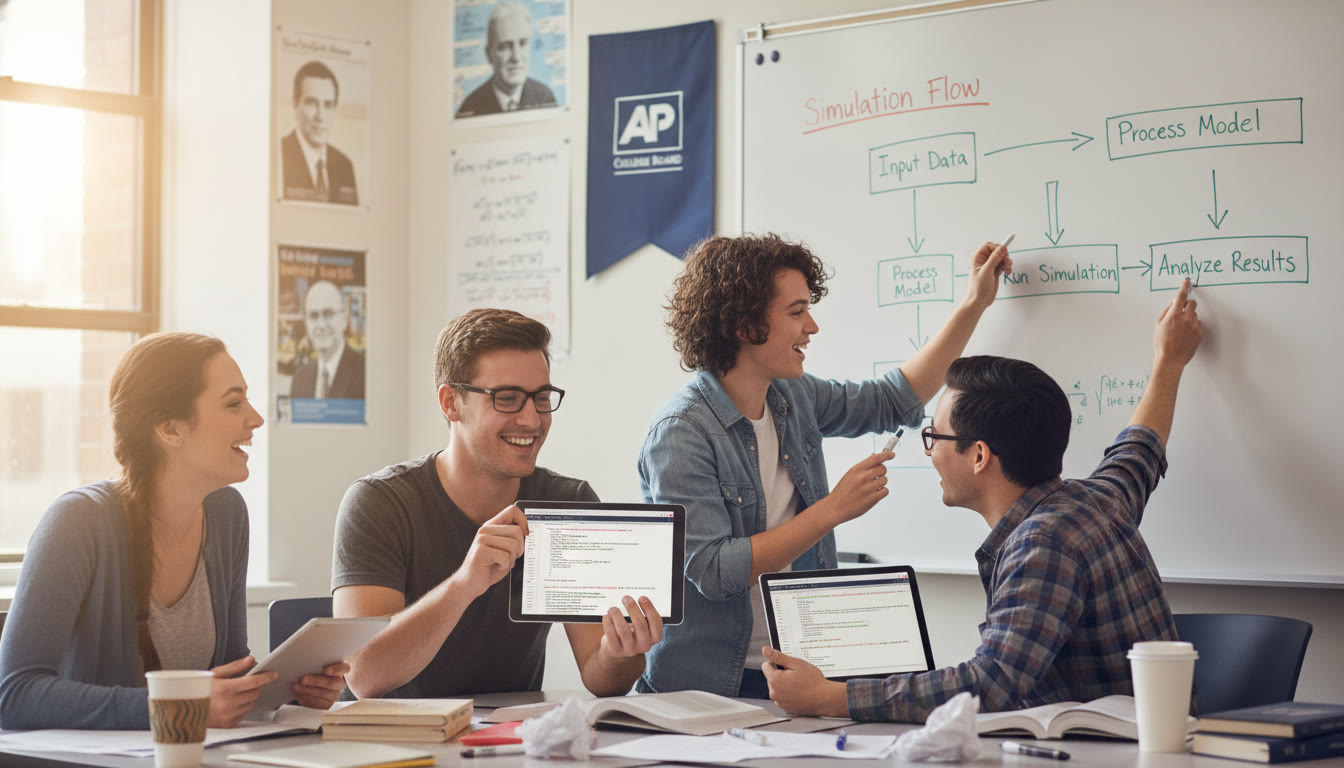
These concepts don’t live in separate silos. A great CSP Create task or exam response shows how abstraction makes algorithms manageable, and how simulations let you evaluate algorithms in realistic scenarios.
Example: You’re modelling a simple predator-prey simulation. Abstraction lets you create Animal classes or structured procedures like move(), eat(), reproduce(). Algorithms govern how agents decide actions each step. Simulation runs many iterations to show how populations change over time.
Sample Workflow for a Create Task
- Pick a real-world phenomenon you care about (movement, sorting of items, resource allocation).
- Design abstractions—what are the main entities and functions?
- Write algorithms for core behaviors and explain them in pseudocode.
- Simulate different scenarios and collect results.
- Analyze and reflect: what did the simulation reveal? What are limitations?
Study Plan: 8-Week Focused Practice for Big Idea 3
Here’s a realistic schedule you can use whether you’re preparing over a semester break or cramming before your exam. Tailor times to your other obligations.
| Week | Focus | Key Activities |
|---|---|---|
| 1 | Foundations | Review definitions: algorithm, abstraction, simulation; read course summary; do quick practice problems. |
| 2 | Algorithms Basics | Implement simple search and aggregation routines; practice tracing algorithms by hand. |
| 3 | Abstraction Practice | Refactor code into functions; document abstractions; practice describing them in writing. |
| 4 | Intro to Simulation | Build a small simulation (e.g., random walk) and collect data; visualize results. |
| 5 | Integration | Combine abstractions and algorithms into a simulation; test multiple parameter sets. |
| 6 | Create Task Prep | Choose a project idea, outline abstractions and algorithms, draft written responses and video plan. |
| 7 | Mock Tasks and Review | Complete a practice Create task under timed conditions; get feedback. |
| 8 | Polish and Drill | Polish code and write-ups; practice multiple-choice and free-response questions focused on Big Idea 3. |
Concrete Study Activities That Produce Results
Activities matter more than passive reading. Here are high-leverage drills that map directly to exam skills.
- Trace Algorithms: Take code and write down variable states at each step for small inputs.
- Refactor: Turn repetitive code into functions and explain why the abstraction was chosen.
- Parameter Sweeps: For a simulation, run it under multiple inputs and record differences—this shows experimental thinking.
- Write Pseudocode: Practice explaining algorithms in plain language and concise pseudocode—examiners love clarity.
- Peer Review: Explain your algorithm to a friend; teaching is the fastest way to reveal gaps.
Model Answers and How to Explain Your Choices
The exam and the Create task reward explanation. Don’t just show code—explain decisions. Here’s a short template you can use when describing a function or algorithm in writing:
- Name: What is the function or algorithm called?
- Purpose: What problem does it solve?
- Inputs and Outputs: What does it receive, what does it return or change?
- Steps: A numbered list or brief pseudocode.
- Why an Abstraction: Why was this grouped into a function or module?
- Limitations: What cases does it not handle? What assumptions did you make?
Common Mistakes Students Make (And How to Fix Them)
- Too Much Code, Too Little Explanation: Always pair code with a clear narrative—explain why you chose that approach.
- Ignoring Edge Cases: Test with small and unusual inputs. Describe how your program handles them.
- Weak Abstractions: If your functions are one-line wrappers or arbitrary, rethink the abstraction—does it reduce complexity?
- Shallow Simulations: A simulation should investigate a question. Don’t just animate things—collect and analyze data.
Sample Project Idea: Crowd Flow Simulation (Short Walk-Through)
Here’s a compact example that illustrates abstraction, algorithm design, and simulation together. It’s the kind of project that could become a strong Create performance task if you document and analyze carefully.
- Goal: Model how people exit a theater through two doors and measure average exit time under different spacing and door widths.
- Abstractions: Agent (person) with attributes {position, speed, destination}, Door object with width, Theater grid to hold positions.
- Core Algorithms: Movement algorithm (choose next cell toward door), Collision handling (if next cell taken, wait or sidestep), Exit counting (remove agent when at door).
- Simulation Plan: Run for N agents, vary door width and spacing, repeat multiple trials and record average exit time.
- Analysis: Plot average exit time vs door width and discuss observed trends and limitations (e.g., 2D simplification, uniform agent speed).
How to Use Feedback and One-On-One Help Effectively
Targeted feedback shortens your learning curve. If you’re using tutoring—like Sparkl’s personalized tutoring—make the most of it with specific, focused goals:
- Ask your tutor to review one function or algorithm per session rather than the whole project at once.
- Request a mock Create task review where the tutor simulates an AP scorer’s feedback on clarity and abstraction.
- Use tailored study plans to plug weak spots—if you struggle with tracing algorithms, schedule short drills until your speed improves.
Sparkl’s 1-on-1 guidance, tailored study plans, and expert tutors can be especially helpful when you need that human walkthrough to clarify abstractions or refine your simulation methodology. If you prefer data-driven practice, some tutoring services complement human coaching with AI-driven insights that show patterns in your mistakes.
Exam-Day Tips Focused on Big Idea 3
- Read prompts carefully: identify whether the question asks for design, evaluation, or code tracing.
- Show working: on free-response, write concise pseudocode steps and annotate with reasoning.
- Time management: dedicate the first minutes to planning for free-response tasks—clear structure wins points.
- For multiple-choice, eliminate obviously wrong algorithmic behaviors (e.g., infinite loops, off-by-one errors) quickly to narrow choices.
Quick Reference Table: Concepts, How They Appear, and What Examiners Look For
| Concept | Common Exam Appearance | Scoring Focus |
|---|---|---|
| Abstraction | Explain function roles; identify data representations | Clarity of abstraction and how it reduces complexity |
| Algorithm Design | Pseudocode, step descriptions, code snippets | Correctness, completeness, and clarity of steps |
| Algorithm Evaluation | Questions on efficiency or behavior under input changes | Reasoned comparison; recognition of scaling behavior |
| Simulation | Create tasks and written prompts exploring modeled systems | Validity of model, parameter analysis, and interpretation of results |
Real-World Context: Why These Skills Matter Beyond the Exam
These ideas are not just for passing a test. Engineers, scientists, economists, and designers use abstraction to manage complex systems—whether it’s modularizing a mobile app, modeling climate data, or simulating traffic lights to reduce congestion. Learning to build algorithms and test them through simulation trains you to ask better questions and make evidence-based recommendations—skills employers and colleges value highly.
Final Checklist Before Submission or Exam
- Have you named and explained your abstractions and their purpose?
- Is your algorithm described clearly with inputs, outputs, and example runs?
- Does your simulation include parameters, repeated trials, and a short analysis of results?
- Have you documented limitations and ethical considerations where relevant (e.g., data privacy, bias)?
- Did you test edge cases and document how your program handles them?
Closing Thoughts: Make the Ideas Your Own
AP CSP’s Big Idea 3 is a chance to show how you think. Focus on clarity over cleverness: a clear, well-explained algorithm with a thoughtful simulation and solid abstractions will always outshine a messy implementation with no narrative. Practice explaining your choices aloud, get feedback, and iterate—just like good software development.
And remember: targeted support can accelerate progress. If you want structured guidance, 1-on-1 tutoring that emphasizes personalized study plans and expert feedback can help you turn raw practice into exam-ready performance. Use practice tasks, simulate variations, and keep a short lab notebook of what you learned each week—small notes add up to big improvements.
Go Build Something
Pick a small project, sketch abstractions first, write the core algorithm, run a simulation, and write a one-page reflection on what your simulation taught you. That short cycle of build-test-reflect is the fastest path from confusion to mastery. Good luck—your curiosity is your most powerful tool.




























No Comments
Leave a comment Cancel