

Why Concision Matters in Capstone Writing
Capstone projects ask you to synthesize research, analysis, and argument into a coherent whole. Yet many students believe that complexity equals length—that adding pages, quotes, and caveats will make their work look more rigorous. The truth is subtler: clarity and concision often signal a deeper understanding. Being concise doesn’t mean dumbing down; it means selecting the most rigorous evidence and presenting it in the most effective way.
In AP Capstone—whether Seminar or Research—evaluators are looking for intellectual maturity: precise claims, logical structure, and efficient use of evidence. An essay that is crisp and dense with insight often outperforms a verbose paper where the central claim gets lost in the weeds.
What Concision Is (And What It Isn’t)
Concision is a craft, not a shortcut. It involves:
- Eliminating redundancy without losing nuance.
- Choosing specific, high-value evidence over lengthy summaries.
- Using language that conveys complexity economically—often through precise terminology and well-chosen examples.
Concision is not:
- Oversimplification or omission of crucial counterarguments.
- Rushed writing that leaves gaps in logic or evidence.
- Stripping out context so that claims hang unsupported.
First Principles: Building a Concise Argument
To write concisely while keeping rigor, start with the skeleton of reasoning. Think of your paper as an engine: every paragraph should perform a clear function.
1. Craft a Precise Thesis
Your thesis is the North Star. A strong thesis for a capstone does three things: it states an arguable claim, it orients the reader to scope, and it hints at the method or evidence. For example:
Weak: “This paper discusses the impacts of social media on teenagers.”
Strong and concise: “Compulsory social media usage during school hours significantly undermines adolescent attention by increasing task-switching frequency, as shown by experimental eye-tracking and survey data.”
The stronger thesis is narrower, assertive, and testable—qualities that reduce the need for long prefatory material.
2. Use a Transparent Structure
Organize with intention. A clear roadmap helps readers accept concise moves because they understand where you’re headed.
- Intro: Thesis + 1–2-sentence roadmap.
- Body: Each paragraph = one claim + one piece of evidence + short analysis.
- Counterargument section: A compact concession and a sharp rebuttal.
- Conclusion: Synthesize implications and suggest measured next steps.
Techniques to Trim Without Compromising Depth
Below are practical strategies you can use in drafting and revision.
1. The One-Sentence Paragraph Principle
If a paragraph can be summarized in one sentence, make that sentence the topic sentence and ensure every following sentence contributes directly. If a paragraph contains two ideas, split it.
2. Replace Long Examples with High-Value Evidence
Rather than narrating lengthy case studies, extract the salient data point or pattern and present it succinctly. For instance, instead of a two-page descriptive vignette, provide a targeted excerpt followed by analysis explaining why the excerpt supports your argument.
3. Choose Strong Verbs and Precise Nouns
Words like “shows,” “reveals,” “corroborates,” or “undermines” carry argumentative weight that saves sentences. Replace vague phrases (“is kind of like”) with crisp language (“mirrors,” “interferes with”). Precision reduces the need for hedging.
4. Use Tables and Figures for Dense Data
Tables let you present complex results compactly. Instead of paragraphs describing trends, a well-labeled table communicates the same information in fewer words and increases readability.
| Measure | Control Group | Treatment Group | Effect Size (Cohen’s d) |
|---|---|---|---|
| Average Attention Span (mins) | 22.4 | 15.1 | 0.78 |
| Task-Switches per Hour | 3.2 | 7.9 | 1.12 |
| Self-Reported Focus (1–10) | 6.8 | 4.3 | 0.95 |
Including a short paragraph that interprets the table (one to three sentences) preserves rigor while keeping description tight.
Balancing Counterarguments: Be Compact, Be Fair
A rigorous capstone anticipates objections. The trick is to acknowledge the strongest counterargument in a concise form and then dismantle it with targeted evidence.
How to Structure a Compact Counterargument
- State the counterargument in one sentence (charitable, not strawman).
- Provide one piece of evidence or reasoning that limits the counterargument’s scope.
- Conclude with a one-sentence synthesis showing how your original claim stands.
Example:
“Critics might argue that the attention deficits observed are short-lived and therefore inconsequential. Yet a six-month follow-up cohort shows persistent task-switching patterns and measurable academic dip—suggesting the effect is stable beyond immediate novelty—and thus warrants policy consideration.”
Practical Editing Steps: From Draft to Polished Capstone
Editing for concision is systematic. Try this workflow:
- Draft freely without constraints—capture ideas and evidence.
- Macro-edit: Check structure, thesis clarity, and paragraph purposes. Eliminate whole paragraphs that don’t advance the central claim.
- Micro-edit: Tighten sentences, remove filler phrases (“there is no doubt that,” “it should be noted”), and reduce passive voice where active voice improves clarity.
- Data-check: Replace long descriptive passages with tables, charts, or concise statistics.
- Read-aloud pass: If a sentence requires two breaths, consider splitting or rewriting it.
Common Fillers to Cut
- It is important to note that…
- Due to the fact that…
- In order to…
- The reason why is…
Examples: Before and After
Seeing transformations helps internalize the approach. Below are two short examples that model tightening without losing content.
Example A — Long Version
“It is important to consider that when students are using social media during the school day, they often switch between class-related tasks and social media tasks, which could, in a number of ways, make it harder for them to sustain attention on the lesson that is being presented to them by the teacher. Numerous studies have suggested that such frequent switching causes a decrease in the student’s ability to focus for longer periods of time and may eventually result in lower test performance.”
Example A — Concise Version
“In-school social media use increases task-switching, reducing sustained attention and correlating with lower test scores.”
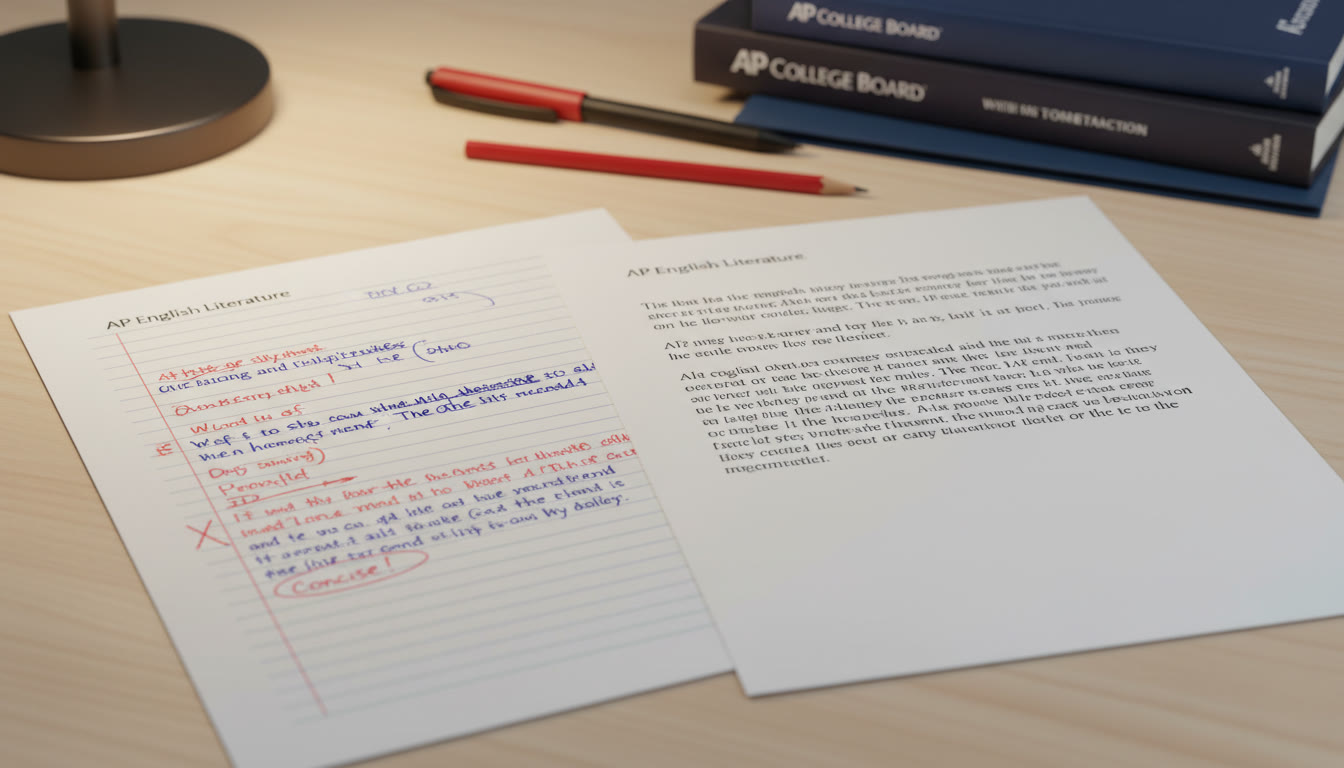
The concise version keeps the claim and outcome but removes hedging and redundancy.
Example B — Long Version
“Because of the design of the experiment, which involved random assignment and blinding of observers, one might reasonably conclude that the differences we observed between the two groups are likely attributable to the treatment rather than to random chance or uncontrolled variables that could otherwise be influencing the outcome of the study.”
Example B — Concise Version
“Random assignment and observer blinding indicate the observed group differences are attributable to the treatment.”
Both concise rewrites retain the core inferential claim; they simply make it easier for readers and graders to follow your reasoning.
Formatting and Presentation Tips That Support Concision
Presentation choices can make concise writing land more powerfully:
- Use bold or italics sparingly for key terms or variables.
- Include a one-paragraph abstract (75–125 words) that mirrors your thesis and roadmap. A strong abstract reduces the need for lengthy introductions.
- Numbered or bulleted lists for sequences of findings or methodological steps compress information without sacrificing clarity.
When to Expand
Concision isn’t the only goal. Expand when:
- A nuance materially alters the interpretation of evidence.
- Methodological transparency is essential to validate findings (e.g., sampling frame, measurement reliability).
- Counterevidence demands careful engagement to maintain credibility.
Study Habits to Develop Concision Over Time
Writing concisely is a skill honed through consistent practice. Here are habits that pay dividends:
- Daily micro-writing: Summarize a research article in 150 words.
- Peer review swaps: Exchange drafts and ask each other to cut 20% of sentence length without losing meaning.
- Reverse outlining: After drafting, list each paragraph’s main point; if points are repetitive, merge or cut.
- Timed edits: Give yourself 20 minutes to reduce a 500-word section to 350 words, preserving key claims.
For students working on AP Capstone projects, targeted practice improves not only writing but also analytical clarity—an asset when presenting to panels or defending findings.
Tools and Support: Smart Ways to Improve Without Losing Voice
While human judgment is irreplaceable, tools and tutoring can accelerate skill-building. Working 1-on-1 with a tutor helps you identify where your writing redundantly repeats ideas or where evidence could be stronger, and a tailored study plan keeps practice focused. Sparkl’s personalized tutoring, for instance, offers tailored study plans, expert tutors, and AI-driven insights that can highlight patterns in your drafts and suggest focused revisions—helpful when you need to balance brevity and academic depth.
Use tools to flag wordiness, but always make the final decision. Machines can spot long sentences and passive voice; you decide which nuanced caveats are essential to retain rigor.
Assessment-Focused Checklist for Final Revision
Before you submit, run through this concise checklist that ties to scoring expectations in capstone assessments:
- Thesis: Is it precise, arguable, and testable?
- Structure: Does each paragraph advance the argument?
- Evidence: Is every claim supported by the strongest available evidence?
- Counterargument: Is it acknowledged fairly and rebutted succinctly?
- Clarity: Would a reader unfamiliar with the topic follow the logic?
- Economy: Can any sentence be reduced without losing essential meaning?
- Formatting: Are tables, figures, and lists used to compress information effectively?
Examples of Concision-Friendly Paragraph Templates
These templates help you write tight paragraphs that still carry scholarly weight.
- Claim-Data-Interpretation: “Claim.” “Key data point or quotation (citation).” “One-sentence interpretation linking data to claim.”
- Method-Result-Implication: “Method in one line.” “Result (statistic or trend).” “Implication for the research question.”
- Counter-Rebuttal: “Counterargument (one line).” “Evidence limiting the counterargument (one line).” “Reinforcement of original claim (one line).”
Putting It Together: A Mini Outline Template
Use this template to ensure concision is built into your structure from the start.
- Abstract (75–125 words)
- Introduction (thesis + 1–2-sentence roadmap)
- Background (1–2 concise paragraphs)
- Methods (bulleted list or short paragraph)
- Results (table + 1–3 concise paragraphs)
- Discussion (3–4 concise paragraphs, including counterargument)
- Conclusion (2–4 sentences with implications and measured next steps)
Final Thought: Precision as Respect for the Reader
Writing concisely is an act of respect for your reader and for your ideas. It signals that you understand the architecture of your argument well enough to present it cleanly. For AP Capstone students, mastering concision while preserving rigor not only improves scores—it prepares you for college-level discourse and professional communication.
As you revise, remember to be ruthless about repetition, generous about evidence, and deliberate about structure. With deliberate practice, the lean, rigorous voice you develop will make your work stand out: clear, confident, and convincing.

Need help making that shift from long to lean? A few sessions with a skilled tutor can accelerate progress. Sparkl’s personalized tutoring blends 1-on-1 guidance, tailored study plans, and AI-driven insights to help you refine thesis clarity, tighten structure, and practice concise revisions—so your capstone reads like the high-caliber work it is.
Now take a section of your draft, apply one of the paragraph templates above, and time a 20-minute edit. You’ll be surprised how much stronger—and how much shorter—your argument becomes. Concision is not deprivation; it is precision. When done well, it lets your rigor shine.
Appendix: Quick Reference Cheat Sheet
Keep this on your desk during edits:
| Issue | Fix | Example |
|---|---|---|
| Redundancy | Remove repeated ideas; merge sentences | “…and this also shows” → “…which also shows” |
| Vague Language | Replace with precise term or statistic | “many students” → “67% of students in sample” |
| Overlong Paragraph | Split into focused paragraphs | One idea per paragraph |
| Excessive Quotation | Paraphrase and cite; use brief excerpt if necessary | Summarize main point, include short quote |
Good capstone writing walks a line: it’s tight, but not tight-lipped; economical, but not evasive. Aim for that balance and you’ll deliver work that’s intellectually rich and elegantly composed. Good luck—your clearest, most rigorous capstone is within reach.
























No Comments
Leave a comment Cancel