
Balancing STEM and the Humanities: An IB DP Strategy for Swarthmore Admissions
Swarthmore is a place that prizes intellectual curiosity more than a checklist of credentials. For IB Diploma students, that means your challenge—and your advantage—is to tell a clear, convincing academic story that threads together rigorous subject choices, meaningful projects, and evidence of intellectual habits. This blog walks you through a practical strategy for shaping a STEM + humanities balance that aligns with Swarthmore’s liberal-arts ethos, while also flagging important international admissions nuances you should know if you’re casting a wider net.
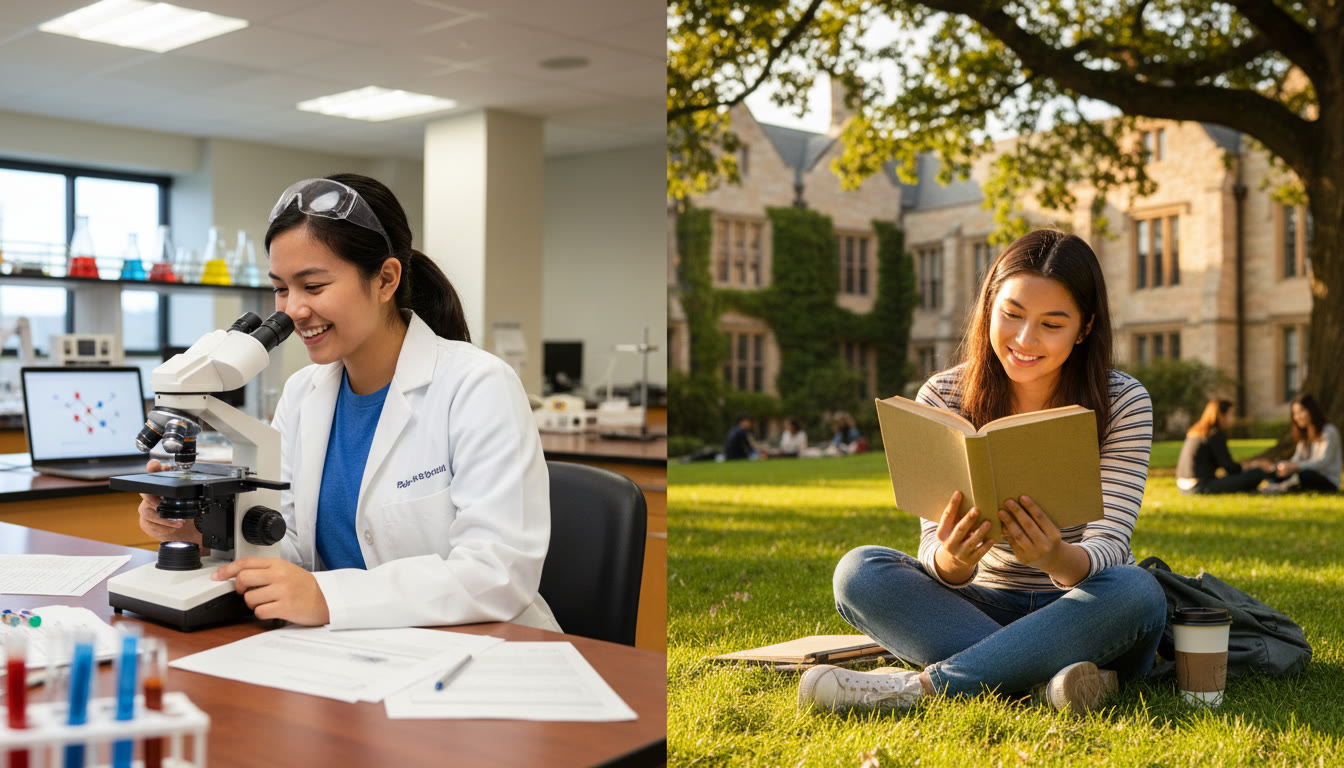
Why balance matters at Swarthmore
Swarthmore’s small, discussion-heavy classes reward students who can move across disciplines. Admitting committees look for evidence that you can think like a scientist and a humanist—solve a problem, then explain why it matters. For IB students, the diploma already signals breadth and rigor; your task is to make that breadth coherent. Rather than trying to do everything at the HL level, choose HL subjects that demonstrate both depth in your intended area and genuine curiosity elsewhere.
Topline mindset
- Think narrative: your application should present a three-part story—what you love academically, how you have pursued it, and how Swarthmore’s environment will let you take it further.
- Depth + Breadth: pick HLs that show serious preparation for your intended field, plus at least one HL that shows you engage with a contrasting way of thinking.
- Make the Diploma work for you: EE and ToK should reinforce your story rather than exist as afterthoughts.
Choosing HLs: concrete guidance for STEM + humanities applicants
Below are pragmatic HL pairings that work well for a Swarthmore application. Use them as templates—your interests, course availability, and teacher strengths should drive final decisions.
| Profile | Suggested HLs (2–3) | Complementary SLs | Why this helps |
|---|---|---|---|
| STEM-focused (but liberal-arts ready) | Math HL, Physics HL | English A SL, History SL or an experimental science SL | Shows technical readiness and communication skills—appeals to students aiming at majors like physics, math, or engineering within a liberal-arts setting. |
| Balanced STEM + Humanities | Math HL (or Math AA/AI HL), English A HL or History HL | Chemistry SL, Language B SL | Signals interdisciplinary thinking—great for students who can situate technical interests in broader cultural or ethical contexts. |
| Humanities with STEM engagement | English A HL or History HL, Economics HL | Math SL, Biology SL | Shows a humanities core while demonstrating quantitative literacy—appealing for fields like economics, policy, or environmental studies. |
| Engineering-leaning | Math HL, Physics HL, an optional third HL in Chemistry or Computer Science | English A SL, Design Technology SL | Prepares you for technical coursework while keeping space for strong writing and reflection. |
How many HLs?
Swarthmore wants evidence of intellectual seriousness, not exhaustion. Two HLs done well and one additional HL or strong SLs often make a compelling profile. If you take three HLs, make sure none of them is purely ceremonial—each should contribute to your academic narrative.
Extended Essay and Theory of Knowledge: narrative levers
Your Extended Essay (EE) and Theory of Knowledge (ToK) presentation are not box-checkers; they are opportunities to reinforce the story you present elsewhere on the application. Choose an EE topic that ties directly to your stated interests—if you’re applying as a physics-minded student who reads widely in philosophy, look for a question that sits at the intersection. ToK reflections are gold for demonstrating metacognition: use them to show how you think about evidence, models, and interpretation across STEM and humanities.
Practical tips for EE and ToK
- Start early. An EE with strong conceptual framing takes time; allow room for revision tied to teacher feedback.
- Use ToK to explain how you read a research paper or how a historical narrative is constructed—these mini-lessons showcase sophistication.
- Cross-reference: a line or two in your application that points to your EE can make your academic interests feel cohesive.
How IB performance maps to Swarthmore expectations
There’s no fixed IB score that guarantees admission—Swarthmore reads applications holistically. That said, competitive applicants typically show strong HL performance in subjects relevant to their intended major, high predicted grades, and academic momentum across both years of the Diploma. Use your SLs strategically: strong SLs in subjects that support your narrative are better than weak HLs taken for show.
Presenting predicted grades and exam planning
- Ask for predicted grades early; provide teachers with a concise summary of your achievements and why you chose them.
- If you can improve a projected HL grade through mock performance or targeted revision, do it—rise in the second year is noticed positively.
- Consider subject-specific admissions tests only if Swarthmore or your intended major requires or recommends them. Always confirm the most recent application instructions for standardized tests.
Application components: creating a coherent package
US applications ask you to show evidence of academic fit, intellectual vitality, and community contribution. For IB students, here are the elements to make space for on your application:
Academic record and course rigor
- Highlight HL choices that align with your intended field, but explain the reasoning briefly in your application narrative.
- Where possible, include projects, research, lab work, or competitions that demonstrate applied skills.
Essays and supplemental materials
Think of essays as a space where your IB experiences (EE, ToK, CAS projects) can be translated into motivations and habits. Specificity wins: instead of saying “I love science,” describe a lab failure that changed how you ask questions or a book that reframed a historical event for you.
Recommendations
Choose teachers who can speak to your analytic and written strengths across disciplines when possible (for a STEM + humanities portfolio, a teacher from each side is ideal). Give recommenders concrete reminders about projects, essays, or moments that illustrate your academic character.
Timeline considerations for IB applicants
IB students should balance internal deadlines (school predictions, HL exam preparation) with application timing. Identify when your school submits predicted grades and coordinate with teachers on recommendations. If you are applying early-decision or early-action, be mindful that HL exams and final predicted grades may come after your application—use interim reports, EE drafts, and mock exams to strengthen your case.
How to use school reports and predicted grades
- Ask your counselor how predicted grades are calculated and whether you can provide contextual information about course difficulty or teacher availability.
- If your school offers internal exam data or portfolios, include concise summaries in your application where permitted.
International application notes you should not miss
Although this piece focuses on Swarthmore, many IB students apply to a mix of US, UK, and other international programs. A few important country-specific realities are especially useful to know as you shape subject choices and timelines.
United Kingdom (UCAS)
If you also plan to apply to UK universities, be aware that UCAS is moving to a structured response model for the personal statement. The current format asks applicants to address three structured questions—Motivation, Preparedness, and Other Experiences—instead of a single long personal statement. Think of these as modular prompts: each answer should be concise, example-driven, and tightly tied to your subject choices. Do not prepare the old-style 4,000-character essay in isolation; align your answers so they complement your IB curriculum choices and Extended Essay.
Switzerland (EPFL)
If the idea of studying in Switzerland is on your radar, remember that EPFL’s admission process for international bachelor’s students is competitive and ranked rather than guaranteed by a single score. Recent announcements have pointed to a capped intake for international undergraduates (for example, a 3,000 student cap has been part of recent policy discussions), so admissions are especially selective. That makes a clear, focused subject profile and demonstrated achievement—rather than generic high scores—vital for applicants targeting selective Swiss programs.
Canada
When you look at Canadian offers, note the distinction between Automatic Entrance Scholarships (grade-based awards you qualify for by meeting set thresholds) and Major Application Awards (scholarships or nominations tied to leadership, portfolio, or major-specific application components). Make sure you meet the automatic thresholds, and if you aim for a Major Application Award, prepare the required nomination materials or leadership evidence well in advance.
Netherlands
For Numerus Fixus programs—selective, capacity-limited courses such as engineering at some technical universities—watch the January 15th deadline carefully. That deadline is often much earlier than the general university application deadline and applies to competitive programs like aerospace or certain computer science tracks. If you plan to target competitive tracks in the Netherlands, front-load your preparation and submission.
Singapore
Singaporean universities frequently release offers later in the cycle for IB students—often mid-year—so applicants can experience a gap between early admissions decisions from US or UK schools and offers from Singapore. Be mindful of this timing mismatch and how it affects deposit deadlines and decision-making.
How to show interdisciplinary strength without diluting focus
Demonstrating genuine cross-disciplinary curiosity—rather than scattered interests—will set you apart. Here are practical choices that keep your profile focused and richly textured:
- Link EE/ToK to your intended major, even if it’s in a different discipline. A humanities EE can still inform the way you understand scientific communication, for instance.
- Choose CAS projects that demonstrate sustained commitment and skill development rather than one-off events.
- When writing supplements, connect specific classroom moments to future academic goals. Admissions officers remember few slogans but many tangible images.
Sample weekly senior-year plan for IB applicants targeting Swarthmore
This sample plan helps balance final IB commitments with application work without burning out.
- Monday–Wednesday: Focused HL study blocks and EE research (2–3 hours each evening).
- Thursday: Drafting and revising application essays or supplemental responses (1–2 hours).
- Friday: Teacher meetings for recommendations and feedback; revise EE or ToK outline.
- Weekend: Practice problem sets for STEM HLs and close reading practice for humanities HLs; incorporate rest and CAS activities.
How targeted tutoring can help
One-on-one guidance that understands both Swarthmore’s liberal-arts expectations and the IB structure can save time and sharpen outcomes. A targeted tutor will help you select HLs, plan an EE that aligns with your narrative, and coach you through supplemental essays so that your IB work and application materials amplify each other rather than compete for time. For many students, tailored support on time management and targeted test or portfolio prep makes the difference between a good application and a memorable one. Sparkl‘s personalized tutoring is an example of the kind of structured, one-on-one support that can help you balance rigorous coursework and a compelling application, offering tailored study plans, expert tutors, and AI-informed insights that keep your academic story consistent across documents.
Putting it all together: a final checklist
- Have a 2–3 sentence academic narrative that links your HL choices, EE, and extracurriculars.
- Confirm predicted grade submission dates with your counselor and provide recommenders with concrete reminders and evidence.
- Finalize one or two pieces of writing that exemplify your analytical voice (EE excerpt, research abstract, or a compelling supplemental paragraph).
- Prepare for timeline mismatches (for example, later offers from some international programs) when deciding on deposits.
- If you use tutoring, prioritize focused help on weak points—essay clarity, HL exam technique, or research methods—rather than generic study time.
Final notes on fit and intellectual honesty
Swarthmore is looking for students who will thrive in an environment of rigorous conversation. The most convincing applications come from students who are honest about their intellectual priorities and who choose subjects and projects that allow them to grow. Your IB choices should reflect both curiosity and strategy: select HLs that prepare you technically and an additional HL or strong SLs that demonstrate perspective. Use your EE and ToK to display how you think, not just what you know. When your application tells a coherent, specific story, admissions readers can see you as a future contributor to the college’s academic life.
This concludes the academic guidance on building a balanced IB DP strategy for a competitive Swarthmore application.



















No Comments
Leave a comment Cancel