
CBSE 30-Day Strategy for Fast Revision
If you’ve got about a month left and the syllabus still feels large, take a deep breath — 30 focused days can turn scattered notes into a confident, exam-ready you. This plan is practical, CBSE-focused and built around the realities of marking schemes, full-length timed practice, and the need to align strictly with the prescribed syllabus. It’s not a miracle cure; it’s a structure that lets you prioritize, practice, and polish in a way that mimics the board exam itself.
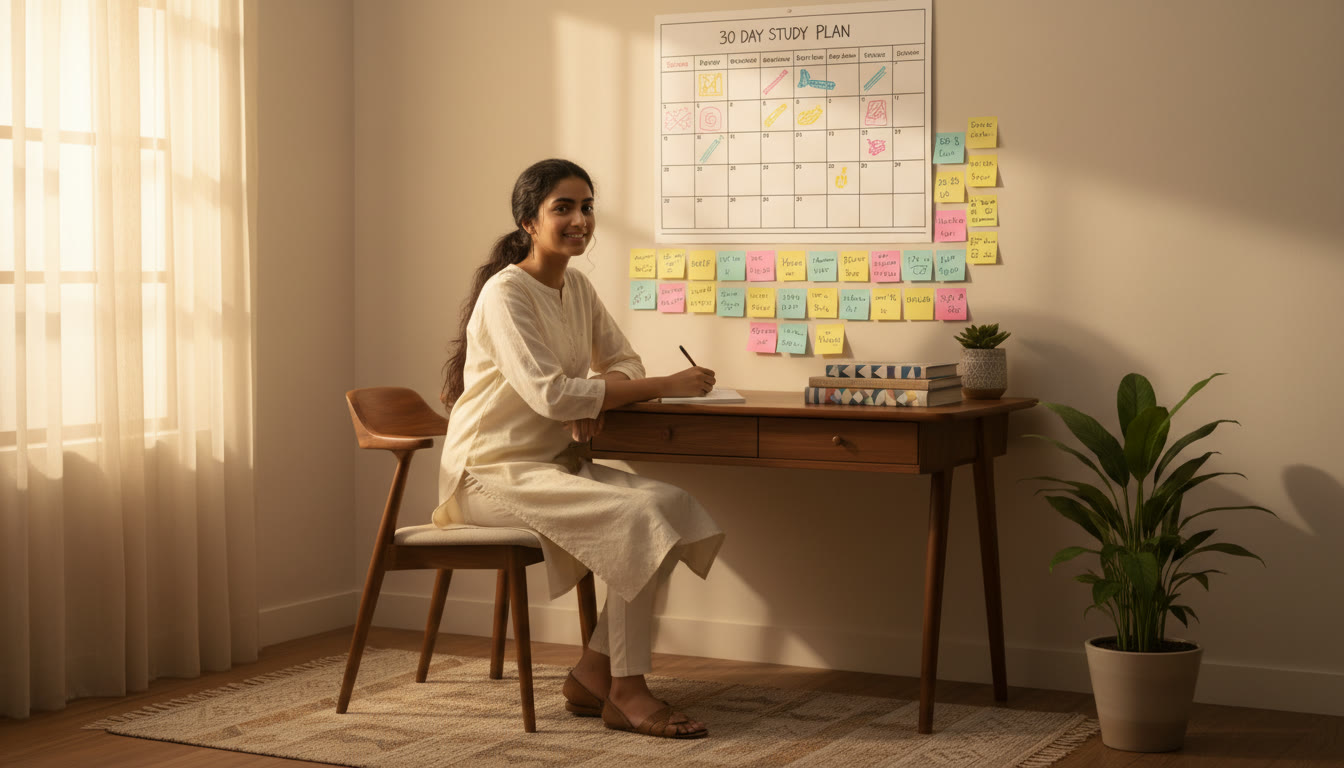
Why a 30-day sprint works
Thirty days is short enough to force focus and long enough to cycle through revision, practice and consolidation. The goal is not to learn every new topic from scratch — it’s to strengthen what you already know, shore up the weak spots that cost marks, and train the timing and presentation habits that match CBSE assessment style. Because CBSE papers reward clarity, sequence and accuracy, a tidy month of targeted work beats two chaotic months of unfocused effort.
Core principles behind this plan
- Syllabus alignment: Stick to the prescribed syllabus and allocate time proportional to the weightage of each unit.
- Marking-aware practice: Practice answers as per the mark distribution. Break long answers into clear steps and label diagrams when required.
- Active testing over passive rereading: Self-quizzing, timed answers and mock tests are the engine of fast revision.
- Quality notes: Build one-page summaries and formula sheets for quick last-minute reference.
- Regular review + correction: A test without careful correction is wasted time. Spend at least as long reviewing mistakes as you spent making them.
How to use this plan — simple rules before you begin
- Make a list of all chapters and topics in each subject, then mark them as strong / moderate / weak. Be realistic — overrating yourself costs time.
- Prioritize high-weight topics first. If a chapter has historically more marks, give it proportionally more revision slots.
- Do not start new extensive topics in the final week. The last seven days are for consolidation and polishing, not new learning.
- Commit to daily short, timed practice: aim for at least one timed answer or one timed question paper segment every day.
- Sleep, nutrition and short physical activity matter. Productivity falls rapidly when you burn out.
Week-by-week breakdown (one practical structure)
This is a flexible template — adjust by subject count and your personal strengths. The table below shows the primary focus per week and the expected daily targets.
| Week | Primary Focus | Daily Targets | Practice Type | Expected Outcome |
|---|---|---|---|---|
| Week 1 | Concept refresh & high-weight topics | Finish 2–4 chapters (subject dependent); build 1-page notes per chapter | Short topic tests, focused exercises | Clearer concept map and compact notes |
| Week 2 | Practice + application | Solve end-of-chapter and board-style questions for revised chapters | Sectional timed practice, solved-answer writing | Improved speed & answer structure |
| Week 3 | Full-length mocks + analysis | 1 full mock + 2 shorter timed tests per subject spread across the week | Full-length timed papers under exam conditions | Time management and identification of recurring errors |
| Week 4 | Polish, formula sheets & final corrections | Daily quick revision sessions of weak points and flashcard drills | Rapid revision, last mock, targeted topic fixes | Exam-ready clarity and calm |
Sample daily schedule (template you can edit)
Adapt timings to your energy peaks. The important idea is distribution: alternate study blocks with active practice and short reviews.
| Slot | Activity | Goal |
|---|---|---|
| Morning (90–120 min) | High-focus study: one difficult topic or long answer practice | Understand and write a model answer or solve problems |
| Midday (60 min) | Quick practice: 20–30 minute timed question or MCQs | Speed and accuracy |
| Afternoon (60–90 min) | Revision of notes/diagrams and short quizzes | Memory reinforcement |
| Evening (60–90 min) | Problem-solving or answer-writing under time limit | Exam-style output |
| Night (20–30 min) | Reflection: review mistakes and plan next day | Correction and mental rest |
Active revision techniques that actually work
- Self-testing: Close your notes and write what you remember. Then compare and correct. This is faster than rereading.
- Teach-back: Explain a topic aloud in two minutes as if you’re teaching it to someone who hasn’t studied it.
- One-page summaries: For every chapter, create a one-page note with key definitions, formulae, and typical problems.
- Timed answer practice: Practice writing answers keeping the mark distribution in mind; break long answers into labeled steps so examiners can award full marks easily.
- Diagram drills: For subjects that need diagrams, practice drawing and labeling them neatly — clear labeling often wins marks.
- Spaced recall: Revisit each summary on days 3, 7 and 14 after you make it — repetition cements retrieval.
How to align practice with CBSE marking
CBSE marks reward logical structure, clarity and complete steps. When practicing, match your answer format to the marks. For example, if a question is worth 6 marks and expects working steps, write the solution in 4–6 neat steps, each contributing to the logic and the total marks. Avoid writing long essays for short-mark questions or skipping steps because the marker needs to see the process. Practicing with a marking mindset trains you to write answers that capture full credit.
Mock-tests: your practice exam cycle
Mock tests are the backbone of the 30-day approach. They reveal where you lose marks and whether your timing is realistic.
- Start with sectional mocks in Week 2 to build speed and accuracy for different question types.
- By Week 3, take full-length papers under exam conditions — same duration, same breaks, no phone—so your mental stamina is assessed.
- After every mock, spend at least as long reviewing it as you spent writing it. Mark correct/incorrect, identify silly mistakes, and categorize errors into conceptual gaps, careless slips, or time pressure errors.

Mock test checklist
| Before | During | After |
|---|---|---|
| Set the time, collect stationery, silence phone | Follow time plan; mark tough questions to revisit; avoid getting stuck too long on one question | Self-mark; rewrite model answers for errors; update one-page notes |
Handling different question types
CBSE papers include short answers, long answers, numerical problems and application-based questions. Here’s how to practice each:
- Short answers: Practice crisp definitions and one-line explanations. Keep key terms and examples ready.
- Long answers: Break into subheadings, include diagrams where helpful and summarize your conclusion in one line.
- Numerical problems: Show steps clearly, use neat units and box the final answer for clarity.
- Application-based questions: Practice the scenario approach: read carefully, note what is asked, list required principles, and apply them step-by-step.
Common pitfalls and how to avoid them
- Starting too many new topics in the last week — avoid it. Focus on consolidation.
- Rote memorization without understanding — combine short recall with quick explanation to yourself.
- Ignoring marking patterns — practice exactly as the paper demands: labeled steps, neat diagrams, and portioned time.
- Not correcting mock tests properly — always extract lessons and add them to your one-page notes.
Final week: what to focus on (last 7 days)
The final seven days are not for big changes. Use them to sharpen, not to learn new ground. Here’s a tight checklist:
- Run through one short mock and one full mock early in the week, then one short timed revision each day.
- Use one-page summaries and flashcards for quick recall of formulae, definitions and labelled diagrams.
- Polish handwriting and answer layout: clear headings, steps and boxed final answers help examiners award marks faster.
- Sleep well and keep meals light and regular. A tired brain loses retrieval speed.
Tracking progress: simple metrics
Keep a small tracker for each subject with three columns: Topic — Practice Score — Mistake Type. After every practice session, update the score (out of 10) and note whether the errors were conceptual, careless or time-related. If a topic stays below 6 after two attempts, mark it as a high priority for quick review sessions.
When and how to get targeted help
Sometimes, a focused, short-term outsider perspective speeds progress. If you need:
- One-on-one guidance to prioritise topics or split study time;
- Tailored study plans that match your weak areas and exam pattern;
- Expert explanations for stubborn concepts, or AI-driven practice suggestions to fill gaps quickly;
Then targeted tutoring that combines expert tutors with personalised study plans can help you shorten the learning curve. If you choose that route, look for short, exam-focused help that understands CBSE-style marking and practice needs. For example, Sparkl‘s personalised tutoring offers 1-on-1 guidance, tailored study plans, expert tutors and AI-driven insights which many students find useful when they need fast, focused support.
Real examples of daily targets (subject-agnostic)
These micro-targets help you convert a vague “I’ll study chemistry” into a trackable task:
- Finish a single chapter’s one-page summary and solve three typical long-answer questions.
- Do 20 MCQs or 10 short-answer questions in 30 minutes and correct them immediately.
- Write out one full answer to a 6-mark question in 12–15 minutes, focusing on structure and steps.
- Draw and label a diagram three times until you can do it in under three minutes neatly.
Small but powerful habits
- Start each day by writing the single most important study outcome for that day and finish by checking whether you achieved it.
- Maintain a mistake log. One column for the error, one for the corrected approach and one for when you reviewed it again.
- Use short timed breaks and walk for five minutes after heavy study — clarity often returns after a brief physical break.
Sample quick checklist before entering the exam hall
- Check stationery, admit card and required materials the night before.
- Sleep early; avoid midnight cramming that can scramble your recall.
- Leave time for light breakfast and a brief warm-up revision (five key formulas or one-page notes) just before the paper.
- Plan your time in the first 10 minutes of the exam: skim the paper, decide which sections to attempt first, and mark difficult questions to return to later.
Parting academic note — finishing the academic task
Thirty days of focused, marking-aware revision is about composition: schedule what to practice, practice how the exam rewards you, and correct with discipline. Follow the weekly scaffold, prioritize high-weight topics, use full-length timed tests to build stamina, and turn errors into recorded lessons. If you keep this rhythm — focused work, precise practice, careful correction — you will finish the syllabus with a clearer head and stronger exam habits.




















No Comments
Leave a comment Cancel