
Turn Teacher Feedback Into Grade Improvements: An IB DP Two‑Year Roadmap
Feedback is the secret currency of the IB Diploma Programme: quiet, invaluable, and sometimes frustratingly terse. You get a red pen note—”more analysis”—or a comment in the margins—”clarify this idea”—and you walk away feeling both seen and uncertain. That tension is normal. The trick is not just to read feedback, but to translate it into a repeatable system that improves your work, builds confidence, and lifts marks in a measurable way.

Why feedback matters more than raw effort
Two students can spend the same hours studying, but if one is practicing the right things—targeted revisions, criterion-focused improvements, clearer structure—they’ll progress faster. Feedback points exactly to the gap between what assessors expect in the IB and what you delivered. Used well, it becomes a roadmap toward meeting assessment criteria rather than a list of vague problems to worry about.
How to read a teacher comment like a detective
Teacher feedback often hides three layers:
- Surface fix: Immediately correctable items like grammar, citation format, or missing data.
- Structural hint: Suggestions about organization—paragraphing, argument flow, or the order of ideas.
- Criterion nudge: Signals about assessment criteria—e.g., depth of analysis, use of evidence, or understanding of concepts.
When you spot a comment, ask yourself: does this point to a quick win, a rewrite, or a change in approach across multiple tasks? Mark each comment with one of those three categories. That small classification step will change how you act.
Practical steps: Turning a comment into a plan
Step 1 — Turn comments into clear actions
Not all feedback is actionable as written. If the teacher writes “analysis needed,” convert that into:
- What exactly to analyze (e.g., implication of X on Y).
- How to show it (link claim → evidence → explanation).
- A measurable goal (add two analysis paragraphs that connect evidence to the claim in each body section).
Making a comment specific collapses ambiguity and gives you a checklist for revision.
Step 2 — Prioritize by impact and effort
Use a simple filter: if a change takes less than 30 minutes but could boost a criterion, do it now. For bigger moves, schedule them. Prioritization prevents you from spending hours polishing punctuation while missing the bigger analytical gap.
Step 3 — Test the revision with a mini rubric
Before you hand in a revision, score your work against the relevant IB criterion quickly. If you can justify how each change addresses a descriptor in the rubric, the revision is likely to produce better marks.
Feedback-to-action: a compact translation table
| Teacher Comment | What it Usually Means | Actionable Steps | Time Estimate |
|---|---|---|---|
| “More analysis needed” | Claims are not linked to evidence or significance | Choose two key claims, add evidence, explain ‘why this matters’ and link to criterion. | 45–90 minutes |
| “Unfocused introduction” | Research question or thesis unclear | Rewrite thesis, tighten scope, preview structure clearly. | 30–60 minutes |
| “Weak conclusion” | No synthesis or real closure | Summarize insights, link to research question, state one implication. | 20–40 minutes |
| “Use more theory / evidence” | Depth and context missing | Add one theoretical lens or two high-quality sources and discuss relevance. | 1–3 hours |
That table is a practical way to stop staring at a margin note and start doing something concrete.
Examples in IB work: EE, IA, TOK, and essays
Extended Essay — make the research question do the heavy lifting
Typical feedback: “Too broad” or “needs clearer focus.” Your action: resurrect the research question and treat it like a promise you must keep. If feedback asks for “more critical engagement,” pick two central sources and interrogate their assumptions in a new paragraph. Demonstrate how your evidence supports a nuanced claim rather than a descriptive summary.
Internal Assessments — show your process
IA comments often point to method clarity or interpretation. Make methodological changes visible: add a short paragraph explaining why you chose a method and what its limitations are, and show how you validated results. Small clarity improvements often free up marks in both criterion and examiner impression.
Theory of Knowledge (TOK) — make connections explicit
TOK feedback frequently asks for “clearer links to TOK concepts”. When that happens, explicitly map your example to the TOK concept, then show the implication—how does this example change the way knowledge is constructed? Turning implicit ideas into explicit argumentation is a consistent way to improve TOK scores.
HL vs SL essays — depth vs breadth
Higher Level work is judged more stringently on depth and originality. If feedback says “more depth” on an HL paper, invest time in developing one line of argument thoroughly rather than sprinkling many shallow points. SL tasks reward clarity and coherence; if feedback requests “structure,” a clear three-part argument can lift the mark.
Build a two‑year roadmap that treats feedback as fuel
Think of the DP as two marathon years with many checkpoints. Your roadmap should map feedback cycles onto that timeline: quick wins, medium-term rewrites, and long-term skill development.
| Phase | Focus | Typical Actions | Example Deliverables |
|---|---|---|---|
| Early Year 1 | Foundations: academic voice, referencing, basic criterion awareness | Build feedback log, set templates, attend mini-sessions on rubric use | Feedback log, one revised HL essay |
| Mid Year 1 | Practice: IAs drafts, TOK discussions, research skills | Iterative IA drafts, peer reviews, mini‑presentations | IA draft 2, TOK essay plan |
| Late Year 1 | Consolidation: larger rewrites, exam technique | Mock exams, refine argumentation, target weaknesses from feedback | Mock exam reports, polished essay |
| Year 2 | Execution: EEs submitted, IAs finalized, exam calibration | Final edits, timed practice, 1-on-1 coaching where needed | EE final version, IA final versions |
What a good weekly routine looks like
- One focused feedback session per week: pick a comment and fix it end-to-end.
- Peer review slot: swap a section with a classmate to get quick alternate perspectives.
- Reflection log: 10–15 minutes recording what you changed and why.
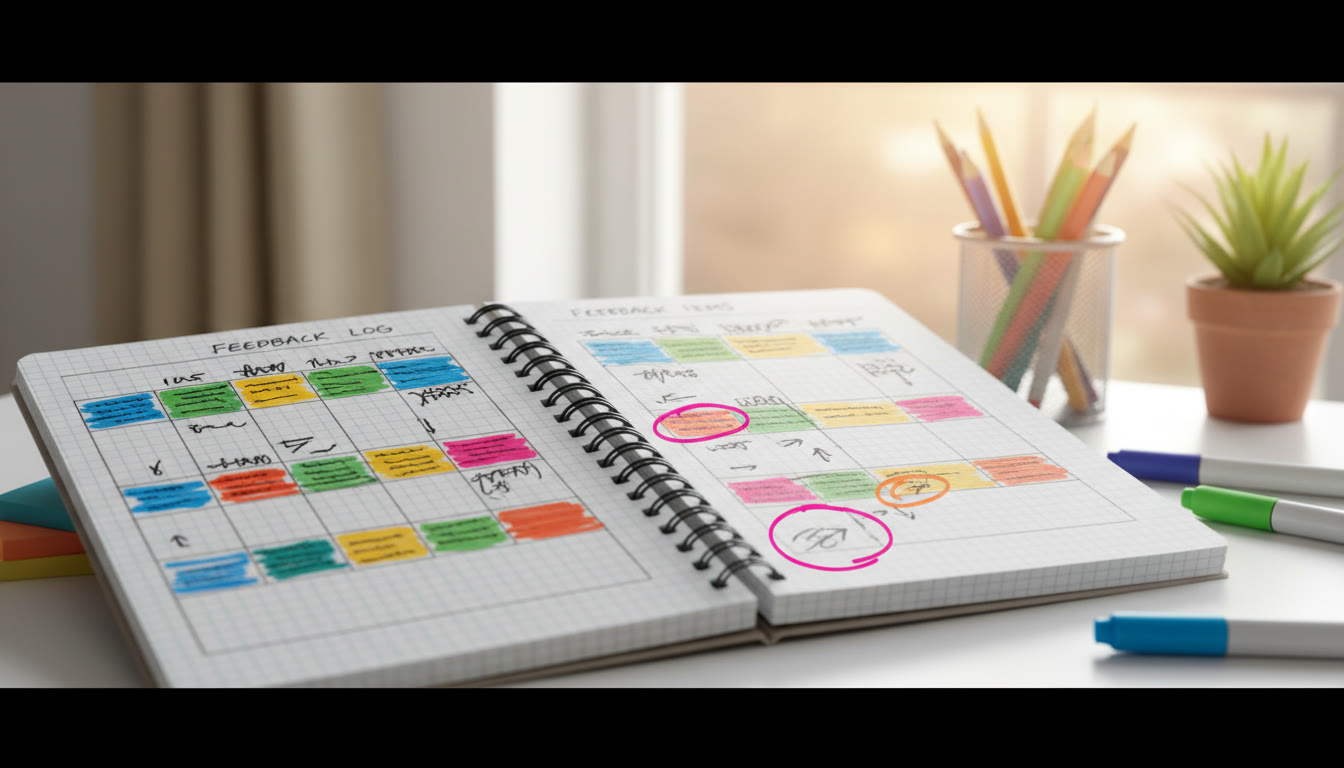
Tracking progress: the feedback log
Create a simple feedback log (spreadsheet or notebook) with columns for:
- Date
- Piece of work
- Teacher comment
- Action taken
- Time spent
- Before/after self-score against criterion
Over time you’ll see patterns—recurring weaknesses or strengths—and those patterns tell you where to invest your energy. That is how small changes compound into real grade improvements.
How to use teacher conversations productively
Prepare before the meeting
- Bring your feedback log and a 60‑second pitch: what you tried, what you think needs help, and a proposed next step.
- Ask for criteria-focused clarification: “Which part of the criterion should I target here?”
During the meeting
- Turn vague comments into explicit examples: ask the teacher to point to a passage and say exactly what they’d change.
- Confirm a timeline for resubmission or follow-up.
After the meeting
Write a short note in your feedback log summarizing the teacher’s guidance and the agreed action. That record will keep your next revision on track and raise the quality of your follow-ups—teachers notice and respect that kind of professional approach.
Use study partners and structured support wisely
Peer feedback is valuable, but it’s most useful when you train peers to use the rubric. Offer them a short checklist with the top 3 criteria for the task so their comments map to assessment needs rather than tastes.
If you need focused help for specific weak points—say, translating teacher comments into exam-style practice—targeted tutoring can be useful. For example, Sparkl‘s personalized tutoring offers 1-on-1 guidance, tailored study plans, expert tutors, and AI-driven insights that can accelerate the loop from feedback to improved performance. A short series of sessions can convert recurring comments into durable skills rather than temporary fixes.
Common pitfalls and how to avoid them
- Fixation on wording: Polishing prose without addressing the underlying argument rarely improves marks. Address the idea first, then style.
- Scattered changes: Making many small unrelated edits is less effective than a deep revision of one structural issue.
- Ignoring small marks: Repeated grammar or citation errors add up. Block these into a 10‑minute weekly ritual.
Measuring success: how to know feedback is working
Use three lenses to measure improvement:
- Rubric alignment: If your self-score against the criterion rises consistently after revisions, you’re improving.
- Teacher response: Notices like “much improved” or fewer critical comments are a qualitative signal that you’re moving in the right direction.
- Mock and assessed grades: Track incremental grade changes across mocks and formal assessments to see cumulative progress.
Sample mini-metrics dashboard
| Metric | Baseline | Goal (3 months) | How to measure |
|---|---|---|---|
| Average rubric self-score | 5/10 | 7/10 | Weekly self-scoring after revision |
| Recurring comments per assignment | 3 | 1 | Count entries in feedback log |
| Mock exam band | Middle band | Upper band | Teacher-marked mocks |
Real-world examples (short case studies)
Case 1: From descriptive to analytical — History HL
Problem: Repeated teacher note: “Too descriptive.” Action: Student picked two paragraphs and converted each from description into claim-evidence-analysis. Result: The next draft earned higher marks in analysis and reduced the teacher’s margin notes to stylistic comments.
Case 2: Clearer methodology — Chemistry IA
Problem: Teacher wrote “unclear method and unreliable data.” Action: The student added a short methods paragraph, included repeatability checks, and reran key trials. Result: Data quality improved and the student secured higher marks for method and evaluation.
Case 3: TOK clarity
Problem: “Examples not linked to theory.” Action: Student rewrote paragraphs to explicitly map each example to a TOK concept and its implication for knowledge claims. Result: Markers noted clearer structure and better criterion alignment.
Final practical checklist before any submission
- Have I translated each teacher comment into a concrete action?
- Did I address the highest-impact comments first?
- Can I justify each change with the rubric language?
- Have I recorded the revision in my feedback log?
- Did I leave time for a final clarity read (20–30 minutes) or a tutor/peer check?
Closing thought
Feedback becomes transformative when you stop treating it as judgment and start treating it as a set of directions: precise, testable, and repeatable. A two‑year IB plan that treats teacher comments as the engine of steady, measurable improvement will not only lift grades but also build the intellectual muscle that lasts beyond the programme.
























No Comments
Leave a comment Cancel