
IB DP Year 1 vs Year 2: What Changes and Why It Matters
If you’re standing at the doorway of the Diploma Programme or midway through Year 1, you might feel both excited and mildly terrified — and that’s perfectly normal. The IB is a two‑year arc with a shape that’s easy to miss when you’re buried in notes, lab reports, and TOK prompts. In plain terms: Year 1 builds the foundations; Year 2 asks you to demonstrate what you can do independently. Understanding that shift is the fastest way to stop reacting to deadlines and start steering your own learning.

Why the difference matters
People often ask whether Year 2 is simply more of the same. It isn’t. Year 1 is where you acquire breadth — vocabulary, core concepts, experimental methods, essay structure, and research habits. Year 2 is where those ingredients become a finished dish: polished internal assessments, a complete extended essay, the TOK work that ties ideas together, and final external examinations. Missing that change in emphasis can mean you spend all your energy learning more content when you should be consolidating, rehearsing, and demonstrating.
Core assessment architecture — the shape of DP evaluation
The Diploma Programme mixes internally assessed work (teacher‑marked tasks that are often moderated externally) and externally assessed components (most commonly the formal written examinations at the end of the course). Alongside subject grades, the DP core — the extended essay (a 4,000‑word independent research project), theory of knowledge (assessed through an exhibition and a prescribed essay), and creativity, activity, service (CAS) — plays a central role in how the diploma is awarded. Knowing which pieces are high‑stakes and when they must be completed will shape how you allocate time across the two years.
Year 1: Exploration, foundation and habit-building
Think of Year 1 as a laboratory for making strong academic habits. Teachers will often use Year 1 to:
- introduce the full breadth of subject content and the assessment criteria;
- teach the skills you’ll rely on later: essay structure, lab technique, source evaluation, and data presentation;
- help you begin research thinking for the extended essay and provide the first feedback loops for internal assessments;
- launch CAS projects and encourage early reflection so you don’t leave hours of evidence‑building to the final term;
- give early formative assessments and low‑stakes mocks to map strengths and weaknesses.
Practical Year 1 checklist:
- Finalize or review your subject choices and HL/SL balance with a focus on long‑term stamina rather than short‑term interest.
- Start a simple research log for extended essay topic ideas — little notes add up fast.
- Keep all IA drafts and teacher feedback in one place (digital folder + physical binder works well).
- Practice exam technique early: timed short answers and planning essays build speed and clarity.
Year 2: Consolidation, independence, and demonstration
Year 2 is where independence is expected. Many assessments reach their deadlines now, and external exams form the backbone of final subject grades. The tone shifts from guided discovery to ownership: you’ll be expected to complete independent research, submit final drafts, and perform consistently under exam conditions.
- Most final written examinations occur at the end of Year 2; preparation will center on structured revision and past‑paper practice.
- Internal assessments must be completed on schedule and meet IB authentication procedures set by your school.
- The extended essay should move from draft to final submission, with supervisor feedback integrated carefully.
- TOK work (the exhibition and the essay) is finalized and submitted in Year 2; CAS must be completed and authenticated.
Table: Quick at-a-glance comparison
| Area | Year 1 — Focus | Year 2 — Focus |
|---|---|---|
| Learning style | Exploration, scaffolding, experimenting with academic voice | Autonomy, polishing argumentation, exam technique |
| Assessments | Formative tasks and early IA drafts | Final IAs, EE submission, TOK exhibition/essay, external exams |
| Teacher role | Guide and skills instructor | Moderator, final reviewer, and performance coach |
| Mindset | Curiosity and skill acquisition | Consistency, refinement, and demonstration |
| Time allocation | Balance between classes, research prep, and CAS | More revision, focused EE work, and IA completion |
Two‑year roadmap — phased milestones you can follow
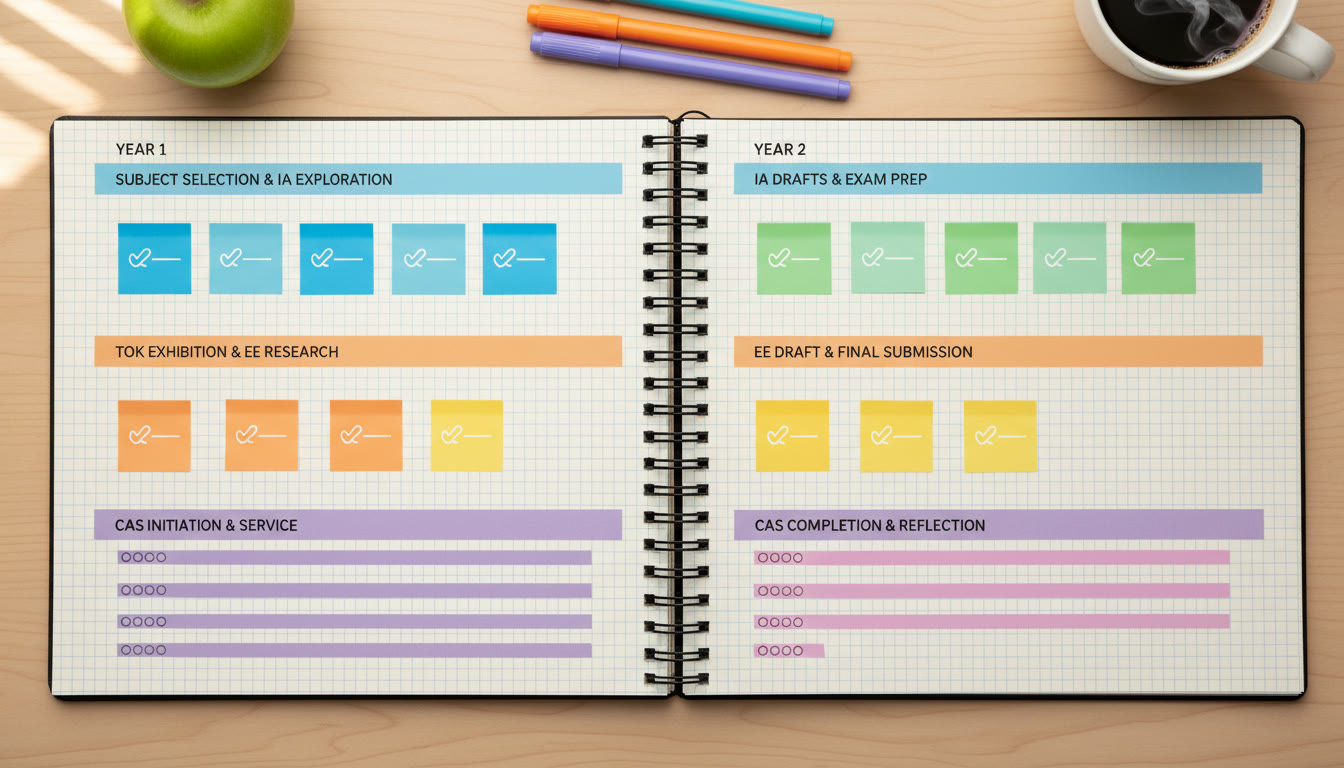
Here’s a practical roadmap, broken into four phases. Use it as a template and personalize it to your subjects, school calendar, and personal commitments.
| Phase | Typical aims | Deliverables / Actions |
|---|---|---|
| Phase 1: Start of Year 1 | Orient, select topics, set long‑term goals | Confirm HL/SL choices; draft EE topics; start CAS activities; build study timetable |
| Phase 2: End of Year 1 | Build depth and produce early drafts | First IA drafts; EE preliminary bibliography and research question; CAS project midpoints; subdued mock exams |
| Phase 3: Start of Year 2 | Polish and accelerate independent work | Finalise IA submissions; full EE draft submitted to supervisor; TOK exhibition planning; intensify revision blocks |
| Phase 4: Final term | Demonstrate and reflect | Submit EE and TOK; complete CAS evidence and reflections; sit external examinations |
How to distribute study time (practical rhythms)
There’s no single correct timetable, but patterns work. Early on, distribute time to build competence across all subjects. As Year 2 progresses, bias your schedule toward higher‑weight pieces (final IAs, EE revisions, exam practice). Here’s an example rhythm to personalize:
- Weekly: set consistent slots for each subject (short, focused blocks beat marathon sessions).
- Monthly: reserve a weekend for a deep revision cycle or EE research days.
- Pre‑exam season: create three simple goals per week — one content target, one exam practice target, and one wellbeing/rest target.
Example sample week during a non‑exam term (adapt to your load):
- HL subjects: 2–3 focused study blocks of 50–90 minutes each across the week.
- SL subjects: 1–2 attentive study blocks of 40–60 minutes.
- EE/TOK/IA: one longer session (2–4 hours) plus two short check‑ins.
- CAS/health: scheduled time for activities and reflection so evidence is accumulated steadily.
Internal assessments, EE and TOK — concrete tactics
These three are often the deciding factors in whether you feel in control or overwhelmed. Treat them as projects with milestones rather than one big looming task.
- Extended Essay: start by narrowing a question rather than pinning an exact title. Build a simple timeline with supervisor meetings and deadlines for a literature review, methods, and drafts.
- Internal Assessments: collect raw evidence early (labs, sources, recordings). Keep a compilation file of feedback and versions so you can show progression to moderators if needed.
- TOK: practice linking subject knowledge with real‑world examples. For the exhibition, curate objects or case studies that let you analyze knowledge questions concisely.
Schools set internal deadlines so work reaches the IB submission window on time; treat those school deadlines as immovable. If you’re ever unsure about the official IB submission date for your school’s session, ask your DP coordinator early so you can plan internal drafts accordingly.
Common pitfalls and how to avoid them
- Procrastination on incremental tasks: break IAs and EE into very small deliverables and celebrate finishing each.
- Treating Year 1 like a free pass: skipping mock exams or ignoring feedback makes Year 2 feel like scrambling.
- Poor record‑keeping for CAS and IA evidence: use a simple digital folder structure and weekly reflection habit.
- Ignoring exam technique: content without clear exam presentation loses marks fast — practise timed responses under realistic conditions.
Where targeted, personalized support fits
There will be moments where a one‑to‑one conversation, a tailored study plan, or a specific discussion about your EE question saves you days of confusion. For targeted tutoring that complements classroom teaching, many students use personalised services to fill the gap between teacher feedback and independent revision. For example, Sparkl can offer focused 1‑on‑1 guidance, bespoke study plans, expert tutors who know IB criteria, and AI‑driven insights that help spot gaps in understanding. Using such help sparingly — to target stubborn weak spots or to polish high‑value pieces like the EE or final mock exams — often yields the best return on investment.
Mini case studies: how plans can differ
1) The STEM‑focused student who needs labs and problem practice: focus Year 1 on mastering experimental technique and core problem types; use Year 2 to translate that skill into polished IA reports and relentless past‑paper practice.
2) The arts/humanities student who needs portfolio and extended writing: use Year 1 to build a rich documentation trail (sketchbooks, annotations, source logs) and test different EE angles; Year 2 is for refining the final submissions and curating your best material for assessment.
3) The student juggling part‑time work or extracurricular intensity: front‑load research and CAS documentation in Year 1 so Year 2 focuses on revision blocks. Communicate clearly with teachers early to agree realistic interim deadlines.
Checklist: end‑of‑Year‑1 to start‑of‑Year‑2 handover
- Confirm final EE topic and supervisor meeting schedule.
- Organize IA evidence and ensure drafts have teacher feedback attached.
- Have a CAS log with reflections up to date and a plan for remaining hours.
- Complete a personal mock exam review: list three content gaps and three exam technique goals.
- Set a realistic revision timetable for Year 2 that includes rest and recovery.
Final notes on mindset — learning the rhythm of demonstration
The difference between Year 1 and Year 2 is less about harder content and more about a shift in purpose. Year 1 teaches you the language of each subject. Year 2 expects you to speak fluently, coherently, and under pressure. Focus on building micro‑habits in Year 1 (weekly drafts, short timed answers, consistent CAS reflection) so Year 2 becomes a season of refinement rather than a panic. Keep evidence of progress, ask for targeted feedback, practice exam conditions, and remember that consistent small improvements beat last‑minute marathons.
The path from Year 1 to Year 2 is a designed progression: from guided learning to independent demonstration, from curiosity to forensic precision. Treat your two years as a carefully staged performance — you’re not simply collecting knowledge, you’re rehearsing how to show you understand it.


















No Comments
Leave a comment Cancel