

IB Physics HL: Your Roadmap to a 7
Scoring a 7 in IB Physics HL feels like a mountain climb: steep, technical, and occasionally exhilarating. The good news is that the peak is within reach if you treat preparation like a well-designed expedition. This guide isn’t a list of magic formulas; it’s a companionable blend of strategy, practical routines, and mindset shifts that real students use to make that climb without burning out.
We’ll cover how to build deep conceptual understanding, develop problem-solving routines that work under time pressure, turn lab work and the Internal Assessment into strengths, and finish with exam-day tactics that protect the marks you’ve earned. You’ll find examples, realistic study plans, and a couple of data tables to make planning easier. Along the way I’ll note how tailored support—like 1-on-1 guidance, focused study plans, and targeted feedback—can fit naturally into your preparation.

Start with the right mindset: precision over memorization
Physics is less about reciting facts and more about thinking like a physicist: translate a physical situation into a clear model, identify assumptions, perform calculations carefully, and evaluate results against reality. That mode of thinking is trainable. Spend less time passively rereading notes and more time interrogating ideas: ask “Why does this equation make sense?”, “Under what conditions would it fail?”, and “How does this connect to a different topic I already know?”
Understand what examiners are actually assessing
IB assessment rewards clarity, justification, and correct use of physics language as much as it rewards final answers. Examiners look for:
- Clear setup: definitions, chosen models, and labelled diagrams where relevant.
- Logical reasoning: each step follows from the previous one or from stated assumptions.
- Appropriate mathematics: correct equations, unit analysis, and algebraic manipulation.
- Evaluation: checking the reasonableness of answers, uncertainty considerations in practicals, and reflecting on limitations.
Approach every practice question with those examiner priorities in mind. Train yourself to write the physics you used to arrive at your answer, not just the answer itself.
Command terms decoded
Command terms are the exam’s instructions. Knowing them changes how you answer.
| Command Term | What examiners want | Quick tip |
|---|---|---|
| Define | A concise, textbook-style meaning with units if applicable | One crisp sentence |
| Explain | Cause-and-effect, using physics principles | Connect principles to the scenario |
| Calculate / Determine | Show clear steps, units, and a final numerical answer | Units and significant figures matter |
| Discuss / Evaluate | Balanced strengths/limitations, compare alternatives | Use evidence, mention assumptions |
Build deep conceptual foundations
Top scorers don’t just memorize equations—they understand where those equations come from and how to apply them flexibly.
- Connect ideas across topics. For example, momentum conservation ideas recur in collisions (mechanics) and in charge flow (electric circuits) as conservation principles of a kind—practice mapping the same technique to different contexts.
- Use explanatory diagrams. Sketch fields, forces, motion paths, or energy flow before doing algebra—this helps avoid categoric mistakes that cost marks.
- Ask ‘‘what if’’ questions. Change a parameter and predict qualitatively what happens. If your qualitative sense is shaky, the algebra will be too.
Work with concept checks rather than long passive readings: explain the same topic to a peer or record yourself summarizing it. If you can teach it clearly, you’re ready to use it under pressure.
Sharpen problem-solving into a reliable routine
When time is limited, a consistent problem-solving routine prevents wasted minutes and sloppy math. Train this routine until it’s automatic:
- Step 1: Read actively. Circle the asked-for quantity and list what’s given.
- Step 2: Identify the model. State assumptions (negligible air resistance, point masses, ideal wires, etc.).
- Step 3: Draw a labelled diagram. Put coordinate axes and direction arrows on it.
- Step 4: Write down relevant equations and link them logically.
- Step 5: Do algebra symbolically as far as possible, then substitute numbers. This reduces arithmetic errors.
- Step 6: Check units, orders of magnitude, and special cases (e.g., does the result make sense if mass → 0?).
Practice this routine relentlessly on past-paper problems or quality question banks. Time yourself, but also spend unspeeded practice where you refuse to move on until you can explain each step clearly.
Math fluency and unit-checking
Physics is applied math. Strengthen algebra, trigonometry and calculus skills until rearranging equations is second nature. Always do a quick unit consistency check: units that don’t match are an immediate clue to algebra or conceptual mistakes. When you practice, annotate your steps with units; turn that habit into an exam-time reflex.
Turn practicals and the IA into high-scoring assets
Many students think the Internal Assessment is a separate hurdle. Treat it instead as an opportunity to demonstrate scientific thinking: a well-designed IA shows planning, control of variables, meaningful measurement and thoughtful analysis.
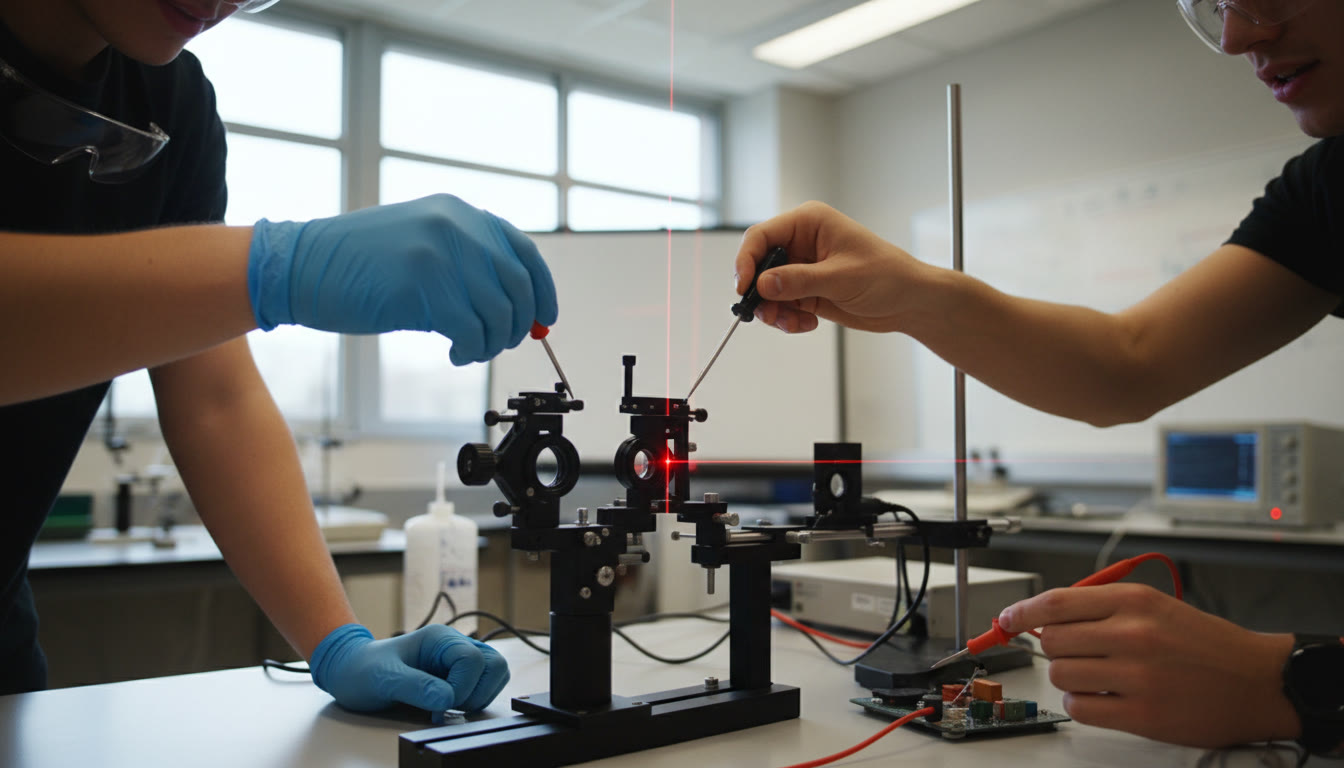
Key practical strengths examiners value:
- Clear research question and rationale rooted in physics concepts.
- Thoughtful method that controls key variables and collects data to test the underlying model.
- Appropriate uncertainty analysis and graphical data presentation.
- Critical evaluation: discuss limitations, suggest smart improvements, and link back to theory.
Keep your IA diary-like while you work: dates, small experimental changes, and preliminary observations. These details supply evidence for your decision-making and make the evaluation section more convincing.
If you choose to get targeted help with experiment design or data analysis, tailored 1-on-1 guidance can be useful to identify blind spots and polish the written report without substituting for your own work. For example, Sparkl‘s tutors can help you sharpen your method and analysis approach while keeping your voice central to the IA.
Design a revision plan that scales with time
Revise actively: alternate focused concept blocks with mixed problem sets that force you to choose the right model. Here’s a sample eight-phase focus that fits a concentrated revision cycle; adapt the pace to suit your calendar.
| Phase | Focus | Key Activities |
|---|---|---|
| 1 | Core mechanics | Concept checks, free-body diagrams, kinematics problems |
| 2 | Waves & energy | Derivations, qualitative predictions, waveform analysis |
| 3 | Electricity & magnetism | Circuit problems, field vs potential exercises |
| 4 | Thermal & modern topics | Statistical reasoning, quantum concept sketches |
| 5 | Options / HL extensions | Option-specific problems, deeper derivations |
| 6 | Practicals & IA polishing | Data re-analysis, graphing, uncertainty practice |
| 7 | Mixed past-paper practice | Time-limited papers, examiner-style marking |
| 8 | Final consolidation | Targeted weak-spot review, light practice to build confidence |
Weekly routines that actually stick
Use a rhythm that alternates focused learning days and mixed-practice days. Example week: three 90-minute focused concept sessions, two 60–90 minute mixed-problem sessions, and one extended paper-style block. Rest and sleep are non-negotiable—deep learning needs consolidation time.
Exam technique: protect marks with structure and calm
On a paper, you can lose marks quickly by skipping structure. Here are practical habits that save points:
- Write a quick plan for long questions: list the physics principles you will use and the sequence of steps.
- Show working. Even partial credit is given for correct method, so present steps clearly.
- Label diagrams and axes on graphs. A good diagram can earn method marks even before calculation.
- Always include units and a short unit check in your working. If the result has wrong units, you can spot algebraic errors fast.
Time management under pressure
Practice with realistic timing. In live conditions, circle or highlight questions you’ll return to, and work through the paper once to collect accessible marks first. Reserve time at the end to check units, significant figures, and that your answers are consistent qualitatively with expectations.
Common pitfalls and how to fix them
- Relying on memorization: Fix by explaining derivations in your own words and practicing variations of problems.
- Skipping diagrams: Fix by making them mandatory in your practice routine until they’re habit.
- Poor uncertainty analysis in practicals: Fix by practicing uncertainty propagation on small datasets and interpreting error bars meaningfully.
- Not using past-paper marking schemes: Fix by marking your answers against examiner reports to learn what earns method marks.
Using targeted support without losing ownership
One-on-one coaching can be transformational if used to clarify thinking, highlight blind spots, and model exam-style answers rather than writing them for you. Short, focused sessions that review a single topic or a mock exam section are often more effective than long, unfocused tutoring blocks. If you use guided support, stay in charge: choose sessions that help you practice skills you then apply independently.
For example, students sometimes book a few sessions to refine IA design or to drill problem-solving routines; these focused interventions, paired with disciplined solo practice, create durable improvements. A tailored option can include personalized study plans and feedback on answer structure, which helps translate raw knowledge into examable performance.
Quick checklist: the final polish
- Do daily short concept checks and weekly mixed-practice papers.
- Annotate every practice solution: state assumptions, write units, and perform a reasonableness check.
- Keep IA notes neat: data, method changes, and thought process all documented.
- Simulate exam conditions several times before the real paper to build pacing and mental stamina.
- Seek targeted feedback on your weakest two topics until you can explain them clearly to a peer.
Sample timeline: focused six-week sprint
| Week | Main Goal | Daily Habit |
|---|---|---|
| 1 | Identify weak zones and shore up fundamentals | 30–60 min concept checks + 1 problem set |
| 2 | Targeted practice on two weak topics | Focused notes and past-question practice |
| 3 | Practicals & IA focus | Data analysis practice and uncertainty exercises |
| 4 | Timed past-paper sessions | One timed paper + marking and review |
| 5 | Refine exam technique and command-term fluency | Short drills on command terms + targeted marking |
| 6 | Consolidation and light practice | Low-stress mixed problems and rest to sharpen recall |
Final academic point: mastering practice and reflection
Reaching a 7 in IB Physics HL is the product of a disciplined loop: practice deliberately, get precise feedback, refine your method, and reflect on what changes your understanding. Technical fluency in math and units, clear diagrams and model statements, careful lab and IA work, and exam habits that preserve marks combine to make high performance reliable rather than accidental. Keep practice structured, keep explanations verbal as well as written, and treat each error as a coached moment to improve reasoning rather than a verdict on ability.



























No Comments
Leave a comment Cancel