
When plans keep changing: the IB DP dilemma
It’s a familiar scene in many DP counselling offices: a thoughtful student arrives excitedly with a new plan, only to return weeks later with a different major, a new dream, or the declaration that they’re “undecided again.” For IB Diploma students, who are navigating rigorous academics alongside identity, curiosity and pressure to choose a future, this month-to-month pivoting can be both energizing and exhausting—for the student and for the adults supporting them.

This article is written for IB DP counsellors, teachers and advisers who want humane, practical ways to help students turn frequent flips into informed exploration rather than indecision. The suggestions are designed to be flexible across different schools and regional systems, to respect the DP’s structure, and to keep student agency at the centre. Where specific supports are useful, I’ll mention tailored tutoring and guidance options such as Sparkl that can complement school-based counselling.
Start with empathy: what frequent plan changes usually mean
Curiosity, not failure
Most students who change plans often are experimenting. They read a blog, talk to a cousin, see a talk at an open day and get excited. For many adolescents, interests are still forming; the DP’s breadth actually encourages exploration. The counselling pivot can therefore be a sign of intellectual engagement rather than poor planning.
Other common underlying reasons
- Exploration and discovery—trying out possible identities and careers.
- Information gaps—students pick ideas without understanding realistic pathways, prerequisites or day-to-day work.
- Perfectionism and fear—amazement at what peers achieve leads to frequent resets.
- External pressure—family, friends or social media nudging students toward certain roles.
- Emotional or attentional patterns—anxiety, ADHD, or mood swings can make sustained follow-through hard.
Mindset for counsellors: curiosity, containment, and structure
Curiosity over judgement
When a student arrives with a new plan, start with genuine curiosity. Ask questions that help them explain the why behind the idea: What excited you about this option? What did you learn that changed your mind? That stance turns conversation into exploration rather than correction.
Containment: set gentle boundaries
Containment means creating predictable moments for planning and reflection—monthly check-ins, a decision notebook that records pros and cons, and a clear process for how subject or application choices will be finalized. These structures validate curiosity while preventing endless last-minute changes that risk academic disruption.
Document the journey
Keep a simple log: date, student-stated interest, evidence they’ve collected, and next small experiment. Documentation reduces repetition and helps students see patterns in their interests over time.
Practical, step-by-step approach
Step 1 — Turn bold statements into questions
Transform “I want to study X” into a short inquiry: “What specifically about X appeals to you?” Then guide the student to translate excitement into testable steps—reading a foundational article, calling a professional, or completing a weekend task related to X. Small experiments teach faster than long declarations.
Step 2 — Design short experiments
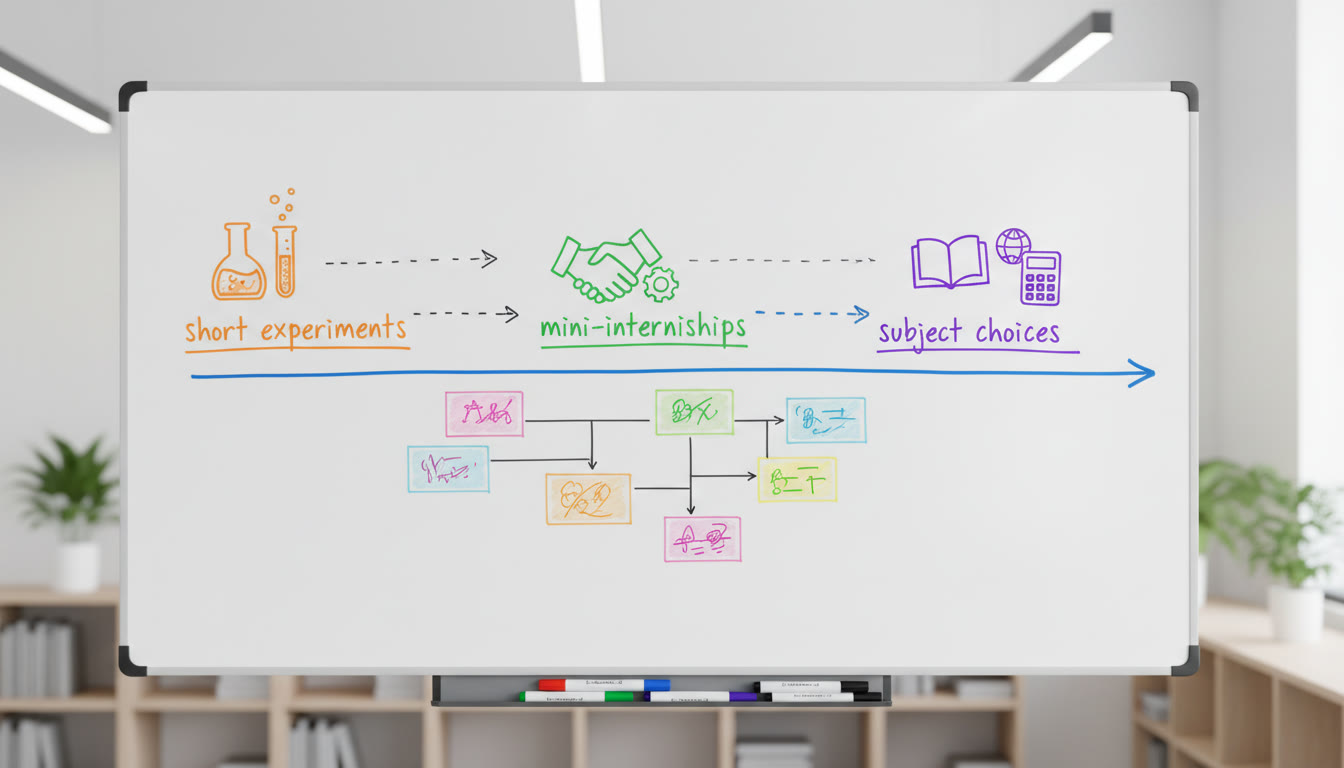
Short, time-boxed activities give students real evidence. Examples: a 4-week reading stack about a field, a one-day job shadow, a mini-CAS project, or an interview with an alumni. Frame the experiment with clear outcomes: “After this, you’ll know whether you enjoy the thinking, the people and the pace of the role.”
Step 3 — Protect subject choices while preserving flexibility
Some choices narrow future options; others keep multiple pathways open. Advise students on a subject mix that preserves options (e.g., combining a science HL with a flexible humanities SL or selecting subjects that meet prerequisites for several fields). Where students are oscillating, recommend subject choices that build transferable skills—writing, research methods, quantitative reasoning—so that shifting majors later is less risky.
Step 4 — Integrate Extended Essay and CAS as exploration tools
The EE can be a safe place to investigate a possible interest in depth; CAS projects can create exposure to communities and careers. Encourage students to pick EE topics that let them test a question related to a potential major and to craft CAS experiences that simulate real-world work or research.
Conversation scripts that work
Counsellors and teachers often benefit from short, replicable scripts. Here are a few to keep in your pocket:
- “Tell me one concrete thing you’d like to find out this month about that idea.”
- “What would prove to you that this is a good fit?”
- “Let’s agree on a six-week trial and then reflect on evidence.”
- “If this path doesn’t fit, what did you learn that you can use next?”
Tools and records: simple templates that keep students accountable
Give students a one-page decision tracker that they can update. It should include: the interest name, why it matters, three actions to test it, expected evidence, and the review date. Digital or paper—what matters is regular review.
Quick-reference table: behaviours, causes and counsellor responses
| Observed behaviour | Possible underlying cause | Counsellor response | Concrete next step |
|---|---|---|---|
| Changes plan weekly after reading online articles | Information overload; excitement without depth | Help the student evaluate credibility; encourage depth over breadth | 1 short article or a podcast + reflection within 2 weeks |
| Chooses what peers choose | Peer pressure, identity testing | Explore values and personal strengths; role-play future scenarios | Interview 1 alum who studied that major |
| Flips between distant fields (e.g., medicine ↔ design) | Interest in different working styles; fear of commitment | Map transfer skills and necessary prerequisites | Select DP subjects that build foundational skills for both pathways |
| Repeats same change every cycle | Decision paralysis, anxiety, or ADHD-style impulsivity | Consider a referral to mental health support; set smaller, measurable experiments | Weekly check-ins, brief mental health screening if needed |
How subject choices can be both safe and strategic
Balance is your friend
For students who cannot settle, recommend a subject combination that prioritizes skill diversity: one rigorous HL in a subject they enjoy, one HL that demonstrates quantitative or scientific thinking if they are considering STEM, and subjects that foster communication and research. This keeps pathways open while encouraging depth.
Use SL and HL strategically
Where possible, advise students to take a subject at SL if they want exposure without locking in a future requirement. Some universities accept SL for broadly related majors; others prefer HL. Teach students to check entry requirements in the current cycle and to build alternative plans where necessary.
Applications, essays and the story of change
Turn shifting interests into an asset
A narrative that acknowledges exploration and learning can be powerful. Encourage students to write about what their changing interests taught them—how those experiments produced skills, clarified values, or revealed a working style. Admissions readers often appreciate intellectual curiosity and evidence of growth, not rigid certainty.
Be honest and strategic in personal statements
A good personal statement can briefly explain a process of exploration and then highlight a coherent thread—problem solving, creativity, empathy, or leadership—that connects different interests. Use examples of projects, EE work, or CAS activities as concrete evidence.
Working with parents, teachers and the school community
Manage expectations with transparency
Parents often want certainty. Offer them a visible plan: experiments, dates, and decision points. This reassures families that exploration is structured and not aimless.
Create teacher allies
Invite subject teachers to support short experiments—allow a student to write an EE or take a project related to a possible field. Teachers can provide formative evidence about fit: whether a student enjoys the work ethic, the subject’s thinking style, and the classroom tasks that are typical of that discipline.
When to involve specialists
Changing plans frequently is normal, but sometimes it signals deeper needs. Consider a referral when:
- There’s a repeated pattern of impulsive choices that impact grades significantly.
- The student reports persistent anxiety, low mood, or attentional challenges.
- Decision-making disrupts essential DP commitments like coursework and exams.
Work with school psychologists or external professionals to separate developmental exploration from clinical issues requiring support.
How tutoring and personalized support fit in
Short experiments often demand focused skill-building—research methods for an EE, math support for a STEM trial, or help with portfolio development for creative subjects. Tailored 1-on-1 support can accelerate learning and provide confidence during trials. Services that offer personalized plans, expert tutors and insights driven by student performance data can help make experiments efficient and informative. For example, Sparkl can provide focused tutoring and study plans that align with a student’s exploration timeline.
Example case studies (short and practical)
Case 1 — The explorer
A student flips between engineering and architecture monthly. Response: create a 6-week split experiment—two Saturdays of shadowing an engineer, two Saturdays with an architect, a mini EE topic comparing design thinking in both fields. Keep subject choices that build maths and creative thinking. After the trial, review the log and choose subject emphasis for the coming months.
Case 2 — The anxious perfectionist
A learner changes plans because they fear making the wrong move. Response: reduce the perceived stakes. Frame decisions as reversible, set a short experiment with a clear success metric (e.g., complete one substantial task in the field) and provide regular praise for progress—not only outcomes.
Case 3 — The indecisive high achiever
A student’s grades dip because every plan change requires new study strategies. Response: invoke a ‘decision notebook,’ pair the student with a mentor for accountability, and use targeted tutoring for the subject that is currently affecting grades. Data-driven tutoring sessions can make the transition less disruptive to overall DP performance.
Timelines and check-in rhythm
Consistency beats intensity. Recommended rhythms:
- Weekly micro-checks for immediate accountability (10–15 minutes).
- Monthly planning sessions for deciding next experiments (30–45 minutes).
- A termly review to align subject choices with application timelines and EE/CAS commitments.
| Timeframe | Primary goal | Typical activity |
|---|---|---|
| Immediate (1–2 weeks) | Stabilize schoolwork and reduce impulsive switches | Agree on one trial task and daily check-ins |
| Short-term (1–3 months) | Test hypotheses about fit | Short experiments, EE topic exploration, targeted tutoring |
| Medium-term (3–12 months) | Consolidate decisions and prepare applications | Finalize subject emphases, craft personal statements, gather evidence |
Measuring progress: what counts as useful evidence?
Avoid relying solely on feelings. Useful evidence comes in many forms: completed tasks (a short research paper or portfolio piece), reflections that show deeper understanding, feedback from professionals or teachers, and observable changes in persistence or problem-solving. Encourage students to gather at least two types of evidence before changing course again.
Final practical checklist for counsellors
- Adopt a curious, non-judgemental stance in every conversation.
- Use short, measurable experiments to test interests.
- Keep records: date-stamped notes, decisions, and evidence.
- Protect DP requirements by suggesting subject mixes that preserve options.
- Engage parents with transparent plans and timelines.
- Refer to specialists when emotional or attentional issues hinder decision-making.
- Use targeted tutoring and tailored study plans to reduce the academic cost of exploration.
Closing academic reflection
Helping an IB DP student who changes plans frequently is about converting curiosity into structured learning. By framing each shift as an experiment, documenting evidence, protecting the integrity of the DP, and using short, skill-based interventions, counsellors can help students develop clearer preferences and transferable abilities. This approach respects adolescent exploration while keeping academic progress on track and aligns educational choices with genuine interest and demonstrable skill.





















No Comments
Leave a comment Cancel