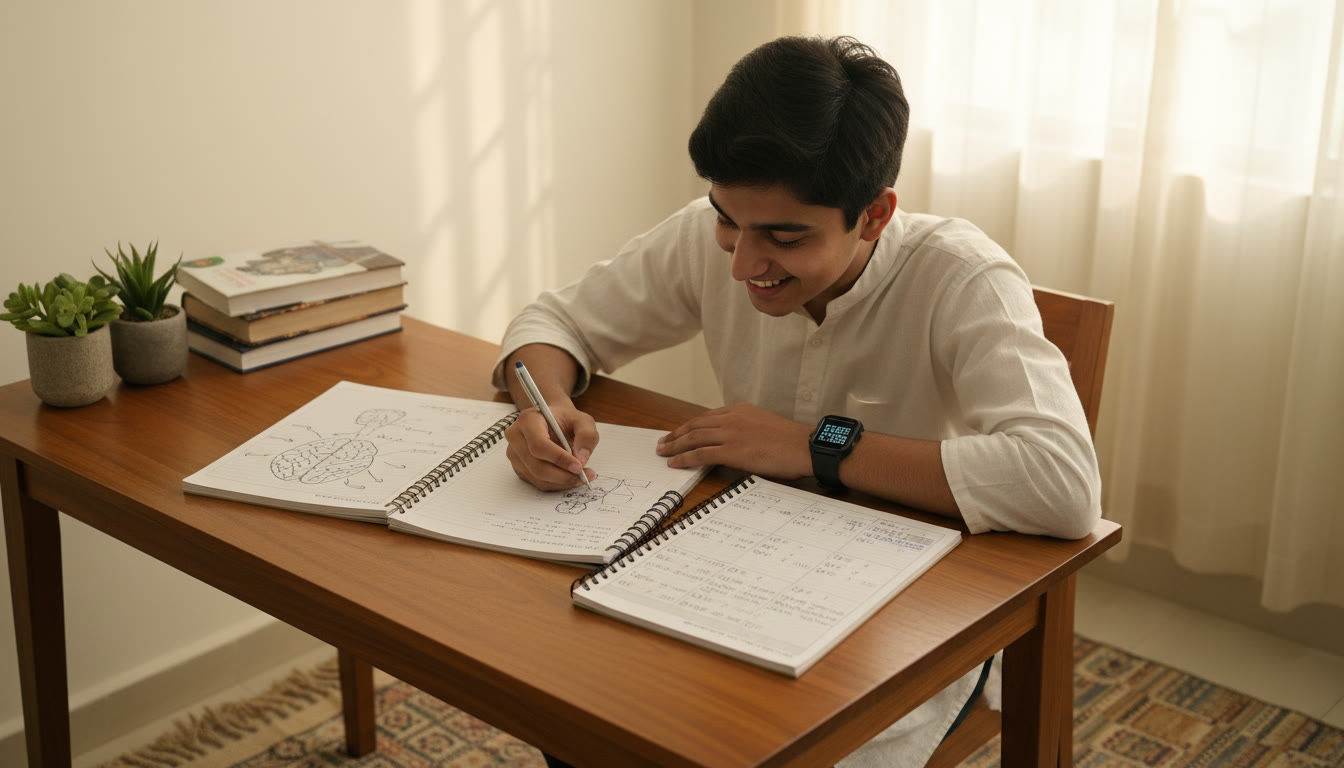

Why ISC and NEET Feel Like Two Different Races — and Why They’re Really One Course with Two Finishes
If you’re doing ISC and aiming for NEET, you’ve probably felt pulled in two directions: descriptive answers, projects, and long-form explanations on one side; timed multiple-choice pressure, OMR discipline, and negative marking on the other. The good news is that the hard work you put into ISC builds a foundation that can be turned into NEET-ready strength with a few smart adjustments.
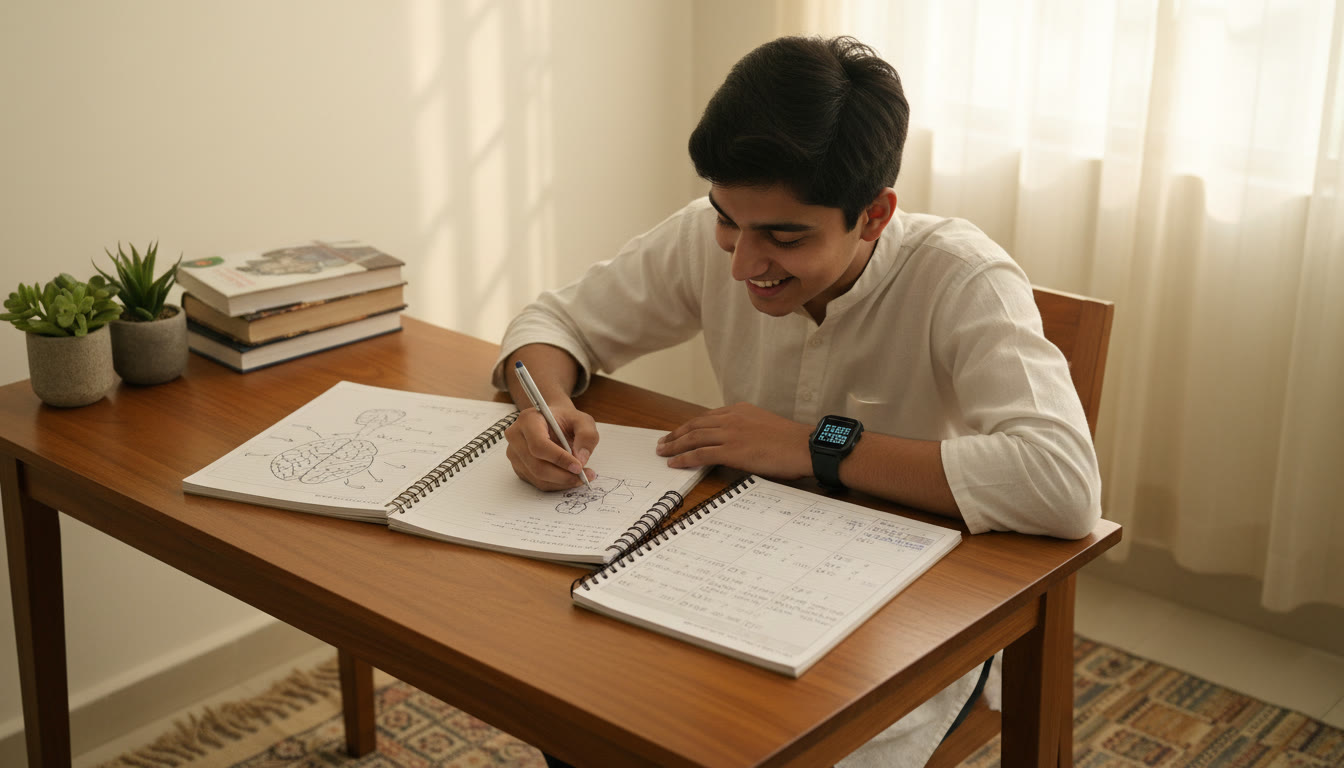
NEET is an MCQ-based, three-hour exam that penalizes incorrect answers and requires strict OMR discipline. That means accuracy, time management, and targeted practice are as important as understanding. ISC gives you depth and clarity — your job is to reshape that depth into speed, recall, and exam strategy without losing conceptual strength.
Key, Non-Negotiable Facts to Base Your Plan On
- NEET uses multiple-choice questions; answers are evaluated via OMR and incorrect answers attract negative marks.
- A full-length simulated NEET takes three hours — practise at that length to build stamina and time sense.
- Syllabus overlap is high across Physics, Chemistry, and Biology, but NEET favors concise recall, application, and problem-solving over descriptive exposition.
- Diagrams, derivations, and long answers are excellent learning tools in ISC preparation; for NEET, treat them as memory anchors and concept-checks, not as the final deliverable.
Map Your Syllabus: Find Overlap, Spot the Gaps
Begin by creating a two-column syllabus map: ISC topics you must master vs topics NEET asks for. You’ll quickly see large overlaps (human physiology, optics, organic reactions) and a few niche NEET-favored items that need targeted work. A methodical map lets you prioritize rather than panic.
Sample Syllabus Mapping — How to Translate ISC Topics to NEET Action
| Topic Area | Typical ISC Focus | NEET Demand | Gap to Bridge | Suggested Action |
|---|---|---|---|---|
| Biology — Human Physiology | Detailed flow, long answers, diagrams | Direct MCQs on functions, causes, pathways | Speed of recall, factual precision | Make 1-page concept maps and do 20 rapid MCQs/day. |
| Biology — Genetics & Evolution | Problem-solving and extended explanations | Pedigree problems, inheritance patterns in MCQ form | Translating steps to MCQ strategy | Practice pedigree and Punnett MCQs with timed drills. |
| Physics — Mechanics | Derivations and long numerical work | Quick concept-based numericals and application MCQs | Faster problem set-ups and approximations | Shorten derivations to 3–4 key equations; solve 4 NEET-style numericals/day. |
| Chemistry — Physical Chemistry | Step-by-step calculations and theory | Numerical MCQs with one correct option | Speed and error-checking under negative marking | Simulate time-limited batches and maintain a formula sheet for last-minute revision. |
| Chemistry — Organic | Mechanisms and logical explanations | Reaction outcomes, reagent recognition | Rapid reagent identification and exception awareness | Create reaction-flashcards and daily reagent quizzes. |
| Physics — Optics & Modern Physics | Conceptual and mathematical depth | Concept-based MCQs and short calculations | Flexing conceptual understanding to rapid MCQ answers | Do conceptual quizzes and 1 full-section test weekly. |
Turn ISC Strengths into NEET Advantages: A Practical Study Strategy
Your ISC notes are gold — they contain narrative clarity that most last-minute crammers lack. The challenge is organizing those notes to serve NEET-style recall and problem-solving. The following routine helps you preserve depth while gaining speed.
Daily and Weekly Habit Framework
- Morning (90–120 minutes): Active concept revision from ISC notes — condense into one-page summaries.
- Midday (60–90 minutes): NEET-style MCQ practice in the subject you revised in the morning (timed, with negative-marking discipline).
- Afternoon/Evening (90–150 minutes): Problem-solving — numericals for Physics/Chemistry; diagrams and application questions for Biology.
- Night (30–45 minutes): Light review — flashcards, mnemonic recall, or error-log reflections.
A Week-in-View Example
- 4 days — Focused study: one subject per day in deep mode (concepts + notes + practice).
- 1 day — Mixed practice: 100–150 MCQs across subjects with timed sections.
- 1 day — Full-length, three-hour simulated NEET once every two weeks; maintain OMR discipline.
- 1 day — Rest, light revision, and planning.
Biology: Convert Descriptive Mastery into Precision Recall
Biology is often the biggest bridge between board marks and NEET rank because the ISC detail helps you remember processes deeply. Turn paragraphs into bite-sized facts: convert a 400-word explanation into a 10–point checklist plus two diagrams that act as memory hooks.
Practical Biology Habits
- Make one-page concept maps for each chapter; add a 10-question MCQ quiz that you answer from memory.
- Use diagrams as recall prompts — redraw them from memory and annotate key steps aloud.
- Create a ‘fact bank’ of high-yield facts (e.g., hormone functions, enzyme locations, cell organelle roles) and test yourself daily.
- For inheritance questions, practise pedigree interpretation and cross-calculation problems until they feel routine.
Physics: From Derivations to Instant Problem Setup
Physics in ISC may reward long derivations; NEET rewards the right setup, quick algebra, and concept clarity. Your goal is to shrink derivations into skeleton steps and focus on problem-recognition patterns.
Physics Drill Plan
- Create a formula sheet with derivation milestones: what you need to remember, and what you can re-derive quickly.
- Practice 3 levels of problems weekly: easy (apply formula), medium (combine concepts), hard (multi-step reasoning).
- Maintain a ‘mistake book’: every time you lose a mark in a mock, write the reason and one corrective step.
Chemistry: Balance Concept, Reaction, and Calculation
Chemistry is the most varied of the three subjects: factual recall in inorganic, mechanistic thinking in organic, and careful calculation in physical chemistry. ISC gives you thorough explanations — your job is to compress that into rapid recognition and calculation fluency.
Chemistry Practical Checklist
- Daily reagent recognition drills (organic) and exception lists (inorganic).
- Timed numerical sets for physical chemistry; always practice with negative-marking discipline.
- Make one annotated reaction map per organic chapter showing reagents, conditions, and probable products.
Test-Taking Skills: OMR Discipline, Negative Marking, and Time Management
Practising with random MCQs won’t be enough — you must replicate exam conditions. Work on three things: how you attempt (strategy), how you transfer answers (OMR habits), and how you think under time pressure.
NEET-Style Attempt Strategy
- First pass: answer only the questions you can do in 30–90 seconds. Mark others for review.
- Second pass: tackle medium-difficulty questions with a 2–4 minute thinking window.
- Third pass: spend remaining time on tough questions, and make sure you’re comfortable with the negative-marking trade-off.
- OMR discipline: bubble answers in small, regular blocks, leave time at the end for verification, and use consistent marking to avoid misreads.
Filling the Gap Fast: A 12-Week Catch-Up Table (High-Intensity Plan)
When time is limited, a clear week-by-week focus keeps you from scattering effort. The following table outlines a balanced catch-up approach you can scale to your available weeks.
| Weeks | Primary Focus | Weekly Targets | Assessment |
|---|---|---|---|
| 1–3 | Foundations & Syllabus Mapping | Condense board notes, make 1-page maps for 12–15 chapters, 50 MCQs/day | Sectional test at end of week 3 |
| 4–6 | Skill Building — Physics & Chemistry | Targeted numericals, 3 full practice sets/week, mistake log | One full-length timed mock every 10 days |
| 7–9 | Consolidation — Biology & High-Yield Topics | Daily rapid-recall drills, 150 MCQs/week, 2 full-length mocks | Performance review and focused revision list |
| 10–12 | Fine-tuning & Exam Simulation | Alternate full-length mocks and restorative revision days, OMR practice | Final performance benchmark and last-minute checklist |
How to Use Technology and Targeted Tutoring Wisely
Personalized support can accelerate gap-filling. If you need focused help for a specific weak area, tailored 1-on-1 guidance speeds things up: it gives you a plan created for your strengths and weak spots, expert tutors who show efficient problem-solving paths, and intelligent feedback that reduces wasted hours.
If you use a personalized tutoring option, look for these features: targeted study plans, regular progress checks, tutor feedback on mistake logs, and insights that tell you whether to consolidate or advance. For example, Sparkl’s approach to 1-on-1 guidance, tailored study plans, expert tutors, and AI-driven insights is designed to convert ISC depth into NEET precision without sacrificing conceptual clarity.
Daily Tools to Keep You Honest and Efficient
- Maintain an error log: record the question, your error type (careless/conceptual/knowledge gap), and a single corrective action.
- One-page summaries: for quick morning reviews, annotate the top 20 facts per subject each week.
- Timed micro-tests: 20 MCQs in 25 minutes daily builds both speed and endurance.
- Regular full-length mocks with OMR practice to simulate the exact exam stress and transfer skills.
Common Student Scenarios and Rapid Fixes
Every ISC student will feel a slightly different type of gap. Here are quick fixes for the most common situations.
- Strong at theory, slow on calculations: do focused numerical drills and keep a one-line checklist for formula selection.
- Great at board diagrams, poor at recall: convert diagrams into point-wise flashcards and self-test until retrieval is instant.
- Solid overall but low speed: practice timed sectional mocks and refine the “first-pass/second-pass/third-pass” attempt method.
- Frustrated by negative marking: work on elimination techniques — often you can eliminate two options confidently and make a high-odds guess only when necessary.
Scheduling Tips Around ISC Exams and School Commitments
When school assessments are heavy, adapt by using short, high-quality study bursts: 45–60 minutes of focused NEET-style practice after school and a concentrated 2–3 hour revision block on weekends. Swap long reading sessions for active recall and MCQ practice during high school workload periods to keep momentum without burning out.
Final Academic Takeaways
ISC and NEET preparation need not be opposing forces. Treat ISC study as the conceptual spine and actively sculpt those concepts into quick, precise NEET-ready forms through condensation, daily MCQ practice, timed problem-solving, and disciplined OMR habits. Use targeted tutoring and personalized plans to plug stubborn gaps efficiently, and keep a mistake-driven revision loop as your engine of steady improvement. With mapped priorities, realistic mock practice, and consistent error analysis, the gap becomes a manageable bridge from board-level mastery to NEET success.
























No Comments
Leave a comment Cancel