
IB DP Global Admissions: Why your ECAs are the quiet powerhouse of a STEM application
Think of your extracurricular activities (ECAs) as the visible proof of how you think, tinker, and persist when the classroom timetable ends. For IB Diploma Programme (DP) students headed for top STEM universities, ECAs are where curiosity becomes evidence. They show admissions officers — whether in a small interview room, a UCAS response field, or a competitive ranking list — that you don’t only understand concepts, you use them to make things, solve problems, teach others, or push a project across the finish line.

Short truth: quality trumps quantity
Universities want depth more than a long resume of half-hearted activities. A sustained research project, a polished portfolio of code, or leadership that built an annual outreach program tells a clearer story than a dozen short-lived clubs. The IB framework gives you special advantages — Extended Essay (EE), Creativity, Activity, Service (CAS), and internal assessments — that can be used to create meaningful, documentable ECAs that translate into stronger applications.
The global admissions landscape — how ECAs are weighed differently
Every country and system has its own rhythm. Understanding those rhythms helps you choose and present ECAs strategically rather than scattershot.
- United States: Holistic evaluation; ECAs can make or break your narrative. Research, internships, founder projects, and leadership shine here.
- United Kingdom (UCAS): The application now expects concise, targeted responses through the three structured questions — Motivation, Preparedness, Other Experiences. ECAs must be woven into those short, focused answers.
- Netherlands (Numerus Fixus): Certain engineering programs use an earlier deadline (January 15th) and may value demonstrable technical experiences and entrance tests.
- Switzerland (EPFL): Admissions for international bachelor students are increasingly competitive and ranked; note the latest announced 3,000 student cap for international bachelor’s intake and the move away from automatic admission by score alone.
- Canada: Distinguish between Automatic Entrance Scholarships (grade-based) and Major Application Awards (leadership/nomination-based). The latter rewards documented leadership and domain-specific impact.
- Singapore: Offers for IB students often arrive late in the cycle (often mid-year), creating a gap risk compared with earlier US/UK offers.
Top ECAs that genuinely help STEM-focused IB DP students
Here are the ECAs that consistently show high admissions value — and how to make each one count.
1. Sustained research or lab projects
Why it helps: Shows true curiosity, the ability to manage a long-term project, and exposure to scientific method. How to make it matter: publish a poster, submit to a student research fair, or produce a short paper/technical report that you can reference in applications.
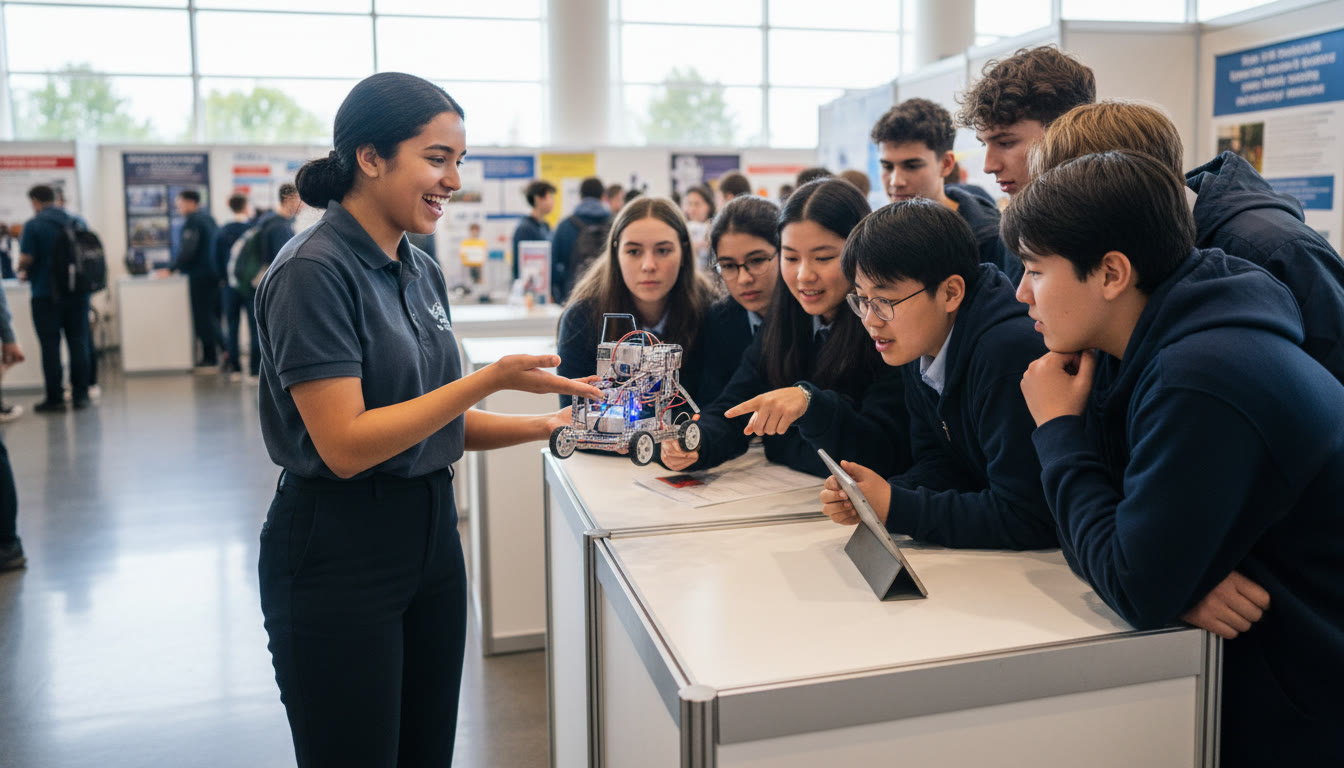
2. Coding, open-source contributions, and robotics
Why it helps: Demonstrates tangible technical skill and problem-solving. How to make it matter: maintain a GitHub with clear READMEs, show deployed projects, or enter regional robotics/CS competitions with documented outcomes.
3. Math/Physics/Engineering competitions and certifications
Why it helps: Competitive results are a clean, comparable signal. How to make it matter: accompany scores with reflections on what you learned and how you applied it in a project or teaching role.
4. Internships, industry shadowing, and university lab experiences
Why it helps: Connects theory to real-world application and provides strong letters of recommendation. How to make it matter: gather a short supervisor statement, keep a lab notebook, and build a small deliverable you can show.
5. Teaching, tutoring, and outreach
Why it helps: Demonstrates mastery and leadership. How to make it matter: record lesson plans, student outcomes, and any expansion you led (e.g., a program that grew from five to fifty participants).
6. Maker projects and entrepreneurship
Why it helps: Building a prototype, product, or startup shows initiative and cross-disciplinary skills. How to make it matter: present prototypes, patent abstracts, or user metrics even if small — these are narrative gold.
7. Extended Essay (EE) aligned with an ECA
Why it helps: The EE is uniquely IB — when aligned with an ECA it gives you a scholarly artifact you can reference (methodology, bibliography, and critical reflection). How to make it matter: choose a topic that dovetails with research or a project and keep the EE robust and evidence-based.
How to present ECAs in different application formats
Presentation matters as much as the activity itself. Below are practical pointers for the most common routes.
UCAS and the three structured questions
The new UCAS arrangement asks responses to three focused prompts: Motivation, Preparedness, and Other Experiences. Use them like this:
- Motivation: Start with a single storytelling line that explains your magnet for the subject, then give a concise example of one ECA that cemented that interest.
- Preparedness: List technical skills and outcomes that prove you can handle the course (e.g., a sustained research result, coursework extension, competition placement).
- Other Experiences: Use this for leadership, resilience, and community-facing STEM work — CAS projects that scaled, outreach, or volunteer tutoring.
Keep each answer focused and evidence-backed: specific projects, measurable outcomes, and what you learned.
Common App and American-style essays
Here you have more room to tell a coherent story: pick a pivotal ECA or two and build a narrative arc — curiosity, challenge, action, outcome, reflection. Admissions readers want to see growth and intellectual character.
Netherlands Numerus Fixus programs (note the January 15th date)
If you’re targeting a Numerus Fixus engineering program (for example, competitive places at leading technical universities), prepare early. The January 15th deadline for those programs is much earlier than many general deadlines, and admissions processes often look for demonstrable technical experience and sometimes entrance-testing results.
EPFL and Swiss competitive intake
For students considering Swiss polytechnics, remember that the latest announced 3,000 student cap for international bachelor entrants and a move toward ranked, competitive selection make demonstrable project-based experience and standout achievements more important than raw scores alone.
Canada: Automatic Entrance Scholarships vs Major Application Awards
Do not call them lanes. Automatic Entrance Scholarships are grade-based and often awarded to those meeting academic cut-offs. Major Application Awards are different: they reward documented leadership, creative projects, or department-nominated excellence. If you want to compete for Major Application Awards, prepare narrative evidence — portfolios, recommendation letters that stress impact, and sometimes short written submissions or interviews.
Singapore and mid-cycle offers
Note that offers for IB students in Singapore can arrive later (often mid-year); prepare for the gap risk by planning conditional alternatives, financial logistics, and confirming deferral/deposit policies if needed.
Concrete evidence checklist and a quick reference table
Admissions teams look for verifiable evidence, not claims. Build a simple evidence folder for each ECA that includes: a one-page summary, key metrics/outcomes, supervisor statement (if applicable), and artifacts (code links, posters, photos). Below is a compact table you can use as a reference when deciding what to pursue.
| ECA Type | Best Evidence | Why Admissions Value It | Regions Where It’s Especially Valuable |
|---|---|---|---|
| Sustained Research Project | Poster, short paper, supervisor note | Shows independent inquiry and scholarly skills | US, UK, Switzerland, Canada |
| Open-source/Code Portfolio | GitHub repo, deployed demo, README | Demonstrates technical fluency and collaboration | US, Netherlands, UK |
| Competitions (math/physics/robotics) | Score certificates, awards, problem sets solved | Comparable external benchmark of skill | Global (especially US/Europe) |
| Internships / Lab Experience | Supervisor letter, deliverables, reflection | Real-world application and endorsement | US, UK, Canada, Switzerland |
Structure your activities across the DP timeline
Timing your ECAs well across the two DP years matters. A suggested rhythm:
- Before DP or Year 1: Explore broadly — clubs, short internships, coding basics, sample research questions.
- Year 1 DP: Start a deep project (research, build, competition prep). Use CAS to pilot something that can scale.
- Summer after Year 1: Push intensively — summer research, university programs, concentrated skill training.
- Year 2 DP: Consolidate and document. Turn pilot projects into polished deliverables, gather supervisor statements, and finish the EE if it aligns with your ECA.
How to scale a small project into a standout ECA
Start with a narrow, solvable idea. Add measurable outcomes (e.g., versions released, people taught, problems solved), and create artifacts (report, video demo, GitHub). Recruit a mentor or supervisor who can attest to your role and growth. Admissions love evidence of iteration and impact.
Sample ECA packages for different STEM tracks
Below are short, realistic packages you might build depending on the kind of STEM program you’re targeting.
For competitive Engineering (Numerus Fixus / TU Delft-style)
- Maker portfolio with two functional prototypes and an explanation of the engineering process.
- Math/physics competition participation with prepared reflections.
- One short internship or university lab visit with supervisor note.
For Swiss polytechnic applicants (EPFL and similar)
- Sustained research or project with measurable outputs and written summary.
- Clear technical skill evidence (programming, CAD, simulations).
- Leadership or teaching that shows you can contribute to a competitive cohort.
For US STEM programs
- Research project with a strong narrative arc and a recommendation from a mentor.
- Hackathon or startup experience showing initiative and results.
- Consistent volunteering or tutoring that demonstrates communication skills.
Storytelling: turning an activity into an admissions narrative
Every ECA should answer three simple questions for an admissions reader: What did you do? Why did you do it? What did you learn or change? Keep answers concrete and measurable. Instead of “I led a club,” write: “As president I redesigned the robotics team’s testing protocol, reducing failure rates from X to Y and mentoring three members who later led competitions.” That blend of action, result, and impact is persuasive.
Documentation and interview prep
Maintain a digital dossier: concise one-page summaries for each project, a folder of artifacts (reports, code, photos, certificates), and short supervisor statements. For interviews, rehearse a two-minute pitch for your top project and have a clear story of failure + learning — that’s often more revealing than a list of successes.
How targeted support can accelerate progress
Many students benefit from one-on-one mentorship to structure projects, prepare application narratives, and refine technical skills. If you explore tutoring or coaching, look for providers that offer tailored plans, project feedback, and experienced mentors who understand global admissions nuances. Sparkl‘s personalized tutoring can help with focused 1-on-1 guidance, tailored study plans, expert tutors, and AI-driven insights that identify gaps and boost project presentation.
Practical checklist before you submit
- Align at least one major ECA with your EE and list the overlap in your application.
- Collect at least one supervisor statement or reference for your main project.
- Prepare concise evidence (one-page summary + 2 artifacts) for every activity you plan to mention.
- For UCAS: map each ECA to one of the three structured questions (Motivation, Preparedness, Other Experiences).
- For Numerus Fixus programs: note and prepare for the January 15th deadline and any required tests or portfolios.
- For EPFL and similar: document impact and competitive distinctions clearly to stand out under a capped international intake.
- For Canadian Major Application Awards: assemble leadership evidence and nomination-ready documents where required.
- For Singapore: plan for a potential mid-year offer gap with conditional options and financial contingency planning.
Final academic note
When ECAs are chosen thoughtfully and presented with clear evidence, they transform from extracurricular ornaments into central, academic demonstrations of your readiness for rigorous STEM study. Use the DP’s unique structures — the EE, CAS, and internal assessments — to build real projects, document outcomes, and craft concise narratives that map directly onto the expectations of different admissions systems. That alignment between authentic activity and tight presentation is the academic heart of a successful application.



















No Comments
Leave a comment Cancel