
How to Prepare for NEET Physics from Scratch
Starting NEET Physics from zero can feel like standing at the foot of a mountain and wondering which path to take. The good news: physics rewards logic, practice, and clarity more consistently than luck. If you build a clear map, practice deliberately, and refine your exam strategy, you can convert confusion into confidence. This article walks you step-by-step through a practical, human-friendly plan — from mapping the syllabus to executing a 3-hour mock with OMR discipline — so you know exactly what to practice and why.

Understand the exam context — why the approach matters
NEET is an MCQ-based test taken under strict exam conditions. The full paper runs for three hours, and every answer is captured on an OMR sheet. In this environment, clear understanding and accurate practice beat last-minute cramming. Important structural points to keep in mind as you plan your preparation: the test consists of multiple-choice questions, negative marking applies for incorrect answers, OMR discipline matters (clear, deliberate markings and no stray marks), and there is no partial credit for descriptive or partially-correct workings — answers are right or wrong. Treat diagrams, derivations, and worked notes as learning tools that sharpen understanding and speed, not as things that will earn partial marks on the answer sheet.
Map the physics syllabus: what to cover first
Instead of memorizing an endless list, group topics into logical clusters and learn them in an order that builds intuition:
- Mechanics and Kinematics: motion, forces, energy, momentum, rotation — the backbone of many questions.
- Waves and Oscillations: simple harmonic motion, wave propagation, sound.
- Thermodynamics and Heat: laws, calorimetry, ideal gases — concept-driven questions often appear here.
- Properties of Matter and Fluid Mechanics: stress, strain, viscosity, buoyancy.
- Electricity and Magnetism: electrostatics, current electricity, circuits, magnetism, electromagnetic induction.
- Optics: reflection, refraction, ray optics, wave optics and lenses.
- Modern Physics: atomic models, nuclear physics, photoelectric effect, semiconductors — often high-yield conceptual items.
- Units, Dimensions, and Experimental Skills: habit of checking units and reading simple experiment descriptions.
Start with topics that give conceptual leverage — mechanics and electricity typically repay early study with transferable problem-solving skills.
A step-by-step learning routine for beginners
Here is a simple progression that takes you from basics to exam-ready performance:
- Learn the concept: Read short, clear explanations. Aim to be able to narrate the idea in your own words and draw a simple diagram that captures the essence.
- See worked examples: Follow solving steps for 2–3 solved examples. Pay attention to assumptions, approximations, and common shortcuts.
- Practice graded problems: Start with easy problems, then do medium and finally a few challenging ones. Track mistakes.
- Do timed sets: Solve a set of 10–20 mixed questions under timed conditions to build speed and decision habits.
- Take full-length mocks: Simulate the three-hour test under OMR discipline. Use the mock to guide revision, not just to collect scores.
Sample 8-week beginner-friendly weekly plan (example)
| Week | Focus | Hours/week | Goals |
|---|---|---|---|
| 1 | Foundations: Kinematics, Vectors, Units | 12–15 | Understand motion graphs and vector resolution; solve 40–50 easy problems |
| 2 | Newton’s laws, Forces, Work & Energy | 12–15 | Master free-body diagrams and energy methods; graded problem sets |
| 3 | Rotational motion, Momentum, Collisions | 12–15 | Link linear and rotational concepts; practice conservation problems |
| 4 | Waves, Oscillations, Sound | 10–12 | Concept clarity and 30–40 mixed problems |
| 5 | Thermal physics, Properties of matter | 10–12 | Equation-driven practice and experiment interpretation |
| 6 | Electrostatics and Current Electricity | 12–15 | Circuit practice, potential and field intuition |
| 7 | Magnetism, Induction, Optics | 12–15 | Combine concept questions with calculation practice |
| 8 | Modern physics, Revision and first full mock | 15–18 | Take a 3-hour full-length mock, analyze mistakes, build revision list |
This plan is a template — tailor the hours and order to your own learning speed. The crucial bit is consistent practice and weekly review.
Daily micro-routine: a simple habit to keep momentum
- Warm-up (15–20 minutes): quick formula recall or conceptual flashcards.
- Core study (60–90 minutes): focused concept + worked examples for one topic.
- Problem practice (45–60 minutes): mixed difficulty, timed where possible.
- Reflection (15–20 minutes): review mistakes, add to an error log and formula sheet.
How to practice problems effectively (not just grind numbers)
Quality of practice beats quantity. When you attempt problems, follow this loop: attempt → compare solutions → analyze mistakes → re-attempt variants. Keep a short error register where you record the root cause of each mistake (forgetting sign convention, wrong assumption, algebra slip, unit error, conceptual gap). Revisit the register weekly and make one mini-targeted practice slot for the most frequent errors.
Topic-focused techniques (practical tips that change your score)
Mechanics and Kinematics
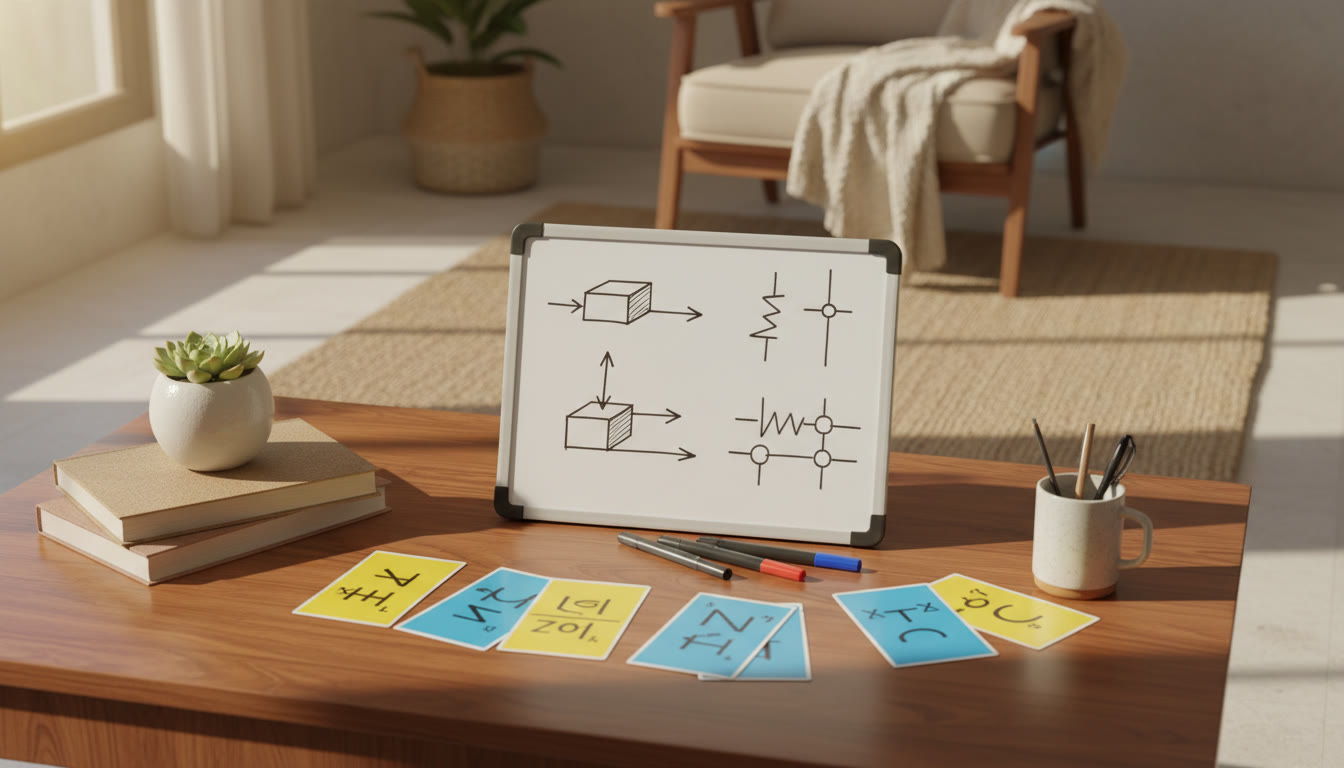
- Draw clear diagrams and label directions — most errors begin with a sloppy diagram.
- Use energy methods when algebra becomes messy; use momentum in collision problems.
- Practice dimensional checks: energy in joules, momentum with mass×velocity — a quick unit check reveals many mistakes.
Electricity and Magnetism
- Start with field/flux intuition before jumping into integrals — visualize lines and symmetry.
- For circuits, reduce networks systematically: series/parallel, Thevenin equivalents conceptually.
- Use sign conventions consistently, especially for potential and current directions.
Optics and Modern Physics
- Ray diagrams are the fastest route to the answer for lenses and mirrors; draw even in your scratchpad for MCQs.
- For photoelectric effect and semiconductors, focus on conceptual graphs and threshold relationships rather than rote formulas.
Thermodynamics and Waves
- Link microscopic and macroscopic pictures: pressure is force per area, temperature trends reflect average kinetic energy.
- Practice simple SHM problems until you can map equations to physical motion immediately.
Mocks, OMR discipline and the three-hour rehearsal
Nothing accelerates progress like full-length mock tests under exam-like conditions. Treat at least one mock every 7–10 days as a simulated exam: sit for the full three hours, fill answers on an OMR-style sheet, practice the exact routine you will use on exam day (timers, breaks, allowed stationery). After the test, spend more time analyzing mistakes than celebrating the score. Look for patterns: are you losing marks on multi-step computation, sign errors, conceptual traps, or careless reading?
OMR discipline is not cosmetic — stray marks and inconsistent shading can be costly. Practice marking answers cleanly, learn the required pen/marker and marking density (as per your actual exam instructions), and develop the habit of circling questions to revisit. Negative marking means you cannot rely on blind guessing; instead, use elimination to increase the odds when making an educated guess.
Using time inside the exam intelligently
- First pass: answer all straightforward questions quickly. Do not get stuck — mark anything doubtful for review.
- Second pass: tackle moderate questions that require 1–2 short calculations.
- Final pass: spend remaining time on hard problems, applying careful checks. Keep an eye on the clock and leave a small buffer for reconciliation of OMR entries.
Revision strategies that actually stick
Space out revision and prioritize active recall. A simple cadence: learn → review after 2 days → review after a week → review after 3–4 weeks. Build a one-page formula and concept sheet for each topic and shrink it each time you revise — by the third pass you should have a compact set of memory cues you can scan in 10–12 minutes. Use short mixed quizzes to practise retrieval rather than passive re-reading.
How to measure progress: quality metrics to track
- Error reduction rate: track the percentage of repeated mistakes you no longer make after targeted practice.
- Time per question: track how long you take on average for easy, medium, and hard questions.
- Mock-test stability: track median scores across 5–7 mocks rather than a single best score.
When to get personalized help
If your progress stalls after deliberate practice — if the same conceptual errors reappear or your mock-score fluctuates wildly despite regular study — consider focused one-on-one guidance. Personalized tutoring can give targeted diagnosis, a tailored study plan, and accountability on weak areas. For example, Sparkl‘s personalized tutoring offers 1-on-1 guidance, tailored study plans, expert tutors, and AI-driven insights that help identify weak topics and track improvement with data — useful when you need focused correction rather than generic advice.
Practical tools: what to keep on your study desk
- Two notebooks: one for concise concept notes, another for solved problems and error log.
- A list of key formulas and standard assumptions (e.g., g = 9.8 m/s² as a working value if you prefer) — write them in your own words.
- A timer for timed practice and a mock OMR sheet to rehearse shading and marking.
Common mistakes and how to avoid them
- Skipping diagrams: always sketch — it often makes the path to the answer obvious.
- Blind memorization: memorize only after understanding; otherwise you forget under pressure.
- Ignoring small errors: arithmetic and sign mistakes compound into lost marks. Add a two-minute final check for units and signs.
- Infrequent revision: revise frequently in short bursts and mix topics to force retrieval practice.
Maintaining focus and stamina
Long study hours matter less than consistent, high-quality sessions. Build stamina by gradually increasing timed practice durations and by taking full-length mocks. Sleep, short exercise, and breaks that include movement will help maintain concentration. Approach each mock as a diagnostic tool: treat the analysis as the real work, and let scores guide improvements rather than morale.
Final practical checklist before any mock or exam
- Clear understanding of the topic board: can you explain key ideas aloud in 60 seconds?
- Five to ten practice problems solved from that topic in timed conditions.
- One quick scan of formula sheet and error log for the most recent mistakes.
- OMR practice: make sure your answer shading is consistent and you know the allowed stationery procedure.
Physics for NEET is a marathon of steady, deliberate practice. Start with concepts, toughen your problem-solving through graded practice, rehearse the exam day with full mocks and strict OMR discipline, and use focused revision to fix recurring errors. Personalized help can accelerate this process if you need targeted intervention, but the backbone of success remains structured practice and thoughtful analysis of every mistake.
Mastery comes from clarity: when concepts are clear, formulas lose their mystery and every practice question becomes a predictable, solvable challenge. Keep refining the basics, practice with purpose, analyze honestly, and use mocks to sharpen both speed and accuracy until confident performance becomes routine.





















No Comments
Leave a comment Cancel