
How to Prepare for NEET at Home Effectively
Preparing for NEET from home is both a challenge and an opportunity. With the right structure, steady practice, and a few smart habits, you can turn your home into a focused, efficient training ground for an MCQ-driven, three-hour examination. This guide walks you through a practical, human-centered approach — from building a realistic daily rhythm to running full-length 3-hour mock practice sessions that replicate OMR discipline and negative-marking pressure.
Think of your home preparation as a laboratory where ideas are tested, refined, and made exam-ready. It’s not about grinding endlessly; it’s about consistent, deliberate practice and well-timed revision. Below you’ll find strategies that respect the NEET-style test structure — MCQs, strict OMR protocol, no partial credit for descriptive answers — while helping you build accuracy, speed, and calm under timed conditions.
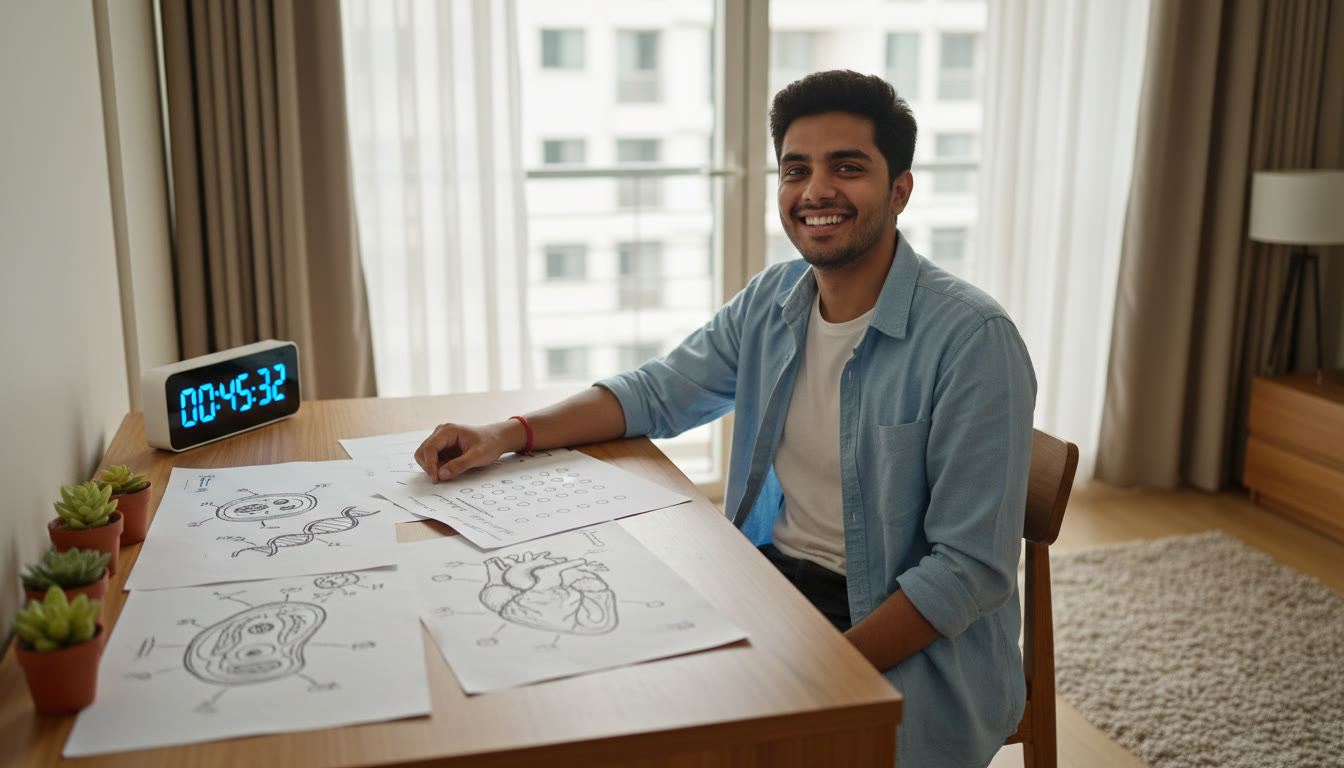
Start by mapping the syllabus and setting priorities
The foundational step is mapping the entire NEET syllabus into manageable chunks across Physics, Chemistry, and Biology. Break topics into three layers: must-score topics (high-frequency, high-weight), important topics (moderate frequency), and stretch topics (lower frequency but high-value if mastered). This triage helps you focus energy where returns are highest, while still scheduling time for complete coverage.
What to include in your initial mapping
- List all major units of Physics, Chemistry, and Biology.
- Mark topics you are comfortable with, those you find hard, and those you haven’t yet studied.
- Estimate time — realistic hours per week for each subject — and set a fortnightly checkpoint to reassess.
Remember: NEET-style testing rewards accuracy and conceptual clarity. Aim to finish content coverage early enough to enter a focused revision and mock-test phase well before the exam window in the current cycle.
Design a realistic home study plan
Your plan should balance content study, daily practice, and full-length mock tests. A reliable rhythm looks like focused study blocks, short active-recall sessions, and a weekly or biweekly full-length mock practice that mimics the real three-hour exam.
Sample weekly structure (flexible)
| Day | Morning (3 hrs) | Afternoon (2 hrs) | Evening (2 hrs) |
|---|---|---|---|
| Mon | Physics concept + problems | Chemistry theory (inorganic/physical) | Biology diagrams + facts |
| Tue | Chemistry numericals + practice | Biology concept reading | Short MCQ set (60 Qs timed) |
| Wed | Biology deep-dive (physiology/eco) | Physics problem set | Revision flashcards |
| Thu | Mixed MCQs (60 Qs) | Weak-topic focus | Light reading + concept maps |
| Fri | Full-length timed section practice (3 hrs alternate) | Correction & error log work | Relaxed recall session |
| Sat | Full-length 3-hour mock (replicate OMR, timing) | Detailed analysis of mock | Targeted remedial practice |
| Sun | Light revision & catch-up | Group discussion or doubt clearing | Plan next week |
Use this as a template and adapt hours to your daily energy levels. The key is regular simulation: at least one full-length, strict 3-hour mock per week as you approach the intense revision phase, and more frequent shorter timed sets earlier in the schedule.
Subject-wise tactics: how to study smarter
Biology — build conceptual recall and diagram fluency
Biology is largely memory plus application. Treat diagrams and processes (like cellular respiration or plant transport) as tools you will redraw and narrate. Instead of rote cramming, use active recall: cover the page and reproduce the diagram, or explain the process aloud in 2–3 sentences. Practice MCQs by linking facts to underlying processes; many questions test understanding rather than isolated facts.
- Prioritize high-yield topics but keep a rolling schedule so nothing is ignored.
- Create one-page concept sheets for every chapter: processes, exceptions, keywords.
- Use weekly mixed-MCQ sessions to convert memorized facts into quick-answer habits.
Physics — clarity over memorization
Physics rewards conceptual clarity. Treat derivations and worked examples as learning tools: the derivation teaches the relationships, and worked examples teach applied steps. Make a formula sheet you can revise quickly, but avoid becoming dependent on rote formula recall without understanding when and why to apply it. Practice problem classification: know which shortcut or principle fits which question type.
- Practice numerical accuracy and estimate answers mentally to catch calculation errors.
- Break down complex problems into smaller sub-steps and time yourself on each step.
- After solving, rewrite the trickiest problems in an error-log to revisit weekly.
Chemistry — balance concept, reaction handling, and practice
Chemistry needs a different rhythm across its subparts. Physical chemistry is like math — practice calculations until procedures are fluid. Organic chemistry is pattern recognition — build reaction mechanisms as chains you can narrate. Inorganic chemistry is memory-based but logical classifications make it manageable. Convert reaction lists into short “if-then” maps that speed up recall under time pressure.
- Work multiple versions of physical chemistry problems to see common patterns.
- Turn organic mechanisms into short stories to remember electron flow and reagents.
- Use tabular summaries for inorganic groups and periodic trends.
Daily routines and micro-habits that add up
Small, sustainable habits matter more than dramatic one-time efforts. A few examples you can adopt immediately:
- Pomodoro blocks: 50 minutes focused study, 10 minutes break — repeat 3–4 times.
- End each day by writing a 10-minute list of three concrete goals for tomorrow.
- Keep a single “error log” notebook where every incorrect mock question gets a short explanation and a planned re-test date.
- Use flashcards or spaced repetition for stubborn facts and small-value items.
Mock tests, OMR discipline, and time management
Mock tests are the engine of home preparation. When you take a mock, treat it exactly like the real exam: the same seating arrangement, the same three-hour window, no phone, and strict OMR-like marking discipline. Practicing this way trains both technique and temperament.
How to run an effective mock-test session
- Simulate the full 3-hour environment and sit through the mock without interruptions.
- Use the same reading and marking sequence you plan for the exam — for instance, a subject-order strategy or a mixed-offset approach.
- Record the time spent per section and per question type; analyze where time leaks happen.
- Immediately after the mock, do a calm correction session: mark each mistake, classify its cause (conceptual, careless, calculation), and assign remediation tasks.
Negative marking demands disciplined guessing: only attempt when elimination raises confidence. There are no partial credits for descriptive answers in NEET-style MCQs, so clear elimination and educated guessing are the two tools to use under uncertainty.
Revision: spacing, testing, and consolidation
Revision is not a single activity — it’s a pattern of spaced recall, self-testing, and targeted correction. Use an interleaved review schedule so you revisit topics multiple times with increasing intervals. Short weekly cumulative tests help maintain momentum; long-format mock tests help consolidate endurance.
Practical revision techniques
- Spaced repetition: schedule first review within 48 hours, second review in about a week, third review later based on difficulty.
- Active recall: write answers without looking at notes and grade yourself honestly.
- Teach back: explain a topic to a study partner or to an imaginary class — teaching exposes gaps faster than passive reading.
Designing your study space and daily system
Your physical and digital environment affects focus. Create a clean, dedicated study corner with good light, an organized material shelf, and a visible timer. Limit phone use to essential study tasks — use focus apps only if they help you maintain blocks of uninterrupted work.
- Prepare a ‘ready-to-study’ kit: notebooks, pens, calculators, a water bottle, and printed question packs.
- Maintain a weekly planner. Cross off completed tasks for a sense of progress.
- Schedule short physical activity and sleep; cognitive function depends on rest, not just hours of study.

When to get personalized help and what to expect
Some moments call for guided intervention: persistent conceptual blocks, repeated mock-test mistakes, or the need for a more tailored pacing plan. Personalized tutoring can accelerate recovery from plateaus by giving focused feedback and adjusting your study plan based on performance data.
If you decide to pursue tailored support, look for 1-on-1 guidance that offers individualized study plans, clear performance tracking, and expert tutors who can convert your mock-test data into daily next steps. For example, Sparkl‘s personalized tutoring is built around these ideas: one-on-one mentoring, tailored study plans, subject specialists, and AI-driven insights that highlight weak zones and suggest remediation. Use such help to fix specific gaps rather than to outsource responsibility for your entire preparation.
Practical checklists: daily, weekly, and pre-mock
Daily checklist
- Morning: 2–3 focused hours on a high-yield topic.
- Afternoon: practice problems or MCQ sets (timed).
- Evening: review error log and quick active recall (30 minutes).
- End of day: plan 3 concrete goals for tomorrow.
Weekly checklist
- Complete scheduled topic coverage and one full subject test.
- Take at least one strict 3-hour full-length mock practice session.
- Analyze errors, update the error log, and set focused remediation tasks.
Pre-mock checklist (day before)
- Pack your materials, ensure a quiet environment, and set a mock-timer.
- Sleep well; avoid last-minute cramming that disrupts recall.
- Have a light review of a formula sheet or list of high-yield facts — not a full re-study.
Common pitfalls and how to avoid them
Home prep can be derailed by predictable mistakes. Here are the most common, and the corrective steps:
- Over-reliance on last-minute cramming — instead, build cumulative revision cycles.
- Ignoring mock-test simulation — schedule strict 3-hour tests regularly to build exam temperament.
- Skipping error analysis — a wrong answer without explanation is a lost lesson; annotate errors immediately.
- Studying in passive modes (only reading) — switch to active recall and timed practice.
Sample 8-week focus roadmap (compact)
| Weeks | Main Goal | Practice Focus | Mock Frequency |
|---|---|---|---|
| 1–2 | Finish core topics across subjects | Daily chapter-level MCQs, formula drills | 1 short mixed mock |
| 3–4 | Strengthen weak topics, start full-length practice | Targeted remediation, error-log revision | 1 full-length mock per week |
| 5–6 | Intensive timed practice and revision | Mixed timed sets, rapid revision cycles | 2 full-length mocks per week |
| 7–8 | Consolidation and final polishing | Light revision, formula checks, high-yield recall | 1–2 full-length mocks with strict OMR simulation |
Keeping motivation and balance
Long preparations are as much about mood management as they are about content. Create small wins: finish a topic, beat your previous mock score, or clear a previously stubborn concept. Schedule short breaks, social time, and physical activity — a steady brain performs better than an exhausted one. If stress spikes, short breathing exercises and micro-breaks can restore focus quickly.
Using data to iterate: how to learn from mocks
Mock tests give you actionable metrics: areas of strength, timing patterns, and error types. Convert those metrics into learning tasks. For example, if physics numerical errors stem from calculation mistakes, add focused calculation drills and timed mini-quizzes to your plan. If biology misses are recall-based, increase active recall frequency and spaced repetition for those chapters.
Final academic note
Success in a NEET-style exam from home comes from a blend of disciplined scheduling, active practice, rigorous mock-test simulation, and targeted remediation. Emphasize the three pillars: content clarity, timed application under MCQ rules with negative marking and OMR discipline, and repeated, spaced revision. With consistent iteration on weak points and a sustainable daily rhythm, you build the speed, accuracy, and conceptual depth that the exam demands.

















No Comments
Leave a comment Cancel