

How to Build a Healthy Study Environment for NEET
Preparing for NEET is as much about what happens around you as what happens in your head. The exam’s MCQ format, negative marking, and strict OMR discipline mean clarity, calm and consistency win more often than last-minute cramming. If you’re reading this, you probably want a practical, warm-handed guide — not a list of platitudes. This article walks you through creating a study environment that helps you learn smarter, keep stress manageable, and simulate exam realities like 3-hour full-length mock practice so that when exam day arrives you’re steady and intentional.

Why a Healthy Study Environment Matters for NEET
NEET tests not just what you know but how well you perform under exam conditions. The right environment reduces friction that steals attention — flickering lights, clutter, constant phone interruptions — and replaces it with routines that make deep focus and recall easier. A few facts to keep in mind as you design your space:
- The exam is MCQ-based and relies on precision; guesses cost points because of negative marking.
- Full-length practice is a three-hour stretch: simulated tests help build stamina and time-management instincts.
- OMR discipline matters: neat, deliberate marking and no stray pencil marks or scribbles in the wrong places.
- Scoring depends on clear answers — there is no partial credit for descriptive detail in MCQs.
- The syllabus is centered on Physics, Chemistry, and Biology; your space should support subject-specific work (diagrams for Biology, derivations for Physics, reaction tables for Chemistry).
Designing a Physical Space That Encourages Focus
Your physical space is the foundation of mental habit. It doesn’t have to be perfect — it just needs to support predictable routines and low friction between intention and action.
- Single-purpose desk: Keep a dedicated table for studying. When you sit there, the brain should start a study mode. If space is tight, create a consistent corner or a neatly marked tray that signals the same intent.
- Ergonomic basics: A comfortable chair, desk at the right height, and good lighting reduce physical fatigue. Natural light is ideal; supplement with a warm desk lamp for evenings.
- Minimal clutter: A clear surface with only essential materials — one textbook, a notebook, stationery, and your clock/timer — cuts decision fatigue.
- Noise control: Use earplugs or low-volume instrumental playlists for focus. If household noise is unavoidable, set clear “focus windows” with housemates and use short, firm breaks to stay synchronized.
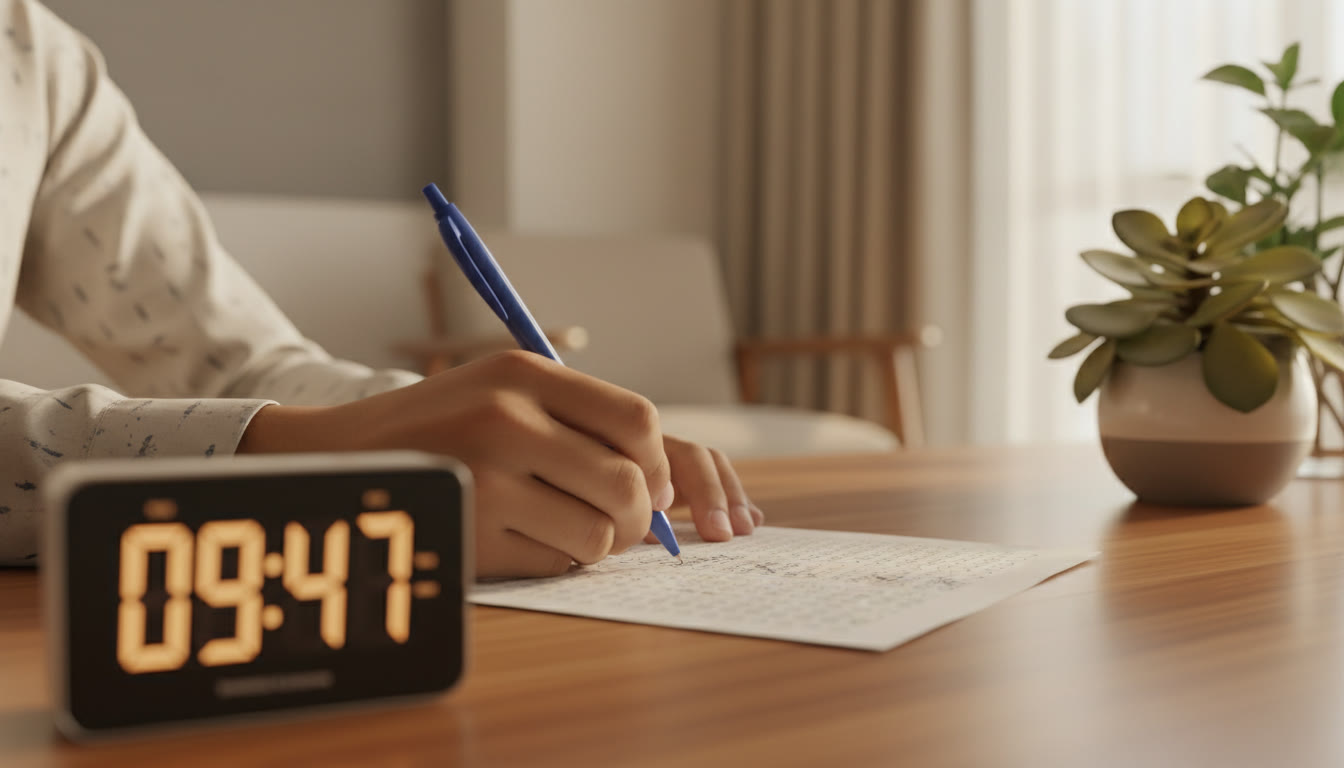
- Exam-sim corner: Keep one setup that mimics exam conditions — just a pen/pencil, ruler, stopwatch, and blank OMR-like sheet for practice. Practise filling answer bubbles without extra marks.
Sample Daily Blocks: Balance, Depth, and Recovery
Block scheduling helps the brain settle into deep work and regular refreshes. Below is a simple sample that balances intense focus with recovery; adjust durations to your energy rhythm.
| Block | Duration | Primary Activity |
|---|---|---|
| Morning deep session | 2–3 hours | New concept learning (Physics derivations / Biology diagrams) |
| Midday focused practice | 1.5–2 hours | MCQ practice and short revision of previous topics |
| Afternoon consolidation | 1–1.5 hours | Problem-solving, numerical practice, reaction mechanisms |
| Evening light revision | 1 hour | Flashcards, mnemonics, error log review |
| Weekly | 3 hours | Full-length mock test under exam conditions |
Time Management: Make the 3-Hour Mock Test Work for You
Full-length mocks replicate exam intensity. Treat each timed practice like the real thing: sit at your exam-sim corner, follow OMR discipline, and refuse to peek at notes. The objective is not only points but learning how your concentration behaves across three hours.
- Start with strategy: Decide whether you’ll attempt easy questions first or sweep all questions for sure attempts. Stick to this in the mock to test its effectiveness.
- Time checkpoints: Partition the three hours mentally — for example, aim to finish 50 questions in the first hour, 50 in the second, and review in the last hour. Adapt based on your speed but keep consistent checkpoints in practice.
- OMR rehearsal: Practice filling answer bubbles under calm, timed conditions. Make a habit of double-checking the question number against the OMR marking — small errors cost big points.
- Negative marking discipline: Simulate the same penalty rules. Work on risk calibration: if a question is pure guess with low chance, skip it to protect accuracy.
Mental and Emotional Environment: Fuel, Rest, and Focus
Study environment isn’t only furniture. It includes your body and mind. A calm, nourished, and rested student is far more efficient than a marathon-sesh zombie. Small, consistent habits pay dividends.
- Sleep wins: Aim for steady sleep; irregular all-nighters harm consolidation and intuition needed for MCQs.
- Nutrition for focus: Hydrate regularly. Balanced meals with protein and complex carbs sustain concentration during long blocks.
- Micro-breaks: Use the 5–10 minute rule after intense 45–60 minute sessions for stretching, breathing, and eye rest. These are active resets, not distraction time.
- Emotional hygiene: Keep a short, nonjudgmental error log. After each mock or practice, note three things done well and three targeted improvements. This builds positive momentum and stops rumination.
Study Tools, Notes, and the Role of Diagrams
Tools should help you think, not decorate your desk. For NEET, well-organized notes and diagram practice matter more than ornate layouts. Remember that diagrams, derivations, and notes are learning tools — they help you understand and recall — but they are not what the exam will reward directly. The exam rewards accurate answers on MCQs.
- Active notes: Summarize concepts in your own words; include 1–2 visual anchors per topic (a labeled diagram, a key formula, or a reaction flow).
- Flashcards & spaced recall: Use cards for high-yield facts (e.g., important enzymes, key equations, common reaction reagents). Revisit them with spacing to move facts into long-term memory.
- Error log: Maintain a small notebook of mistakes: record question number, type of error (conceptual, calculation, OMR slip), and correction strategy. Review weekly.
- Practice tools: Timers, scratch pads that mimic rough OMR work, and a dedicated test sheet for each mock help build routine. Avoid excessive digital note-churning during mocks to simulate exam constraints.
Active Learning Techniques That Fit NEET
Active methods beat passive rereading. Here are small, high-impact tactics to fold into your environment and schedule.
- Teach-back: Explain a topic aloud as if teaching a peer. If you can’t explain a concept simply, you haven’t mastered it.
- Problem-first study: Start a session by solving a representative problem; then study the underlying theory. This contextualizes learning and highlights gaps quickly.
- Interleaving: Mix subjects across blocks (e.g., a Physics problem set followed by fast Biology flashcards) to improve discrimination and recall under exam-like switching.
- Space and repeat: Revisit tough topics at increasing intervals; this is how durability of knowledge is built for a large syllabus.
Practicing OMR Discipline and Exam-Day Simulations
Treat OMR discipline like the mechanics of driving: practiced movements become automatic. In the exam, a stray mark or a misaligned bubble can cost more than missing a single formula.
- Consistent marking: Use a firm, dark mark as required by the current instructions. Practice the same pressure and motion to reduce time spent on each bubble.
- Question-to-OMR mapping: During practice, habitually check question numbers against the OMR — this is an action to make automatic.
- No partial-credit assumptions: The exam awards marks for correct MCQ answers only; do not depend on explanation-based partials. That means accuracy and deliberate answer choice selection matter in each attempt.
Common Mistakes to Avoid in Your Study Environment
Avoid the small traps that break momentum:
- Over-organization: Spending hours perfecting notes layout can be procrastination. Prioritize understanding over aesthetics.
- Chaotic digital life: Disable nonessential notifications during study blocks and keep an occasional, scheduled social check-in instead of constant snacking on feeds.
- Unrealistic daily goals: Tiny wins stack — aim for consistent, achievable blocks rather than heroic sprints you can’t sustain.
- Mock neglect: Skipping full-length timed tests prevents you from calibrating speed and risk-taking under negative marking.
How to Use Personalized Help Without Losing Ownership
Personalized support can accelerate progress if it respects your rhythm. One helpful option available to students now is Sparkl‘s personalized tutoring, which pairs 1-on-1 guidance with tailored study plans and AI-driven insights to highlight weak spots. If you choose to add tutoring to your environment, keep these rules in mind:
- Keep it diagnostic: Use sessions to clarify misconceptions, get strategy feedback, and refine time management rather than outsource daily practice.
- Integrate, don’t replace: Tutor feedback should plug into your schedule and error log. Apply suggestions during the next mock to test impact.
- Measure improvement: Track mock scores, error patterns, and time per question to see real gains from guided study.
Quick, Practical Checklist for a Focused Study Day
Before you begin a day of study, run a short checklist to align your environment and mind.
- Desk cleared of nonessential items.
- Phone on Do Not Disturb in another room or face down.
- Timer set for your first block and a water bottle filled.
- One specific learning goal (e.g., finish three concept questions on electrostatics).
- If it’s a mock day: printed answer sheet/OMR simulation ready and uninterrupted 3-hour window reserved.
Small Design Tweaks That Yield Big Results
Often, a few tiny changes create a ripple effect:
- Visual anchors: A single mind map or key-formula sheet on your wall gives quick retrieval cues during revision.
- Task bins: Keep three trays or folders: To Study, In Progress, and Review. Move items through these so nothing is forgotten.
- Reward micro-schedule: Pair a short, pleasant activity (tea, fresh air, 10-minute walk) with a completed deep block to reinforce habit formation.
Putting It All Together: A Week of Smart Habits
One practical week might look like this: focus two mornings on new material (subject rotation across Physics/Chemistry/Biology), mid-day practice sets, afternoon consolidation with mixed-subject MCQs, and one full-length mock on a fixed day to track stamina. Weekly review of your error log plus one session to tidy notes turns random practice into systematic growth.
Final Academic Takeaway
Building a healthy study environment for NEET is a deliberate blend of physical setup, predictable routines, mental hygiene, and disciplined practice. By aligning your space with the exam’s realities — MCQ format, negative marking, OMR discipline, and three-hour endurance — and by using active learning, spaced revision, and targeted mocks, you create a scaffold for sustained learning. Small, consistent choices (clear desk, timed blocks, an honest error log, and realistic mocks) add up to reliable performance on test day, because the exam rewards accurate recall, clean marking, and steady mental stamina rather than last-minute effort.




















No Comments
Leave a comment Cancel