

How to Improve Your Chemistry Score in NEET — Turn a Mock into Momentum
Seeing a chemistry mock score that’s lower than you hoped can feel like a punch in the chest. That first reaction is normal. The important part happens in the next hour, not the next panic. A mock test is a diagnostic tool — it tells you where your energy should go next. Your chemistry score responds fast to targeted practice because chemistry in the NEET context rewards clarity, pattern recognition, and steady calculation speed.

Why a Mock Score Is Useful (and Not the Final Word)
A mock score is a map, not a verdict. It shows:
- Which chapters are costing you marks (conceptual gaps or careless mistakes).
- How exam conditions affect your speed and accuracy (time pressure, OMR filling errors, calculation mistakes).
- Where you should invest practice time to get the biggest score gains quickly.
Use your mock score to prioritize — not to panic. A focused plan that addresses your top three error types will usually produce visible improvement in a few weeks.
First Step: Smart Mock Analysis
Immediate, practical steps after you see your mock score
Don’t jump straight into cramming. Follow this short, clear checklist:
- Cool down for ten minutes — avoid impulsive overhaul of your entire study plan.
- Record the raw facts: marks, attempted questions, accuracy percentage in chemistry, and time spent per section if you tracked it.
- Classify mistakes into three buckets: Conceptual (you didn’t understand), Strategy (you ran out of time or chose wrong approach), Careless/OMR (misread options, bubbled wrong, arithmetic slip).
Create a concise error log
An error log is the fast track to improvement. For each wrong answer write three things: (1) the chapter/topic, (2) the reason (concept/strategy/careless), and (3) the corrective step (targeted reading, problem type practice, timing drill). Keep this log visible and update it after every mock.
Sectional Strategy: Physical, Organic, Inorganic — What to Focus On
Chemistry divides naturally into three study modes. Treat each with the approach that suits its learning demands.
Physical Chemistry — Problem approach and speed
Physical chemistry is the rules + math part. Your goals here are to sharpen concept clarity and calculation speed. Tactics that work:
- Master the core formulas, and more importantly, know when to use them. Don’t memorize formulas in isolation — pair each with a one-line cue: what it calculates and when it’s best applied.
- Practice dimensional checks and unit sanity tests; they catch sign and factor mistakes quickly.
- Use short, timed practice sets — five questions, 20 minutes — to build muscle memory for common manipulations (stoichiometry, equilibrium constants, rate laws, thermodynamics sign conventions).
- When facing a tricky MCQ, list the givens, write the simplest relation, estimate — pick the closest option if answers are rounded.
Treat calculation practice like drills: repetition, then speed, then error-analysis. Keep a small notebook of “trick calculations” you botched so you don’t repeat the same arithmetic traps.
Organic Chemistry — Visual thinking and reaction logic
Organic questions reward visualization and mechanism-aware shortcuts. You don’t need to memorize endless sequences if you learn patterns.
- Learn functional group behavior: know how each group typically reacts and why. Grouping reactions by theme (oxidation, nucleophilic substitution, electrophilic addition) helps retrieval under pressure.
- Practice mechanism sketches: train yourself to draw electron flow arrows quickly. Even if an exam question doesn’t ask for mechanisms, seeing the arrow logic prevents rote errors.
- Make a reagent cheat-sheet: a one-page reference for common transformations and how to recognize them in options. Repeated review makes reagent recognition instantaneous on test day.
- Solve synthesis-style quickies: convert the target into simpler retrosynthetic steps in sketches. These problems sharpen your ability to discard distractor options fast.
Inorganic Chemistry — Systematic memory and pattern checks
Inorganic is often the fastest section to raise because it rewards structured memory rather than heavy calculation. Key approaches:
- Create concise tables for group trends, common oxidation states, and important salts. Repeated glance-and-recall sessions make these facts exam-ready.
- Use mnemonics for tricky lists (e.g., solubility exceptions, order of reactivity). A vivid image makes a series of facts stick.
- Practice quick reasoning questions: many inorganic MCQs hinge on a single rule (e.g., acidity trend, basicity, color due to d-electron transitions). Learn to spot which rule applies fast.
Practical, Daily Habits That Move the Needle
How to structure practice so each day produces measurable improvement
Instead of vague “study chemistry”, break practice into tight, measurable sessions. A robust daily block might look like this:
- Warm-up (20–30 minutes): 8–10 mixed micro-questions from yesterday’s weak topics.
- Focused learning (45–60 minutes): deep work on one core concept — read, annotate, and do 6–8 graded problems.
- Speed practice (30 minutes): a timed set of problems emphasizing physical calculations or organic reaction recognition.
- Review (15–20 minutes): update your error log and flashcards, and schedule the next spaced repetition.
Weekly mock and targeted follow-up
Use a full-length 3-hour mock periodically under exam-like conditions. Immediately after, spend the next session doing focused correction work: don’t just re-solve; write why you chose a wrong answer and the exact constraint that would have led to the correct option.
Example 8-Week Focused Chemistry Plan (Suggested)
This sample table is a practical template you can adapt based on your mock log. Numbers are suggested for disciplined practice blocks; tune them to your available time and weak areas.
| Week | Main Focus | Hours/Week | Key Tasks |
|---|---|---|---|
| 1 | Physical basics & formula consolidation | 12 | Concept checks, 30 timed questions, error log |
| 2 | Organic fundamentals (nomenclature, mechanisms) | 12 | Mechanism sketches, reagent sheet, 25 practice Qs |
| 3 | Inorganic mapping (periodic trends, ox. states) | 10 | Flashcards, recall drills, 20 MCQs |
| 4 | Mixed timed sets + one full mock | 14 | Mock test, OMR discipline practice, error log |
| 5 | Target weak chapters identified from mock | 12 | Focused practice and concept rebuilding |
| 6 | Application practice: synthesis & calculations | 12 | Timed synthesis problems and multi-step calcs |
| 7 | Revision rounds & mnemonics consolidation | 10 | Flashcard review, one mini-mock |
| 8 | Full-length mock + targeted polish | 14 | Mock, focused correction, OMR check drills |
Active Techniques: How to Turn Practice into Better Scores
Active recall and spaced repetition
Make flashcards for quick facts, and schedule short review sessions. The goal is to move information from fragile short-term memory into durable recall. For inorganic rules and reagent-function pairs, five minutes each day will compound into confident retrieval under pressure.
Interleaving practice
Mix problem types in short sessions so you learn to choose the right method quickly. Instead of doing 20 equilibrium questions in a row, do 5 equilibrium, 5 kinetics, 5 thermochemistry — your brain learns to select tools rather than follow a single script.
Feynman and teach-back
Explain a concept aloud to yourself (or to a peer). If you can’t teach it in two minutes, you haven’t truly understood it. This technique is especially powerful for mechanism logic in organic chemistry and for the conceptual foundations of physical chemistry.
Exam-Day Execution and OMR Discipline
Simulate exam conditions to eliminate surprises
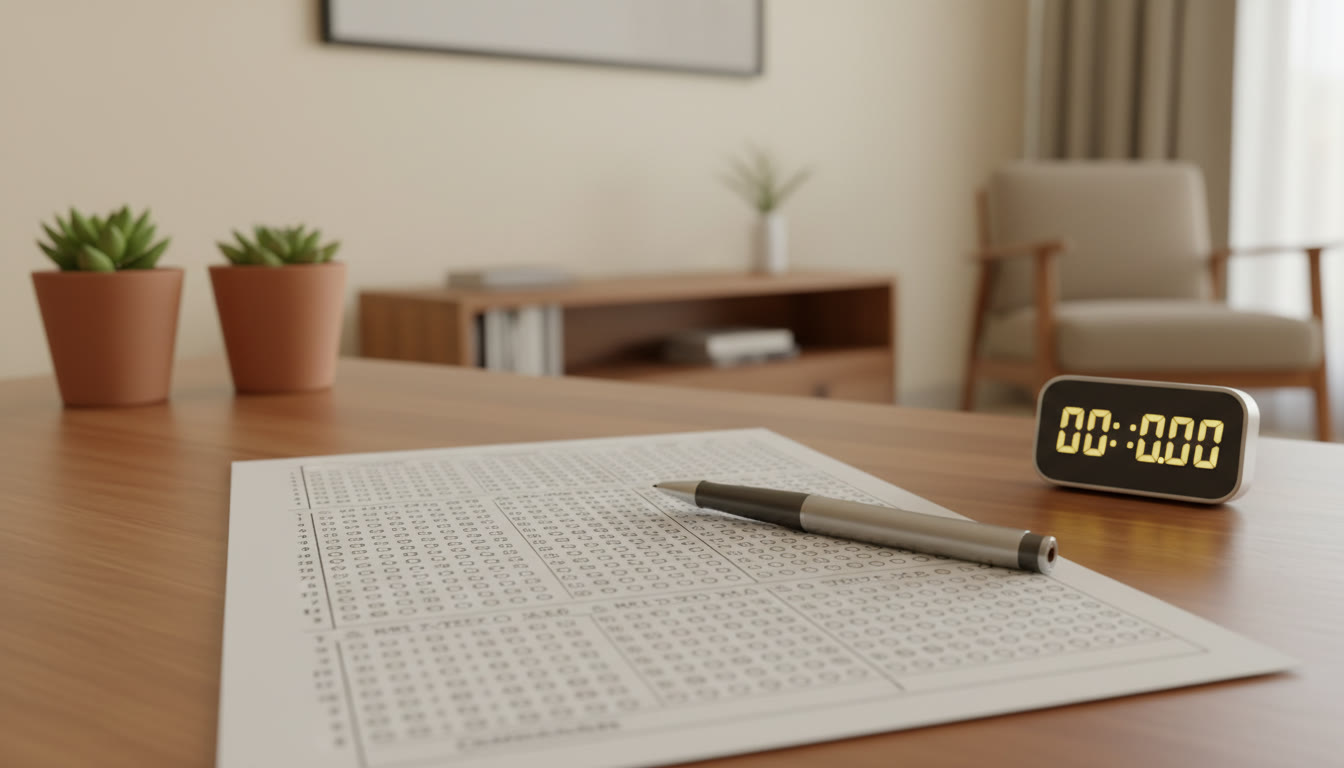
Practice full 3-hour mocks with strict rules: identical start time, no extra breaks, and OMR filling practice. Train the simple routines you’ll do on exam day so they become automatic: writing roll number clearly, filling bubbles precisely, and pacing yourself through the paper.
OMR tips that matter
- Follow the current OMR filling instructions provided for the examination day — exam authorities sometimes specify the writing instrument and exact method. Practicing with the correct tool avoids last-minute surprises.
- Bubble deliberately: read carefully, confirm the option, then fill. Rushing here costs marks for neatness errors and double-bubbling.
- Track accuracy, not just attempts. A high attempt rate with many negatives will lower your score more than careful attempt selection.
When and How to Seek Personalized Help
Signs you should consider 1-on-1 guidance
If your mock analysis repeatedly shows the same conceptual gap after focused practice, or if you’re running out of time despite hours of practice, targeted tutoring can change the curve. Personalized sessions help translate general advice into actions tailored to your errors.
For students who choose extra support, Sparkl’s personalized tutoring can provide one-on-one guidance, tailored study plans, expert tutors who explain tricky concepts, and AI-driven insights that highlight recurring weakness areas. Use any personalized help to reinforce the error log and integrate suggested practice into your daily routine.
Common Pitfalls and How to Avoid Them
- Chasing perfection on every question: prioritize topics that give the most marks for least time invested.
- Ignoring the error log: if a mistake isn’t logged and corrected, it becomes a repeating loss.
- Studying passively: rereading text gives a false sense of progress. Replace passive review with problem solving and teach-back exercises.
- Skipping OMR practice: small OMR slips turn high knowledge into low scores; simulate bubbling under timed stress.
Memory Aids and Quick Tricks
Mnemonics that actually help
Keep mnemonics short and vivid. For inorganic sequences or solubility exceptions, a one-sentence story linked to an image will beat a long meaningless phrase. Convert lists into visual maps of the periodic table so trends become spatial cues rather than arbitrary facts.
One-page concept maps
Create single-sheet summaries for each major topic (equilibrium, kinetics, electrochemistry, organic reagents, periodic trends). A one-page sheet forces you to condense and connect ideas — perfect for the last revision rounds.
Measuring Progress: What to Track
Track these weekly numbers and watch trends, not single data points:
- Accuracy percentage on chemistry questions in full mocks.
- Average time per chemistry question in timed practice sets.
- Number of repeat mistakes from your error log.
- Number of topics moved from “weak” to “comfortable” in your notes.
Reward progress in small, measurable steps. A 5–10% increase in accuracy or two fewer repeat mistakes per mock is real momentum.
Final Notes on Habits That Stick
Improving chemistry scores is about disciplined cycles: diagnose, practice, analyze, and adjust. Keep your practice varied, make error analysis non-negotiable, and use quick daily sessions to keep facts activated. Targeted effort in the right topics — physical calculation drills, organic mechanism sketches, and inorganic recall — produces disproportionately large score gains compared to unfocused hours.
Conclusion
Your mock score is a directional signal: interpret it precisely, correct repeatedly, and measure progress with simple metrics. Focus on the highest-yield changes — error logging, timed practice, selective tutoring where needed, and strict OMR discipline — and your chemistry score will respond in a predictable, steady way.





















No Comments
Leave a comment Cancel