
How to Improve Your NEET Physics Score: A Friendly Roadmap
Physics can feel like a make-or-break subject for many NEET aspirants: it’s precise, logical, and unforgiving of sloppy work. But that doesn’t mean it’s mysterious. The truth is, most students who struggle aren’t short on intelligence — they’re short on a system that turns mock-test feedback into practical improvement. This article walks you through a clear, human-friendly plan to understand your mock score, decode your mistakes, and steadily lift your physics marks, all while aligning with the NEET-style exam reality: MCQ format, a full-length timed environment, negative marking, OMR discipline, and syllabus-driven questions.

What Your Mock Score Is Really Saying
See a low or middling mock score as information, not judgment. Your raw number is the starting point; the story lives in the pattern behind it. A single mock score can hide several realities: weak conceptual foundations, calculation slowness, careless slips, or poor OMR/strategy execution. The first step is always to break that single number into meaningful pieces.
Quick diagnostic checklist
- Was your time spread even across sections or did you rush certain parts?
- How many questions did you leave blank versus attempt and get wrong?
- Were most mistakes concentrated in a few topics or scattered everywhere?
- Did you lose marks due to OMR errors or mis-bubbling?
- How many careless mistakes were present (units, sign errors, misreading)?
Sample topic-wise snapshot (example)
| Topic | Attempted | Correct | Wrong | Accuracy | Immediate Action |
|---|---|---|---|---|---|
| Mechanics | 16 | 12 | 4 | 75% | Revise vector basics; re-do relative motion problems |
| Electricity & Magnetism | 14 | 8 | 6 | 57% | Do circuit analysis drills; check common formula slips |
| Optics | 8 | 6 | 2 | 75% | Practice ray diagrams and thin-lens shortcuts |
| Modern Physics | 6 | 5 | 1 | 83% | Revise photoelectric and atomic models |
This table is an example of how to convert a single score into topic-level actions. Create your own snapshot immediately after every mock.
Categorize Mistakes — The Single Most Useful Habit
When you review a wrong question, don’t just mark it as ‘wrong’ and move on. Label each mistake with one of these categories so your fixes target the root cause:
- Conceptual gap: You don’t fully understand the underlying idea (e.g., torque vs. moment of inertia confusion).
- Formula or sign error: You know the idea but picked the wrong relation or missed a sign/unit.
- Calculation slip: Arithmetic or algebra mistake during working out.
- Careless/reading error: Misread the question, ignored units, or mis-copied data.
- Time-pressure guess: You rushed and picked an option without proper elimination.
- OMR/technical error: Bubbling mistakes, mismatched question numbers, or test-environment issues.
Labeling gives direction: conceptual gaps need targeted learning; calculation slips call for deliberate accuracy drills; OMR errors require simulation practice.
The Post-Mock Review Ritual: A 3-Step Method
Turn a review session into a repeatable ritual so improvement becomes routine, not random. Follow this sequence every time.
Step 1 — Cool down and record (within 1 hour)
- Calm down for 20–30 minutes to reset emotionally — scoring runs better when you aren’t reactive.
- Note raw stats: attempted, correct, wrong, unanswered, and your time stamps if available.
- Write a one-line gut reaction: was it time management, silly errors, or a topic-specific block?
Step 2 — Deep review (the next study block)
- For each wrong or doubtful question: re-solve without looking at the solution. If you can’t, identify the exact missing piece.
- Annotate the question with the mistake category and a one-line corrective action (e.g., ‘Re-derive lens formula from geometry’).
- For correct but slow answers, note faster approaches you could have used.
Step 3 — Consolidation and spaced practice
- Bite-sized drills: convert each corrective action into a 15–30 minute micro-drill to be repeated across the week.
- Add key concepts or tricky questions to a revision deck (flashcards or a one-page digital note).
- Re-test those specific weak topics in the next mock or mini-test to check progress.
Build the Three Pillars: Concept, Speed, Accuracy
These three are interdependent. Work on all simultaneously but use your mock analysis to weight them: if your accuracy is high but speed low, bias toward timed drills; if many answers are conceptually wrong, invest in re-teaching fundamentals first.
Concept: Make ideas unambiguous
- Derive formulae instead of memorizing them. The act of derivation anchors assumptions and applicable limits.
- Use simple real-world analogies: treat electric current like water flow to internalize conservation and potential differences.
- Create one-page concept maps per chapter linking core ideas and typical question forms.
Speed: Practice thinking shortcuts, not careless tricks
- Learn common problem templates: many MCQs are dressed variants of a small number of templates.
- Develop estimation skills: often an approximate method or dimensional check quickly discards wrong options.
- Practice timed mini-sets (20–30 minute, focused topic sets) to build rapid pattern recognition.
Accuracy: Build checklists and anti-silly habits
- Before finalizing an answer, run a quick checklist: units consistent, sign sensible, special-case sanity check.
- Maintain a calm pace in the last 30 minutes of a mock to reduce careless slips when fatigue kicks in.
- Practice clean setup on scratch paper so you don’t lose track of signs or steps.
Weekly Practice Framework (example plan)
Below is a sample four-week focus plan you can adapt. The idea is to alternate concentrated concept work with simulated exam practice.
| Week | Focus | Daily Sessions | Mock Frequency | Goal |
|---|---|---|---|---|
| Week 1 | Core concepts and weak-topic repair | 2 focused sessions (1.5–3 hrs total) | Mini-test at weekend | Eliminate top 2 conceptual gaps |
| Week 2 | Speed drills and calculations | 2–3 short drills daily | Full-length mock at week end | Improve time per question by 10–20% |
| Week 3 | Mixed problem sets and OMR practice | 3 sessions with timed sections | Full-length mock mid-week and weekend | Raise accuracy in mixed sets |
| Week 4 | Revision, error-log consolidation, final simulation | Short concept refresh + 1 full mock | 2 full mocks including OMR drill | Turn weaknesses into stable performance |
Mock-Test Tactics: OMR Discipline and Negative Marking
Tests are not just about knowing content; they’re about executing under constraints. Two practical execution points matter more than almost anything else: how you handle the OMR sheet, and how you deal with negative marking.
OMR discipline
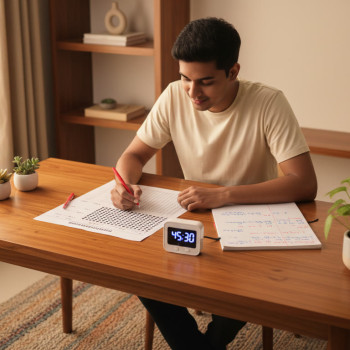
- Practice filling an OMR sheet in simulated conditions so your muscle memory avoids misalignment and stray marks.
- Always confirm question numbers before bubbling; treat this as a fixed habit rather than a last-minute check.
- When re-checking, scan the OMR only once to avoid introducing new accidental marks.
Negative-marking mindset
- Avoid blind guessing. Use elimination: if you can confidently eliminate one or more options, your expected return from guessing changes.
- Prioritize questions where you can apply logic or quick checks rather than random guessing under pressure.
- When uncertain, mark and move on; come back only if time remains and you can apply elimination strategies calmly.
Topic-by-Topic Practical Tips
Here are bite-sized strategies for commonly tested physics areas. These are study actions, not long theory notes.
Mechanics
- Set up free-body diagrams habitually; never skip them even if the question looks simple.
- Master vector resolution and relative motion through 10–15 canonical problems each.
Electricity & Magnetism
- Practice network reduction and common circuit tricks (series-parallel, equivalent resistance) with a focus on short-cuts for MCQs.
- Memorize sign conventions and typical units to avoid the common unit-based trap options.
Optics
- Draw quick ray diagrams for geometrical optics questions; they’re faster than trying to manipulate formulas blindly.
- Know the conditions for image formation versus magnification signs and where approximations hold.
Modern Physics & Thermo
- For modern physics, relate experiments to their physical consequences (e.g., how photoelectric thresholds affect choices).
- For thermodynamics, prefer conceptual checks (limits, reversibility, idealizations) over rote formula plugging.
Micro-Skills That Make Big Differences
Practice these micro-skills in short daily sessions; they compound fast.
- Dimensional checks before finalizing any numeric answer.
- Quick-sanity checks for extreme values (what happens as mass -> 0 or velocity -> 0?).
- Unit conversions practiced until they cost almost zero time.
Smart Use of Help: Tutors, One-on-One Guidance, and AI Tools
If persistent conceptual gaps or bad test habits persist despite deliberate effort, targeted help can accelerate the process. Personalized tutoring often means a focused teacher who spots recurring blind spots quickly and prescribes specific drills. For example, Sparkl’s approach pairs tailored study plans with expert tutors and data-driven insights so you practice the right questions at the right time. Use such help selectively — for stubborn blocks rather than as a crutch for basic discipline.
Measure Progress Intelligently
Don’t chase raw score alone. Track the metrics that predict long-term gains:
- Topic accuracy (correct/attempted) over time.
- Average time per question and per section.
- Number of careless errors per mock.
- Ability to re-solve previously wrong questions correctly on a second attempt.
Use a simple spreadsheet or notebook for these metrics and evaluate trends every two weeks. Small consistent improvements beat one-off spikes.
Before the Next Mock: A Pre-Test Checklist
- Sleep well the night before and eat a light, steady meal to avoid energy crashes.
- Pack a practice OMR sheet, pencils or pens per instructions, a watch, and a clean desk setup for simulation.
- Quickly review 10–12 flashcards focused on your weakest micro-topics — not new content.
- Decide your section strategy in advance (which topics to attempt first, where to reserve time).
Final Academic Note
Improving your NEET physics score is a cumulative process: a loop of focused testing, honest analysis, targeted correction, and repeat simulation. Build routines that make diagnosis automatic, convert each mock into a corrective plan, and train micro-skills that survive pressure. Over time, this disciplined approach—rooted in concept clarity, deliberate practice, and clean exam execution—produces reliable, transferable performance in the actual exam setting.






















No Comments
Leave a comment Cancel